A consulting resume template won't save you time. It standardizes spacing, sure, but it also makes a weak bullet look neat, balanced, and respectable when it still says nothing.
That's the trap. You think you have a formatting problem. Most of the time, you have a thinking problem.
If you're searching for a consulting resume template, stop treating layout as the bottleneck. Clean formatting matters. Misaligned bullets and sloppy spacing are distracting. But a tidy document can't rescue vague content. A bullet that says “responsible for analysis” still reads as empty in Arial 11.
The core work is remembering what changed because of your work, then writing that clearly.
A Perfect Template Makes Weak Bullets Symmetrical
A polished consulting resume template controls three things well. Spacing. Section order. Visual consistency. That's useful. It's not decisive.
What it can't do is tell whether your bullets prove anything.
Here's the kind of bullet I see all the time, dropped into a clean, professional layout:
Strategy Analyst
Supported cross-functional initiatives to improve business performance across multiple workstreams.
Looks sharp. Says almost nothing.
That bullet could sit inside the world's cleanest one-page layout and still fail. It hides the only parts that matter: what problem you tackled, what decision you made, and what result followed. Template-shopping makes this worse because it gives you the feeling of progress without fixing the sentence.
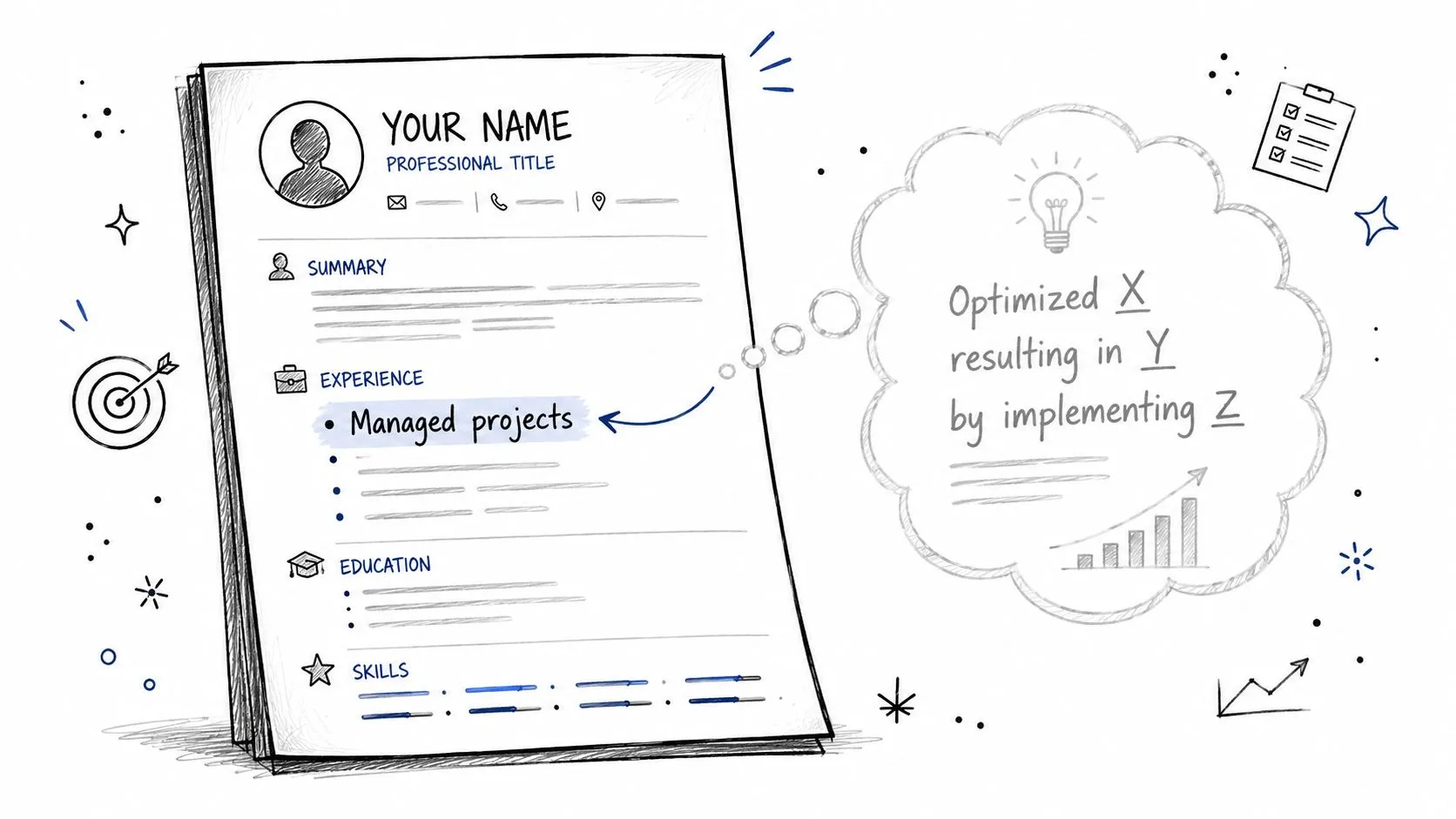
What a template controls
A consulting resume template can help you with the final polish:
- Consistent alignment so dates, titles, and locations don't wobble around the page
- Predictable section flow so education, experience, and skills are easy to scan
- Basic readability so the reader notices your content instead of your formatting errors
That's it.
If you want a better use of time, spend it on the raw material first. Do the reflection work. Reconstruct your projects. Pull up old decks, notes, reviews, and calendars. If you need a sharper process for that early thinking, this guide on resume writer workflows that beat template tinkering is more useful than another download.
The template-perfect failure
Put this weak bullet into a tidy layout:
- Led strategic analysis for key business initiatives
- Collaborated with stakeholders across functions
- Delivered insights to support decision-making
Everything is aligned. Nothing is persuasive.
A consulting resume template makes weak bullets symmetrical. That can make the problem harder to spot, because the page looks finished when the thinking isn't. You don't need prettier boxes. You need better evidence.
Your Resume Must Prove Structured Thinking
Consulting resumes aren't job histories. They're short arguments.
A recruiter isn't trying to admire your career chronology. They're scanning for proof that you think in a structured, analytical, results-oriented way. If your bullets read like a task list, they'll assume you did the work without owning the thinking.
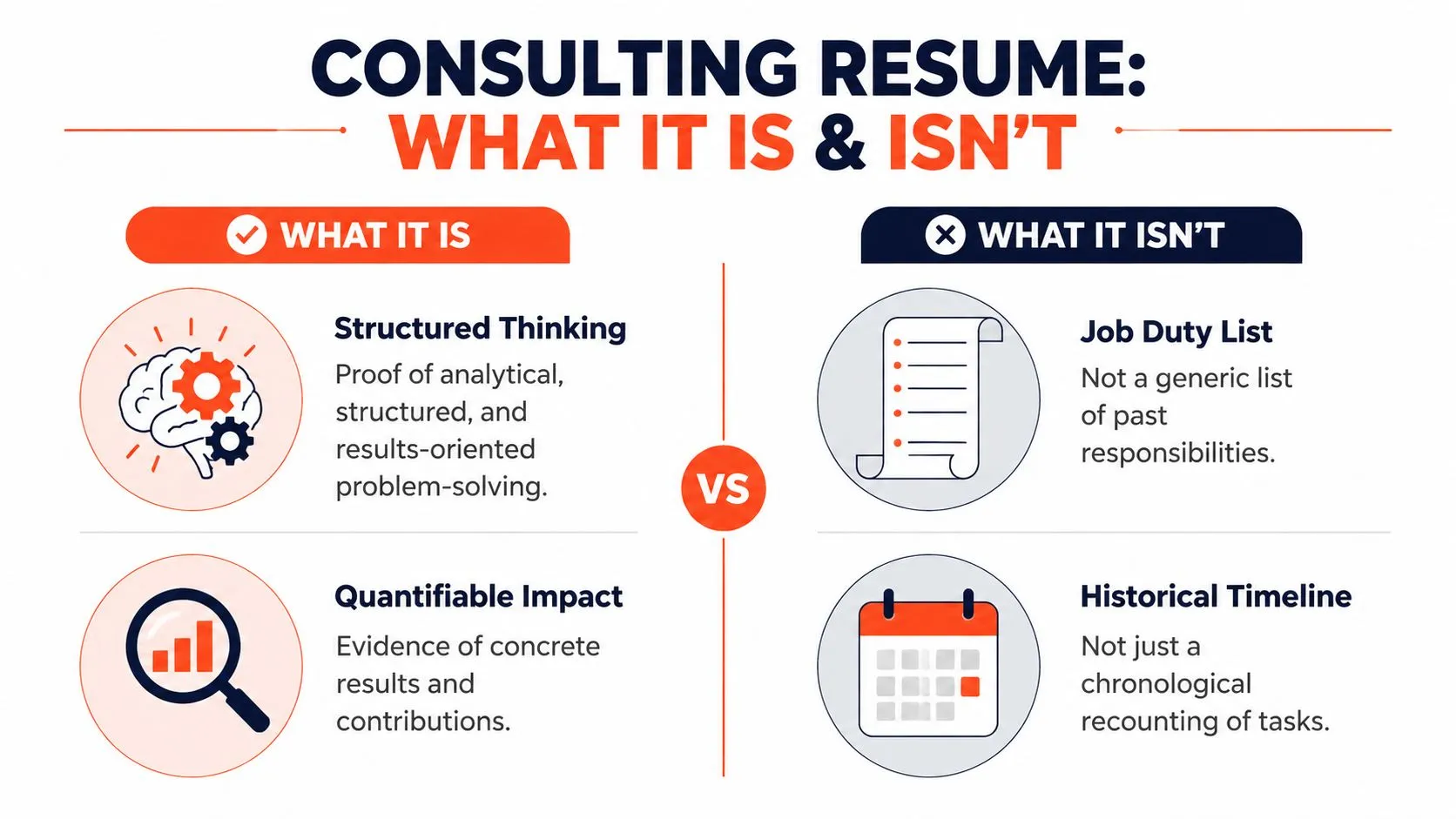
What consulting readers actually look for
The hard truth is simple. “Responsible for” is dead on arrival.
According to Kickresume's ATS-friendly resume guidance, 65% of consulting recruiters reject resumes that lack specific metrics, and resumes with quantified bullet points have a 4.5x higher success rate in passing initial screening. The same source also notes that consulting resumes should prioritize impact over summary.
That lines up with what experienced reviewers already know. Vague language signals vague thinking.
Here's the contrast:
| Weak bullet | Stronger consulting bullet |
|---|---|
| Responsible for market research | Analyzed customer and competitor data to inform a market-entry recommendation for leadership |
| Worked with different teams | Coordinated finance, operations, and sales inputs to resolve conflicting assumptions in planning |
| Helped improve reporting | Redesigned reporting logic so leadership could track decisions against business outcomes |
Notice what changed. The stronger versions sound like someone who framed a problem, sorted inputs, and pushed toward a decision.
Recruiters don't reward effort summaries. They reward evidence that you can break down a messy problem and produce a useful answer.
Why generic templates fail in consulting
Most templates are built for broad compatibility. Consulting screening is not broad. It's selective and impatient.
A generic layout can't tell you which experiences deserve top placement, which bullets prove analytical ability, or which lines should be cut because they only describe process. That judgment matters more than visual style. If you haven't done the reflection work yet, start there. This piece on career reflection before writing the resume gets at the core issue.
Your resume must prove structured thinking in a few lines at a time. If it doesn't, the template isn't the problem. It's just the wrapping.
Turn Your Experience Into Impactful Bullets
You don't need a better template. You need a better formula.
The strongest one here is simple: Accomplished [X] as measured by [Y] by doing [Z]. Firms Consulting lays it out clearly in its guidance on consulting resumes and the X, Y, Z formula. The point isn't fancy phrasing. The point is forcing your bullet to contain an achievement, a measure, and a method.
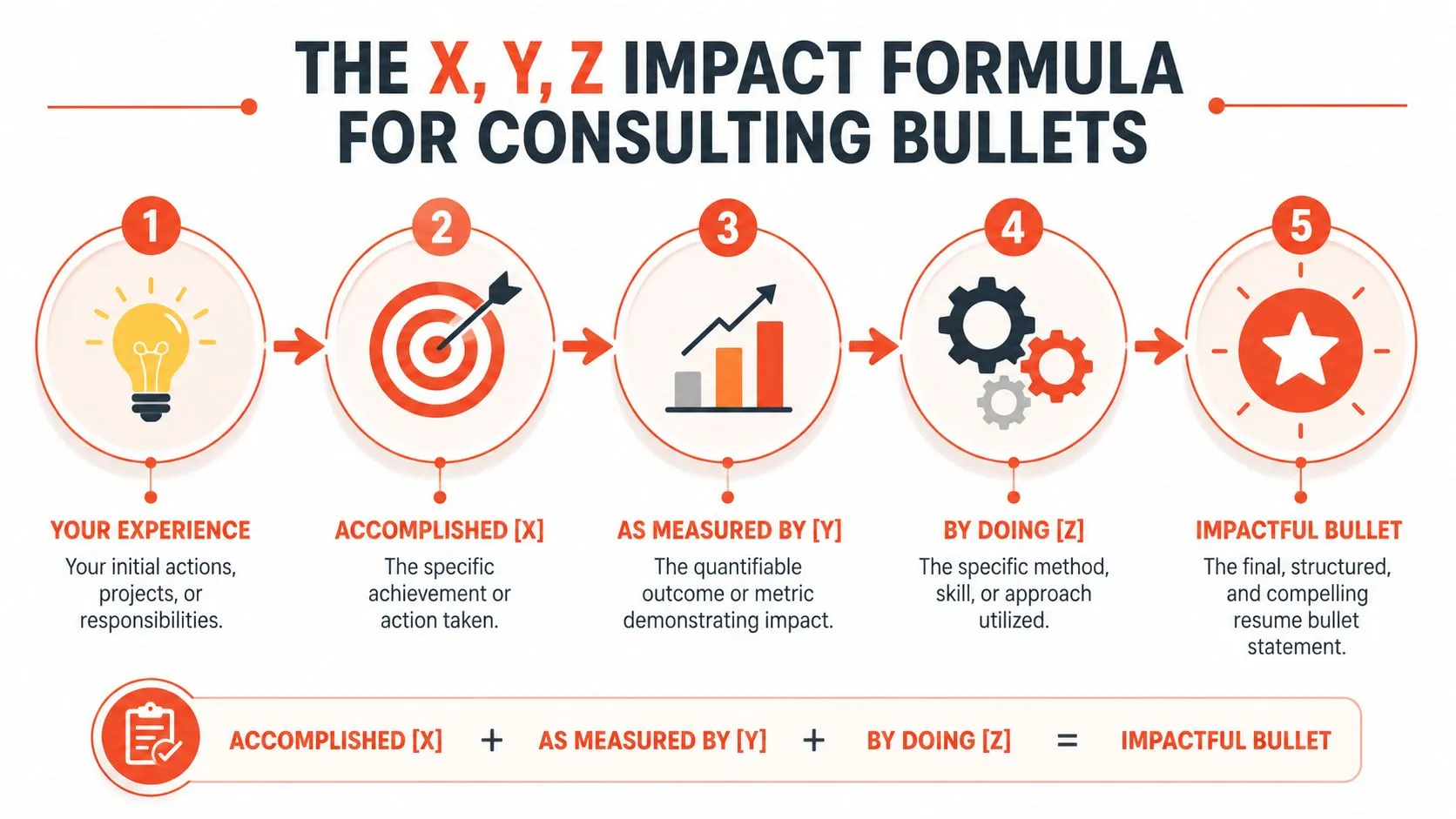
Start with the weak version
Take this bullet:
- Responsible for analyzing sales data
It's common. It's clean. It's useless.
The sentence tells me the activity, not the value. It doesn't say why the analysis mattered, what changed, or how your work influenced a decision.
Rebuild it in three moves
-
Name the actual accomplishment
What did your work help the business do? Find the decision, recommendation, fix, or change. -
Add the measurement
Use the actual number if you have it. Revenue impact, cost savings, team size, time saved, company scale. If you don't have the number yet, go find it. -
Explain the method
Show how you got there. Segmentation, pricing analysis, stakeholder interviews, model redesign, process mapping, whatever methods were used.
Here's the transformation:
| Version | Bullet |
|---|---|
| Weak | Responsible for analyzing sales data |
| Better | Analyzed sales performance data to identify underperforming regions and support commercial planning |
| Stronger | Identified underperforming regions by analyzing sales trends and pricing data, informing a revised commercial plan |
| Consulting-ready | Improved commercial planning by identifying underperforming regions through sales trend and pricing analysis, leading leadership to reallocate focus across priority accounts |
That last version works because it reads like a decision chain. Problem. Analysis. Action. Result.
Here's a useful gut check from StoryCV's article on how to write resume bullet points that actually say something. If you can't explain in one plain sentence what changed because of your work, don't ask AI to polish the bullet yet. You're editing fog.
A similar principle applies when you build any persuasive business narrative. If you've ever had to get your pitch deck funded, you already know slides don't win on visual order alone. The underlying logic has to hold.
Practical rule: Don't write from your task list. Write from the decision your work enabled.
A short walkthrough helps:
A better prompt for your own memory
Ask yourself these questions for each role:
- What was broken or unclear
- What did I specifically do
- What changed after that
- What number proves it
- Why would a consulting recruiter care
If a bullet can't answer at least three of those, it probably doesn't belong.
A Better Way to Remember What You Did
Most mid-to-senior candidates don't have a writing problem. They have a memory retrieval problem.
After 3+ years in work, the challenge shifts. The emphasis should move from piling up facts to conveying a coherent story that flows smoothly, according to this piece on the resume psychology of experienced professionals. That's exactly why filling a rigid consulting resume template often feels weirdly hard. The boxes are there, but the specifics are buried in old meetings, half-remembered projects, and work you now take for granted.

Talking beats filling boxes
When people try to write directly into a template, they usually flatten their experience. They summarize duties because duties are easier to remember than impact.
Talking through the work is different. You remember the messy details faster. The client pushback. The spreadsheet nobody trusted. The assumption you challenged. The recommendation that got adopted. Those details are where the bullet's power resides.
Use prompts that trigger specifics
Try this instead of opening a template first:
-
Recall the pressure point
What problem made this project matter? -
Name the turning point
Where did your judgment change the direction? -
Find the evidence
What metric, scope, or business effect proves it?
If your work involved keeping a close record of where time went, that habit helps here too. Something as simple as reviewing past logs can surface forgotten projects and scope. For consultants especially, it helps to compare time tracking apps for consultants because old records often reveal contributions your memory skips.
“I just can't tell what you did.”
That's the line you're trying to prevent. Not by decorating the page, but by recovering the substance behind each role.
Make Your Resume Readable Not a Work of Art
Formatting matters a little. Not first, not most, and not for long.
Treat the consulting resume template question as a five-minute cleanup pass at the end. You want a document that reads cleanly, scans fast, and survives ATS parsing. You do not want a design project.
The short formatting checklist
According to Indeed's guidance on ATS-friendly resume templates, 85% of ATS algorithms fail to parse text inside tables, text boxes, headers, footers, and graphics. Their practical advice is straightforward: use a minimalist layout, standard headings, 10 to 12 point Arial, Calibri, or Times New Roman, and save the file as a .docx.
So do this:
- Use plain section headings like Professional Summary, Work Experience, and Skills
- Stick to standard fonts such as Arial, Calibri, or Times New Roman in 10 to 12 point
- Keep the layout linear so every line reads in normal order
- Save as .docx if you want the safest ATS compatibility
- Delete decorative elements including icons, graphics, text boxes, and tables
What to stop wasting time on
Don't spend an hour deciding between two shades of gray. Don't nudge margins all afternoon. Don't convince yourself a left sidebar makes you look strategic.
Use one clean page structure. Make dates consistent. Align bullets. Remove clutter. Then stop.
A small amount of formatting consistency is worth it because it removes distraction. It does not create substance.
The best consulting resume template is the one you stop noticing after five minutes. The reader should remember your decisions and results, not your layout preferences.
If you've done strong work but can't get it onto the page clearly, StoryCV is built for that exact problem. It's an online resume writer that uses guided editorial judgment to help you articulate real impact, fast. Start with the substance. Spend your time where it counts: remembering what changed because of your work, then writing bullets that prove it.