Forget the templates. Most cover letter advice is generic, and in Singapore's market, generic gets ignored. Your format is probably wrong. It treats the letter like a formality, not a sales pitch.
The right cover letter format for Singapore is a single A4 page. Keep it between 250-400 words. It needs a clean header, a direct salutation, three focused body paragraphs, and a professional closing. This isn't a suggestion. It's a filter for hiring managers with seconds to spare.
Your Cover Letter Format Is Probably Wrong
Most cover letters just rehash the resume. A total waste of time. Your resume lists what you did. Your cover letter argues why it matters to this specific company.
The problem isn't your experience. It's how you package it. A messy, unstructured letter signals you don't respect the reader's time. Your application gets tossed before they even see your qualifications.
The Singaporean Blueprint
A strong cover letter in Singapore is built on two things: clarity and brevity. Every component has a job. No fluff. Don't get creative with fonts or layouts. Just make your value impossible to miss.
Your goal is a clean, one-page document a hiring manager can scan in 30 seconds. In a market where many employers are drowning in applications, a precise format is your advantage.
Here's how the structure breaks down. Think of it as the skeleton that holds your story together.
Singapore Cover Letter Structure At a Glance
| Component | What to Include | Why It Matters |
|---|---|---|
| Professional Header | Your name, phone, email, LinkedIn URL. | Makes it easy for them to contact you. Professionalism starts here. |
| Targeted Salutation | Address the hiring manager by name (e.g., "Dear Ms. Tan"). | Shows you did your research. "To Whom It May Concern" is a red flag. |
| Three-Paragraph Body | A hook, a paragraph with proof/metrics, and a proactive close. | This is your core argument. It guides the reader from interest to action. |
| Professional Closing | A simple "Sincerely" or "Best regards," followed by your name. | Ends the letter on a polished, respectful note. |
This structure ensures your message is delivered quickly and effectively.
Core Structural Components
Let’s break down that architecture. It’s a simple argument in four parts. Each section builds on the last, guiding the hiring manager from "Who are you?" to "Let's talk."
These are the non-negotiable elements:
-
Professional Header: Just the essentials: your name, phone number, email, and a clickable link to your LinkedIn profile. Keep it clean at the top.
-
Targeted Salutation: Find the hiring manager's name. A quick LinkedIn search is all it takes. "Dear [Hiring Manager's Name]" is the standard.
-
The Three-Paragraph Body: This is where you make your case. Think of it as your hook, your proof, and your call to action. More on this next.
-
Professional Closing: Don't overthink it. "Sincerely" or "Best regards," followed by your typed name, is perfect.
The purpose of a great format isn't to be noticed; it's to be invisible. It should let your message shine through without friction.
Understanding how this document complements your resume is crucial. Your format is the first impression. Make sure it communicates professionalism and respect for the reader's time. If you need a refresher, see the differences between a resume vs. a cover letter.
The Three Paragraphs That Actually Get Read
Your cover letter body is not a summary of your resume. It's a sales pitch.
A Singaporean hiring manager gives you seconds, not minutes. You have three short paragraphs to make your case. Forget long introductions. Land a punch, show the proof, and make the ask. That's it.
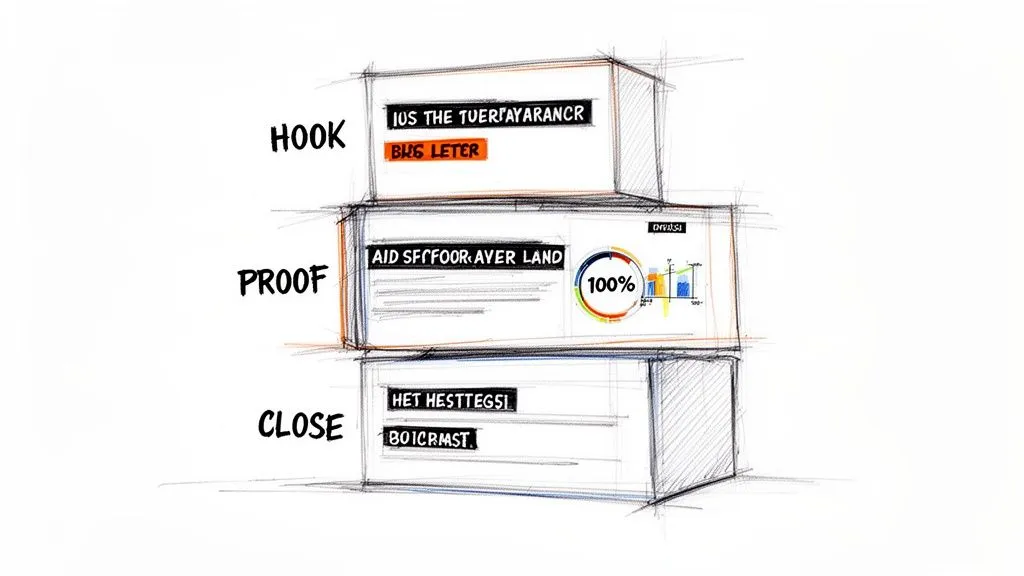
Paragraph One: The Hook
This is your opening shot. Don't waste it with "I am writing to express my interest." They know. You applied.
Get to the point. State the role you’re targeting. Immediately connect it to your single most powerful qualification. Draw a direct line between their need and your solution.
Example for a Senior Product Manager role:
I am applying for the Senior Product Manager position. My experience scaling B2B SaaS products from 10,000 to over 500,000 users by leading cross-functional teams aligns directly with the growth challenges in your job description.
Direct. Confident. Instantly relevant. You’ve hooked them with a high-impact achievement that speaks their language.
Paragraph Two: The Proof
You made a claim. Now back it up.
Connect one of your proudest wins to their biggest problem. Show, don't just tell. Find their main pain point in the job description. Is it market entry? User retention? Modernizing a legacy system? Pick one, and tie a quantified achievement to it.
For a company struggling with user engagement:
At TechCorp, we faced a 25% user drop-off rate in the first month. I led the redesign of the user onboarding flow, introducing interactive tutorials and personalized checklists. This resulted in a 40% improvement in 30-day retention and contributed to a 15% increase in annual recurring revenue.
This works because it's specific. You outlined a problem, detailed your action, and quantified the result with hard numbers. You’ve proven your value.
Paragraph Three: The Close
Your final paragraph pivots to the future. It shifts from what you’ve done to what you will do for them. It has two jobs: reinforce your interest and state your call to action.
Stop using passive phrases like "I hope to hear from you soon." It's weak. Take control.
A stronger alternative:
My background in strategic product development and my ability to boost user retention are a strong match for your goals. I am confident I can bring similar results to [Company Name] and am keen to discuss how my expertise can support your upcoming product launch.
Finish with a clear, forward-looking call to action.
-
Weak: “Thank you for your time and consideration.”
-
Strong: “I look forward to discussing how I can contribute to your team.”
This isn't arrogance. It's the mark of a professional who understands their value and is ready to talk specifics.
How to Write a Cover Letter for a Singaporean Audience
A generic cover letter is a dead end. In Singapore, recruiters value directness and substance. Your letter needs to cut to the point.
The tone should be professional but not robotic. Aim for "confident expert," not "stuffy academic." Steer clear of overly casual greetings ("Hey there!") and corporate jargon ("synergistic value-add"). The goal is sharp communication that respects the reader's time.
For international job seekers in Singapore, strong written and spoken English is vital for career advancement.
Move Beyond Simple Customization
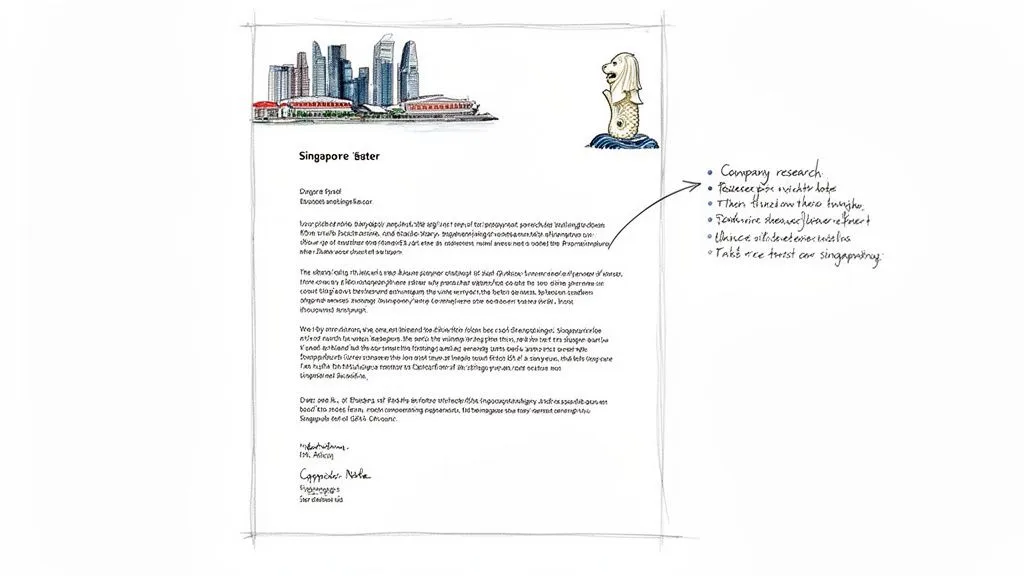
Real tailoring isn't just dropping the company's name into a template. It’s showing you understand their world—their challenges, their goals. This is how you separate yourself from the pile.
Ten minutes of research can transform your letter. It signals you're a proactive problem-solver, not just another person blasting out resumes.
Here’s a quick way to start:
-
Scan their recent news: Check their blog or newsroom. What have they launched? Who have they partnered with?
-
Understand their mission: Head to their "About Us" page. What are their stated values? Find a genuine connection to your own work ethic.
-
Identify their pain points: Read the job description again. What problem are they trying to solve with this hire?
Tailoring isn't flattery. It's about connecting your skills to their specific needs. It shifts the conversation from "Here's what I've done" to "Here's how I solve your problem."
Weave Your Research into Your Narrative
Work your research into your letter naturally. Don't just list facts. Use them as a bridge to your experience.
Let’s say you're applying to DBS and see they’re pushing digital transformation.
A generic approach: "I am interested in working for a forward-thinking bank like DBS."
A tailored approach: "I was impressed by DBS’s recent launch of the NAV Planner tool, as it aligns with my experience in developing user-centric fintech solutions that drove a 30% increase in customer engagement at my last company."
The second example shows genuine interest. It makes your application memorable. When you invest this effort, your cover letter stops being a formality and starts telling a compelling story with your CV. To get the other half of that story right, check our guide on building a Curriculum Vitae for the Singapore market.
Real Cover Letter Examples for Singapore Professionals
Theory is useless without action. Let's move past templates and break down three realistic cover letters for different Singaporean career scenarios. Think of these as practical blueprints, not just samples.
Example 1: Mid-Level Tech Pro to a Scale-Up
A Senior Software Engineer applies to a fast-growing company like Grab. Their biggest problem is scaling infrastructure without it crashing. A generic letter goes straight to the trash.
Dear Mr. Chen,
I am writing to apply for the Senior Software Engineer position. My experience leading the migration of a monolithic application to a microservices architecture—which resulted in a 40% improvement in system uptime and supported a 3x increase in user traffic—aligns directly with Grab's current scaling objectives.
At my previous role, I was tasked with fixing performance bottlenecks in our core platform. I led a project to implement a distributed caching system using Redis, which slashed average API response times from 800ms to under 150ms. This cut down customer support tickets related to performance by 20%.
Grab’s mission to drive Southeast Asia forward with technology resonates with me. I am confident my hands-on experience in building resilient, scalable systems can support your team's goals. I am keen to discuss how my technical skills can contribute to Grab's continued growth.
Best regards,
Mei Lin Tan
Why This Works:
-
The Hook: It lands a punch with huge, quantifiable wins (40% uptime improvement, 3x traffic support) that speak to a scale-up's anxieties.
-
The Proof: It gives a specific example (Redis implementation) and translates it into business impact—reduced API latency and fewer support tickets.
-
The Close: It connects her skills to the company's mission and confidently positions her as a solution.
Example 2: The Career Changer—Finance to FinTech
An Analyst makes the leap from a traditional bank to a fintech startup. They need to prove their skills aren't stuck in the old world.
Dear Ms. Devi,
I am applying for the Financial Analyst role at [Fintech Startup Name]. With over six years in risk modeling at a major bank, I have developed a deep understanding of financial compliance and data analysis—skills I can apply to the innovative product landscape your team is building.
In my last role, I automated a manual risk reporting process using Python scripts, which reduced report generation time by 90% and eliminated human error. The context was traditional banking, but the core problem was the same: using data to build efficiency and manage risk.
The prospect of contributing to a company that is disrupting traditional finance is exciting. I am confident I can bring a unique blend of regulatory knowledge and a problem-solving mindset to your team. I look forward to discussing how my analytical skills can support your mission.
Sincerely,
David Yong
A career change cover letter isn't about hiding your past. It's about reframing it. Explicitly connect the dots, showing how your supposedly "irrelevant" experience is a hidden strength.
Example 3: Senior Manager to an MNC
A senior leader aims for a strategic role at a multinational corporation (MNC). They need to demonstrate strategic vision, leadership, and market understanding.
Dear Hiring Team,
I am expressing my strong interest in the Regional Operations Director position. Having led regional expansion strategies across APAC for the past decade, I have a proven track record of launching new markets and scaling operational teams, which aligns with [MNC Name]'s stated goal of deepening its presence in Southeast Asia.
Most recently, I directed the launch of our Singapore and Jakarta offices, achieving profitability six months ahead of schedule. This involved building a 50-person team from scratch, navigating complex regulations, and establishing a supply chain that cut regional logistics costs by 18%. My leadership philosophy is built on empowering local teams while ensuring global consistency.
I am particularly drawn to [MNC Name]'s commitment to sustainability, a principle I have actively integrated into my operational frameworks. I am eager to discuss how my strategic experience and leadership can drive similar success for your organization.
Best regards,
Aisha Khan
For more detailed examples, explore our guide on Singapore cover letter examples.
Your Final Checklist Before Hitting Send
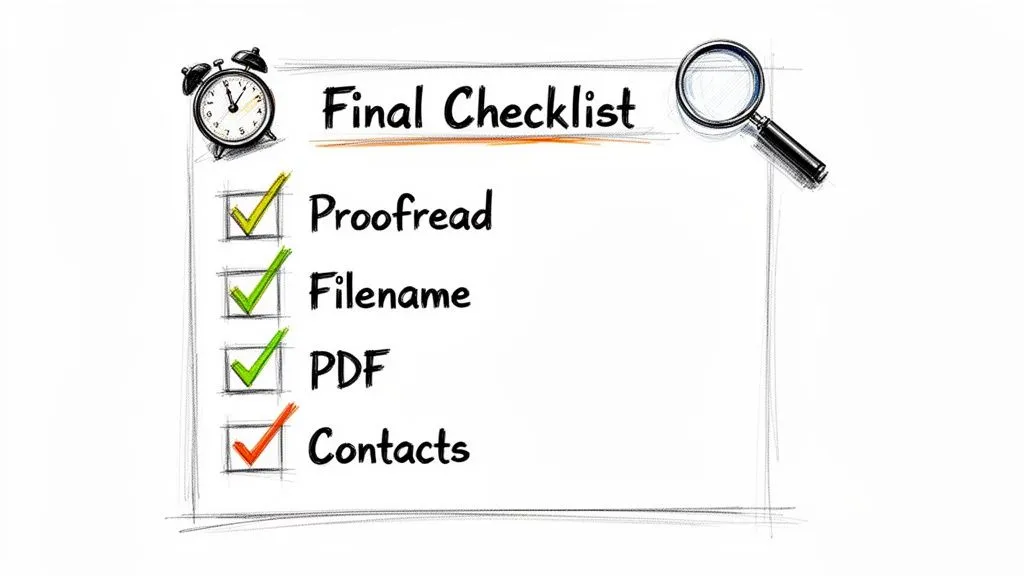
You've done the work. The letter is sharp and tailored. Don't let a clumsy mistake undermine it now. A single typo can send your application to the 'no' pile.
This isn’t about perfection. It’s about professionalism. A quick final check shows you’re detail-oriented—a trait every employer values.
The Technical Polish
Get the technical details right first.
-
File Format: Always send as a PDF. It locks in your formatting and looks professional on any device. A Word doc can look messy.
-
File Name: Don’t send
CoverLetter_Final_v2.docx. UseMei-Lin-Tan-CoverLetter-Grab.pdf. It’s simple, searchable, and organized. -
Contact Details: Triple-check your phone number and email. One wrong digit and you're unreachable. Make sure your LinkedIn URL is a clickable link that works.
The Human Polish
Read your letter one last time from the hiring manager’s perspective. They’re busy and looking for reasons to shorten their pile of applications. Don’t give them one.
One typo might seem small. To a hiring manager, it suggests you don't care or lack attention to detail. Both are terrible first impressions.
Get a second pair of eyes on it. A friend or mentor can spot errors you’ve become blind to. Reading it aloud is another great trick—you’ll catch awkward phrasing your brain skips over.
Use this quick checklist before you submit.
Pre-Submission Final Review
| Check Point | Yes/No | Notes |
|---|---|---|
| Is it a PDF? | Saved in the right format. | |
| Is the filename professional? | YourName-CoverLetter-Company.pdf |
|
| Are all links clickable & correct? | LinkedIn, portfolio, etc. | |
| Contact details 100% correct? | Phone number and email address. | |
| Addressed to a specific person? | Not "To Whom It May Concern". | |
| Is the company name spelled right? | A common and costly mistake. | |
| Did you proofread it backwards? | A trick to spot typos. | |
| Does it fit on one page? | Essential for scannability. |
This simple table can be the difference between getting an interview and getting ignored.
Finally, remember the importance of a well-presented resume. You might explore hosting your resume online for a polished touch. Ensure every element of your submission is professional. This diligence pays off.
Your Top Singapore Cover Letter Questions, Answered
Let’s cut through the noise. Here are quick, direct answers to common questions about cover letters in Singapore.
Should I Bother Sending a Cover Letter If It's Optional?
Yes. Always. "Optional" is a test. Most candidates will skip it. That's why you shouldn't.
Submitting a thoughtful letter shows you're proactive and genuinely interested. It sets you apart before anyone even sees your resume. A small effort for a massive advantage.
How Long Should a Cover Letter Be?
One A4 page, maximum. That's the hard limit.
Aim for 250 to 400 words, broken into three to five short paragraphs. Hiring managers scan, they don’t read novels. Respect their time. Be concise.
A great cover letter is an argument, not a biography. Its job is to convince the reader in under a minute that you are worth talking to. Brevity is a sign of confidence.
What if I Can't Find the Hiring Manager's Name?
First, do your homework. A quick search on LinkedIn usually works.
If you’ve searched and come up empty, "Dear Hiring Manager" or "Dear [Department Name] Team" is perfectly acceptable. It's much better than the outdated "To Whom It May Concern."
How Should I Mention My Salary Expectations?
Don't. Not unless the application explicitly asks for it.
Bringing up money this early weakens your negotiating position. Your cover letter's job is to get you the interview, not to start haggling. Keep the focus on the value you bring.
Stop wrestling with generic advice. StoryCV is your digital resume writer. We use a smart interview to uncover your impact and articulate it with confidence. Get a professional-quality draft in minutes, not days. Start telling your career story at https://story.cv.