The popular advice is wrong: a creative director resume shouldn't be a senior designer resume with better typography and another award. The work stopped being yours the day you became the person who decides which work ships. Your resume should read accordingly.
A portfolio proves taste. A resume proves command. It needs to show the campaigns you steered, the teams you led, the decisions you owned, and the business effects you can credibly claim. It also needs to survive an applicant tracking system, which has little interest in your carefully chosen serif typeface.
The Day the Work Stopped Being Yours
Creative direction is a job of judgment. You set the brief, choose the route, defend the standard, manage disagreement, and decide when the work is ready to leave the building. Sometimes you make the work yourself. Increasingly, your value is in making sure the right work gets made by the right people.
That's the identity shift your resume has to capture. A senior designer resume says, “I made strong things.” A creative director resume says, “I directed the conditions in which strong things got made, shipped, and used.”
The distinction matters because hiring managers aren't only looking for aesthetic taste. They need evidence of team leadership, client judgment, strategic thinking, cross-functional communication, and business accountability. The role has moved beyond hands-on design alone, with growing emphasis on marketing strategy, project management, presentations, and executive communication, as outlined in career pathway analysis for creative directors.
Your opening profile shouldn't be a self-portrait in serif type. It should state the kind of work you direct, the scale at which you operate, and the decisions you routinely own.
The useful hierarchy: the work belongs to the team, the work belongs to the brand, and the resume belongs to you.
That means you can claim your leadership without pretending you personally wrote every line, designed every frame, or approved every export. Your resume needs a clear account of your role in the system.
It also needs restraint. Recruiters spend only about 6–8 seconds on an initial scan, and ATS filters can remove candidates before a human review, according to resume-screening research. Put title alignment, scope, tools, and impact near the top.
If you're worried that direct language will sound boastful, read how to write a resume without bragging. Specificity sounds calmer than adjectives.
The Structure That Matches the Job
A strong document lets a recruiter answer three questions quickly: what kind of creative leader are you, at what scale, and what changed because you were there?
Use a single-column layout with standard headings. It's not glamorous. Neither is being rejected by a parser because your job title lives inside a decorative text box. ATS guidance consistently favours parseable formatting, conventional section names, and clear keyword alignment, as described in creative director resume guidance.
Start with the identity, not the biography
Your header should contain:
- Name and target title: Use “Creative Director” when that's the role you're pursuing.
- Contact details: Add email, phone, and location if relevant.
- Portfolio: Put the link beside your contact details, not in a footer graveyard.
- Two-line summary: Name your category, mandate, and scale.
A useful summary might look like this:
Creative Director specialising in brand and integrated campaign direction for consumer and digital businesses. Leads multidisciplinary teams and agency partners from brief through launch, with responsibility for brand consistency, client confidence, and commercial outcomes.
That's enough. A professional summary belongs near the top and should be crafted for the specific role, rather than filled with general enthusiasm, as UCLA career guidance explains. Keep it to 2–4 sentences, usually around 35–75 words, based on resume summary guidance.
Give experience the right weight
Use reverse chronology, but don't give every role equal space. Recent direction-level work deserves the most room.
For each relevant role, show:
- Title and employer
- Dates
- Team size or reporting structure
- Disciplines led
- Client or brand scope
- Budget accountability, when you can verify it
- Four or fewer strong bullets
Put awards and recognitions after experience, compactly. Keep education brief unless it's unusually relevant or you're early in your career.
Cut objectives, references, soft-skill inventories, and decorative certifications. “Excellent communicator” is not evidence. It's a hope wearing office clothes.
Your skills section should verify fluency in tools and methods, such as Adobe Creative Cloud, Figma, brand strategy, integrated campaigns, creative operations, pitch development, and cross-functional leadership. Don't list every application you've opened since university.
Bullets That Prove Direction, Not Execution
Consider an illustrative scenario. You directed a rebrand for a mid-market consumer brand. The weak version says:
- Created a new visual identity.
- Designed campaign assets.
- Collaborated with the marketing team.
- Managed creative projects.
Nothing here proves direction. It describes activity and hides ownership behind passive language.
A stronger version makes the brief, outcome, and scope visible:
- Set the strategic brief for a repositioning that needed to make the brand more relevant to a broader consumer audience while protecting existing recognition.
- Directed a multidisciplinary team spanning design, copy, motion, production, and external agency partners from concept development through rollout.
- Shaped the campaign system across paid, owned, retail, and digital touchpoints, giving marketing teams a consistent platform rather than a collection of disconnected assets.
- Presented and defended the creative direction with senior client and commercial stakeholders, resolving competing priorities and moving the work into market.
These are illustrative examples, not claims about a real person. Notice what they do. They show what the client needed, what shipped, who worked on it, and where the director made decisions.
You can add a verified business outcome when you have one. Don't invent a number because a bullet feels lonely without it. “Improved campaign performance” needs supporting evidence. “Supported stronger campaign performance after launch” is safer if the exact attribution isn't available.
Here's a starter bank to adapt:
- Directed a brand launch from positioning and naming through campaign rollout across multiple channels.
- Built a creative team by defining roles, hiring specialist talent, and establishing a clearer review process.
- Led a successful pitch by translating a complex brief into a focused creative platform for senior client stakeholders.
- Reframed an agency model to improve collaboration between strategy, creative, production, and account leadership.
- Moved creative capability in-house by setting standards, workflows, and partnerships for ongoing campaign delivery.
- Entered a new category with a visual and verbal system designed to work across launch, retail, and digital environments.
- Directed a post-merger identity system that gave separate teams a shared brand framework.
- Guided campaign development from insight and concept through production, launch, and optimisation.
- Established creative review rituals that improved decision quality and reduced subjective feedback.
- Partnered with marketing and product leaders to connect brand direction with customer and commercial priorities.
- Managed agency relationships by setting clearer briefs, approval paths, and expectations for quality.
- Presented creative strategy to executive stakeholders, turning competing opinions into a usable decision.
Every bullet should answer four questions: who reported in, what shipped, how the business or market moved, and why a creative director was needed instead of a senior designer. The leadership examples for resumes can help you find that distinction in your own history.
The Restraint Paradox
A creative director's resume gains authority from what it refuses to do.
Skip the gradient header, custom logo, clip art, decorative borders, and asymmetric two-column layout. These choices may look expressive on screen, but they often create parsing problems and force the reader to hunt for basic information. The resume isn't a campaign microsite. It has one job.
Use one typeface, two weights, and a quiet hierarchy. A readable baseline is a 10–11pt body size, 13–14pt section headings, generous margins, and conservative spacing. A single accent line is plenty. Your portfolio can carry the visual personality.
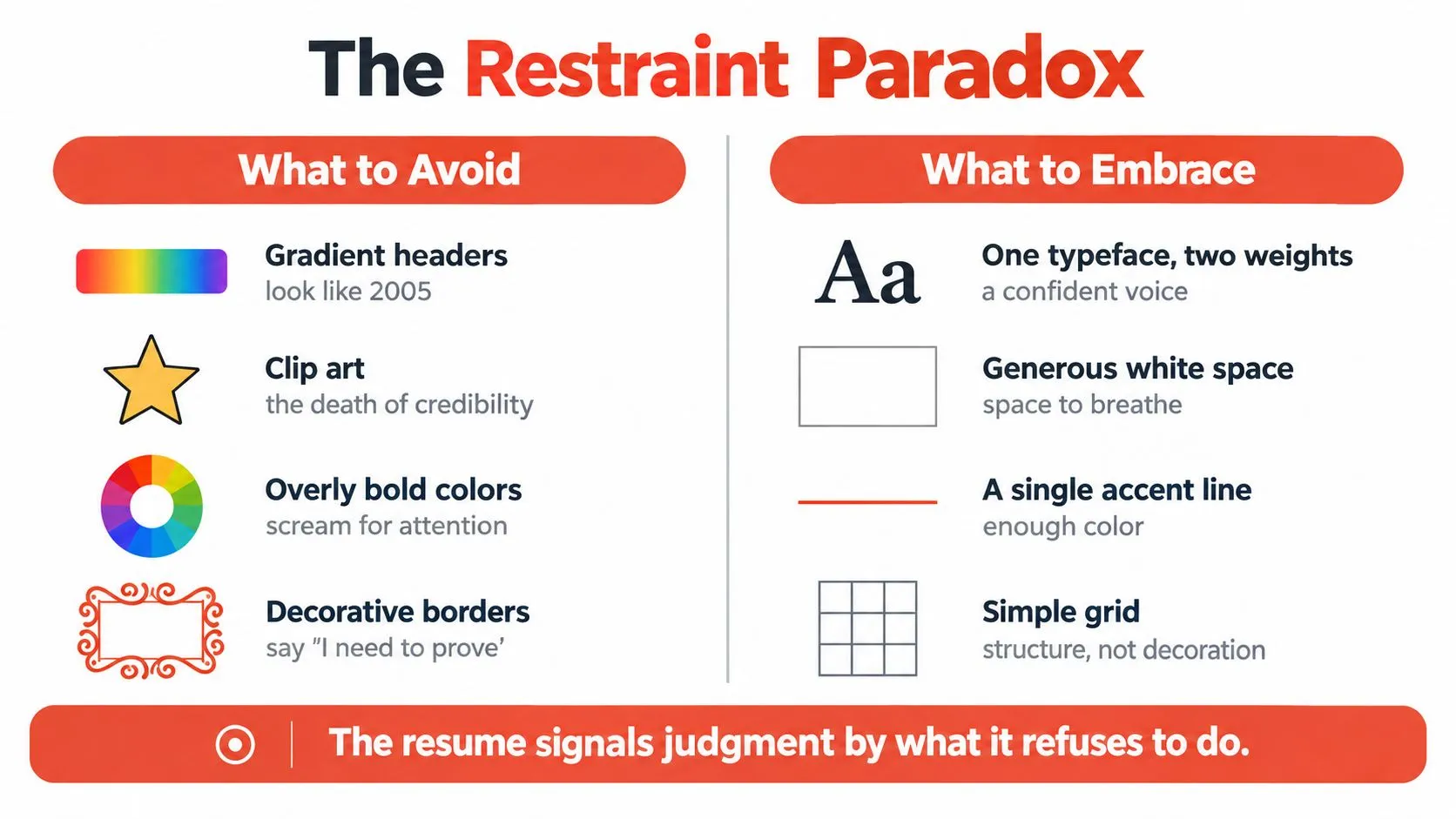
What restraint communicates
A heavily art-directed resume can read like a designer still auditioning. It says, “Please notice that I can arrange a page.” At director level, the reader already assumes you can.
A confident page creates room for the content to do the showing off:
- Embrace: Clear headings, plain text, strong alignment, visible portfolio link.
- Avoid: Dense graphics, progress bars, icon-based skills, tiny type, and mysterious symbols.
- Embrace: Selective bolding for titles, scope, and outcomes.
- Avoid: Every word in bold because everything apparently needs rescuing.
The document should look like something a director designed, not something a director designed itself.
A quiet page also supports the first scan. The recruiter sees the target title, category, leadership scope, and outcomes without decoding your personal brand system. That's judgment. It's less entertaining than a purple sidebar, which is exactly why it works.
Awards, Press, and What to Leave Off
Awards are real currency in creative work. They signal that outside judges, clients, or respected industry bodies found the work worth recognising. They also become noise when you list every internal certificate and social feature you've ever received.
Use compact entries. Name the award and year, then move on.
What earns a line
Tier one includes recognitions that experienced industry readers will understand quickly:
- Cannes Lions
- D&AD Pencils
- The One Show
- ANDY Awards
- Effie Awards
- Webbys, when the category fits your work
- Named client wins shipped under your direction
Tier two includes credible trade coverage, niche publication features, and relevant podcast appearances. Include these when they support your positioning, especially if the role values public speaking, cultural commentary, or category authority.
Tier three is where restraint earns its keep. Cut high school awards, every social media “feature,” anonymous contest placements, and internal honours that only make sense to the people who handed them out.
| Tier | Include | Cut | Reason |
|---|---|---|---|
| One | Cannes Lions, D&AD, One Show, ANDY, Effie, relevant Webbys | None, unless your role is unclear | Recognised industry or client credibility |
| Two | Trade publications, niche blogs, relevant podcasts | General publicity with no connection to your work | Supports authority when it fits the target role |
| Three | Rarely, and only if directly relevant | Internal awards, pay-to-play honours, social features | Readers can tell when the trophy cabinet is padded |
Recency matters. A 2024 D&AD Shortlist can be more useful for a current search than a 2014 Grand Prix, depending on the role. List the recognition that supports the story you're telling now, not every relic from a previous career chapter.
Format awards inline under each role or in a short “Awards and recognition” section. Don't build a separate museum wing for them. For a useful filter on weak signals and inflated claims, see these resume red flags.
Portfolio, Tailoring, and Closing the Loop
The portfolio and resume have different jobs.
The resume proves you can lead, decide, and ship. The portfolio proves the work was good and shows how you shaped it. Repeating every case study in prose wastes the resume page. Give each project a short frame instead: client, brief, role, and outcome.
Keep the portfolio selective. Five or six strong pieces is a practical benchmark for creative director candidates, while the resume remains clean and results-driven, according to industry guidance for creative director applications. A smaller book with useful context beats a sprawling archive of things you once touched.
Use one sentence per selected project:
- Client: A consumer brand entering a new category.
- Brief: Create a coherent identity and launch platform for a new audience.
- Your role: Directed the strategy, creative team, agency partners, and senior approvals.
- Outcome: State the verified business or campaign result, without borrowing credit for work you didn't own.
If your portfolio needs sharper case-study framing, this guide to build a portfolio that sells is a useful reference.
Tailor the leadership story
A fashion or luxury role should lead with brand stewardship, cultural fluency, and consistency across touchpoints. An agency creative director resume should foreground pitch wins, integrated campaigns, client relationships, and team direction.
For an in-house technology role, put team building, digital fluency, cross-functional shipping, and creative operations closer to the top. Don't lead with a software inventory. Show how you used tools or emerging technology to improve speed, quality, experimentation, or collaboration.
A professional summary should change with the role. Candidates with more than 10 years of experience are often advised to use a 3–5-sentence summary, while less-experienced candidates can keep it to 1–2 sentences, according to career guidance from Coursera. For a mid-to-senior candidate, two sharp lines usually beat five respectable ones.
Close the loop with a short cover note. Name the company, identify the creative or organisational gap you'd fill, and invite the hiring team to review the portfolio. Then make sure the resume and portfolio tell the same story, without using the same words for every project.
StoryCV is an Online Resume Writer, not a template library. Its guided interview helps turn team scope, creative decisions, and verified outcomes into an ATS-parseable resume that still sounds like a person. Start with your creative director story at StoryCV, and stop asking a portfolio to do the resume's job.