The most popular resume advice is often aimed at the wrong problem. People argue about fonts, margins, and page length while hiring teams reject resumes because the career story feels vague, unstable, or impossible to verify.
A resume red flag is rarely just a formatting mistake. It's a missing explanation. Your job is to make your impact, direction, and credibility obvious before a recruiter has a reason to move on.
Why Resume Red Flags Are Not What You Think
Recruiters do not reject resumes because they lack decorative polish. They reject unclear stories. Screening research reports an average initial review time of 7.4 seconds, and 75% of resumes are rejected by ATS filters before reaching a human reviewer, according to this resume screening statistics synthesis.
Formatting protects your story. It cannot create one. Attractive headings still fail when every bullet lists responsibilities without showing what changed because you did the work.
The core red flag: A recruiter cannot tell what you achieved, why it mattered, or where your career is going.
Vague bullets make the reader work. Buzzwords create doubt. An unexplained employment gap leaves a question unanswered, while several short roles form a pattern that demands context. Each weakness forces a recruiter to guess. Fast screening favors the candidate whose evidence is easiest to understand.
A technically correct resume can still underperform. A 2024 survey of 625 U.S. hiring managers found that 53% had reservations about resumes containing AI-generated content, while 20% considered it a critical issue that might stop them from hiring a candidate. The same research found that 50% were hesitant to move forward when they saw frequent job-hopping in a candidate's history, as reported by CNBC's coverage of recruiter resume concerns.
The cost is a missed chance to show that you deserve the recruiter's time. Your resume must make impact, judgment, and consistency visible quickly. A guided interview approach, such as StoryCV's, helps capture those details before vague wording hides them. For the evaluator's perspective, use this WorkSignal screening guide for recruiters to examine how screening decisions are made.
Red flags are narrative failures first. Fix the missing story at its source, then refine the formatting.
The Seven Red Flags That Kill Your Application
A resume red flag is a story failure before it becomes a formatting failure. The ATS may fail to read your experience, keywords, or dates, then a human reviewer may interpret the same gap as weak judgment, low credibility, or poor fit.
| Red Flag | ATS Impact | Human Reviewer Impact | Dealbreaker Rate |
|---|---|---|---|
| Unexplained employment gaps | Ambiguous dates can distort timeline calculations | Leaves the pause unexplained | 38% of hiring managers cited long gaps as a hiring concern (Resume Genius survey) |
| Vague or missing outcomes | Removes role-specific terms and evidence of relevance | Makes duties look like achievements | No verified rate |
| Buzzword-heavy language | Adds little searchable context | Can resemble copied or AI-generated writing | 53% had reservations about AI-generated content |
| Inconsistent formatting | Can scramble reading order and section extraction | Signals carelessness or weak self-editing | No verified rate |
| Rapid job-hopping without context | Creates an unclear employment sequence | Raises concerns about stability and retention | No verified rate |
| Mismatched skills and target role | Fails keyword alignment | Makes the application look generic | No verified rate |
| Lies or exaggerations | Produces unsupported or contradictory information | Erodes trust immediately | No verified rate |
Gaps need context, not excuses
Employment gaps are not automatically disqualifying. Leaving the reader to invent an explanation is the problem. A short line such as “Career break for family caregiving” or “Independent consulting and professional development” gives the timeline a human frame without oversharing.
Date consistency matters too. ATS guidance warns that mixed month and year formats can corrupt experience calculations, while some systems flag timelines that exceed 90 days, according to Teal's resume red flags guidance. Use one format throughout, such as Jan 2021 to Mar 2023, and explain meaningful pauses directly.
Proof beats adjectives
“Strategic,” “results-oriented,” and “dynamic” do not demonstrate performance. Show the situation, your action, and the result. If you lack a precise metric, describe the concrete change, scope, decision, or outcome without inflating it.
The same standard applies to short tenures. Do not hide them. Explain the pattern through promotions, project-based work, acquisitions, contract roles, or a clear shift in responsibility. A truthful timeline with context is stronger than one made artificially smooth.
Formatting errors can make qualified candidates invisible. A 2025 analysis of 10,000 CVs found that 73% had at least one critical ATS error, 61% had formatting issues involving tables, columns, or graphics, 44% used non-standard section headings, and 31% had contact information that couldn't be parsed correctly, according to this ATS errors analysis.
The fix is to build the evidence before polishing the page. A guided interview approach such as StoryCV's can surface the missing context, ownership, and outcomes at the source. Use StoryCV's guide to common resume errors to check for omissions that make an otherwise accurate resume hard to trust.
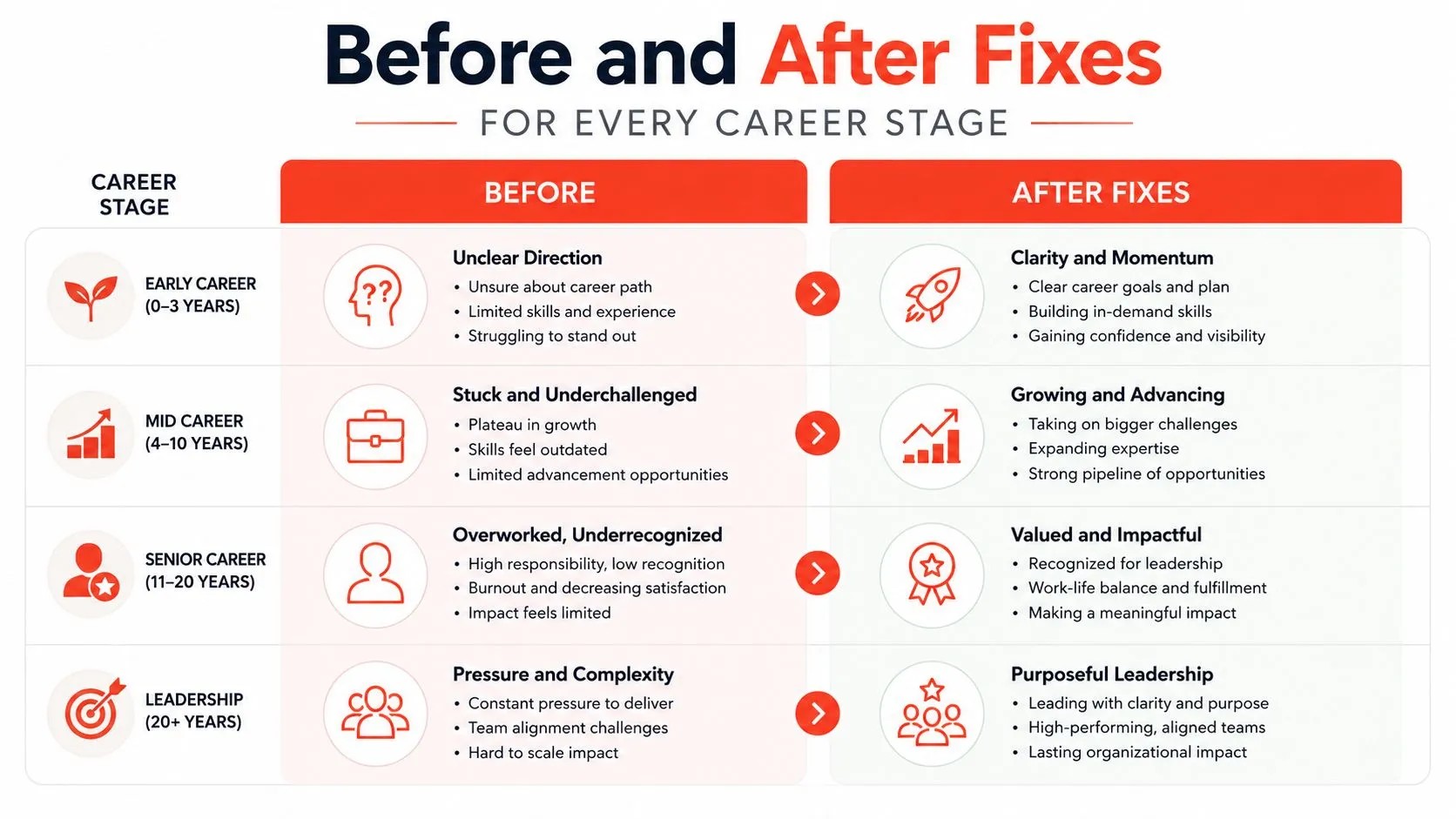
Before and After Fixes for Every Career Stage
A weak resume line usually needs context, not decoration. The fastest fix is to ask four questions: What was happening? What did you do? What changed? How can the reader recognize the role or skill?
Students and new graduates
Before:
“Helped with marketing campaigns and social media.”
After:
“Created social content for a student recruitment campaign, coordinating posts across three channels and reporting engagement trends to the marketing lead.”
The revised version replaces “helped” with an action, names the work, and shows who used the output. If you have a verified result, add it. If you don't, don't invent one. Scope and ownership still make the experience legible.
Before:
“Responsible for research during internship.”
After:
“Reviewed customer feedback, grouped recurring themes, and summarized findings for the product team's planning meeting.”
This turns an activity into a contribution. It also gives the ATS useful terms such as customer feedback, product team, and planning.
Mid-level professionals
Before:
“Led strategic initiatives and used cross-functional collaboration to create synergies.”
After:
“Coordinated product, sales, and support teams to resolve recurring onboarding issues and create a shared implementation checklist.”
The second version removes buzzwords and shows the operating problem. Add the result if you can verify it, such as a reduction in support tickets or faster implementation time.
For frequent moves, use context in the chronology:
Before:
“Marketing Manager, Company A. Marketing Manager, Company B. Marketing Manager, Company C.”
After:
“Marketing Manager, Company A, promoted to lead regional launch planning. Joined Company B after acquisition. Moved to Company C for expanded ownership of lifecycle marketing.”
The explanation doesn't apologize. It gives the sequence a coherent direction.
Career changers
Before:
“Managed projects, communicated with stakeholders, solved problems.”
After:
“Managed multi-team delivery schedules, translated stakeholder requirements into work plans, and resolved blockers across operations and technology teams.”
This is transferable skill framing done properly. It doesn't claim you already held the target role. It shows the behaviors that connect your previous work to it.
Tech and business roles
Before:
“Worked on dashboards and improved reporting.”
After:
“Built a reporting dashboard that consolidated recurring performance updates for business stakeholders, replacing scattered spreadsheet reviews with one shared view.”
The context-action-result structure prevents a responsibility list from masquerading as an achievement. For technical roles, name the relevant systems, languages, methods, or platforms when they're part of the work. For business roles, identify the decision your analysis supported.
These edits take minutes because they don't require prettier prose. They require retrieving the missing story.
Writing for Both ATS Filters and Human Readers
ATS optimization and human readability aren't opposing goals. Both readers want the same basic thing: clear evidence that your experience matches the role.
The ATS needs recognizable terms and predictable structure. The recruiter needs those terms connected to a credible result. Keyword stuffing satisfies neither. A bullet that repeats “project management” without showing what you managed is searchable but forgettable.
| Element | ATS Filter Priority | Human Recruiter Priority | Narrative-First Fix |
|---|---|---|---|
| Job title | Recognizable role language | Clear level and scope | Use the official title, then add a clarifying equivalent where accurate |
| Skills | Exact or related role terms | Evidence of applied ability | Put the skill inside a specific accomplishment |
| Dates | Consistent, parseable chronology | A timeline that makes sense | Use one month and year format throughout |
| Headings | Standard labels | Fast navigation | Use headings such as Experience, Education, Skills, and Certifications |
| Keywords | Relevant matches | Natural, credible wording | Mirror the job description only where it reflects real experience |
| Metrics | Searchable context around outcomes | Proof that work mattered | Pair a result with the action that produced it |
A bullet that serves both readers
Weak for ATS and humans:
“Improved processes and collaborated with stakeholders.”
Readable but weak for ATS:
“Made the handoff between teams less painful.”
Strong for both:
“Redesigned the cross-functional handoff process, documenting ownership and escalation steps for operations and customer success teams.”
The final version contains role context, a clear action, and recognizable terminology without sounding stuffed. It also gives a human reviewer something concrete to discuss.
Use standard section headings and avoid tables, graphics, text boxes, and multi-column layouts. The guide to ATS-friendly resumes from Kindness Community Foundation offers a practical reference for readable structure and parsing risks.
Acronyms need judgment. Write the full term first when it's likely to be searched in that form, then include the acronym if it's commonly used in your field. If your official title is unusual, preserve it for accuracy and add a parenthetical equivalent only when it helps the reader understand the role.
For a deeper look at how automated screening changes resume language, see StoryCV's article on AI resume screening. The principle is simple: write for a machine's extraction, but never sound like a machine wrote it.
The Real Problem Is Remembering Not Writing
Most resume red flags begin before writing. They begin when a candidate can't retrieve the details of their own work.
You remember the pressure, the meetings, and the long hours. You often don't remember the original problem, the decision you made, the obstacle you removed, or the downstream effect. So you write, “Managed operations,” because the specific story is buried under years of experience.
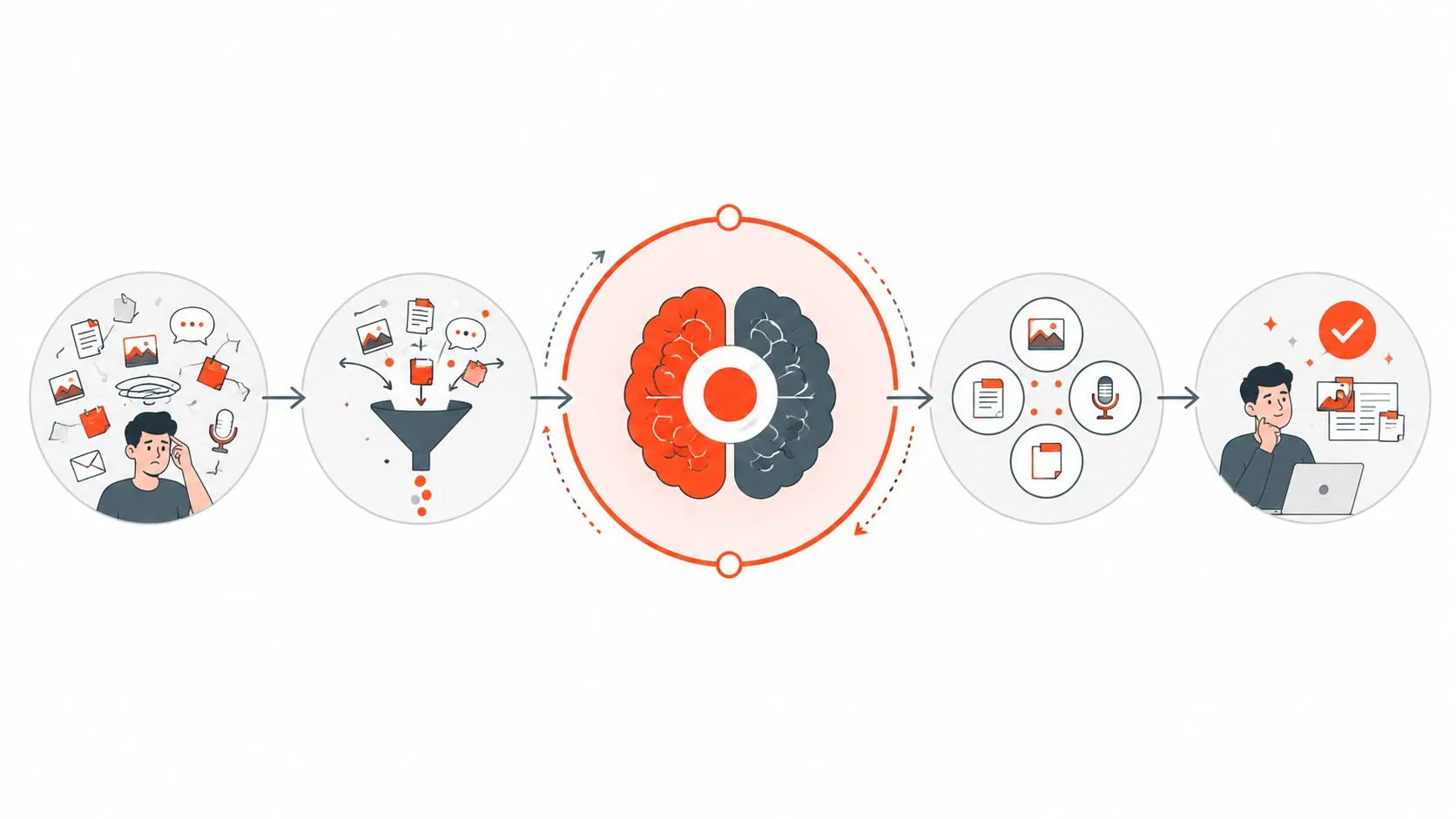
Traditional advice says to write better bullets. That's incomplete. You need a process that pulls the evidence out first.
A guided interview works because it asks questions in sequence. What was broken? Who noticed? What were you responsible for? What choice did you make? What changed afterward? Those prompts recover context that generic resume forms leave untouched.
Better prompt: Don't ask, “What were your responsibilities?” Ask, “What problem kept landing on your desk, and what did you change?”
This applies beyond resumes. Executives often need the same evidence-based narrative when refining their professional presence, and this resource on profile optimization for executives is useful for translating experience into a sharper public story.
StoryCV is one option for this interview-led approach. Its digital resume writer asks structured questions about your work and turns the answers into role-specific narrative rather than asking you to fill empty template boxes. The point isn't to hide a weakness. It's to make the truth easier to see.
Your Resume Audit Workflow
Audit the resume by consequence, not appearance. Formatting cannot rescue a missing career story.
-
Test parsing first. Run the resume through an ATS scanner. Confirm it extracts your name, contact details, titles, dates, headings, and skills correctly. Fix columns, graphics, text boxes, and unusual headings before revising language.
-
Mark unsupported bullets. Highlight lines that describe activity without a result, decision, scope, change, or outcome. Rewrite the weakest bullets with context, action, and result.
-
Remove loose buzzwords. Terms such as “strategic” and “collaborative” earn space only when the surrounding bullet proves what they mean.
-
Normalize the timeline. Check every title, employer, month, and year. Explain meaningful gaps, contract work, caregiving, study, freelance work, or layoffs briefly and factually.
-
Read it aloud. If a bullet sounds like a job description, replace “responsible for” with the action you took and the problem you addressed.
-
Rebuild stubborn sections. Use StoryCV's resume improvement guide when surface editing cannot recover the missing evidence. A guided interview draws out the context, choices, and outcomes behind vague bullets.
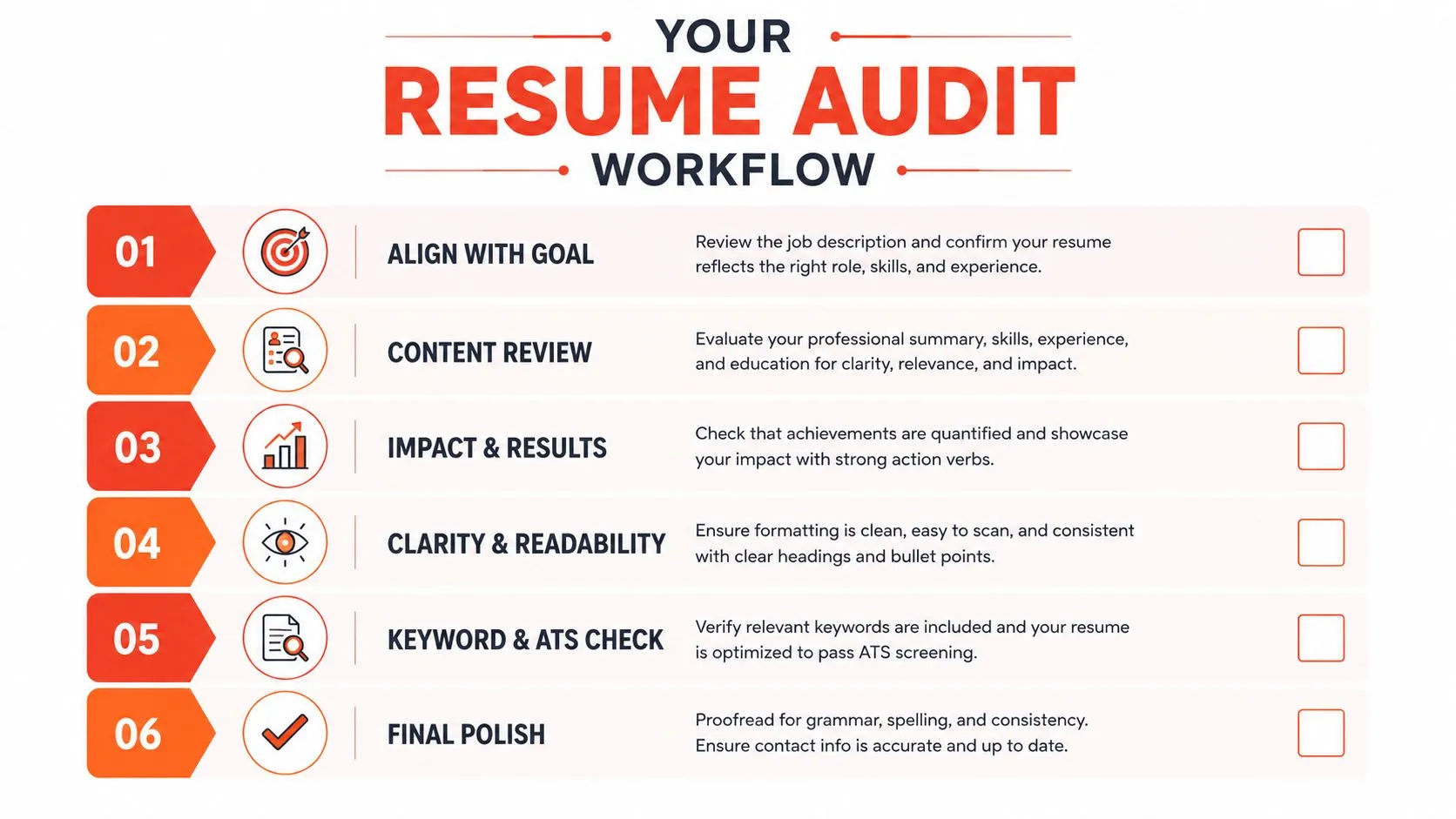
Run a readability check after the content is sound. Senior professionals should be ruthless with length. One hiring survey reported that 17% of hiring managers wouldn't look at candidates with two-page resumes, while another summary placed a commonly cited resume sweet spot around 475 to 600 words, as reported in resume length and format statistics.
A resume is not a scrapbook. It is a short argument for why your next move makes sense. StoryCV's guided interview helps uncover that argument before formatting hides its absence.
StoryCV is an online resume writer, not a template library. It asks structured questions about your context, achievements, and career direction, then turns the answers into clear, ATS-compatible writing. Start with one fully written role for free at StoryCV, and fix the missing story behind your resume red flags.