You can improve a resume in two ways. You can change the words, or you can change what it claims. One makes it read better. The other gets you interviews.
Most advice focuses on changing the words. Swap verbs. Tighten phrasing. Fix formatting. This is a wording-level edit. It's easy, fast, and feels like progress.
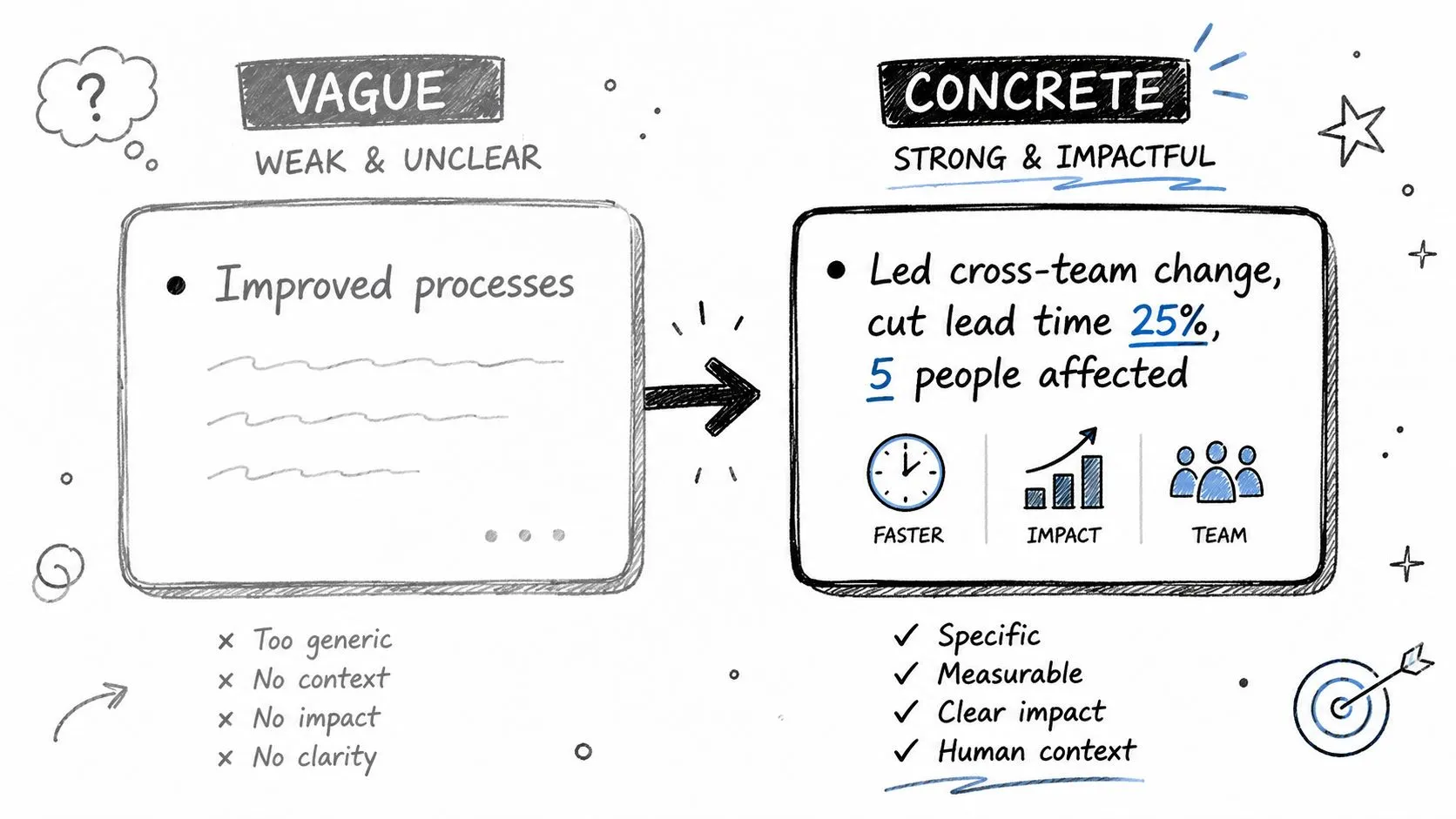
The second path is harder. It changes the substance of what you’re claiming. It forces you to name the actual decision you made and the specific result that followed. This is the work that actually changes outcomes.
Why Wording Edits Feel Good but Don't Work
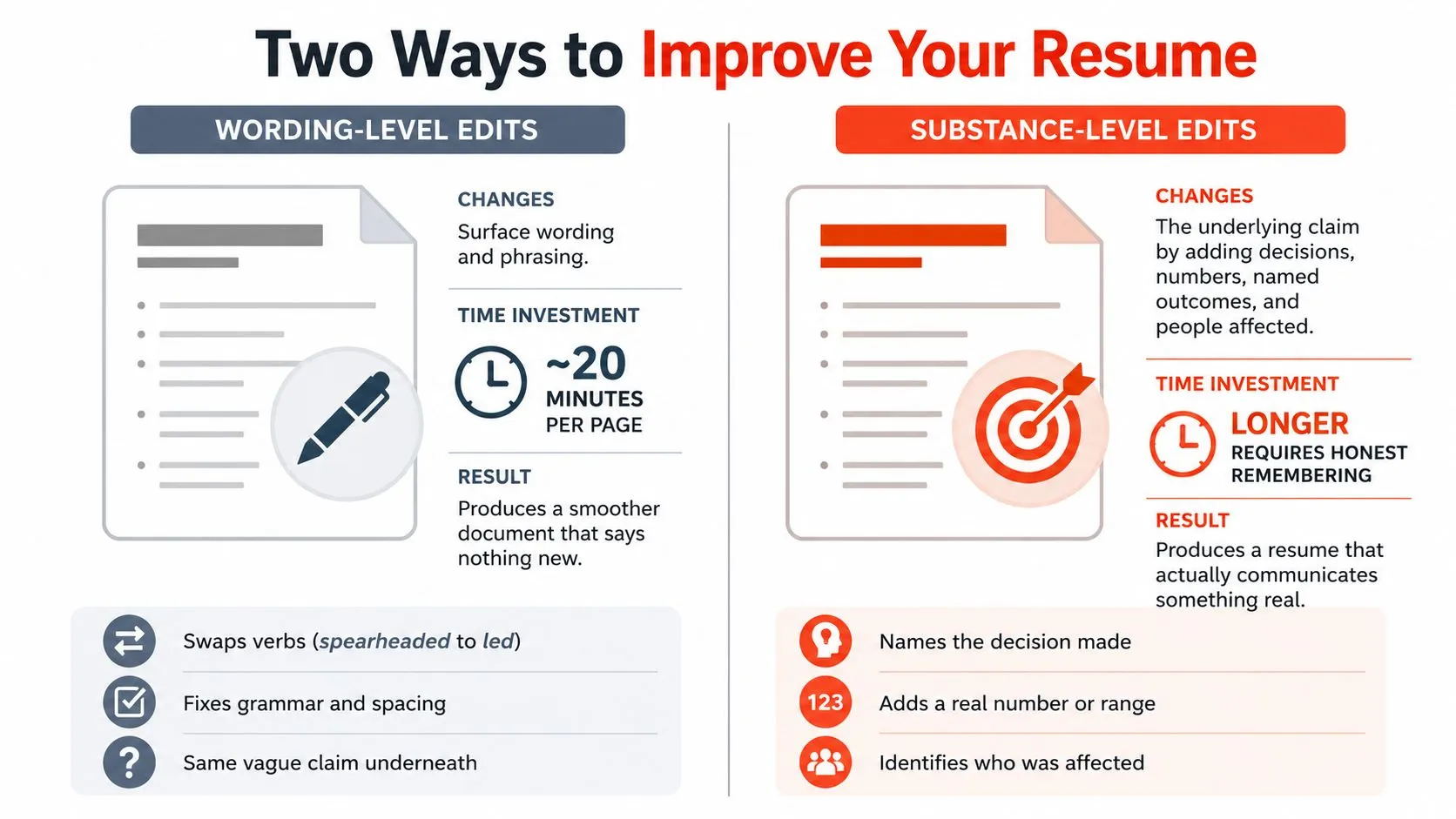
People default to wording edits because they're quick. Swap "managed" for "spearheaded," fix some spacing, and you're done. The resume feels cleaner. The problem is, the claim underneath each sentence hasn't changed. It's still vague.
Substance-level edits are slower. They require you to remember what actually happened. What decision did you make? What number can you point to? Who was affected by the work? This is uncomfortable, but it produces a resume that communicates something worth hiring.
Here's how the two approaches compare:
Wording-Level Edits vs. Substance-Level Edits
| Change Made | Time Required | Likely Impact |
|---|---|---|
| Swaps verbs and phrasing | ~20 minutes | Small readability gain |
| Fixes grammar and spacing | Minutes | Cleaner look, no hiring impact |
| Names a specific decision | 30–60 minutes per bullet | Shows ownership and clarity |
| Adds a real number or range | 10–30 minutes to find data | Provides tangible proof of impact |
Wording edits feel productive because they’re fast. Substance edits feel uncomfortable because they force you to remember specifics.
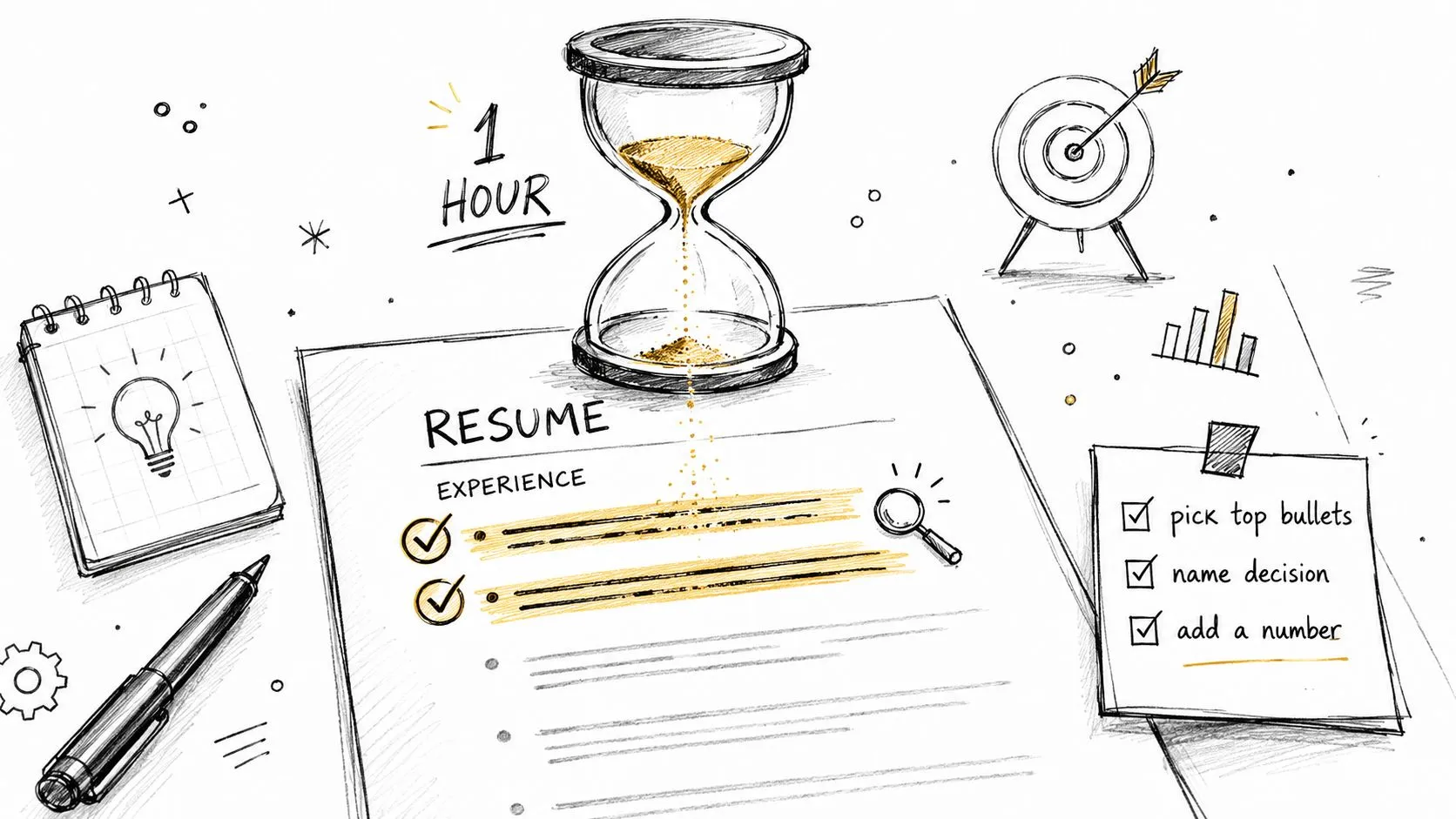
If you only have an hour, don't spread it thin across the whole document. Pick two bullets and rebuild them as decision-result stories. That focused hour does more than an afternoon of polishing vague sentences.
How to Spot the Difference in Your Own Resume
Most resume bullets aren't poorly written; they're poorly remembered. They list duties, not decisions. They name tools, not outcomes. That's why wording edits are so tempting—they tidy the surface while leaving the empty core intact.
The real fix is to change the claim itself. Don't ask, "How do I phrase this?" Ask, "What decision did I make, who did it affect, and what changed afterward?" That pivot turns a bland duty into a mini case study.
Quick wins are comforting. The slow wins get you interviews.
If you have an hour, spend it on substance. Pick two or three bullets high on page one. For each, list the decision, the constraint, and one measurable result. Rewrite the line to show that chain of events in plain language.
A quick checklist to find the substance:
- Identify a decision you made and why it mattered.
- Name the people, teams, or systems that were affected.
- Attach a number, a percentage, or a clear qualitative result.
A few rewritten bullets with real substance beat a resume full of shallowly polished lines.
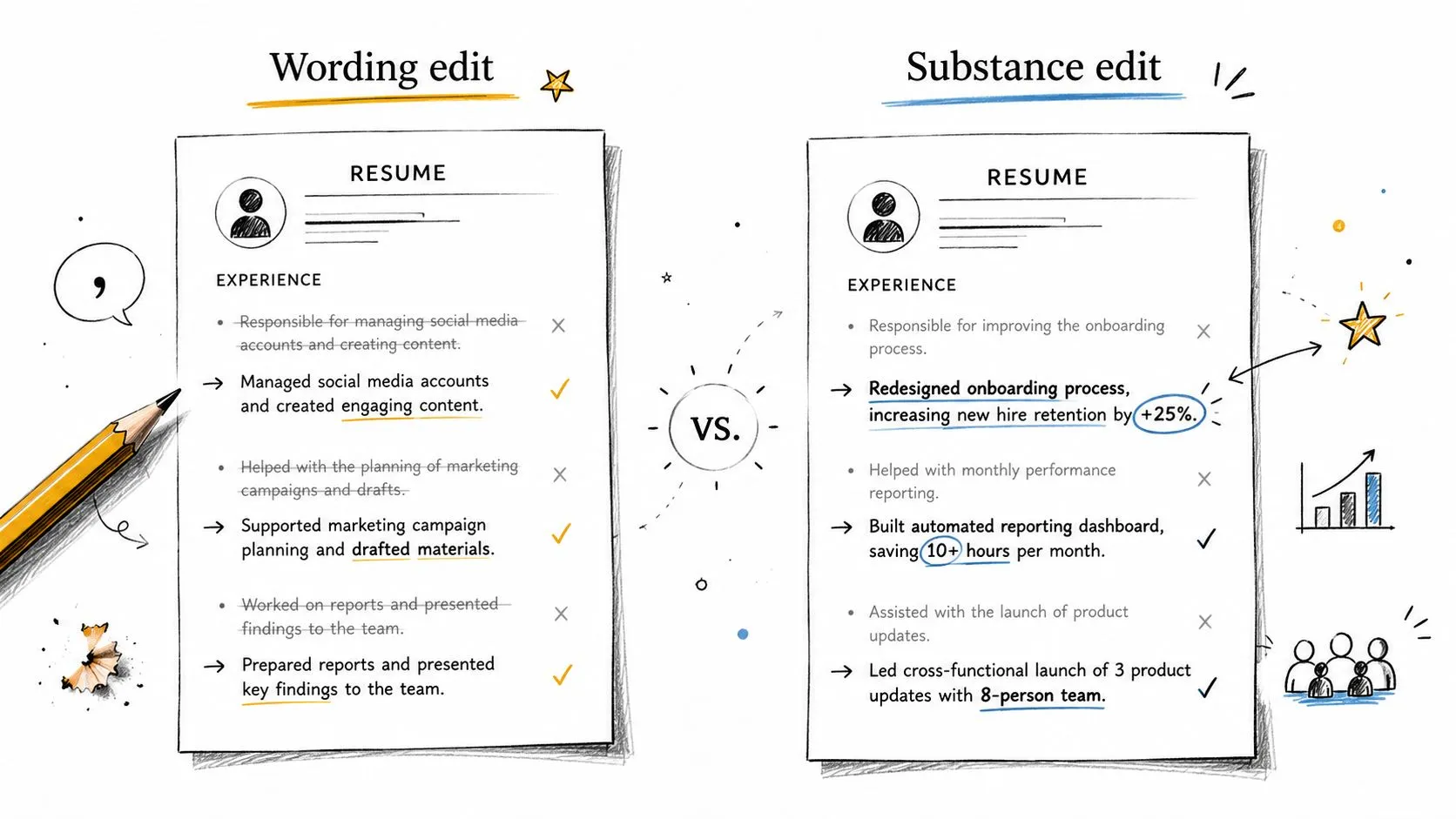
A Worked Example: Wording vs. Substance Edit
Take one flat, duty-style line. Watch two different edits pull it in opposite directions.
Original bullet:
* Managed vendor relationships and supported onboarding processes.
Wording edit:
* Spearheaded vendor relationships and streamlined onboarding processes.
It reads a little better. You swapped a verb and tightened the phrasing. A recruiter might scan it without flinching, but they still walk away knowing almost nothing about what you actually did.
Substance edit:
* Cut vendor onboarding from 21 to 9 days by choosing three preferred partners under a tight budget and negotiating new SLAs for the 12 partners used by sales.
Now you're talking. This version names a decision, a constraint, a measurable result, and the people who felt the difference. A recruiter can see the "so what" in ten seconds.
Why Substance Wins
Recruiters read for evidence, not adjectives. Wording edits polish the surface; substance edits tell a story with proof.
If a bullet can't answer "so what changed?" in one breath, it's only been polished, not improved.
How to Test Each Bullet
Read the line and ask three questions:
1. What decision did I make here?
2. What constraint or problem was I navigating?
3. What changed, and who felt it?
If the answer is fuzzy, rewrite it. Be specific.
Strong writing skills help your achievements land with more force. For general tips, see this guide on Functional Skills English writing tips. If you're struggling to frame your work, our guide on how to Write Resume Without Bragging can help.
Improving a resume isn't just making it sound better. It's changing what it claims happened.
Where to Spend Your First Hour
Forget tidying up language. Focus your hour where it matters. Pick two or three bullets near the top of page one. For each, ask: what decision did I make, what constraint mattered, and what changed afterward?
A Simple Sequence to Follow
- Choose two or three bullets that read like duties.
- Write one sentence answering what decision you made.
- Find one number or a clear, approximate range.
- Rewrite the bullet to lead with the decision and close with the result.
Depth on a few bullets beats a uniform coat of paint across all of them.
This works because recruiters want evidence, not adjectives. A decision, a constraint, and a result turn a vague duty into a believable contribution. Wording fixes take minutes; substance edits take honest remembering but are what actually move hiring outcomes.
Make Your Resume Easier to Read
Once your bullets have substance, a clean layout helps a recruiter find it. Use a single-column format, standard headings, and reverse-chronological order.
Put your most important metric high on page one, visible at a glance. Recent roles need specific, powerful bullets. Older roles? Compress them to a single line. Skip tables, text boxes, and multi-column layouts. They confuse resume scanners and frustrate anyone reading on a phone.
- Content first: Put your top metric in the first few lines of page one.
- Simple structure: Use a clear heading like "Experience."
- Compress the past: Reduce roles older than five years to one line each.
A good layout amplifies strong bullets. A fancy layout just hides weak ones.
Readability tricks that don't waste time:
- Lead with the outcome, then the action.
- Use bold to highlight one key number or result per role.
- Keep bullets to one or two lines for easy mobile scanning.
Layout is the final step. The substance in your bullets is the real meal.
What "Improving a Resume" Actually Means
Improving a resume isn’t a wording problem. It's a remembering problem. Real improvement changes the claim by swapping duties for decisions and outcomes.
If you’ve got one hour, spend it on two bullets at the top of page one. For each, answer:
1. What decision did I make?
2. What constraint did I face?
3. What changed, and who benefited?
Rewrite the line to show that story. You can learn more about framing these stories in our guide on How to Write Impact Statements.
To improve your resume, don't just edit the sentences. Restore the memory of what you actually did.
FAQ
What's the difference between improving a resume's wording and improving its substance?
Wording-level improvement is tightening sentences, swapping verbs, and fixing formatting. It makes the resume read more smoothly without changing what it’s actually claiming. Substance-level improvement changes what the bullet says happened, which is the harder, more effective kind of edit.
Why do most people default to wording-level fixes when trying to improve their resume?
Because it's easier and faster. You can rewrite a sentence in two minutes, but figuring out what decision or result actually belongs in that sentence takes real reflection. Wording fixes feel like progress without requiring the harder work.
If I only have an hour to improve my resume, where should that hour go?
Into picking two or three bullets that currently describe duties and rewriting them to name an actual decision and result. That's a bigger improvement than an hour spent polishing every line's wording. Depth on a few bullets beats a uniform coat of paint across all of them.
Does ATS optimization matter if my bullets are already strong?
Yes, but get the order right. Strong bullets win the human review. ATS optimization ensures a human sees them. Write your bullets with substance first. Then, weave in a few keywords from the job description so your resume lands in the right hands.
Improving a resume means changing what it claims happened, not just how it sounds.
Change what your resume claims with StoryCV. Get editorial judgment at software speed. https://story.cv