“Quantify your impact” is incomplete advice for a customer success manager resume. If sales owned the renewal and you owned onboarding, claiming retained revenue makes your resume less credible, not stronger.
The better standard is evidence you can defend. Show which customers you served, what you changed, what improved, and how much of that result was yours.
Metrics a Customer Success Manager Resume Needs
A CSM resume with duties and no numbers reads like a job posting, not a candidate. Start by choosing the measures that describe your actual work.
Customer outcome metrics, reference values and ownership
| Metric | What it measures | Reference value | Ownership to state |
|---|---|---|---|
| Gross revenue retention (GRR) | Revenue kept from existing customers, excluding expansion | Median 91% for private B2B SaaS, SaaS Capital 2025 | Shared if the book is pooled |
| Net revenue retention (NRR) | Revenue kept plus expansion from the same customers | Median 101% for private B2B SaaS, SaaS Capital 2025 | Direct owner only if you held expansion targets |
| Product adoption | Active users or feature use against purchased seats | Your cohort's starting usage and adoption target | Direct or influence |
| Time-to-value | Days from signature to first measurable customer outcome | Starting elapsed time against the agreed value milestone | Direct or contributor |
| Onboarding completion | Share of accounts finishing setup by an agreed date | Completion rate against the agreed deadline | Direct |
| Customer health score | Composite risk signal used to prioritize accounts | Your company's model, inputs, and risk thresholds | Contributor, or direct if you set the inputs |
| Net Promoter Score (NPS) | Customer willingness to recommend, tracked over time | Previous survey wave using the same cadence and audience | Contributor |
| Churn reduction | Lost accounts or revenue compared with a stated baseline | Prior-period account or revenue churn | Direct or shared |
The Job Explorer's customer success manager description identifies retention, expansion revenue, satisfaction, adoption, usage patterns, and health scores as relevant measures. That doesn't mean every measure belongs on your resume.
Define the number before you use it
GRR and NRR answer different questions. Expansion can lift NRR while lost customers weaken GRR. Name the segment and reporting year so a hiring manager can interpret the result.
Adoption needs a denominator. Activated seats, weekly active users, and use of a critical feature aren't interchangeable. Time-to-value needs an actual customer outcome, not merely a completed kickoff call.
Health scores and NPS need extra care. State the health model or survey cadence rather than presenting a bare number. For churn, distinguish lost accounts from lost revenue and give the starting baseline.
Selection rule: Keep the four or five metrics you can define and defend for 60 seconds. Drop the rest.
Use this guide to metrics in a resume to identify measurable evidence beyond revenue.
A usable bullet starts like this:
- Retention evidence: Held GRR at [X]% across a [$Y]M book, [cohort year], against a starting baseline of [Z]%.
The definition, period, and baseline travel with the number. Without them, the reader has a percentage but little reason to trust your interpretation.
Claiming Impact When You Did Not Own the Revenue
You don't need revenue ownership to be a credible CSM candidate. You need an accurate account of what changed because of your work.
SimpleApply's customer success role analysis describes requirements spanning customer success, account management, analytics, and stakeholder management. A revenue-only resume leaves useful implementation, technical, and pooled-service work unexplained.
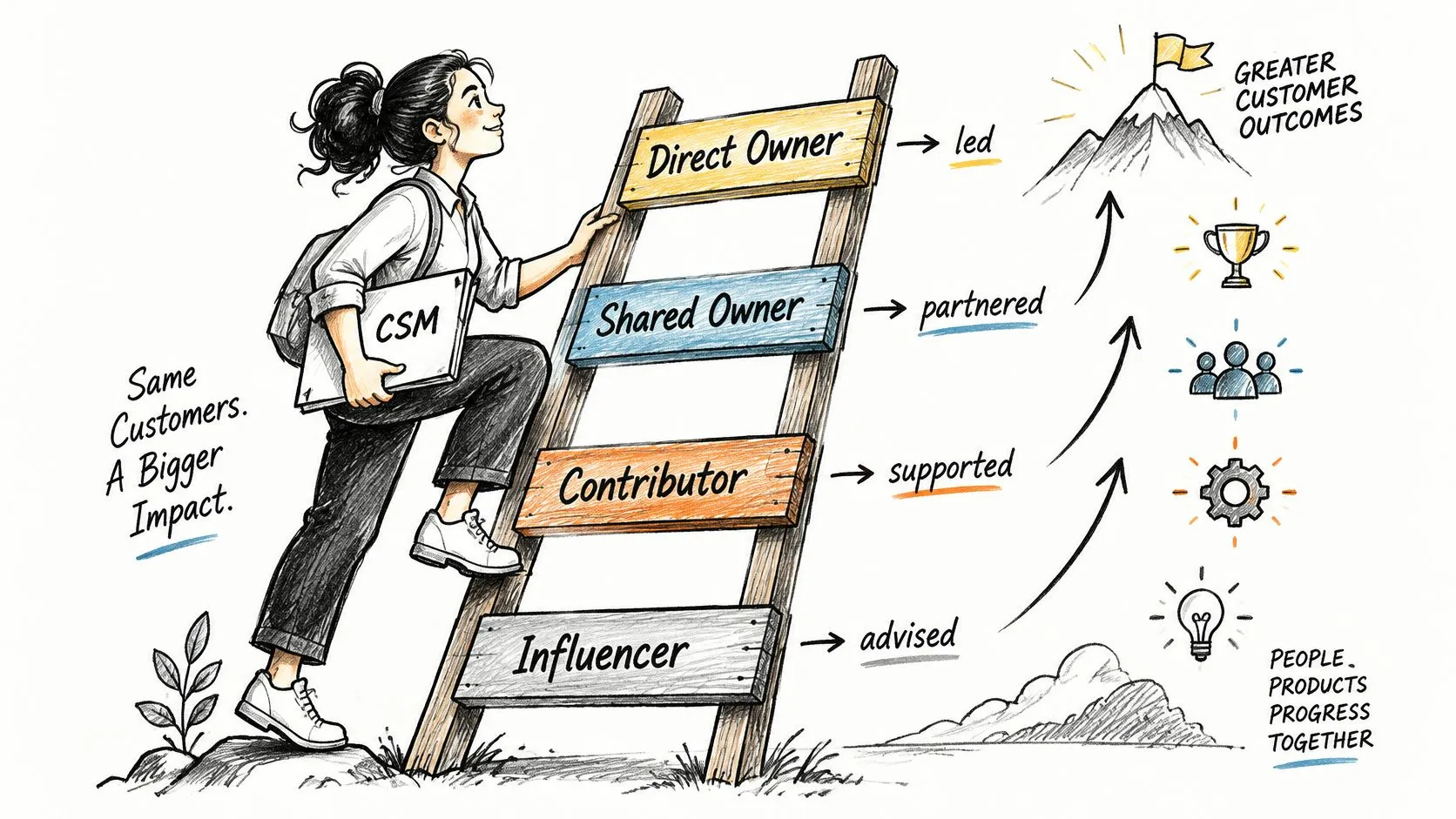
Ownership levels and the verbs that fit them
| Ownership level | Verbs that fit | Example bullet |
|---|---|---|
| Direct owner | Grew, protected, drove | Protected [X]% GRR on a [$Y]M book in [year] |
| Shared owner | Co-led, supported, contributed to | Co-led a renewal plan covering [$Y]M with the account team |
| Contributor | Reduced, improved, lowered | Reduced time-to-value from [X] to [Y] days across [N] onboarding accounts |
| Influencer | Surfaced, flagged, escalated | Surfaced renewal risk used by account teams in [N] renewal reviews |
Direct ownership requires both the target and the result to be yours. Attending renewal calls doesn't earn “drove renewals.” Equally, “helped customers” undersells someone who redesigned the implementation process.
Before-and-after examples without borrowed revenue
These are writing patterns, not achievements to copy. Replace every bracket with evidence from your own work.
- Implementation specialist: Replace ran onboarding for new accounts with reduced time-to-value across [N] onboarding accounts from [X] to [Y] days by replacing [handoff process] with [intervention].
- Support lead: Replace handled escalations with lowered team escalation volume from [X] to [Y] per [period] by introducing [triage change], working with [team].
- Onboarding manager: Replace managed customer setup with improved onboarding completion by the agreed date from [X]% to [Y]% across [N] accounts during [period].
- Pooled CSM: Replace supported customer renewals with surfaced renewal risk used by account teams in [N] renewal reviews through [usage analysis or risk review].
For a technical role, name the blocker you removed: integration failures, missing configuration, or delayed data access. That's more useful than attaching yourself to a renewal you couldn't control.
Outside SaaS, choose the outcome the business tracks. Repeat orders, service uptake, or case resolution may describe your contribution better than NRR. Don't force subscription vocabulary onto a different business model.
Could you name the other people who moved the number, and would they agree with your share?
If the answer is uncomfortable, change the attribution. A narrower, accurate claim is stronger than a larger claim you have to retreat from in an interview.
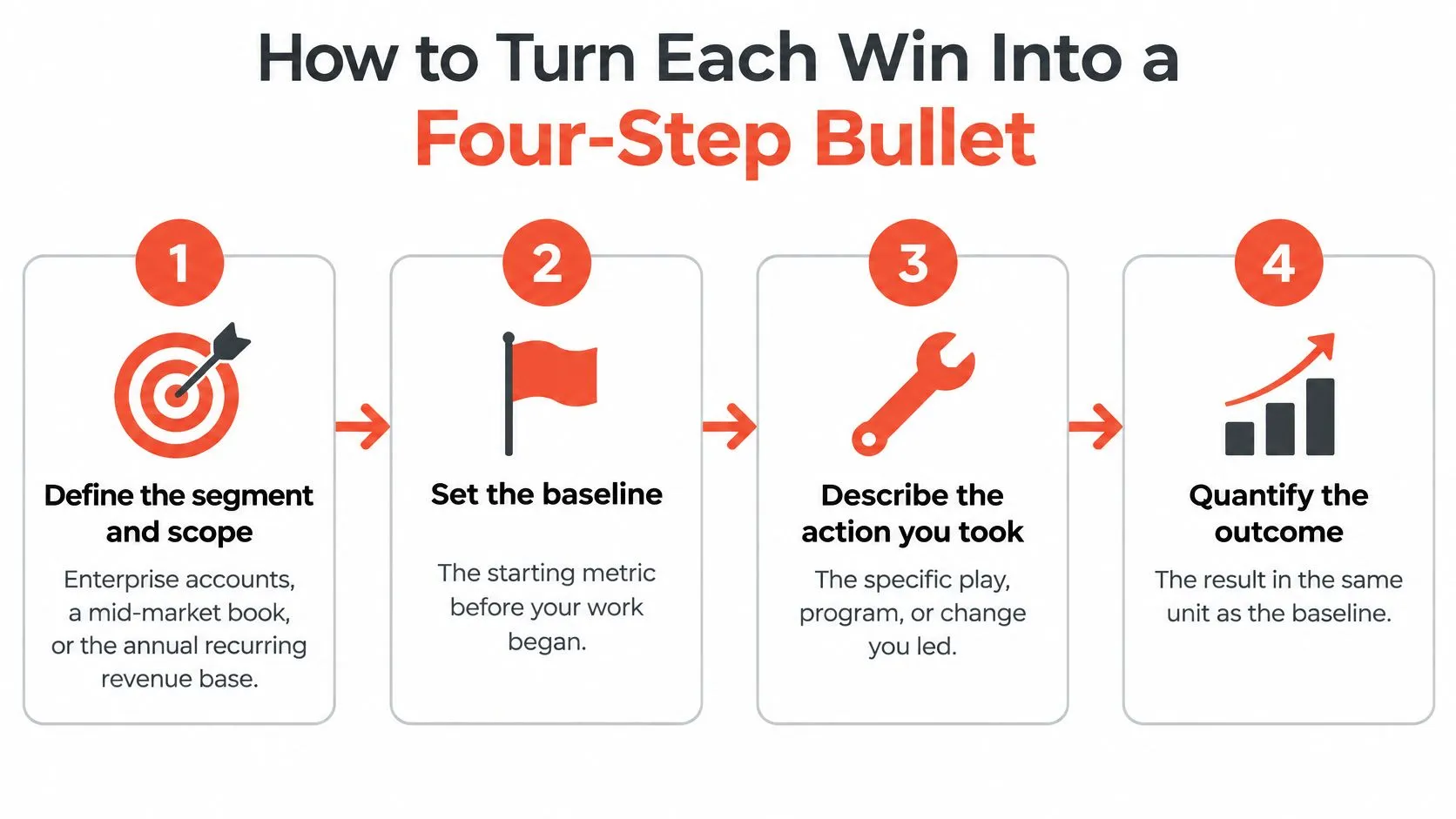
How to Turn Each Win Into a Four-Step Bullet
A strong achievement shows a chain of evidence, not just an impressive endpoint. Write the underlying facts before compressing them into resume language.
- Define the segment and scope. Name the enterprise accounts, mid-market portfolio, or annual recurring revenue base you served. “Managed enterprise customers” gives a segment but no indication of scale or complexity.
- Name the intervention. Specify the onboarding redesign, health-score prioritization, executive business review program, or adoption campaign. Avoid describing a team initiative as your personal creation if you only delivered part of it.
- Quantify the operational outcome. Show what changed in time-to-value, adoption, customer satisfaction, or renewal rate. A result without a baseline or reporting period leaves the reader guessing.
- Connect the commercial impact. Add GRR, NRR, churn reduction, or expansion when you can establish the connection. If your work supported the account team, say so rather than implying sole causation.
Compare a duty with a defensible result
| Weak line | Stronger illustrative line |
|---|---|
| Managed renewals and drove expansion | Improved NRR from 98% to 108% across a $4.2M mid-market book in 12 months |
The stronger line is an illustrative example from Weld's customer success metrics guide, which also reports SaaS Capital's 2025 median annual GRR of 91% and median NRR of 101% across more than 1,000 private B2B SaaS companies. Those benchmarks provide context, not a personal performance target.
The example still needs the intervention to explain how the candidate achieved the result. Add the specific action if the sentence remains readable, or use the next bullet to explain the program.
Swap in your own figures. Be ready to explain the opening revenue cohort, treatment of expansion, and reporting window. A precise-looking percentage isn't proof if you can't explain how it was calculated.
When you don't have usable numbers
Missing records aren't permission to estimate. An NDA also isn't permission to disclose a rounded version of confidential revenue.
Write the scope and direction you can substantiate instead:
- Operational improvement: Redesigned implementation handoffs for [segment], reducing repeat escalations between support and onboarding.
- Customer progress: Introduced milestone reviews that helped more accounts finish setup by the agreed date.
These statements are less numerically detailed, but they still identify an action and outcome. Confirm the before-and-after with your records or a former manager before adding a percentage.
Every number must come from your own work. In our writing process, every number in the resume bullet points comes from the user's own answers.
The Line Above Your First Bullet
Write the headline and summary last. They should come from your two strongest evidence rows, not from a separate exercise in sounding senior.
Use a headline strip for title and scope, then supporting lines for the protected outcome and the intervention you're known for.
Replace personality with evidence
| Hollow version | Evidence-led version |
|---|---|
| Customer Success Manager with [N] years of experience and strong communication skills | Customer Success Manager | [$X]M ARR book | enterprise and mid-market |
| Customer-focused professional passionate about building relationships | Held GRR at [X]% across [N] accounts in [year]. |
| Seeking an opportunity to make an impact | Rebuilt onboarding to cut time-to-value from [X] to [Y] days. |
The first version asks the reader to accept your assessment. The second gives them something to evaluate.
Keep the summary to three lines maximum. If your strongest evidence is adoption rather than retention, use adoption. Don't promote a weaker commercial metric merely because it sounds more senior.
For more ways to compress evidence, use these professional summary examples for a resume. If you're also adapting the same story for a professional profile, EmailScout's LinkedIn About Me examples offer a separate format to consider, not text to paste unchanged.
Every summary claim should reappear as proof further down the page.
Skip the objective statement and “seeking a role where I can grow.” The reader needs your level, scope, and relevant contribution before they need your aspirations.
Skills and Tools a Customer Success Manager Resume Has to Prove
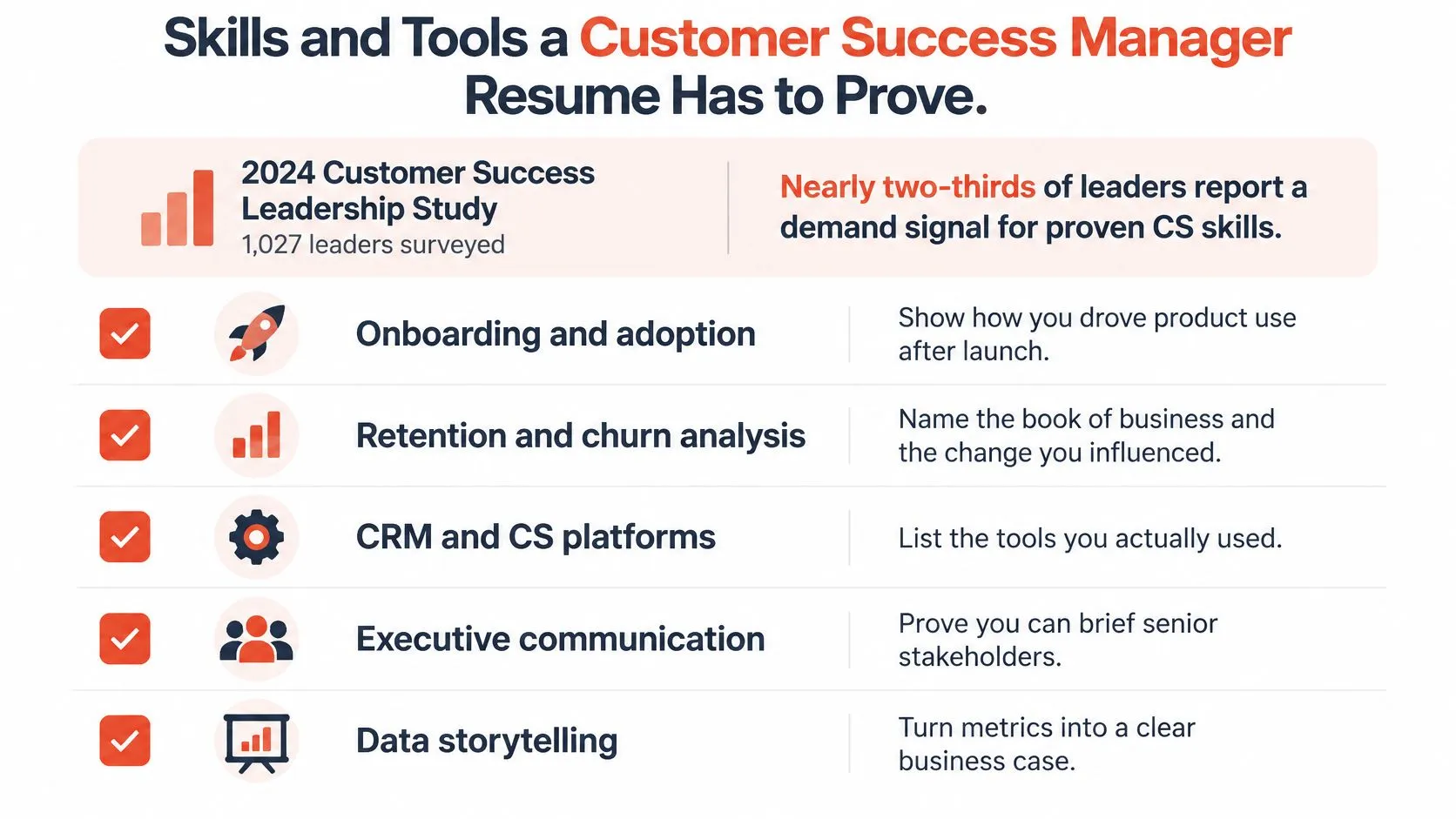
Skills are a summary, not an argument. “Analytical” matters only when you show the analysis and the decision it informed.
The 2024 Customer Success Leadership Study, based on responses from 1,027 customer-success leaders, reported that nearly two-thirds of CSMs selected hard business skills as the area where additional training would most improve effectiveness: analytical skills at 24%, business and strategic skills at 23%, and commercial skills at 17%.
Don't respond by adding those labels to a skills list. Show their application.
Pair each competency with proof
The Customer Success Association competency standard identifies six categories: communication, research, project and time management, data management, account management, and professional development. Translate them into evidence:
- Communication: Agreed customer goals, timing, and success measures with executive sponsors.
- Research: Investigated the customer's operating model before recommending an adoption plan.
- Project and time management: Coordinated a launch across product, support, and the customer's implementation team.
- Data management: Analyzed account usage for a quarterly business review and checked the underlying definitions.
- Account management: Built a success plan with named stakeholders, milestones, and risks.
- Professional development: Applied new product or analytical knowledge to improve an existing customer workflow.
Internal advocacy deserves the same specificity. Indeed's description of customer success work includes gathering customer feedback, analyzing it, and sharing findings across departments.
Replace collaborated cross-functionally with the actual handoff: synthesized integration feedback for product, agreed a workaround with support, and updated the customer's implementation plan. Name the change, not just the meeting.
Tools need an honest claim level
Jobs Every Hour's customer success role guide includes CRM, analytics, and AI-related capabilities. Their value on your resume comes from the business action, not the length of the software list.
Tools and AI skills by honest claim level
| Tool or skill | Level to claim | Business action to show |
|---|---|---|
| Salesforce | Working proficiency | Health data used to prioritize renewal risk |
| SQL | Exposure or working proficiency | Usage query that shaped an adoption plan |
| Usage dashboards | Working proficiency | Dashboard built for an executive business review |
| Predictive analytics | Exposure | Risk flags reviewed with the data team |
| Generative AI | Exposure | Call summaries written with customer data kept out of public tools |
Exposure means you worked with the output or assisted someone else. Working proficiency means you can perform the task independently. Claim ownership only when you designed or maintained the workflow.
If an analyst wrote the SQL, don't claim you built the query. Explain how you interpreted the results and changed the adoption plan. For AI-assisted summaries, identify your review process and use only approved systems with permitted data.
A traditional CSM title doesn't prevent you from demonstrating analytical judgment. Your resume skills section should make that judgment easy to find, with every row ready for an interview follow-up.
Rewrite One Role Before Your Next Application
Don't rebuild the whole resume first. Choose the role containing your strongest defensible outcome and rewrite its opening bullet.
Label your ownership before choosing the verb. Then follow this order:
- List the outcome you can defend. Start with what changed for customers or the business, not the tasks you performed.
- Confirm the definition and baseline. Check your records or ask a former manager to validate the measurement. Separate what you know from what you remember approximately.
- Write the evidence chain. Include the segment, intervention, result, and commercial connection where you can support it.
- Read it aloud to someone unfamiliar with your work. Ask what they'd question. Missing context becomes easier to spot when the listener doesn't already understand your accounts.
Use the questions to find the story
If the sentence still sounds generic, don't search for a stronger adjective. Ask what was broken, what decision you made, who else contributed, and what the customer could do afterward.
StoryCV interviews you about your work, asks the follow-up questions you wouldn't ask yourself, and turns your answers into clear resume bullet points. We ask targeted questions about your industry, role, and accomplishments so the draft reflects your experience rather than a generic CSM description.
You can complete the first role free. A monthly plan includes more roles. Every number in the bullet points comes from your own answers, so the draft starts with facts you can explain.
The useful first step isn't a polished document. It's a truthful account of one meaningful result, written clearly enough that someone else understands its value.
You're not under-qualified. You're under-described.
Bring the role with your strongest customer outcome to StoryCV. Start with a free role interview and turn your account scope, decisions, and results into customer success manager resume bullets you can defend.