The most copied advice is to retitle babysitting as childcare, drop it under Work Experience, and list six duties plus a parent's phone number. That advice inflates some arrangements and shrinks others. A resume line is a claim a stranger can check. Paid, recurring care with set duties earns a job entry. Three Saturday nights do not become a career, and a private household is not a daycare brand you never worked for.
How to put babysitting on a resume is two decisions. First, match the section to how the work ran. Second, prove scope with ages, schedule, and decisions, and leave the family's private life off the page.
Where Babysitting Belongs on the Resume
Babysitting is accountable care. It earns a resume line when it was recurring, paid, or the clearest proof of a skill the posting names. It does not earn a line because childcare sounds softer than "watched kids," and it does not lose a line because the employer was a household.
The placement rule is simple. Recurring paid work with set duties goes under Work Experience. Occasional paid bookings go under Additional Experience or Independent Work. Unpaid help for relatives goes under Volunteer Experience only when the duties were real. Social prestige does not decide the section. Regularity, payment, accountability, and relevance do.
Practical rule: If you were paid on a repeating schedule and someone could describe your duties without you in the room, it is Work Experience. If you cannot name the schedule, it is not.
Use the title Babysitter or Childcare Provider. The employer line is Private Household or Independent Clients, plus the city. Never borrow a center's name. If the hours were closer to a set in-home role than to evening coverage, the nanny versus babysitter guide from Superstar Nannies is worth ten minutes before you pick the title. A nanny arrangement and occasional sitting are different jobs, and the wrong title is the first thing a reader notices.
Each entry needs dates, weekly hours or the recurring pattern, the number of children, and the age range. For 2026, the Social Security Administration treats babysitters as household workers and says that paying at least $3,000 in wages to one household worker generally means Social Security and Medicare taxes. That is a reason to call the work paid household employment rather than freelance. Leave the tax figures, the wage base, and your rate off the page.
Where the line goes
| Arrangement | Resume section | Employer line | Include |
|---|---|---|---|
| Recurring paid care with set duties | Work Experience | Private Household, city | Dates, weekly hours, number of children, ages |
| Occasional paid bookings | Additional Experience | Independent Clients, city | How often, span of months, typical scope |
| Unpaid help with real duties | Volunteer Experience | Family name omitted, city only | Duties and frequency, no invented pay |
| Career change where the skill matches the job | Work Experience, two bullets | Private Household or Independent Clients | Only the duties that match the posting |
| Years of professional work, unrelated target | Omit, or one line under Additional Experience | Same honest label if kept | Only if it fills a gap or proves one requirement |
Do not list every childcare task you have ever done. Pick the evidence that matches the vacancy. Operations postings want scheduling, logistics, and a backup plan. Customer-facing roles want communication and trust. Education and healthcare-adjacent roles want observation, safeguarding, and adjusting to two different children in one room. Adobe's 2025 analysis found that, globally, defining talent pools by overlapping skills could expand eligible candidates by a median 6.1 times, and the same skills-based hiring picture includes 46% of surveyed employers planning to increase skills-based hiring and 43% placing more weight on work experience, internships, or apprenticeships. Overlapping skills are not a license to call household care the target profession.
When the line should come off
Someone with years of professional roles keeps babysitting only to fill a gap or prove one requirement, and stops at one short entry. If the posting never mentions scheduling, care, communication, or responsibility for other people, the line is noise. A first resume is different. With no office job to lead, this entry can sit in Experience, which is the same judgment behind a student resume with no work experience. Still group the families. One entry, one city, one span of dates. A stack of surnames reads like a contact list, not a job.
How to Write the Babysitting Entry
Write the entry as context, action, and result, not as a personality sketch. The Santa Clara University career center recommends scope, a specific action, and a quantified result you can verify, and it tells you not to invent percentages or safety claims. We use the same test on any role: what you owned, what you changed, and what happened next.
The six moves below are the whole method. The graphic is the short version.
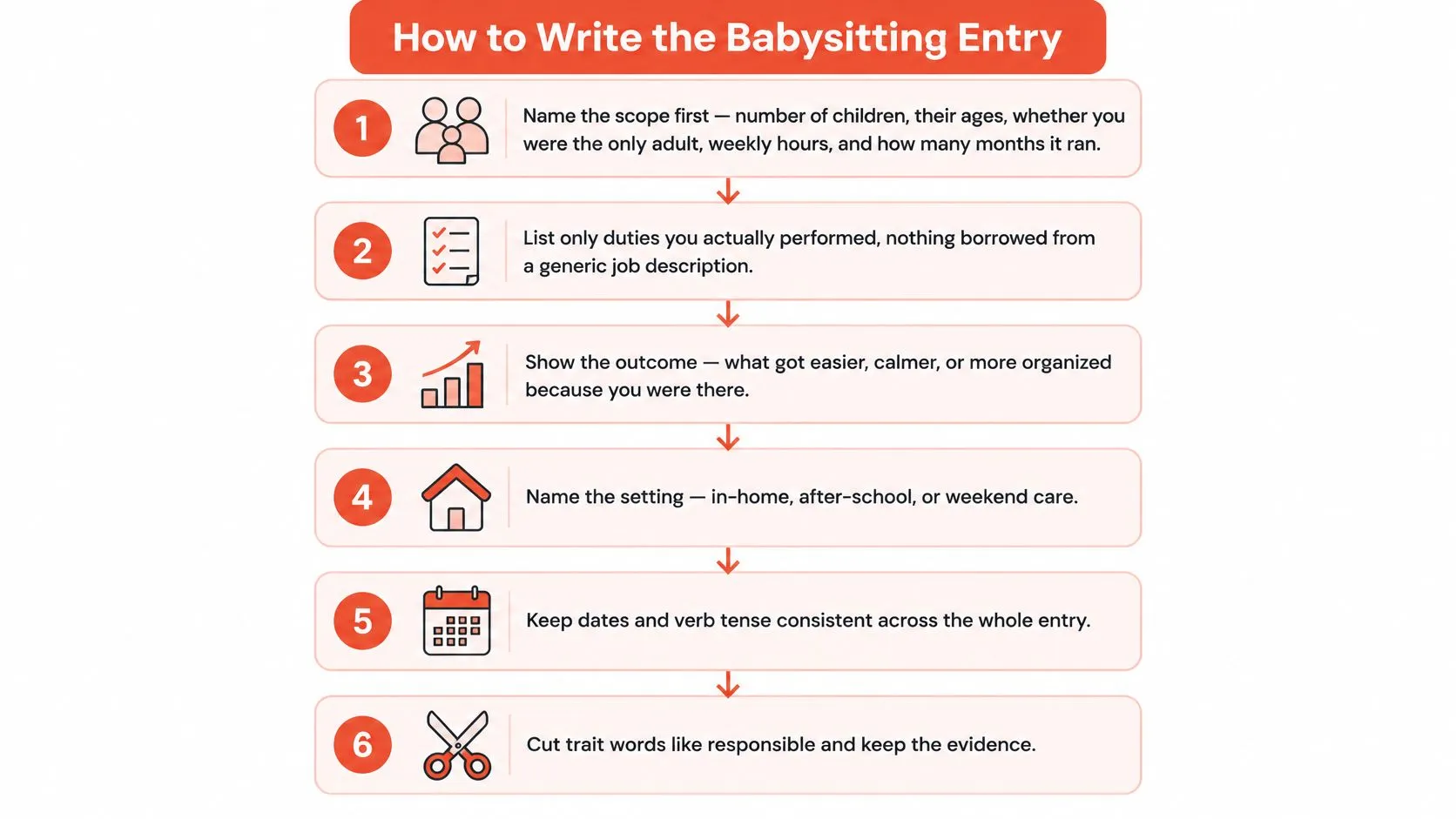
- Name the scope before any trait. Number of children, ages, whether you were the only adult, weekly hours, and how many months it ran. Skipping this is how "great with kids" gets onto the page with nothing behind it.
- List only duties you performed. Supervising safety, preparing meals, keeping rest and play routines, helping with homework, handling transport, updating parents, and recording meals or medication belong only if they were your job. Borrowing a generic childcare list is the mistake this step prevents.
- Keep two or three duties that match the posting. Drop the rest. A six-line inventory makes every task look equally important, which means none of them look chosen.
- Write each bullet as context, action, and result. Context is ages and schedule. The action is a verb someone could have seen. The result is something you can defend: routines kept on time, homework finished before pickup, or the same family booking you again. "Incident-free" is not a result unless you are prepared to define the incidents you mean, so leave it out.
- Quantify with counts you can check. Hours a week, number of children, weeknights, months. A made-up improvement percentage fails the moment anyone asks how you measured it.
- Add CPR or first aid only when the card is current. An expired class is not a certification. Listing it is how a true safety habit turns into a false one.
One finished bullet
Managed after-school care for three children ages 5 to 10, running snacks, homework, and bedtime across four weekday shifts a week for 18 months.
That line already holds scope, action, and a span you can point to on a calendar. For an operations role, the same facts stress the four shifts and the order of snacks, homework, and bedtime. For customer-facing work, swap in the parent update. For education, swap in how you handled homework with two different ages in one room. Tailor the facts. Do not retitle the job into the profession you want.
One entry with scope beats a list of every Tuesday.
If you remember the mess of a weeknight more clearly than the outcome, stay with what you can still point to. A rebooking, a routine that held, homework done before a parent walked in. Those are results. A mood is not.
Bullets That Fit the Job You Want
Keep the same entry. Change the evidence, not the job title. Babysitter or Childcare Provider stays. The bullets change because the posting is asking a different question.
In a National Association of Colleges and Employers study of 606 employer members, 96.3% rated critical thinking and problem-solving as important in the workplace, 91.6% valued oral and written communication, and 90.0% valued teamwork and collaboration. Name the competency by showing the task. Do not paste the adjective onto the line.
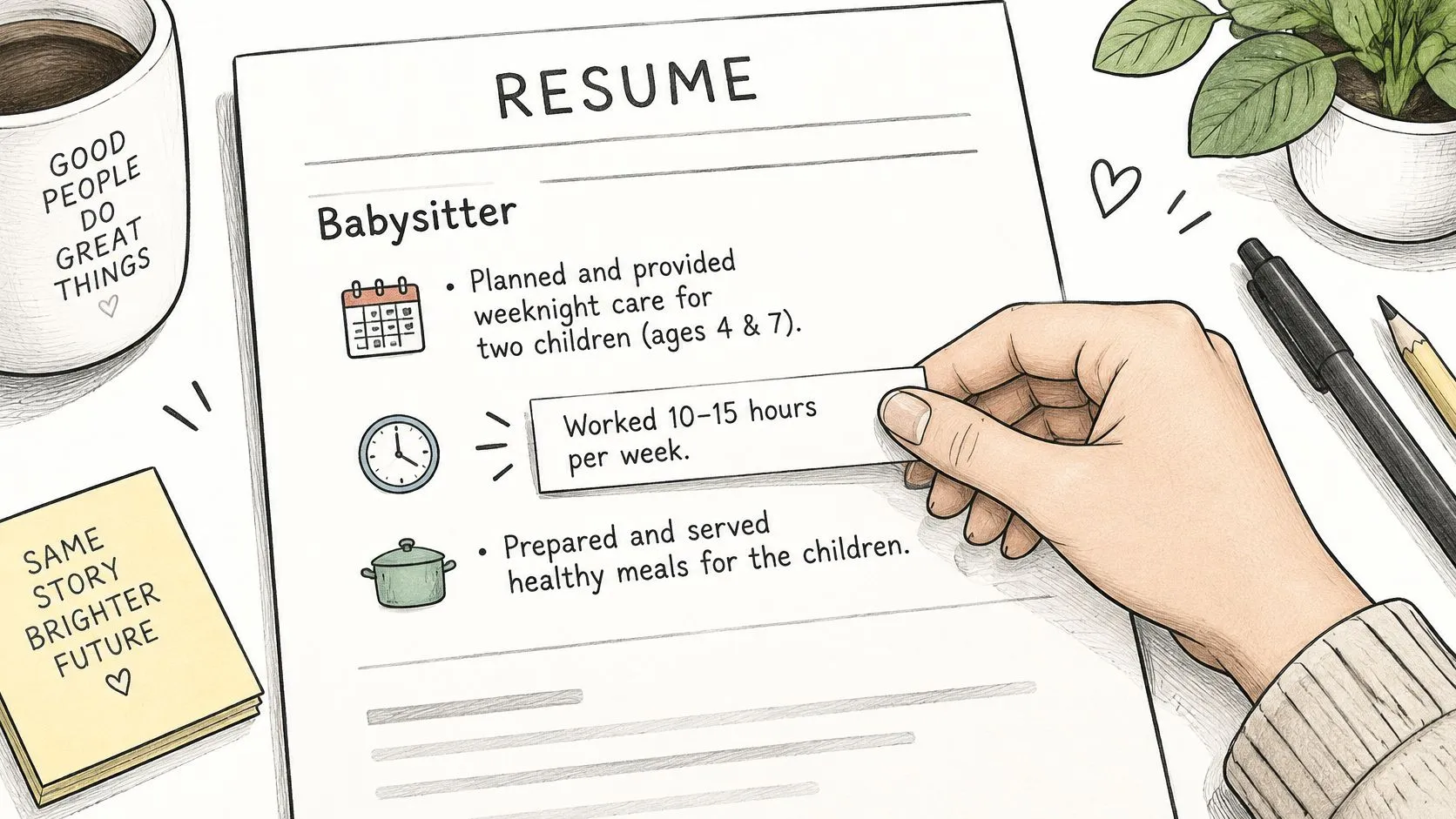
Operations
Planned weeknight care for two children ages 4 and 7, covering meals, pickup, and a backup plan when a parent ran late, across 10 hours a week for a year.
Operations gets this line because the job is sequencing and a contingency, not warmth. The late parent is the decision. The year and the 10 hours are the scope.
Customer-facing work
Sent a short end-of-evening update to parents on meals, behavior, and anything that needed a decision, and kept the same two families for 14 months.
Customer-facing work gets the update habit and the rebooking. Trust here is repeat business you can describe, not the word "trust." Teamwork, if you coordinated with another adult, belongs in a second line only when that coordination was real.
Education or healthcare-adjacent roles
Adjusted activities for a 5-year-old and a 9-year-old in the same room, watched for fatigue or conflict, and kept the bedtime routine the parents had set.
These roles get observation and an individual adjustment. You are showing that you noticed two different needs and held someone else's standard. That is closer to a camp or classroom skill than to a generic "patient" claim, which is why a resume for a camp counselor should be built the same way: duties you ran, not traits you like.
A first resume can lead with this entry plus a short skills list tied to those same facts. Scheduling, parent updates, age-specific activities. A career changer or someone returning to work uses two bullets and stops. An experienced resume uses the work only when a requirement is otherwise unproved. Two households and a year of weeknights can show reliability. They cannot show that you ran a clinic, a classroom, or a program.
Scope You Can Prove and Details You Omit
Put the work in numbers before you write the bullet. Count the children, the hours, the weeknights, the ages, and the repeated duties. Name the routines you ran and the decisions you made. Add only the details you can defend in an interview. If you cannot pin it down, leave it out.
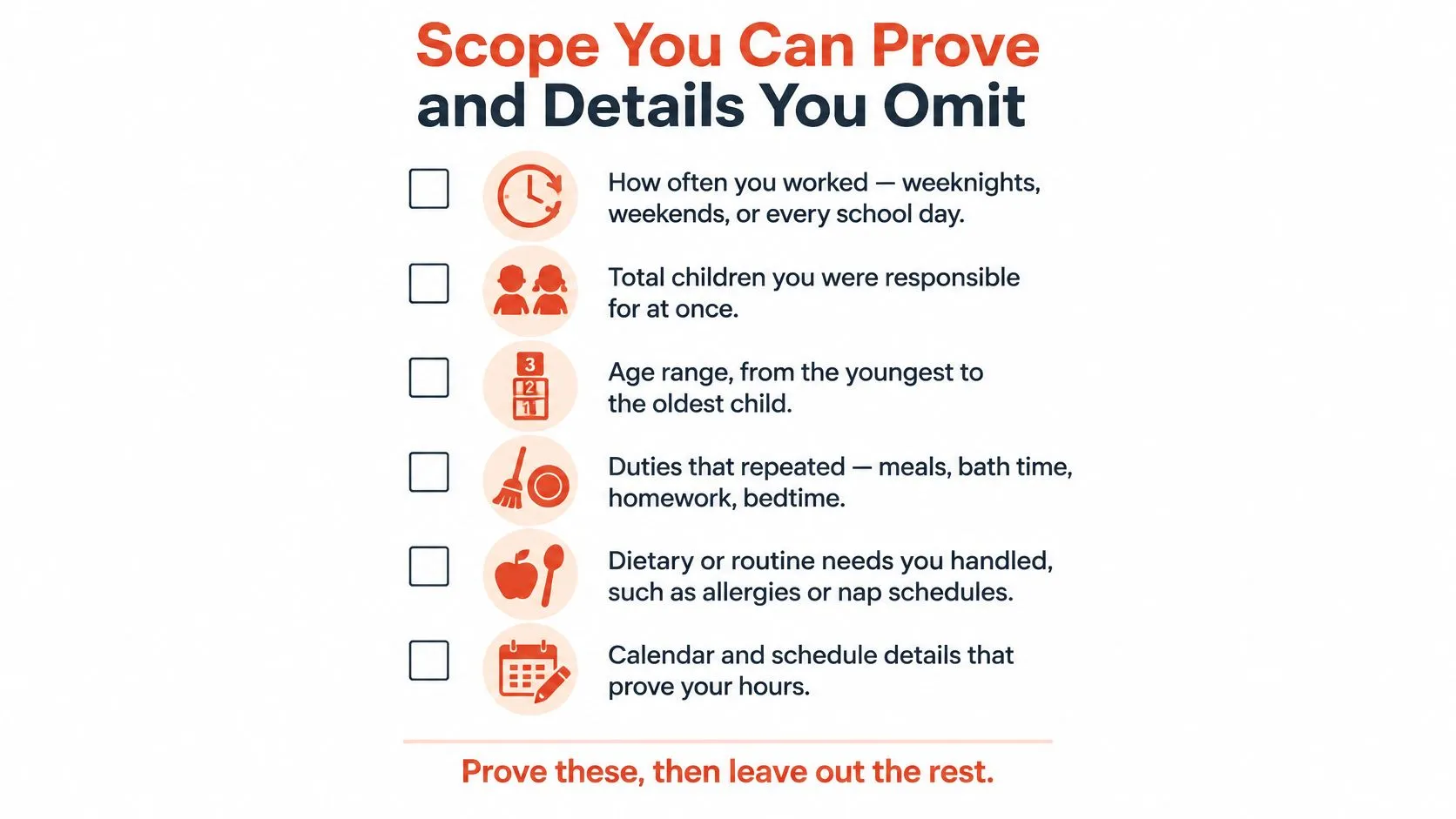
Scope belongs on the resume. Identity does not. Safe details include approximate ages, weekly hours, city, and duties you handled. Leave off children's names, schools, addresses, medical diagnoses, message screenshots, and private family comments. A result is usable when it has a boundary: a schedule you kept, a routine that held, a family that rebooked you, or a current certification. Paraphrase feedback without a quote that identifies a child. Do not claim incident-free care, a percentage improvement, or special-needs expertise unless that is exactly what happened and you can explain it without exposing private details.
A plain scope line beats a glowing adjective. The University of Oregon career center maps childcare to communication, critical thinking, and career self-development. It does that by naming the work instead of using one blob of "helped with kids." That is the right standard here. Write the hours, ages, duties, and outcome. Skip the personality claim. The same keep-or-cut judgment applies when you describe caregiver duties on a resume: observable work, not a private record.
Keep or cut
| Detail | Put on the resume | Leave off |
|---|---|---|
| Who was cared for | Number of children and age range | Names, school, address, photos |
| When | Dates, weekly hours, or weeknights | The family's full calendar |
| What you did | Meals, routines, transport, homework, updates you actually handled | Duties copied from a generic childcare list |
| How it went | Rebooked by the family, routines kept, homework done before pickup | Invented percentages or incident-free claims |
| Health and safety | Current CPR or first aid only | Expired cards, diagnoses, medication details |
| Pay | Paid household work or independent clients if true | Hourly rate, tax filings, wage totals |
A parent who reads the bullet should recognize the work and still not see their private life. If they would wince, you included a diary entry. If they would not recognize it, you included a template. Either failure means the line is not ready.
Lines That Make Babysitting Look Small
Weak lines fail in one direction or the other. They either hide the work behind a trait, or they promote one household into a program. Fix the line in place. Do not add a second sentence to apologize for it.
"Watched kids for the Smiths" becomes "Provided 12 hours of weekly care for three children over 18 months," with no family name. "Responsible, patient, and great with kids" becomes the homework, meal, and bedtime bullet, because the trait is your conclusion and the task is the evidence. A bullet buried under Other or Hobbies moves to the section the arrangement earned. A list of every childcare duty shrinks to the two duties the posting needs.
Titles and leftovers that should go
"Managed a childcare program" goes back to Babysitter for a private household when the work was one home. CPR from a class taken years ago comes off unless the card is current. "Excellent communicator" comes off unless a real update habit is described, such as a short note at the end of each evening. Cut "helped with" and "assisted in" when a plain verb will do. Maintained, prepared, coordinated, and sent are enough.
A stranger should be able to tell how many children, how often, and what you decided. If a line fails that check, it is still a personality note, not an entry.
Read the three lines you plan to keep out loud once. If you could swap in any other sitter's name and nothing would change, the lines are still generic. If a parent would not want a stranger to hold that sentence, it is still private. Save the file only after both checks pass.
Write Two Bullets From What You Actually Did
Stop shopping for a template. Templates hand you trait words and a fake achievement line. You need two bullets from memory, then a section you already chose.
Bullet one is scope: children, ages, hours, and months. Bullet two is one decision and what happened next, matched to the job you are applying for. Copy both under Babysitter or Childcare Provider, with city and dates. Leave pay rates and family names out.
If remembering the work is the hard part, StoryCV is a resume writer, not a template. It does not write a bullet until the problem, the action, and the result are in your answers, and every number in those bullets comes only from what you said. You can finish a full resume in 1 to 1.5 hours, and the same-day draft is copy you paste into your own template. A clearer entry does not promise an interview. It only makes the care checkable.
Write those two lines, check them against the keep-or-cut list, and save. If you cannot name the hours or the decision, you are not ready to add the entry.
StoryCV interviews you about the care you ran, then turns the scope, the decision, and the result into plain resume bullets you can paste into your own file. If babysitting is the work you keep underselling or dressing up, start with those two lines at StoryCV.