Delete every buzzword. That's the standard advice, and it's half right.
An analysis of 41,844 recent resume summaries found hiring outcomes split sharply by adjective. Candidates using "ambitious" were hired 24.4% of the time, against a 19% overall average. "Dependable" appeared in resumes that led to hires only 7.2% of the time, as reported by CPA Practice Advisor. Same shelf. Opposite results.
So the word isn't the problem. The unsupported word is. "Ambitious" earns its place when the next line shows you took on something nobody assigned you. "Dependable" earns nothing, because nothing on the page says what you carried.
Read your summary with that lens and most of it evaporates. What's left is a handful of adjectives doing work that evidence should be doing: results-driven, detail-oriented, team player, hard-working, passionate, synergy, self-starter, proven track record. Each one is a promise. None of them is proof.
Here are the eight to cut first, why each one fails, and the exact line to write instead. Every entry comes with a test you can run on your own bullets in under a minute.
1. Results-Driven
Results-driven is a promise with no delivery date. It says you care about outcomes without naming one, and half the pile claims it. The label occupies the exact space your evidence should occupy.
Managers treat the absence of results as a screening problem, not a taste preference. A 2018 Harris Poll of 1,138 U.S. hiring and HR managers, commissioned for CareerBuilder, found that 34% considered a resume without quantifiable results an immediate deal breaker (Useresume on quantifying achievements). That's a third of the room deciding against you before they reach your second job.
Practical rule: If a sentence could sit on any resume in your industry, it's using space that belongs to a number.
Weak: "Results-driven operations leader with a focus on efficiency."
Stronger: "Cut vendor onboarding time from 45 days to 19 by redesigning the approval workflow across three regional teams."
Read both out loud. The second one survives. The first one could be deleted without losing information, which is the definition of filler.
The 60-second fix
- Delete first, write second. Remove the phrase before you draft the replacement, so you aren't tempted to keep both.
- Lead with your best number. It goes in the first bullet of your most recent role, not buried on page two.
- No number? Name the scale. Team size, budget, customer count, transaction volume. Scope is evidence.
- Ask what changed because you were there. Whatever your answer is, that's the bullet.

2. Detail-Oriented
Detail-oriented is the safest claim on a resume. Nobody can disprove it from the page, which is precisely why it reads as filler. The reader learns that you'd like to be thought of as careful, not where your care showed up.
It's also the default setting. A 2025 analysis of nearly 1.8 million English-language resumes found that only 20% were completely free of clichés, and "dynamic" appeared on 14% of resumes, the single most common offender (Kickresume). Adjectives are what everyone writes. Precision is what almost nobody writes.
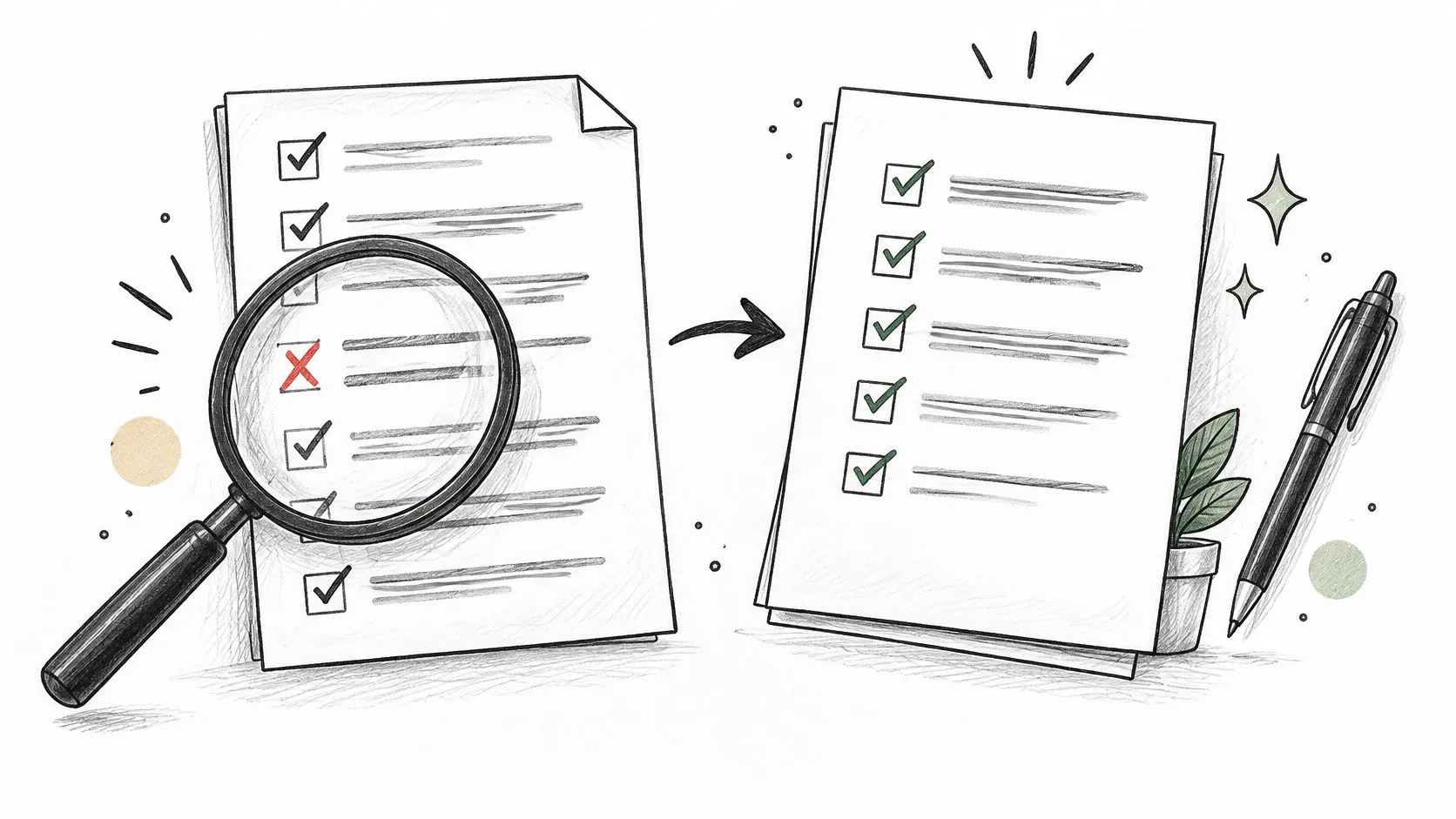
Weak: "Detail-oriented project coordinator who keeps teams on track."
Stronger: "Reviewed 300 vendor invoices each month and reduced billing discrepancies from 6 percent to under 1 percent over two quarters."
The second line never says you're careful. It shows where your attention landed and what it saved. That's a stronger argument than any adjective.
Where detail actually shows up
- An audit you ran. What you checked, how many items, what you caught.
- An error rate you cut. Before and after, in the same unit of measure.
- A document others still use. The checklist, template, or runbook with your name on it.
- A control you built. Reconciliation step, approval gate, QA pass.
Use the posting's language where it's honest. If the job asks for accuracy or quality control, name the specific control you built, not the personality trait you'd like credit for.
The test: cover the adjective with your thumb. If the bullet still reads strong, you never needed it.
3. Team Player
“Team player” gives hiring managers no proof. A generous colleague and someone who takes credit can both claim the label. Replace it with the people you worked with, what you owned, and what the group delivered.
Specific action verbs carry more weight than vague status phrases. CareerBuilder's buzzword survey, reported by ERE, highlights how generic descriptions can weaken a resume. Show the work instead.

Weak: “Strong team player who collaborates well with cross-functional partners.”
Stronger: “Led a four-team migration to the new billing platform, coordinating weekly with engineering, support, and finance for six months with zero missed invoice cycles.”
The stronger version names the teams, your role, and the shared outcome. Use the same approach to describe collaboration skills in interviews.
What to name instead of the label
- The teams. Name the functions or groups you worked with, such as engineering, finance, or support.
- Your contribution. State the part you owned, the meeting you ran, or the conflict you resolved.
- The shared result. Explain what the group delivered and how your work helped.
If collaboration is buried under an old job title, use this guide to soft and transferable skills to find clearer language for the work you did.
The test: could any teammate claim this bullet as their own? If yes, specify your contribution.
4. Hard-Working
Hard-working describes effort, and effort is the baseline. Every manager already assumes you'll show up and try. The phrase usually appears when the writer wants to signal reliability and forgets to show what that reliability delivered.
Cutting the phrase isn't an argument for shrinking the page. A ResumeGo study of 482 hiring professionals and 7,712 resume evaluations found two-page resumes were preferred 2.3 times as often as one-page resumes with comparable credentials, scoring 8.6 out of 10 on average against 7.1 (Mirrai). Cut the announcement of effort. Keep the evidence of it.
Weak: "Hard-working professional with a strong commitment to excellence."
Stronger: "Covered two open analyst roles for seven weeks while keeping weekly forecast accuracy within 2 percent."
That second bullet is a work ethic, documented. It doesn't ask the reader to take your word for anything.
How to prove effort without naming it
- Show the volume. How many accounts, tickets, files, or requisitions crossed your desk.
- Show the constraint. The deadline, the headcount gap, the freeze, the migration window.
- Show what would have failed. If your piece had slipped, what broke? Write that.
- Pick the sharper adjective instead. If you need vocabulary for exactly this, these adjectives for work ethic work better when they're attached to proof.
The bullet should demonstrate the work ethic. The moment you announce it, the reader stops believing it.
5. Passionate
Passionate is a feeling, and feelings don't survive a fast scan. LinkedIn's 2017 analysis of roughly 400 million member profiles put "passionate" on its list of ten most overused professional terms, alongside "strategic," "experienced," and "creative." Recruiters in that analysis typically had only 5 to 10 seconds to form a first impression (CBS News). A feeling doesn't fit in that window. A project does.
Weak: "Passionate about customer success and building lasting relationships."
Stronger: "Built a customer health scoring model on my own time that flagged 14 at-risk accounts; 11 renewed after outreach."
Notice what happened. The passion is still there, but it's proven by an unpaid weekend project rather than asserted in an adjective.
Three ways to move enthusiasm onto the page
- Name the thing you built anyway. The model, the dashboard, the community, the internal wiki nobody asked for.
- Attach a result to the side interest. Certification, open-source contribution, volunteer program. Give each one a number or an outcome.
- Move the personal story to the cover letter. That's the one place a short narrative about why you care reads as human instead of hollow.
Save "passionate" for the sentence where you can point at something you did on purpose. Otherwise the word is doing nothing except confirming you own a dictionary.
6. Synergy
Synergy sounds like a result and describes nothing. People reach for it when they want to sound strategic without naming a strategy. Read it back and you'll notice it could describe a merger, a meeting, or a group chat.
Recruiters search for skills, not vibes. In a recruiter survey, 76.4% reported filtering by skills, compared with 55.3% by job title and 50.6% by certifications or licenses (Useresume on resume keywords). Synergy matches none of those filters. It's a word the software can't use and the human doesn't trust.

Weak: "Created synergy between sales and product teams to drive value."
Stronger: "Set up a biweekly review between sales and product that cut enterprise feature requests from 90 days to 35 days."
The strong version names the mechanism. A meeting, a handoff, one shared metric. That's what "synergy" is hiding: a boring operational fix that produced a real number.
Replace the word with the mechanism
- The meeting. Who attended, how often, what it decided.
- The handoff. Where work used to stall and what you changed about it.
- The shared metric. One number both groups now watch.
- The dependency. What stops working if you leave.
If a bullet sounds like a conference slide, rewrite it as a plain sentence and see what's left.
7. Self-Starter
Self-starter claims initiative, and every candidate claims initiative. Managers want people who move without being pushed. They just don't believe it because a summary says so.
They believe the achievement. Jobscan's 2025 survey of 384 recruiters found 58% ranked measurable achievements as the single most valuable element of a resume (Bridgeview IT). Initiative that produced a measurable change is proof. Initiative described in an adjective is a personality claim.
Weak: "Self-starter who takes initiative and thrives in fast-paced environments."
Stronger: "Noticed duplicate customer tickets in our support queue, wrote a tagging rule set, and cut repeat ticket volume by 22 percent in one quarter."
The structure is the point: problem you spotted, action you took unprompted, result that followed. That's a self-starter, demonstrated in one line.
How to find your moment
- What bugged you first? The messy spreadsheet you fixed before anyone asked. Start there.
- What did you notice that others didn't? Lead with the observation, then the fix.
- Who benefited? Name the team, the customer group, the function that stopped chasing the problem.
- No result yet? Say what changed in the workflow anyway. Faster, cleaner, fewer steps.
Keep the word out of the resume if you can. Say it in the interview, where you can watch the reaction and back it up.
8. Proven Track Record
Proven track record promises proof and delivers a noun phrase. Which record? Over what period? Measured against what target? The reader has no idea, and after the fiftieth version of this line, they stop registering it entirely.
Replace the claim with dated outcomes. Specific results do the job the phrase only advertises.
Weak: "Proven track record of delivering high-impact programs on time and under budget."
Stronger: "Delivered three product launches between 2021 and 2024, each on schedule, with combined first-year revenue of 4.2 million dollars."
Three ways to handle this one
- Delete it and lead with your strongest dated result. Dates add credibility the phrase can't.
- Use a short numbered list. Three to five outcomes, each with a year and a measure. Far more persuasive than a claim about your record.
- Confidential numbers? Use accurate percentages or ranges and say so when asked. Never invent precision.
If writing outcome bullets feels like pulling teeth, this walkthrough on how to write achievements in resume is the practical version. The short form: verb, what you changed, the unit that proves it.
Eight Overused Resume Buzzwords at a Glance
| Item | Where It Usually Appears | Main Problem | Fix Starts With |
|---|---|---|---|
| Results-Driven | Summary or skills section | Claims focus on outcomes without naming one | Replace the label with your strongest measurable result |
| Detail-Oriented | Resume headline or skills section | Makes an unproven claim about a soft skill | Show an audit, checklist, or error reduction |
| Team Player | Skills section or summary | Hides your specific role and contribution | Name the teams involved and what you handled |
| Hard-Working | Entry-level and hourly resumes | Describes effort, not output | State the volume, deadline, or pressure you handled |
| Passionate | Cover letters and summaries | Describes unverifiable enthusiasm | Name a project you pursued and what it achieved |
| Synergy | Project or strategy descriptions | Uses jargon instead of explaining the work | Describe the meeting, handoff, or shared metric |
| Self-Starter | Job descriptions and resume summaries | Claims initiative without showing an example | Name a problem you spotted and what you started |
| Proven Track Record | Executive summaries | Claims past success without dates, scale, or results | Lead with your strongest dated result |
Swap the Label for the Proof
Pick the three adjectives you use most. Delete them from your resume today, before you write replacements. Then find the number, date, or result behind each one.
Some will have an obvious answer. "Detail-oriented" turns into the invoice audit and the error rate you cut. "Team player" turns into the migration you coordinated across four teams. Those are the easy ones, because the work was already there and only the description was wrong.
Others won't have an answer, and that's the useful part. If you can't find evidence for a claim, you either did the work and forgot it, or you're describing a job you never did. The first is fixable in twenty minutes of honest recall. The second is a line worth deleting.
The pattern behind all eight buzzwords is the same. A label describes what you'd like the reader to assume. Evidence describes what happened. Hiring managers are not cynical about your abilities. They're just reading thirty of these before lunch, and the ones with numbers are the ones they can repeat to a colleague in a corridor.
That's the whole test. Can a reader repeat your bullet to someone else, without you in the room, and have it still mean something? "Results-driven" fails. "Cut vendor onboarding from 45 days to 19" passes, every time.
One more thing worth doing. Re-read your summary for adjectives that describe your personality and your bullets for verbs that describe your activity. Most resumes have both problems at once: a summary full of feelings and a work history full of responsibilities. Fix the summary with results, fix the bullets with direction, and the same career reads completely differently. For a deeper look at how senior candidates frame this, these senior software engineer resume examples show the difference between describing a role and describing an outcome.
StoryCV interviews you about the work you did, asks the follow-up questions that surface the problem, action, and result, and turns your answers into bullets. Every number in those bullets comes from your own answers, so nothing gets invented to fill a gap.
Most job seekers aren't under-qualified, they're under-described, and a resume full of labels is the symptom. StoryCV is a resume writer, not a builder: it asks about your role, your industry, and what changed because of you, then writes the bullets you'd have written yourself if someone had asked the right questions. Start free with two finished bullet points, or visit StoryCV to see how far one honest conversation gets you.