Professional recruiters spent an average of 7.4 seconds on an initial resume review in The Ladders' eye-tracking study. That's not enough time to reconstruct your career from a list of responsibilities. Your resume needs to work as an evidence map: clear locations, recognizable experience, and proof worth reading.
What Recruiters Check in the First Few Seconds
The first review is a fit check, not a close reading. Recruiters look for your name, current and previous titles and employers, employment dates, and education. Those details help them place you before they evaluate the substance of your work.
Screening signals by resume location
| Resume location | What the recruiter checks | Weak version that loses the reader |
|---|---|---|
| Name, current title and employer | Fit at a glance | Internal-only titles nobody outside the company understands |
| Previous titles and employers | Seniority path | Titles that hide the real scope of the work |
| Employment dates on each role | Timeline and level | Missing or inconsistent dates |
| Education | Baseline credentials | Buried at the bottom with no context |
| First bullet of each role | Scope and outcome | Duties that open with “Responsible for” |
Make your current role understandable without company-specific knowledge. If your official title is unusual, keep it and add an accurate functional explanation. A title such as Delivery Lead needs context if your work was technical program management.
Don't promote yourself on paper. Explain your scope instead: what you owned, which decisions you made, and who depended on the work. A director title without scope says less than a clear account of responsibility.
Put the strongest evidence where the eye lands
Your first bullet shouldn't describe the most routine part of the job. It should establish why this experience matters for the vacancy. Lead with the relevant outcome, then explain the contribution that produced it.
Education needs similar judgment. Keep credentials easy to locate, especially when the position requires a particular qualification. For an experienced professional, that doesn't mean moving education above recent work. It means labeling it clearly and including the context needed to understand the qualification.
First-screen test: Can someone identify your function, level, and strongest relevant contribution without scrolling?
This is the practical answer to what recruiters look for in resumes. They need enough visible evidence to decide whether a closer look is justified. Don't make them infer your suitability from an impressive employer name or an opaque title.
Why Relevance Beats Keyword Stuffing
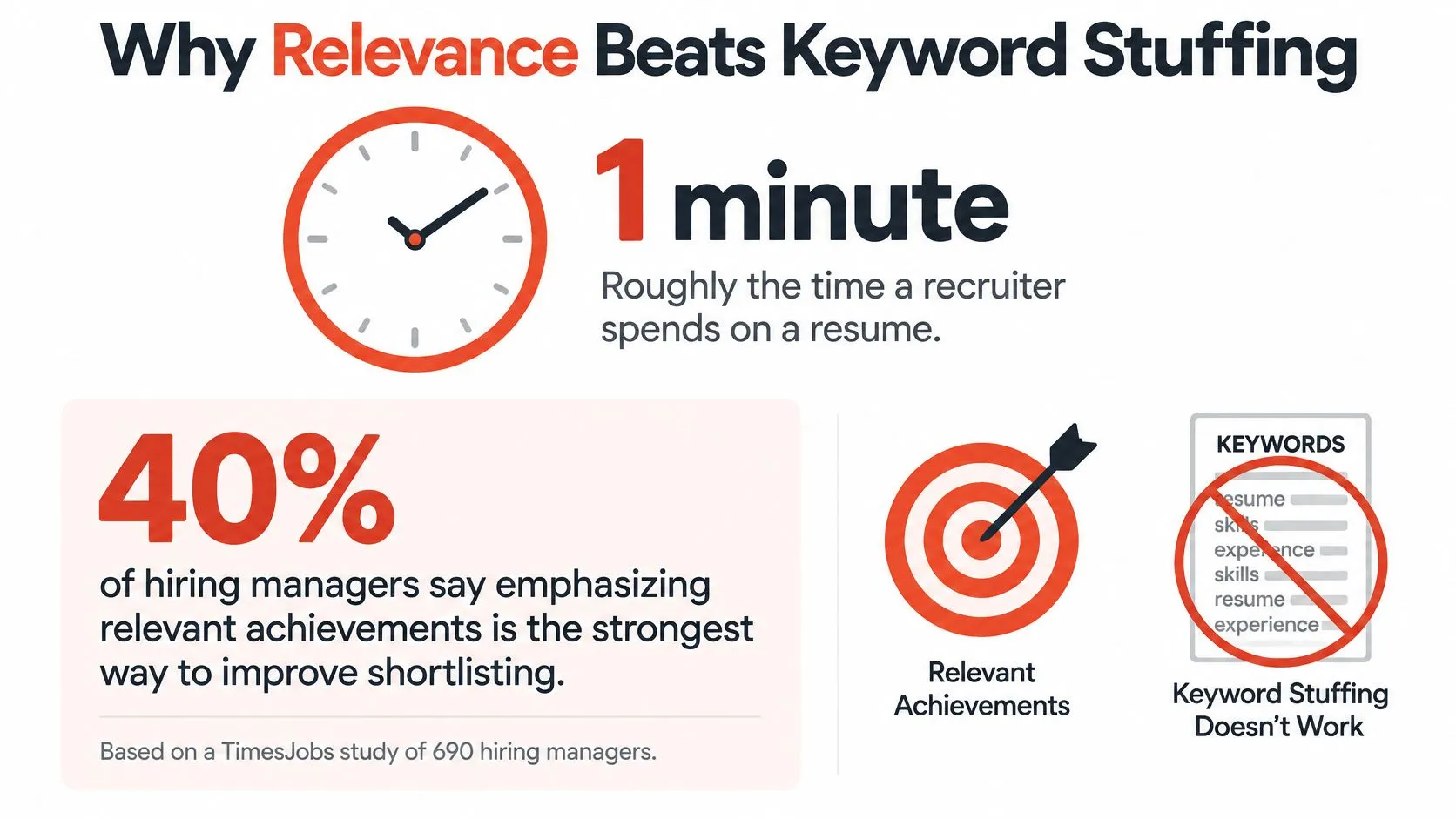
A resume receives roughly one minute of recruiter attention overall, and 40% of recruiters said emphasizing skills directly relevant to the advertised job was the strongest way to improve shortlisting prospects, according to the TimesJobs study of 690 hiring managers reported by The Economic Times.
That makes relevance an editing decision. You're not trying to fit your whole career onto the page. You're choosing the parts that answer this employer's questions.
Start with the posting. Pull out eight to ten terms that describe the actual work: the function, specialist skills, tools, stakeholders, and expected outcomes. Treat this as an editorial shortlist, not a keyword quota.
Then test your experience against it. If the role emphasizes vendor negotiations, a bullet about routine procurement administration won't do the same job as evidence that you challenged terms, selected suppliers, or resolved a contractual risk.
Keep the skill only when you can explain it
Use this filter before adding anything to a skills section:
- Name the situation. Where did you use the capability?
- Identify your action. What did you personally decide, build, change, or resolve?
- Connect it to the vacancy. Why would this employer care?
Soft skills need the same treatment. Don't call yourself collaborative when you can describe how you resolved competing priorities between engineering and operations. Don't claim executive communication when you can explain how you turned technical uncertainty into a decision leadership could make.
Career changers should translate vocabulary, not rewrite history. Military planning experience can demonstrate resource allocation and operational coordination. It doesn't give you permission to claim a civilian title you never held.
The same applies to senior professionals moving between industries. Preserve the actual work while removing internal jargon that obscures it. Industry knowledge matters, but readers shouldn't need your former employer's glossary.
A relevant line lets the recruiter connect your experience to the job in one read.
Cut anything that needs a long explanation to justify its place. A prestigious project can still be the wrong evidence for this application.
How Matching Software Reads Your Resume
You rarely know which matching tool an employer uses or how it's configured. Don't build your application around guesses about a hidden score.
A 2025 study described in One Hour Digital's resume statistics roundup reported that a deep-learning system processed 1,000 resume-job pairs per minute and achieved 91% matching accuracy in the researchers' test setting. Those results describe that system and test, not every employer's screening process.
Use recognizable language without gaming the document
- Use standard names. Choose the established term for a skill or tool when it accurately describes your experience.
- Expand unfamiliar acronyms. Spell out the term on first use, then use the abbreviation.
- Keep evidence beside the term. Put stakeholder management in the context of a decision or delivery problem, not an unsupported list.
- Keep the file readable. Follow the employer's requested format and keep essential content as selectable text rather than graphics.
Our explanation of applicant tracking systems provides context for the terminology. Interview Pilot's guide to getting past automated resume filters is another resource for understanding the process without treating it as a keyword contest.
We make no promise about how an employer's system will score a document. Write claims a person can understand and validate. That's a better use of your time than chasing an imaginary universal ranking formula.
Turning Duties Into Measurable Impact
88% of hiring managers view work experience as the most important resume section, 75% want specific accomplishments and results there, and hiring managers spend 67% of their resume-review time examining it, according to the Qureos compilation of employer and recruiter statistics.
Give that space substance. A duty tells the reader what the position required. An accomplishment tells them what you contributed.
Build each bullet from the problem, action, scale, and result. You don't need to include those elements in a fixed order. You do need enough context to make the claim meaningful.
Weak lines and stronger rewrites
| Weak line | Stronger line | What changed |
|---|---|---|
| Managed operations | Reduced processing time from [X] to [Y] across [N] markets | Named action, scale and result |
| Responsible for system improvements | Cut [process] time from [X] to [Y] for [team size] | Specific change and measurable outcome |
| Collaborated across teams | Coordinated [N] engineers across [N] teams to ship [system] | Named scope and the work that was done |
| Helped with customer retention | Built [process] that moved [metric] from [X] to [Y] | Metric and mechanism instead of a vague verb |
| Handled budget and vendors | Managed a [amount] budget and chose [N] vendors, saving [X] | Size of the budget and the decision made |
These are drafting structures, not finished claims. Replace every bracket with information you can support. Then check whether the sentence accurately represents your ownership.
Find the evidence before polishing the sentence
Look in project reviews, performance notes, dashboards, launch documents, and budget records you're authorized to use. Compare the starting condition with the final condition. Ask what changed for customers, colleagues, costs, delivery, or risk.
For senior roles, include the decision behind the result. Did you stop a weak initiative, negotiate a trade-off, change sequencing, or choose between competing technical approaches? That judgment can distinguish your contribution from the team's output.
A defensible approximation is better than false precision. Label an estimate and know how you derived it. If the number is confidential, use an authorized range or describe the scope without disclosing protected information.
Our guide to using metrics in your resume helps you identify useful measures without forcing a percentage into every sentence.
Evidence rule: A concrete outcome without a number is stronger than a dramatic number you can't explain.
Projects, internships, volunteer work, and military service can all supply outcomes. An internal improvement counts too. Establishing a review process or removing a recurring handoff failure can demonstrate valuable work without a revenue claim.
At StoryCV, we extract the impact from your story, deciding what matters, what to prioritize, and what to cut. Every number in the resume bullet points comes from your own answers.
If a bullet still reads like a job description, ask what changed because you did the work. Write that change first.
Layout Choices That Survive a Skim
42% of respondents almost always skim resumes rather than read them line by line, while 24% reject between 81% and 100% before fully finishing their review, according to Empire Resume's account of the ResumeGo survey. Put proof where a quick scan can find it. A resume is an evidence map: placement and readability shape the first verdict more than a crowded list of keywords.
Recruiters' review times vary by stage and method. Build for a fast skim without treating any single time estimate as a universal deadline.
Remove reading friction
- Use standard headings. Label sections Experience, Education, and Skills so readers can find them without decoding creative alternatives.
- Put recent experience first. Make the sequence of your career clear at a glance.
- Keep bullets compact. Aim for three to five per relevant role, with each taking a line or two. Use this as an editing target, not a reason to shrink text.
- Align dates consistently. Apply the same month-and-year style throughout.
- Create breathing room. Separate positions visibly. Dense blocks slow the reader down.
Keep your summary short so recent experience starts near the top. Use it to establish your positioning, not to repeat the bullets below.
Let the length reflect your career. Give recent, relevant work more space. Don't squeeze substantial leadership experience onto an unreadable page or keep outdated duties just to fill another one.
Check the exported file, not just the editor. Open the PDF, review page breaks, and keep headings with their content. A stranded title or split bullet breaks the evidence map and makes relevant details harder to follow.
Red Flags and Culture Fit Signals to Remove
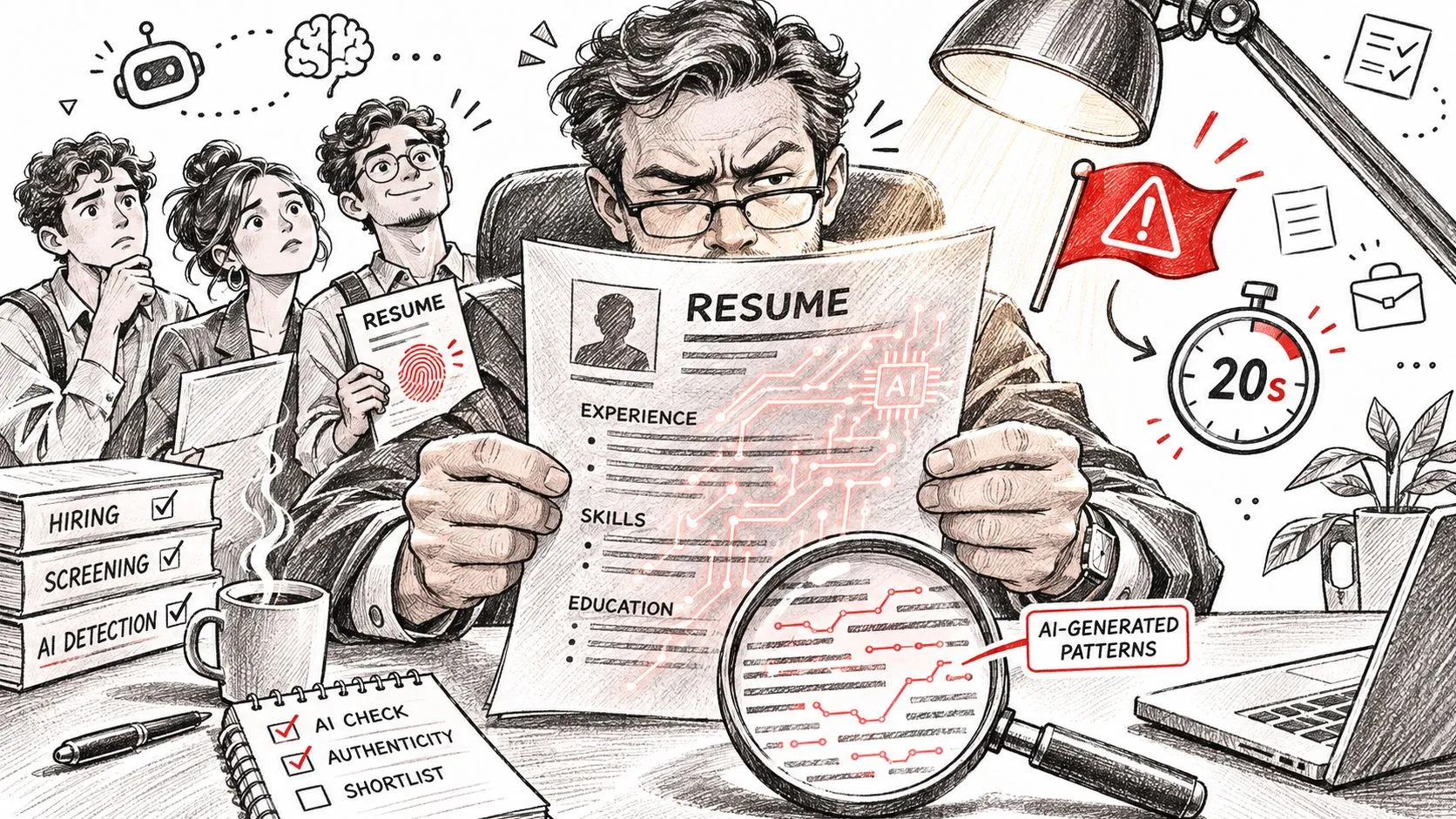
In a 2025 survey of 600 U.S. hiring managers, 33.5% said they could identify an AI-generated resume in under 20 seconds, according to TopResume's AI-in-hiring survey. That's a self-reported belief, not proof that they can reliably detect how a document was written.
The useful lesson isn't to disguise AI use. It's to remove language you can't stand behind. Polished generalities won't help when an interviewer asks what happened.
Red flags, what the reader concludes, and the fix
These are doubts a reader may form, not reliable judgments about the candidate.
| Red flag | What the recruiter concludes | Fix |
|---|---|---|
| Unsupported metrics | The number cannot be defended in an interview | Keep only figures the candidate can explain, with the problem and action behind them |
| Identical bullet openers | The bullets were generated, not lived | Vary the verbs and tie each line to a specific decision |
| Unexplained gap | Something is being hidden | Add one plain line with the reason and move on |
| Inflated title or scope | Credibility problem once the interview starts | Use the real title and state the true scope |
| Generic soft-skill claims | No evidence behind the claim | Replace the adjective with a situation and the action taken |
Show working behavior, not personality slogans
Culture fit shouldn't mean sounding like everyone already employed there. Show how you work: how you handle disagreement, share responsibility, communicate constraints, and make decisions.
Progression helps explain your career, but don't confuse progression with uninterrupted promotions. A move into a specialist role can be deliberate. A sideways move can add valuable scope.
Give a career gap a plain explanation when context would help. A short line about caregiving, study, relocation, or a career break is enough. You don't owe the reader private medical or family details.
Don't write a defense of every departure. Explain a move only when the missing context would distort the story, such as a fixed-term assignment or an internal transfer that looks like a short tenure.
Our guide to resume red flags can help you distinguish an actual credibility problem from a career detail that needs context.
Use AI to ask better questions and tighten your writing. Reject any suggestion that adds authority, ownership, or results you didn't have. Your final wording should sound natural when you explain it aloud.
Run This Check Before You Hit Apply
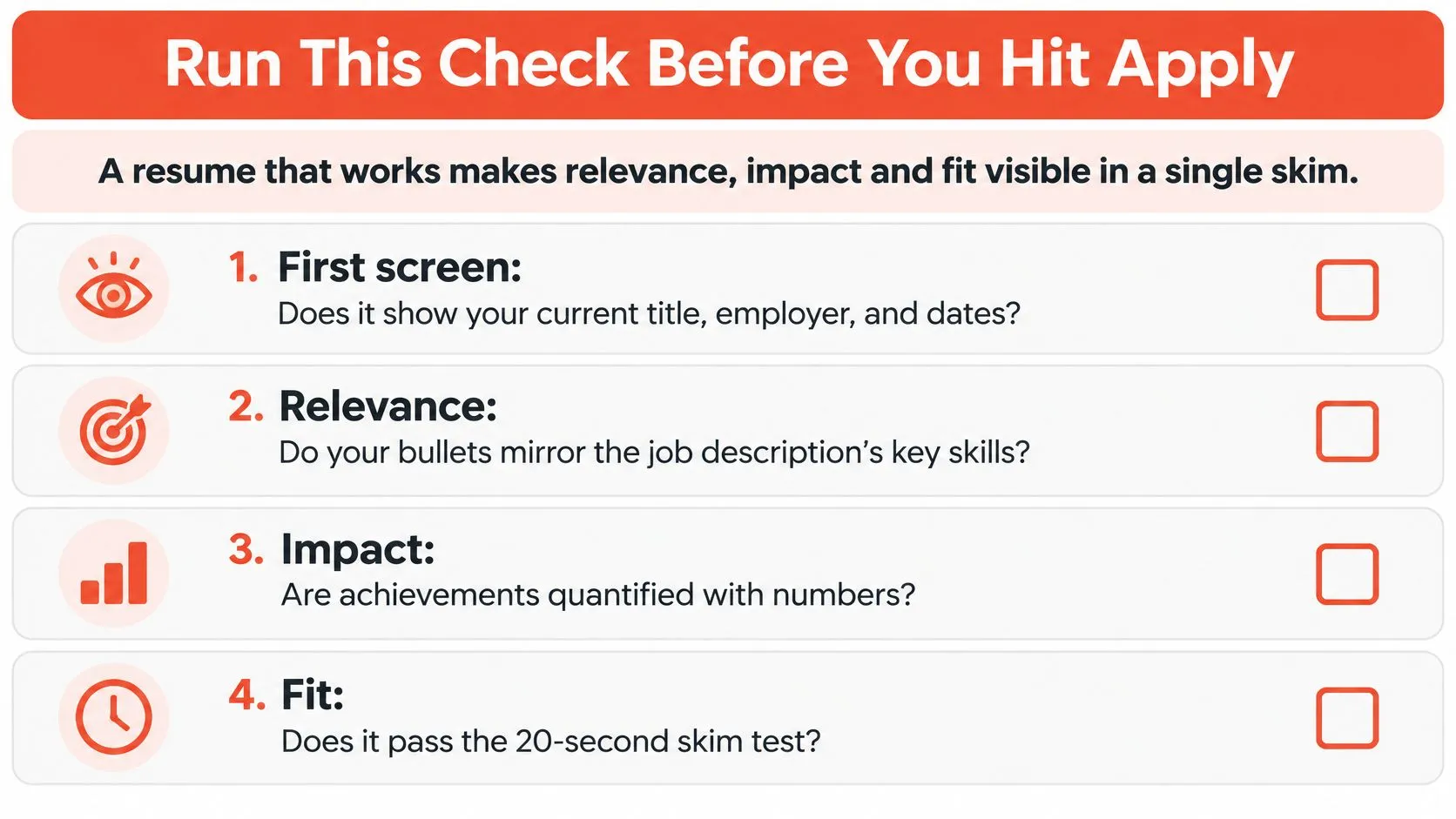
A resume that works makes relevance, impact, and fit visible in a single skim. Use this final pass to find missing evidence, not to keep polishing sentences that already work.
- Check the first screen. Can the reader locate your current title, employer, dates, and relevant credentials?
- Inspect each opening bullet. Does it lead with the result that matters most for this application?
- Compare the posting. Are at least half its core terms represented accurately? Use this as an editing prompt, not a scoring threshold, and never add a skill you don't have.
- Audit every number. Can you explain its source, calculation, and your contribution?
- Resolve timeline questions. Does any gap need a brief contextual line?
- Remove interchangeable language. Could a colleague paste the bullet into their resume unchanged? Add the decision or contribution that makes it yours.
Fix each failed check before applying. Don't solve a weak evidence problem by changing fonts or adding more adjectives.
If the work is hard to describe, a guided interview gives you a practical starting point. We ask targeted questions about your industry, role, and accomplishments, then turn your answers into concise bullets you can paste into your own template. A full resume takes 1 to 1.5 hours to complete.
StoryCV interviews you about the work you've done and edits your answers into clear, specific resume bullet points. Visit StoryCV and start with the role where your contribution is hardest to explain, so a recruiter can understand what you brought to it.