The advice to explain your career gap first gets the order wrong. If you previously owned a budget, led a team, or delivered complex work, your return to work resume should establish that capability before explaining why you stepped away.
Name the break. Keep the dates honest. But build the document around the job you want now, not an apology for the years between jobs.
Choose the Resume That Matches Your Return
Choose a continuity, bridge, or re-entry resume before you write a bullet. These are different evidence plans, not different decorations around the same work history.
A continuity resume establishes that you can resume your profession. A bridge resume connects your experience to adjacent responsibilities. A re-entry resume demonstrates current capability when your former titles no longer answer the employer's question.
Which return to work resume to write
| Version | Use it when | Lead with | How to treat the break | Proof on page one |
|---|---|---|---|---|
| Continuity | Same profession after the break | Total years, scope, and outcomes | Years plus a one-line career break | A recent course, project, or tool you still use |
| Bridge | Adjacent role, step down, or flexible work | Skill groups that match the posting | Dates kept, experience grouped by capability | Volunteer, freelance, or caregiving work translated into the target skills |
| Re-entry | New sector or a long absence | Recent learning and finished projects | A named break, then current capability | Certificates, a portfolio piece, or returnship-style project work |
Choose the target before the evidence
Write the target title on a line above your draft. Be specific: operations manager, implementation lead, environmental scientist. A broad declaration that you're seeking opportunities gives you no basis for deciding what belongs.
The distinction matters because returners aren't all pursuing their former jobs. Coverage of the 2025 STEM Returners Index reports that 75% found returning difficult or very difficult and 53% reported bias related to lack of recent experience, while the same DIGIT report on returner challenges describes 42% of returners as interested in a new role or sector.
For continuity, lead with accumulated expertise, the largest responsibility you held, and evidence that you still know the tools. Don't replace substantial professional achievements with a long list of introductory courses.
For bridge, use capability headings such as operations, delivery, or stakeholder management. Keep the employer, context, and dates attached to each example. Our comparison of functional and chronological resumes can help you decide how much grouping the document needs without losing the work history.
For re-entry, put finished work ahead of old seniority. A relevant analysis, implementation plan, or portfolio piece deserves more space than an impressive but unrelated title.
If you're moving into environmental work, the resume examples on WaterJobsIntel offer a useful role-specific reference. Use them to examine what evidence the target profession needs, not to borrow accomplishments.
Decision rule: Pick the version that answers the employer's hiring question. Don't make the reader assemble a career direction from unrelated evidence.
Why the Gap Should Not Lead the Page
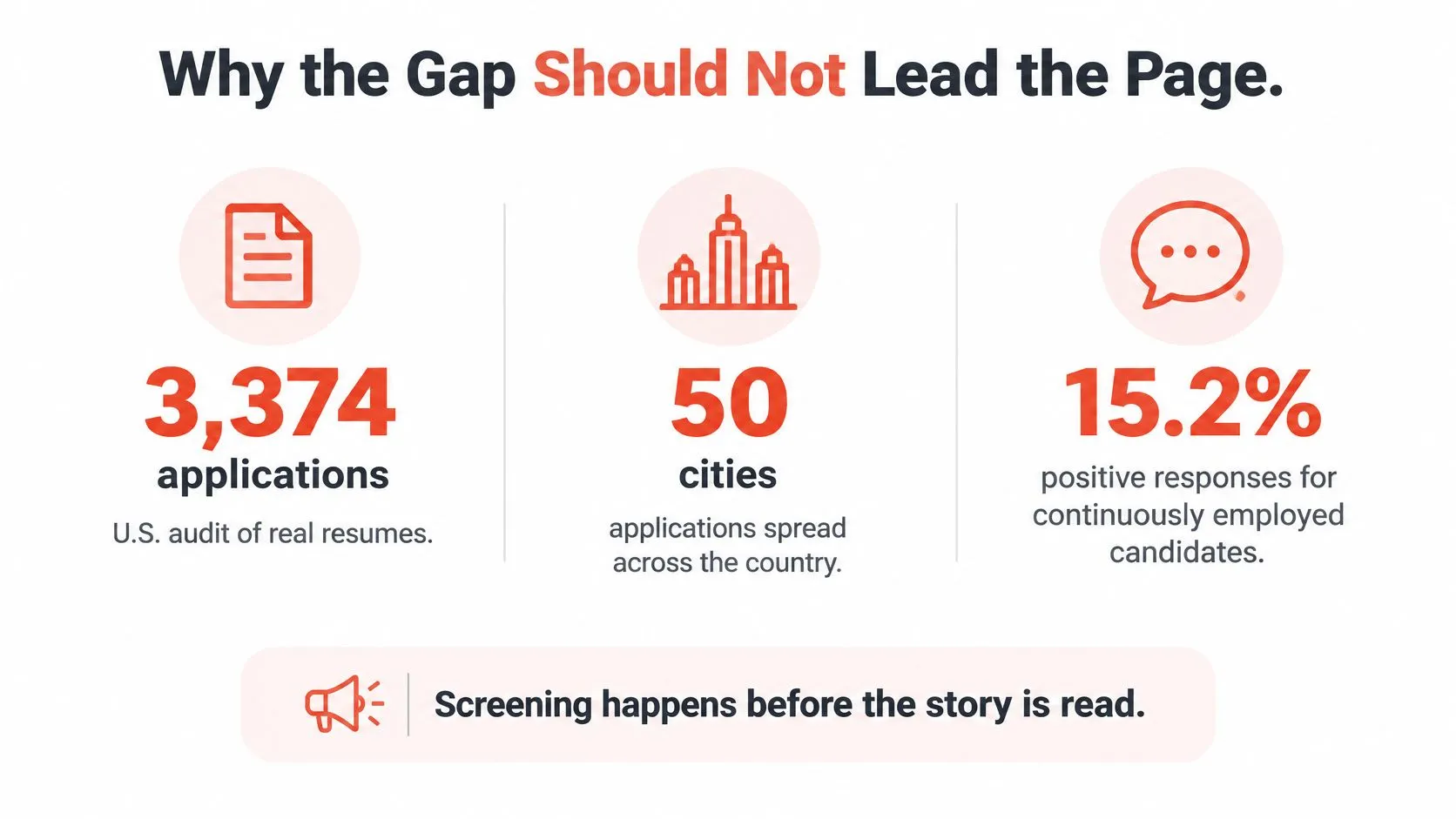
A U.S. correspondence audit of 3,374 fictitious applications across 50 cities found positive-response rates of 15.2% for continuously employed applicants, 9.3% for unemployed applicants, and 5.1% for stay-at-home-parent applicants, according to Technical.ly's account of the employment-gap study. That's a reason to establish professional value early, not a reason to conceal your history.
Caregiving breaks also sit within a larger economic problem. UK government analysis of returners identified approximately 2 million people outside the labour market because of caring responsibilities, almost 9 in 10 of them women, and cited an estimated 2% decline in women's average yearly earnings for each year out, approximately 10% over five years.
You can't fix hiring bias with page layout. You can make sure the first thing a reader learns is what you're qualified to do.
Give each part of the page a job
Use this order of attention within your chosen evidence plan:
- Professional identity: State the target discipline and the responsibility you're equipped to hold.
- Relevant achievement: Surface earlier high-impact work, even when recent learning or projects lead a re-entry version.
- Current proof: Put a relevant certificate, consulting assignment, volunteer output, or recent tool use close to that achievement.
- Career context: Include a compact, dated Career Break entry where it belongs in the timeline.
A break label can be as simple as Career Break, family care, followed by the actual dates. Include the reason when it clarifies the timeline. You don't owe the reader medical details or a family history.
Keep claims proportionate. Coordinating care can demonstrate logistics and record management. It doesn't establish that you maintained industry-specific expertise unless you did.
Your break needs context. Your candidacy needs evidence. Give each the space it deserves.
The reader should be able to identify both your previous level of responsibility and your present readiness without guessing.
How to Show Tenure Without Hiding Dates
Show the years you held a role and the responsibility you carried. Tenure should clarify your experience, not disguise a break. A single gap template fails returners: choose a continuity, bridge, or re-entry evidence plan, then show the years of ownership that support it.
Edit one role in this order
-
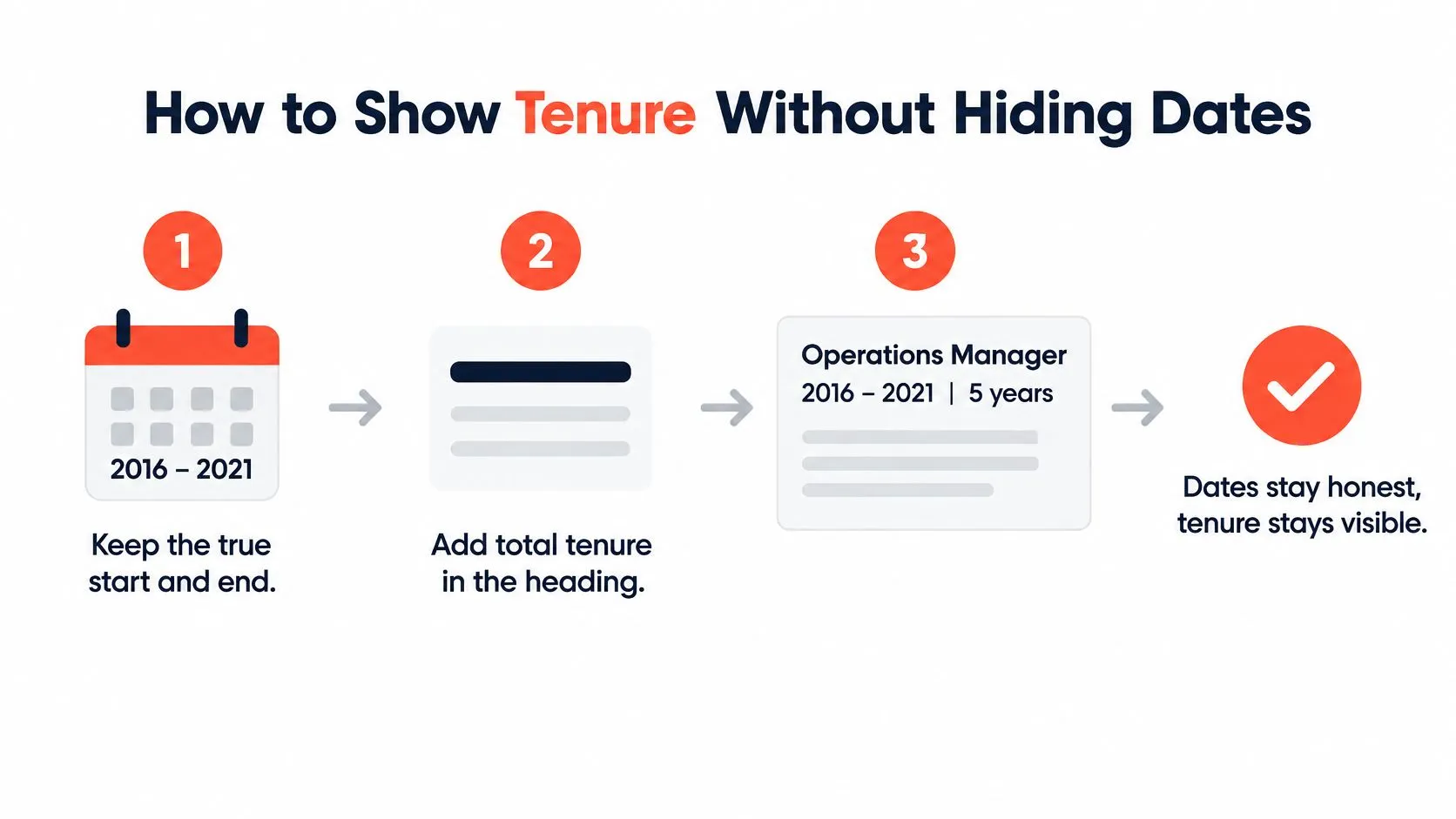
Keep the true dates and add total tenure. A preregistered UK field experiment involving 9,022 real job applications found that tenure-based formatting increased callbacks by approximately 8% relative to applicants without employment gaps and 15% relative to applicants whose resumes visibly contained gaps, according to the published tenure-formatting study. Use a heading such as Operations Manager, 2016-2021, 5 years only when the dates support that duration. Pair it with a concise result or responsibility you owned.
-
Choose date precision carefully. Columbia Career Education's employment-gap guidance offers year-only dates as an option. Apply that format consistently, and provide months when an application asks for them. A role that crossed calendar years does not automatically count as a full year of tenure.
-
Cut irrelevant history, not inconvenient history. Oregon State University's gap guidance suggests considering whether experience older than roughly five to ten years remains relevant. Keep an earlier role when it proves a requirement of the target job. Use the resume work history timeline rules as a separate relevance check.
-
Add a short Career Break entry. Give the actual period and, when it helps clarify the timeline, a brief reason such as family care, health, relocation, or study. State it plainly. Skip a defensive explanation.
-
Place related activity in its true context. Courses, certificates, contract work, association work, committee service, and independent projects can appear beneath the break or in clearly labelled experience groups. Date each item accurately so it adds evidence without blurring employment history.
-
Write the summary around the target. Name the profession and relevant experience, then show scope: budget responsibility, delivery volume, team leadership, or a defensible result. Choose the evidence plan that fits your return. Continuity emphasizes sustained work; a bridge connects related experience; re-entry puts recent proof beside earlier responsibility.
-
Save extended context for conversation. Use a cover letter or interview to explain more only when the detail helps someone assess your readiness. Keep the resume focused on accurate dates, clear scope, and evidence of what you owned.
Match the date treatment to the absence
Date treatments by break length
| Break length | Date treatment | What else must appear | Where the reason goes |
|---|---|---|---|
| Under about 2 years | Years only, with tenure in the heading | One recent proof you stayed current | Optional one-line break entry, or cover letter |
| About 2 to 5 years | Full years plus total tenure, as in 2015-2020, 5 years | Quantified scope from the last role and one refresh activity | Short Career Break line on the resume |
| Longer than 5 years | Same tenure format, with old irrelevant roles cut | Projects, certificates, or contract work from the break | Named break on the resume, details in the interview |
For overlapping roles or short engagements, use the more precise guidance on dates on a resume. Accurate dates make tenure easier to assess. Clarity beats cosmetic continuity.
Translate Break Work into Hiring Language
Don't describe every activity during the break. Select the work that proves a requirement of the target role, then explain it with the same care you'd give paid experience.
The University of St. Gallen's discussion of career-gap findings notes that 93% of surveyed returners believe skills gained during their break can add employer value, while 86% believe only a minority of employers will recognize those skills. Don't leave that recognition to inference.
Replace activity labels with evidence
The following are hypothetical rewrites, not accomplishments to copy. Use the pattern only where your own facts support it.
Caregiving, for a bridge resume
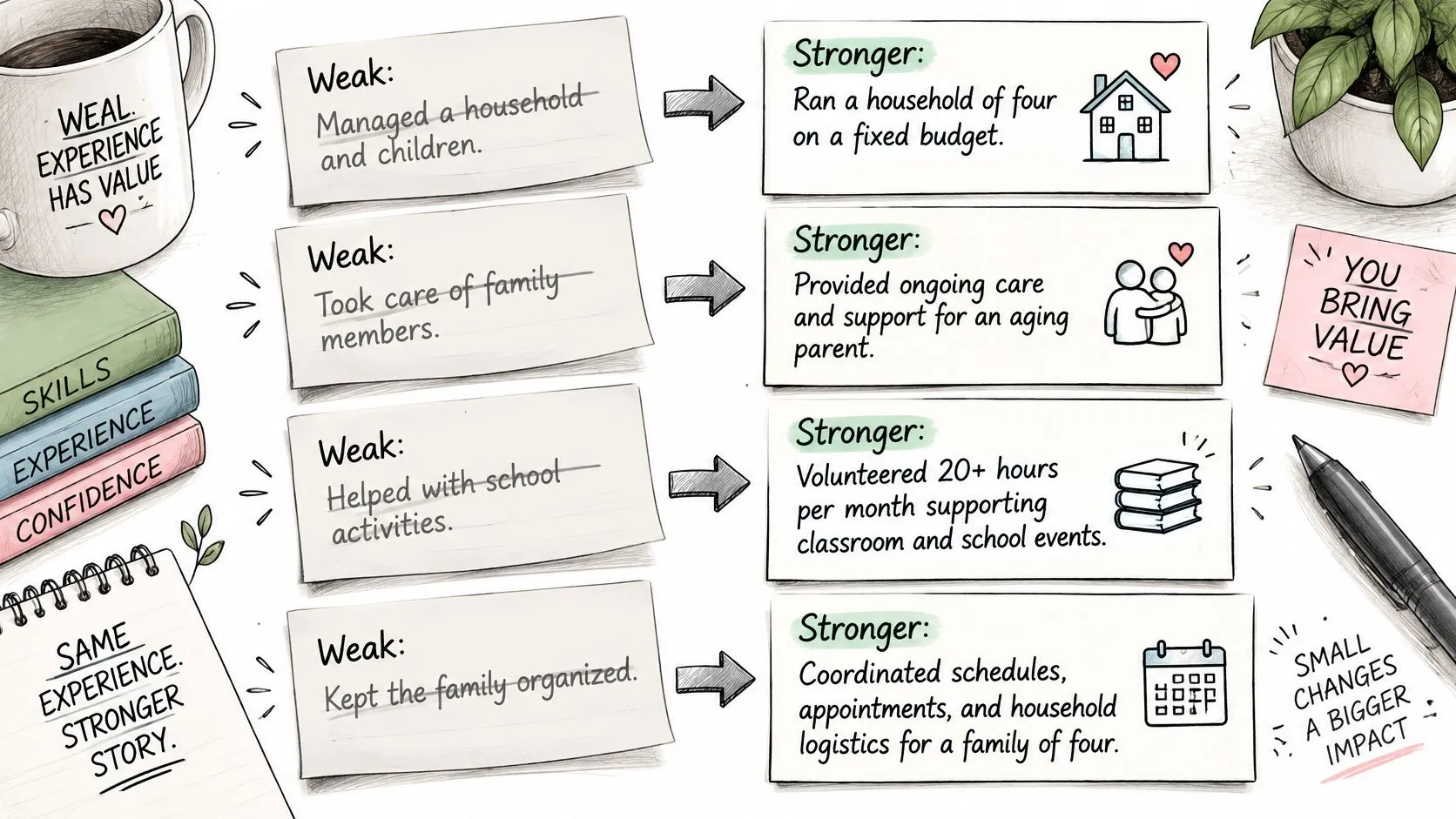
- Weak: Managed a household and children.
- Stronger: Ran a household of four on a fixed budget, coordinated medical and school schedules across three providers, and cut weekly admin time by batching appointments.
- Missing fact added: The coordination scope, operating constraint, and process change.
Place this under a relevant capability such as scheduling or administrative coordination. Don't promote parenting into a fictional executive title. Household responsibility isn't corporate management, and the bullet shouldn't pretend otherwise.
Volunteering, for a bridge resume
- Weak: Helped at the school.
- Stronger: Recruited and rostered 20 parent volunteers for a term-long event series and kept the program on a set budget.
- Missing fact added: Personal ownership, delivery period, staffing scale, and budget control.
Use the volunteer title if there was one. The roster belongs under delivery or volunteer coordination when those responsibilities match the adjacent role.
Study, for a re-entry resume
- Weak: Took an online course.
- Stronger: Completed a data course and rebuilt a personal expense tracker that flagged overspending in three categories.
- Missing fact added: A finished output and what it revealed.
For re-entry, show the tracker or explain its design. For continuity, keep the strongest quantified achievement from your last paid role and add the relevant certificate or tool practice alongside it. Course attendance alone shouldn't displace professional evidence.
Freelancing, for a re-entry resume
- Weak: Did some consulting.
- Stronger: Scoped a three-week process cleanup for a local clinic and documented a handoff the next hire could follow.
- Missing fact added: A defined engagement, a business problem, and a usable deliverable.
If this was paid consulting, label it as consulting. Don't bury real work under interests or hobbies.
Test the bullet before keeping it
Use problem, ownership, action, scale, and change as your editing sequence. A number strengthens the line only when it describes something meaningful.
Ask:
- What was messy? Name the delay, confusion, missing process, or unmet need.
- What did you decide? Separate your contribution from the group's activity.
- Who benefited? Identify the person, team, or organization.
- What can you count? Use a defensible result, volume, budget, or coordination scope.
If the connection to the target job remains weak, leave the activity out.
Use a Returnship Without Waiting for One
A returnship is a structured re-entry program for professionals who've taken a career break. Treat it as a supported assessment of experienced capability, not a lesser version of a real job.
Re-entry isn't necessarily quick. The UK government report on returners and potential returners found that only 8% of female potential returners and 9% of male potential returners re-enter the labour market in a given quarter, counting entry into either employment or unemployment.
Formal programs can provide a route back. The University of Washington's report on returnships describes roughly one-third of Fortune 50 companies as offering re-entry programs and reports that Return Utah hired 60 returners in less than two and a half years, with a 92% conversion rate to long-term employment.
If you completed a returnship
List it as experience with the employer, accurate program title, and dates. Describe the problem you handled, the decisions you made, and the result. Don't tuck substantive delivery work into education because the employer also provided training.
Distinguish what you observed from what you delivered. Shadowing a project lead isn't the same as owning a project handoff.
If you haven't completed one
Build a smaller piece of equivalent evidence:
- Scope a project: Define the user, problem, deliverable, and completion condition before starting.
- Connect learning to output: Use a certificate's skills to produce an analysis, dashboard, operating procedure, or working prototype.
- Deliver for someone: Complete contract or volunteer work with a named recipient and an agreed handoff.
- Record the result: Keep the finished artifact, feedback, or operational measure you're allowed to share.
Practical rule: Don't wait for permission to produce current evidence. Keep the project bounded enough to finish.
A self-directed project isn't a returnship, and you shouldn't label it as one. Its purpose is narrower: give a hiring manager something current to evaluate alongside your earlier achievements. Apply while you build that proof, rather than postponing every application until a program accepts you.
Start from What You Owned During the Break
Settle on continuity, bridge, or re-entry. Then draft three bullets only: one from your last paid role, one from the break, and one from something you finished in the last year.
Don't start by polishing verbs. Start by recovering facts. Our guide to career reflection before writing a resume helps separate what happened from the vague language people use when they're trying to sound employable.
Ask these questions in order
- What was broken, late, or unfinished? Identify the starting condition.
- What did you personally own? Name your responsibility, not the team's entire remit.
- What did you change, decide, or set up? Describe the intervention.
- What happened next? Find a number you can defend or an observable outcome.
Stop polishing when you reach a missing result. Find out what happened before making the sentence sound impressive. If there's no outcome to support, choose a better example.
If you lack a performance measure, use honest scope: people coordinated, deadlines held, budget watched, or volume handled. A caregiving bullet names the logistics and what improved. A course bullet names the finished output, not the fact that you logged in.
Get the facts before the wording
StoryCV is designed for complex career journeys, including career changes, military transitions, and returns to the workforce. Our interview asks what you owned, what you changed, and what happened next for each role, including relevant work that didn't come with a conventional job title.
We don't write a bullet until we have the problem, the action, and the result. That keeps the language attached to work you can explain and defend.
Finish those three lines. Copy them into the resume layout you already use, and send the evidence plan that matches the role in front of you.
StoryCV interviews you about your work and turns the answers into clear, grounded resume bullet points. Bring your last paid role, your break-period responsibilities, and a recent finished project to StoryCV, and start describing the capability you're ready to use again.