

The most repeated advice about a logistics coordinator resume is to fill it with money. Freight spend cut by $300K. Savings of 18% per shipment. Detention fees down by a third.
Most of those numbers never happened. A coordinator doesn't set rates, doesn't sign carrier contracts, and doesn't own the freight budget. You can't save what you don't control, and a transportation manager who has spent a decade on a dock can hear the invention in a single line.
The advice survives because the alternative looks soft. Resume-statistics compilations put the problem plainly: an analysis gathered by Flair HR notes that 81% of resumes omit numbers or percentages, and that a missing result statement is a deal-breaker for 34% of recruiters. Read those as directional, since the underlying samples differ. The direction holds: results get read.
The field is big enough that you can't bluff your way through it. The Bureau of Labor Statistics counted 255,100 logisticians employed in 2025 at a median $82,320 a year, and projects roughly 18% growth through 2035. Plenty of people write this resume. The ones who get called describe contribution with evidence, not savings they can't source.
The Bullet Formula Hiring Managers Scan For
"Responsible for shipments." Four words, and the reader learns nothing beyond the fact that you held the title. No volume, no mode, no system, no outcome. "Handled carrier communication" is the same problem wearing a different verb.
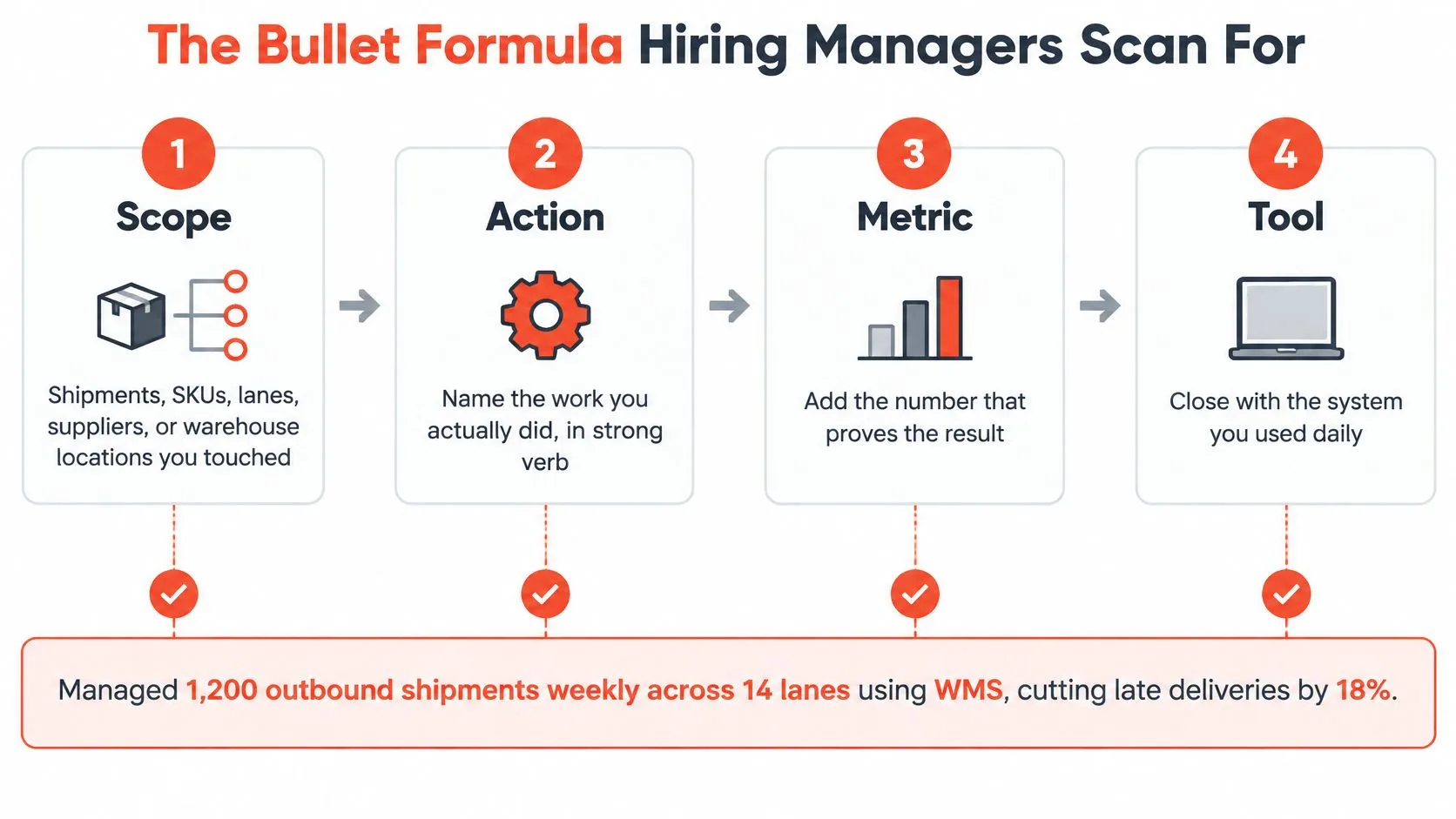
Every strong bullet on a logistics coordinator resume makes the same three moves in the same order: scope, then intervention, then result. The APICS supply chain manager competency model gives you the vocabulary for the middle move. It defines logistics as an interconnected system spanning transportation management, warehouse management, inventory management, dispatching, risk management, WMS and ERP work, international regulations, and synchronization across partners. Name one piece of that system you touched and what changed because of it.
The template: Coordinated [volume/scope] across [systems or stakeholders] by [method], improving [metric] by [amount] while maintaining [constraint].
Rebuild one weak line with me
Take a real line: "Responsible for inbound freight."
Scope comes first: 30 to 50 inbound loads a week, four carriers, one distribution center. Then the intervention: reconciling ERP receipts against packing lists before each dock appointment. Then the result: receiving discrepancies down to fewer than two a month.
Put together: "Coordinated 30 to 50 weekly inbound loads across four carriers, reconciling ERP receipts against packing lists, cutting receiving discrepancies to under two a month." Same job. Now it's evidence.
Read the finished line back against four things: an action verb, a logistics object, a method or system, and a result. A bullet missing any one of them reads like a duty list, because that's exactly what it is.
| Element | What to Write | Sample Phrase |
|---|---|---|
| Action verb | The action you took | Coordinated |
| Logistics object | Scope of the operation | 40 to 60 daily shipments across 12 lanes |
| Method or system | The tool or step you used | using TMS load plans and carrier scorecards |
| Result | The measurable outcome | helping hold a 97% on-time dispatch rate |
When exact financial figures aren't available, swap in operating measures you can defend: shipments per day, order lines processed, delivery territories, carrier count, inventory value, or the percentage of documentation completed without an error. A count that survives an interview beats a dollar figure that doesn't.
If you're on the hiring side of this, how LatHire vets logistics candidates runs the same evidence test from the other direction, and it's a useful read before you guess what a recruiter is scanning for.
Your first win takes five minutes. Pick your current role, take the weakest line on it, and rewrite it using scope, intervention, result. Nothing else on the resume has to change today.
Metrics to Pull From Your Own Records
A remembered number is hard to defend in an interview. A number tied to a report gives you evidence you can explain. Start with daily shipment volume in TMS dispatch reports, then check on-time rate against carrier scorecards or delivery logs. For warehouse-adjacent roles, pull dock-to-stock time and picking accuracy from warehouse KPI and WMS reports. Ticket logs and escalation emails can show exception response time, while a carrier roster shows how many carriers you coordinated.
| Metric | What It Shows | Where to Find It | Sample Phrasing |
|---|---|---|---|
| Daily shipment volume | Scale of your load | TMS dispatch reports | Scheduled 40 to 60 daily deliveries |
| On-time delivery rate | Share of shipments on time | Carrier scorecards and delivery logs | Raised from 96.8% to 98.9% |
| Dock-to-stock time | Speed from receipt to available stock | Warehouse KPI reports | Cut by 45 minutes |
| Picking accuracy | Picks completed without error | WMS pick reports | Raised from 99.2% to 99.6% |
| Exception response time | How fast you resolved problems | Ticket logs and escalation emails | Escalated within 30 minutes |
| Carrier count | Breadth of carriers you managed | Carrier roster | Managed 8 carriers across 3 regional lanes |
A before-and-after figure shows movement more clearly than a standalone percentage. “Raised on-time shipment performance from 96.8% to 98.9%” gives the reader both the starting point and result. “Cut dock-to-stock time by 45 minutes” is more specific than “improved cycle time.” Keep the original unit and timeframe with each figure, so the claim is easy to verify and explain.
Keep benchmarks and achievements separate
A 2026 warehouse benchmarking white paper from Yale reports best-in-class results of at least 99.5% for on-time shipments, under 3.1 hours for dock-to-stock cycle time, at least 90% average warehouse capacity used, and at least 99.7% order-picking accuracy. Treat these as comparison points, not personal achievements. A benchmark can help you assess your own result, but copying it into a resume suggests you achieved a figure you may not be able to substantiate.
Practical rule: Preserve the source unit and timeframe. “12% over two quarters” gives a reader context; “12% improvement” leaves the period unclear.
Dispatch routines create records you can later use to support your figures. These middle-mile dispatch tips from Peak Transport cover the operating rhythm behind those records. For more examples of ways to quantify work across roles, see these quantifiable achievements.
Use a figure only when you can identify the report or log it came from. If you cannot trace it to a record, leave it off the resume.
Showing Impact When You Did Not Own the KPIs
You didn't set the rate. You didn't design the route. You kept a customer from finding out their order was late. That work is real, and most resume advice has nothing to say about it, as this logistics coordinator example set makes clear when it reduces the role to a checklist of transportation keywords.
Coordinators influence outcomes without controlling them: preventing missed pickups, clearing exceptions, protecting delivery commitments. The resume should show contribution in those terms, not borrow ownership you never had. Here's the method.
- List the recurring problems from the last 12 months. Missed pickups, late carrier confirmations, customs holds, appointment no-shows. Write down only the ones that recurred.
- Count them. Email threads, ticket queues, dispatch logs. If late confirmations went from a dozen a week to two, you have the before and after in the same folder.
- Record how fast you responded. Minutes or hours, not adjectives. "Escalated within 30 minutes" is a claim a manager can verify.
- Name the scope. The team, sites, lanes, or customer accounts involved. "Three distribution centers" tells the reader how much surface you covered.
- Find the process change. Where a handoff was redesigned, pair the old state with the new one. A new confirmation step that dropped weekly exceptions to a handful is a stronger story than any invented percentage.
- Choose ownership verbs that match reality. Coordinated, escalated, reconciled, tracked, flagged. Not saved, drove, or owned, unless you controlled the decision.
Here's the finished line: "Coordinated 40 to 60 daily shipments and escalated exceptions within 30 minutes, helping maintain a 97% on-time dispatch rate." Note "helping maintain." That's the honest claim.
Claim the work you did, not the outcome you influenced. "Helped hold" is a phrase a hiring manager trusts. "Saved $240K" from someone who never saw a rate contract is a phrase that ends the conversation.
Then run one test on each bullet: could your manager confirm this from records you could show in an interview? If the answer is no, cut the number, not the bullet, and rebuild it from the log.
Systems and Tools Without an Inflated Software List
A wall of platform names proves nothing except that you've read job postings. Recent supply chain reporting identifies digital and technological proficiency, data analytics, forecasting, problem solving, communication, and negotiation as the capabilities employers want, and a 2025 industry report covered by SupplyChainBrain found that 63% of companies planned to close capability gaps by upskilling existing employees rather than hiring entirely new skill sets. They are betting on judgment and learning speed. Your resume should be written the same way.
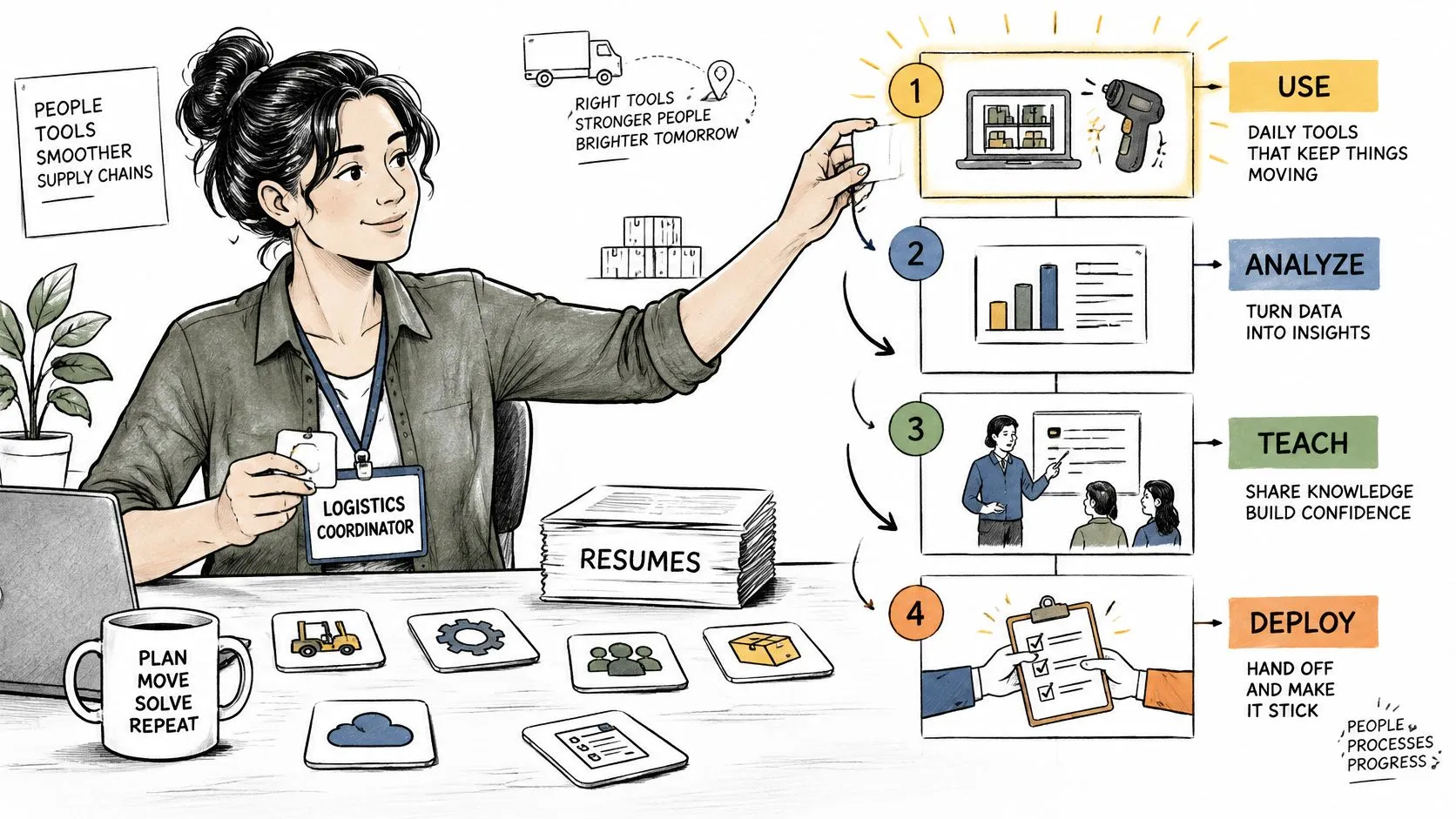
Sort every tool by depth of use, not by how impressive the logo looks. Each depth gets a different verb and a different kind of result.
| Depth Level | When to Use It | Example Phrasing |
|---|---|---|
| Used daily | Part of your weekly workflow | Managed daily dispatch in TMS, flagging late pickups before cutoff |
| Used for reporting | You pulled data for decisions | Built a weekly exception report in Excel for the operations lead |
| Trained others | You taught the tool to someone | Trained two new coordinators on EDI order status checks |
| Supported implementation | You helped roll it out | Tested WMS data fields during rollout to three warehouses |
"Used daily" earns a bullet with an operational outcome attached. "Used for reporting" earns a sentence about the decision the report changed. "Trained others" and "supported implementation" are stronger than most candidates realize, because they show you can transfer knowledge, and that's the exact thing companies say they're short on.
Partial, legacy, and self-taught experience
Career changers, graduates, veterans, and anyone coming from a smaller firm rarely have a tidy system history. That's fine. Describe the system you had, at the depth you had it, and attach an outcome.
Adjacent evidence counts. Reconciling EDI records by hand. Building a spreadsheet tracker for recurring delivery exceptions. Improving handoff visibility between the warehouse and customer service. These are tool-enabled decisions in everything but name, and naming the decision is the point.
If your system work leans toward stock and replenishment, inventory management resume covers the phrasing that fits that desk. Otherwise, apply the rule: keep only the tools you can explain in one interview answer, and cut the rest. A short honest list beats a long one you can't defend.
Certifications to List Honestly
A certification does not decide the hire. Certification is not typically required for logisticians, and organizational ability matters because the role involves tracking detailed records across many responsibilities, as this logistician career overview explains. Credentials can support your experience, but they cannot replace evidence of what you did.
Recognized options include the Certified Professional Logistician, ASCM's Certified in Logistics, Transportation and Distribution, the Institute for Supply Management's Certified Professional in Supply Management, and the SCPro program.
| Credential | Issuing Body | Listing Format |
|---|---|---|
| Certified Professional Logistician | International Society of Logistics | Credential, issuer, status, year |
| Certified in Logistics, Transportation and Distribution | ASCM | CLTD, ASCM, 2025 |
| Certified Professional in Supply Management | Institute for Supply Management | CPSM, ISM, 2025 |
| SCPro program | CSCMP | SCPro, CSCMP, year |
List the exact credential, issuing organization, status, and year. If you are still completing it, label it in progress and include the expected date. A course is not a certification, so do not present one as a credential. Likewise, leave off an expired certification unless you clearly label its status. For guidance on placement and formatting, see how to put certifications on a resume.
For logistics coordinators, credentials work best as supporting evidence. Your bullets should show your contribution to the work, while any results or numbers should stay within what you can substantiate. A certification can establish relevant training, but it does not prove savings or ownership of a team KPI.
The certification supports the bullets. It never carries a claim the work itself has to prove.
Rewrite One Role This Week
Pick your most recent role. Rewrite one bullet. Not the whole resume, one bullet, using scope, action, metric, tool.
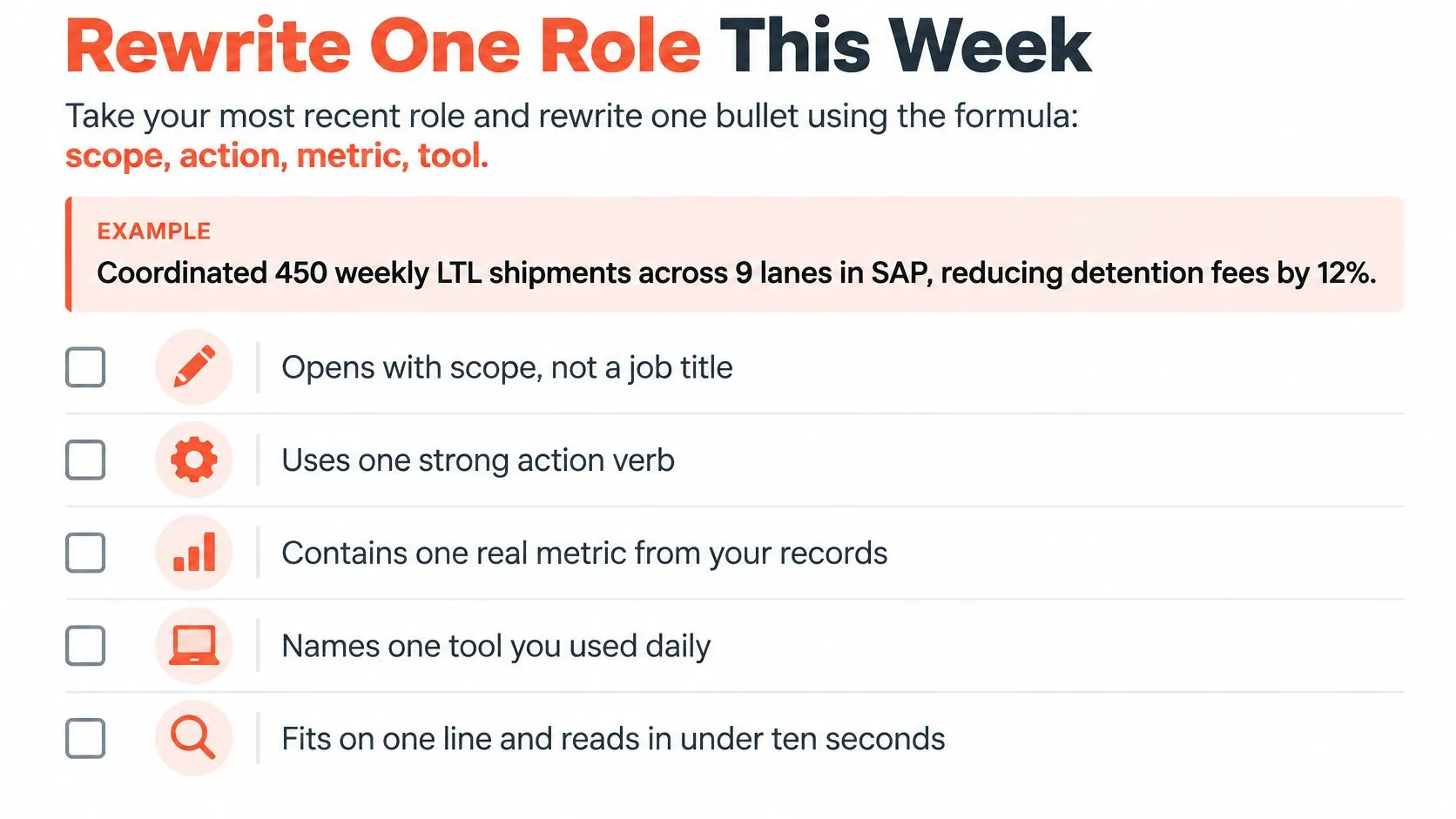
Then run it against five tests.
- It passes the four point check. Action verb, logistics object, method or system, result.
- Every number traces to a record you can name. Report, scorecard, ticket log, roster.
- Each tool ties to an outcome. No feature lists, no software inventory.
- Each certification carries issuer, status, and year.
- No savings you can't defend in an interview. Nothing borrowed, nothing rounded into fiction.
If the bullet passes, repeat the exercise on two earlier roles. If it fails, cut the weakest part first, which is almost always the number, and rebuild it from your records rather than your memory.
You're not under-qualified. You're under-described. The proof is sitting in your dispatch reports right now.
Describing your work worse than you did it is easy, which is why a blank page is the wrong place to start. StoryCV interviews you about the job, asks the follow-up questions you wouldn't ask yourself, and turns the answers into bullet points. Every number in those bullets comes from your own answers, the free start includes two finished bullet points, and a full resume takes hours rather than days.
If the numbers are already sitting in your TMS exports and ticket logs, the only missing piece is the translation, and that's the part StoryCV handles. It interviews you about the work the way a good editor would, then writes bullet points you can defend line by line, each one traceable to something you did. Start with StoryCV and bring one role. You'll have a rewritten bullet before you'd have finished formatting a template.