You have a CV. You also have a resume. You think they’re the same thing. They’re not.
And sending the wrong one will get your application deleted before anyone reads it.
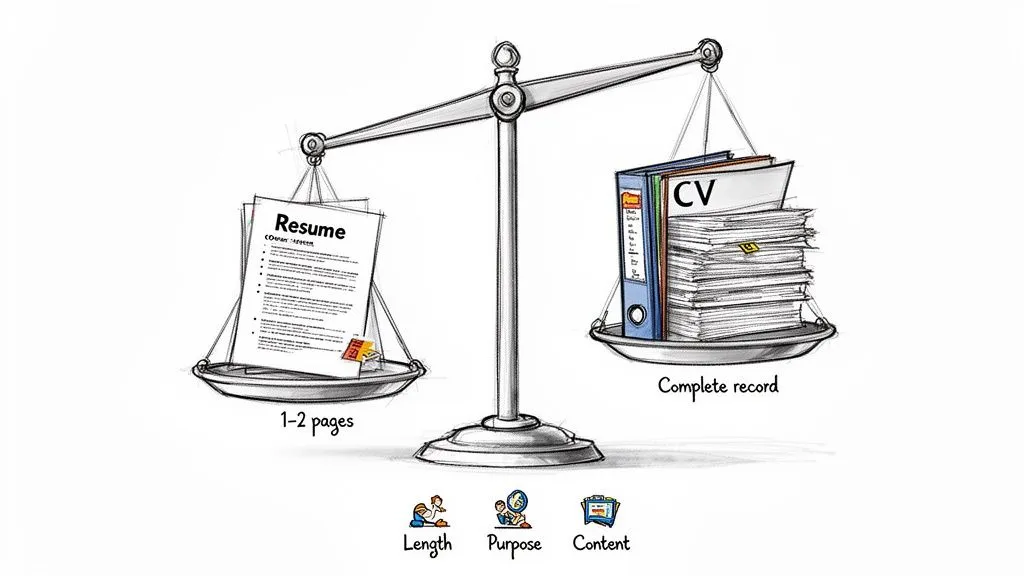
A resume is a short, sharp marketing document. 1-2 pages, tops. Its only job is to get you a specific job. It’s a sales pitch.
A CV (Curriculum Vitae) is a detailed record of your entire career. It’s long. It grows as you do. It’s an archive.
One sells. The other documents. Knowing the difference is critical.
CV vs Resume: The Quick Breakdown
Let’s cut the fluff. Here’s the difference in plain English. This isn’t about length; it’s about purpose.
| Attribute | Resume | CV (Curriculum Vitae) |
|---|---|---|
| Purpose | To land a specific job interview. It’s a sales tool. | To give a full overview of your academic and professional life. It’s a historical record. |
| Length | Strictly 1-2 pages. Anything more is a mistake. | No page limit. 3-10+ pages is normal for experienced academics. |
| Content | A tailored summary of skills and results relevant to one job. | An exhaustive list of publications, grants, research, and awards. |
| Audience | Recruiters, hiring managers. They spend seconds on it. | Academic committees, research institutions. They read everything. |
| Lifespan | Disposable. You create a new version for each job. | Permanent. You add to the same document forever. |
In the US and Canada, this distinction is rigid. A resume is for corporate jobs. A CV is for academia, science, or medicine. That’s it. 98% of Fortune 500 companies use software (ATS) that rejects long, untargeted documents. A concise resume is non-negotiable.
Applying abroad? The rules flip. In the UK and Europe, "CV" is often used for what Americans call a resume. But they’re not identical. You can learn more about how these document differences vary by country on topcv.io.
A resume is a persuasive argument. A CV is a statement of fact. One gets you in the door. The other proves you belong in the room.
The Resume: A Marketing Document, Not a Life Story
Your resume is a 30-second commercial, not a movie. Its only job is to get you an interview. It sells one thing: you.
Most people treat their resume like a boring archive of every task they’ve ever done. That’s why most people get ignored.
A great resume is a targeted argument. It proves you are the direct solution to a company’s specific problem. You have less than ten seconds to make your case. Every word must earn its place. If it doesn’t scream "I can solve your problem," cut it.
Strategy Over Templates
Forget the soul-crushing templates. Filling out boxes is for machines. A strategic resume is built to grab and hold a hiring manager's attention.
- A Sharp Summary: Ditch the fluffy objective. State who you are and what you deliver. Right at the top. If this part has you stuck, find advice on how to describe yourself in a resume.
- Reverse-Chronological Experience: Newest job first. It’s the standard for a reason. It shows what’s relevant now.
- Quantified Impact: This is where you win. Don’t list responsibilities. Show your results. Use numbers.
Your resume isn't about what you did. It's about what you achieved. "Managed a team" is a task. "Grew a team from 3 to 10" is an achievement.
From Responsibilities to Results
Let's turn a weak bullet point into a strong one. This is the most important skill in resume writing.
Before (Weak & Vague):
* Managed the marketing team and ran campaigns.
This says nothing. It’s lazy. It’s the job description, not the result.
After (Strong & Specific):
* Led a 4-person marketing team to execute 12+ multi-channel campaigns, increasing marketing-qualified leads by 45% in six months.
That tells a story. It shows leadership, execution, and measurable business impact. Need help formatting this? Check out this guide on how to list skills on your resume.
Every bullet point is a chance to sell. Don't waste it.
The CV: Your Comprehensive Professional Archive
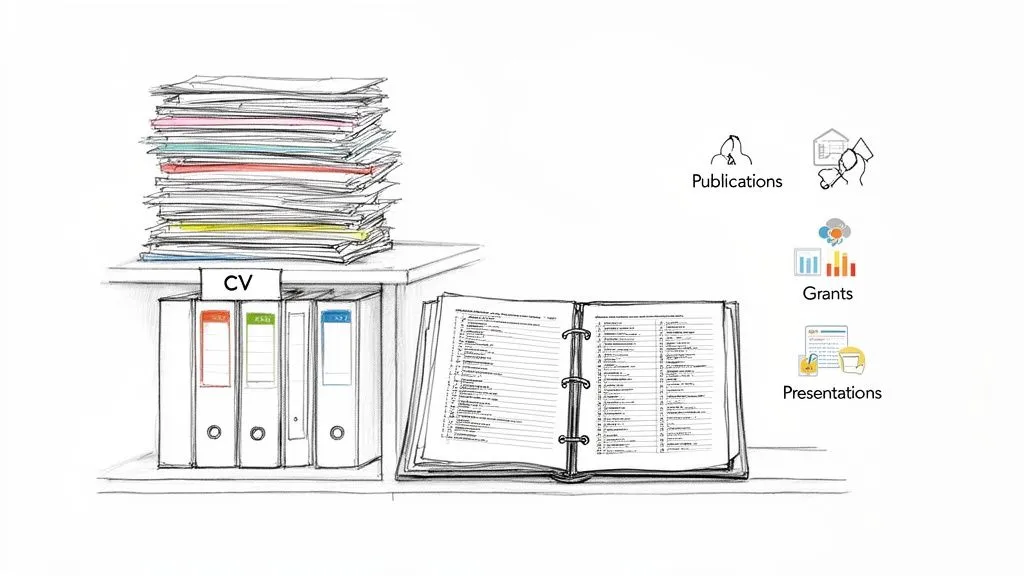
If a resume is a targeted strike, a Curriculum Vitae (CV) is the full campaign history. It’s not for a corporate job. It's a comprehensive archive of your academic and professional journey.
It's for fields where deep history matters: academia, scientific research, medicine. Its purpose is to show your long-term contributions to a field, not to sneak past a robot for a project manager gig. This is why a 10+ page CV is normal. It grows with you, cataloging every new publication, grant, and conference.
The Core Components of a CV
A CV includes everything a resume does, then goes much further. It’s where you prove you’re a serious contributor to your discipline.
Key sections that set a CV apart:
- Publications: A complete list of all your published works—journal articles, books, chapters.
- Conference Presentations: Every paper, poster, or talk you've delivered.
- Research Grants and Fellowships: All funding you've secured.
- Professional Affiliations: Memberships in relevant organizations.
- Teaching Experience: A detailed list of courses taught.
This detail is the currency of your academic career. If you're building one, our graduate student CV sample is a solid starting point.
A CV doesn’t sell potential. It documents a proven track record. It’s evidence, not advertising.
Structuring Your Academic Contributions
How you present this information is critical. It must be clean, professional, and follow the citation conventions of your field. Sloppy formatting signals a lack of attention to detail—a fatal flaw.
Clarity and consistency are everything. No creativity. Stick to the standard.
Example Publication Entry (APA Style):
* Stone, A. M., & Miller, J. (2023). The Impact of Quantum Computing on Data Encryption Protocols. Journal of Applied Physics, 134(5), 051101.
Example Conference Presentation Entry:
* Davis, R. L. (2024, March). Navigating Neural Networks for Advanced AI Modeling. Paper presented at the International Conference on Machine Learning, Austin, TX.
Each entry is a testament to your work. Your CV is your intellectual ledger. It’s your full story, written for an audience that wants every single page.
How Geography Dictates Your Document Choice
Sending a US-style resume for a job in London is a rookie mistake. It gets you tossed. The difference between a CV and a resume isn't just about the words; it's about where you’re sending it. The rules change when you cross a border.
What flies in North America will fail in Europe. What's expected in Asia might be illegal in the US. Ignoring this looks lazy. It tells an employer you couldn’t be bothered to do five minutes of research.
North America: The Resume Is King
In the US and Canada, the rules are simple. For any job outside of academia or medicine, you use a resume. Short, tailored, 1-2 pages. All about results.
Crucially, you must strip out personal information. Do not include:
* A photograph
* Your date of birth
* Your marital status or nationality
This isn't a suggestion; it’s driven by anti-discrimination laws. Sending a resume with a headshot is a massive red flag.
A CV only exists here in academic circles. Applying for a software job? Resume. Applying for a tenured professorship? CV.
UK and Europe: The CV Is Standard
Across the Atlantic, the terminology flips. In the UK and most of Europe, "CV" is what they call a resume. It’s the standard document for almost any job.
But it’s not just a name change. A European CV is typically two pages. Three is pushing it. It’s still focused on professional experience but may include more personal details.
In Germany, for example, the Lebenslauf (CV) has traditionally included a professional photo and date of birth. This is becoming less common but still pops up.
The point: even within Europe, the rules vary. Always research the specific country.
Asia and The Middle East: Details Matter
In many parts of Asia and the Middle East, the CV is also standard, and it often requires personal details that are illegal in the US. Employers there frequently expect:
* A photograph
* Nationality and visa status
* Date of birth
* Marital status
These expectations are rooted in different cultural norms. Knowing your visa status is a practical necessity in global hubs like Dubai or Singapore. Our guide to a curriculum vitae in Singapore explains these local expectations.
A single LinkedIn ad in Dubai can attract 285 applicants. Compare that to the UK's average of 48.7. You can't afford a simple mistake. A US resume has no personal info. A CV for the UAE might require your marital status and visa details. Different game, different rules.
Choosing The Right Document For Your Goal
Picking the wrong document is like showing up to a marathon in hiking boots. You lose before you start. The choice between a CV and a resume is about your goal and your industry.
Corporate, government, or non-profit role? Resume. Professorship, research grant, or medical fellowship? CV.
Getting this right is critical. An estimated 75% of submissions fail before a human sees them. With 98% of Fortune 500 companies using automated systems, a concise, keyword-focused resume is non-negotiable for most jobs in North America.
Your Career Stage Dictates Your Document
The right choice depends on where you are and where you're headed.
- The Recent Graduate: Your goal is proving potential. A one-page resume is your weapon. Focus on internships, projects, and skills.
- The Mid-Career Specialist: You have a track record. A two-page resume is fine. Show quantified achievements and career growth. Prove you've solved their problems before.
- The Career Changer: Your challenge is connecting the dots. Use a resume with a powerful summary that translates past experience into future value. For those rejoining STEM after a career break, framing your journey is everything.
- The Executive: You're selling leadership and vision. A two-page resume highlighting strategic impact, P&L responsibility, and team growth is the standard.
Your document isn't a passive record. It's an active argument for why you are the best person for the job. Choose the format that makes your argument most effectively.
This decision tree visualizes the logic for choosing your document.
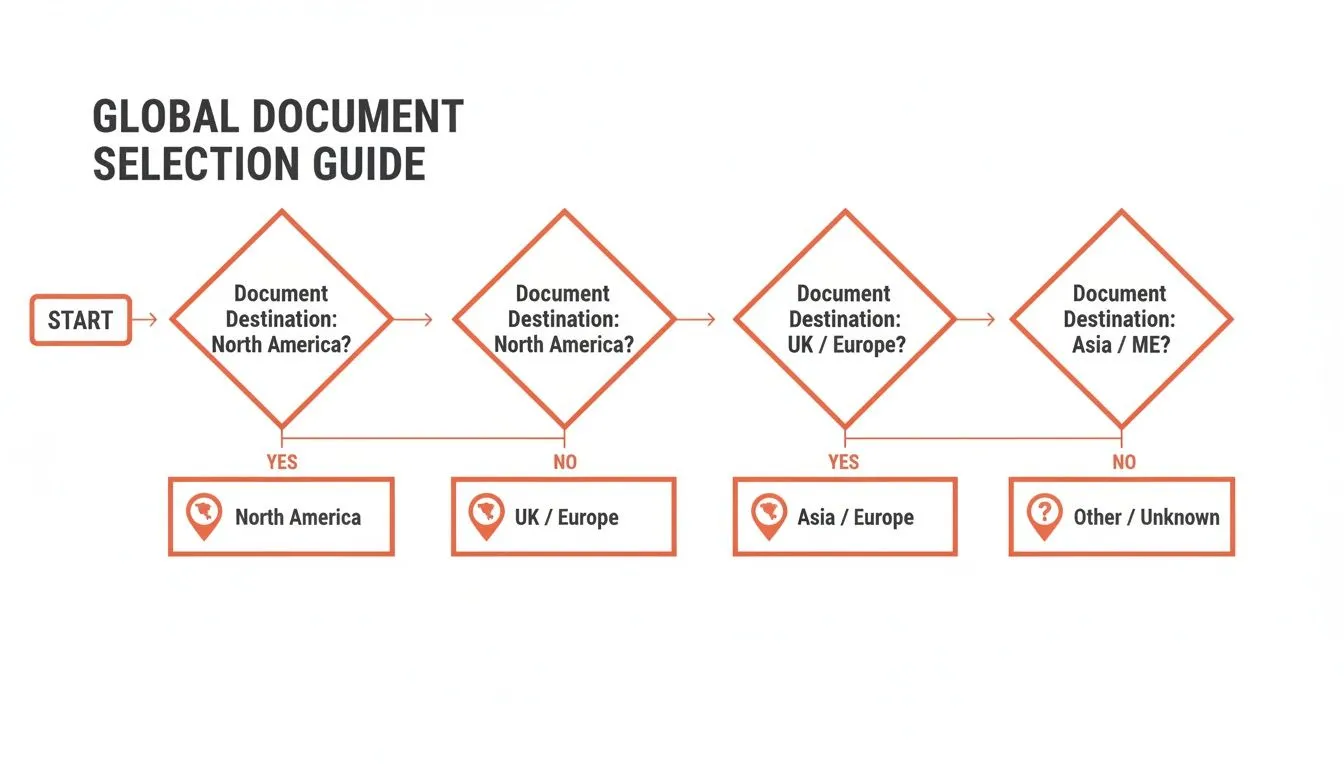
As the flowchart shows, North America has a strict resume-for-industry rule, while the UK and much of Europe default to the CV.
Document Decision Matrix By Role and Region
| Your Goal | Location | Required Document | Key Focus |
|---|---|---|---|
| Corporate/Industry Job | North America (US/Canada) | Resume (1-2 pages) | Quantified achievements, skills, concise impact. |
| Academic Position | Global | Academic CV (3+ pages) | Publications, research, teaching, conferences. |
| Industry/Corporate Job | UK, Ireland, Europe, NZ | CV (Typically 2 pages) | Professional history, skills, brief personal info. |
| Research Scientist (Industry) | Global | Hybrid "Long Resume" | Merges resume impact with key academic credentials. |
Context is everything. Default to the local standard unless the job posting says otherwise.
Navigating The Gray Areas
Sometimes the lines blur. What if you're a Ph.D. applying for a research role at Google? This is a hybrid situation.
Don't send a 15-page academic CV. It’s overkill. They’ll ignore it. But a one-page resume won't do justice to your publications.
The solution is a hybrid document: a "long resume" or "short CV," usually 2-3 pages. Lead with a professional summary and work experience like a resume, but include a curated list of your most relevant publications, patents, and conference talks.
Relevance is the key. Don't list everything. Show you understand both worlds.
Frequently Asked Questions
Still confused? Here are the straight answers. No fluff.
Can I Use a CV Instead of a Resume in the US?
No. Not for a corporate job. Sending a multi-page academic CV for a role in tech or finance is a one-way ticket to the trash. It tells them you don't understand professional norms. They expect a concise, 1-2 page resume. The only exceptions are academia, research, or medicine.
What if the Job Posting Just Says “Submit Your CV”?
It depends on where the company is. If it’s a US-based company, they almost certainly mean "resume." It’s a common mix-up. If the company is in the UK or Europe, they mean a standard two-page professional history—which they call a CV. Check the company’s headquarters.
When in doubt, default to the local standard of the country where the job is. It’s the safest move.
Does a Resume Ever Go Over Two Pages?
For 99% of professionals, no. Even executives with decades of experience use a two-page resume. Brevity proves you can distill what’s important. The only exceptions are some federal government jobs or highly technical roles where a long list of projects or patents is essential. Even then, it’s a "long resume," not an academic CV. Stick to two pages.
Is It Okay to Include a Photo on My Resume?
In the US, Canada, and the UK, absolutely not. It's a major mistake. Anti-discrimination laws are strict, and companies avoid anything that could introduce bias. In other parts of the world, like Germany or parts of Asia, a photo may be expected. But for English-speaking Western countries, leave it off.
What Is the Main Difference Between a CV and a Resume in Simple Terms?
It’s about purpose.
- A resume’s purpose is to sell you for a specific job. It’s a targeted marketing doc.
- A CV’s purpose is to document your entire career. It's a comprehensive archive.
One is an ad. The other is a record. Choosing the right one is the first step.
Tired of fighting with soul-crushing templates? StoryCV is a Digital Resume Writer. We don't give you boxes to fill. We interview you, like a human would, to uncover your real impact. We provide editorial judgment at software speed. Tell your story the right way at Story.cv.