Using the wrong document—a resume vs. a CV—is the fastest way to get your application tossed. It’s not a small detail. It's the first test. A surprising number of smart people fail it.
The difference is more than just length. One is a sharp marketing tool. The other is a full professional history. Knowing which one to use is step one.
Resume vs CV: The Core Difference
You’ve built a great career. Don’t let a simple document choice sink your chances. The resume vs. CV debate isn't abstract. It's a real hurdle that trips up even seasoned pros.
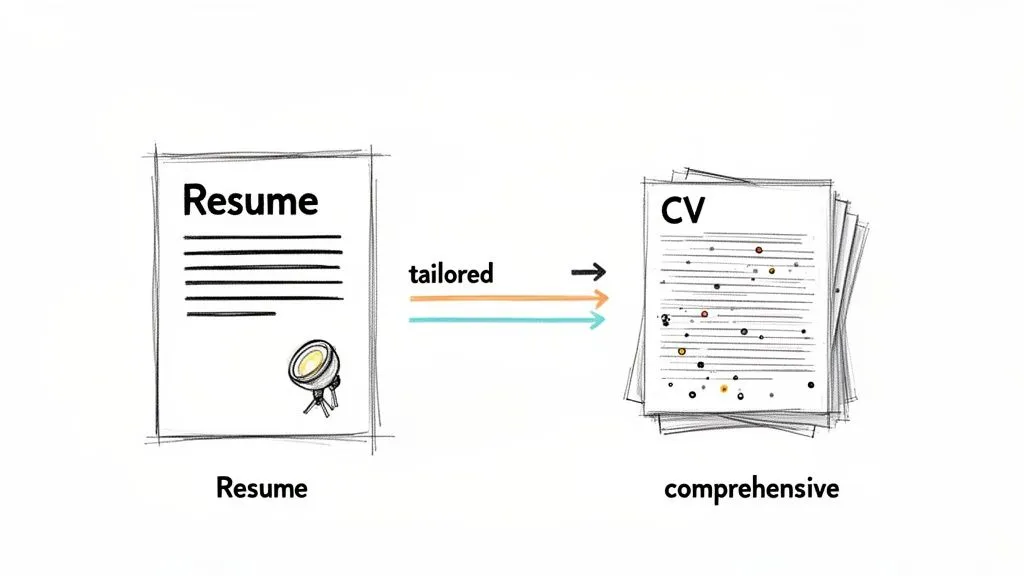
Think of it like this: a resume is a sniper rifle, aimed at a specific target. A CV is a historical archive, documenting your entire journey.
A Tale of Two Documents
Your resume is your highlight reel. It’s a tight summary of your most relevant wins, custom-built for one job. It’s almost always one page, maybe two if you have 10+ years of heavy-hitting experience. Its only job is to convince a hiring manager—fast—that you’re the right person for this role. This is the standard in the US and Canada.
Your CV, or Curriculum Vitae, is Latin for "course of life." And that's what it is. A detailed, multi-page record of your entire academic and professional life. Publications, research, conferences, grants—the works. A CV is the go-to for academia, science, and medicine. It's also the standard for most jobs in Europe, the UK, Asia, and the Middle East. It’s meant to be exhaustive.
Struggling with length? We wrote about whether a resume can be 2 pages.
A CV is not just a long resume. That's the biggest mistake. A resume sells your future value. A CV documents your past accomplishments.
Resume vs CV: A Quick Comparison
Here’s a simple breakdown. No fluff.
| Attribute | Resume | CV (Curriculum Vitae) |
|---|---|---|
| Length | 1-2 pages max. Brevity is key. | 2+ pages. Can be much longer for senior roles. |
| Purpose | To land an interview for a specific role. | To provide a complete professional history. |
| Content | Highly tailored skills and achievements. | An exhaustive list of academic and work history. |
| Primary Use | Corporate jobs in the US & Canada. | Academia, research, and jobs outside North America. |
The format you choose tells the recruiter if you understand the rules. A US hiring manager doesn’t want your life story. An academic committee in Germany will find a one-page summary insulting. Getting this right is an easy win.
The Resume: A Concise Narrative Worldwide
Globally, a resume serves as a strategic presentation. It's not about chronicling every detail; it's about presenting a concise, targeted summary that aligns with a specific job description. Your primary objective is to demonstrate how you can address the employer's needs effectively.
Acting as the executive summary of your career journey, it values the reader's time. For experienced individuals, the task is to condense years of achievements into a compelling narrative that fits within one or two pages.
Why Brevity Wins
The one-to-two-page limit isn't a suggestion. It's a rule. Your resume’s first reader is often a machine—an Applicant Tracking System (ATS). Most corporate, tech, and business roles use them.
98% of Fortune 500 companies use an ATS. These bots are brutal. They reject 75% of documents before a human ever sees them. Recruiters also demand brevity. 90% prefer two-page resumes, and 100% are turned off by anything over four pages.
Every word has to earn its place. It needs to be optimized for the machine and the human who will scan it in seconds.
The resume is simple: past performance, framed correctly, predicts future success. It's not about listing duties. It's about showing quantifiable impact.
From Duties to Impact
A weak resume lists responsibilities. A strong one proves results. A hiring manager doesn't care that you "managed a team." They want to know if you boosted efficiency, grew revenue, or cut costs.
Reframe your experience to show impact:
-
Instead of: "Responsible for managing social media accounts."
-
Try: "Grew organic social media engagement by 45% in six months by implementing a new content strategy focused on user-generated videos."
-
Instead of: "Led a project to update the company website."
-
Try: "Directed a full website redesign, completed two weeks ahead of schedule, which resulted in a 30% increase in user session duration and a 15% drop in bounce rate."
This is storytelling that gets you noticed. It's not about filling a template. It’s about building a case for why you are the best person for the job. Need help building your narrative? Here’s our take on creating your perfect resume.
Sharp, impactful storytelling is the essence of the North American resume. Master it.
The CV: A Comprehensive History for Academia
The Curriculum Vitae (CV) is the standard, and it operates on a different philosophy.
The goal isn't just to prove you can do the job. It's to provide an exhaustive history of your expertise. That's why a CV is longer—often two to three pages, and even more for senior academic or medical professionals.
Detail Is Not a Flaw
Building a resume is an act of subtraction. A CV is built on inclusive detail. It’s a static document designed to chronicle your career in full. It includes sections you'd cut from a resume without a second thought.
What's expected in a global CV?
-
Full Employment History: A detailed, chronological list of every role.
-
Complete Academic Credentials: Degrees, theses, dissertations.
-
Publications and Research: A full list of articles, papers, or books.
-
Presentations and Conferences: A record of where you've spoken.
-
Awards and Grants: Any professional or academic honors.
This level of detail matters. In many global contexts, your entire career trajectory is relevant. If you're building an academic document, our guide on a graduate student CV sample is a good starting point.
Navigating Regional Nuances
Be warned: CV formats vary by country. In the UK and much of Europe, 'CV' is standard for most jobs, and they typically run two to three pages. By 2026, an estimated 85% of UK job postings will demand a CV.
But one global CV doesn't fit all. France has an optional photo. Italy may require more personal info. But they all prioritize detail over American-style brevity. A photo might be expected in Germany but is a red flag in the UK. To understand standardized formats, it's worth learning What Is a Europass CV.
Globally, a one-page resume can seem incomplete. Even disrespectful. It suggests you didn't bother to present your full qualifications.
Submitting the right document shows you understand the local culture. It’s the first sign you’re a serious candidate. Ignoring these norms gets your application tossed.
How to Choose the Right Document for the Job
Picking the wrong document is an unforced error. This isn't about memorizing rules. It's about understanding context.
A Modern Decision Framework
The outdated approach of choosing between a resume or CV based solely on location is no longer effective. Here’s a refreshed perspective:
Key Considerations
-
Marketing Focus: Regardless of the term used—CV or resume—your document should market your skills effectively. Recruiters globally spend limited time on each application, so focus on relevant achievements and tailor your content to match the job description.
-
Content Over Length: In regions like the UK and Australia, a CV is usually two pages, similar to a US resume. However, it should highlight your most recent 10–15 years of experience. Avoid listing every position from your entire career to prevent age bias.
-
Dynamic Approach: With ATS in play, no document should remain unchanged. Customize your CV or resume with keywords and content tailored to each specific job opportunity.
-
Regional Trends: While photos were once common in German applications, many firms now opt for "blind recruitment" to combat bias. Check job postings for guidelines on including photos, especially for DEI compliance.
-
Document Length and Respect: A concise, impactful one-page document can be more effective than a longer, detailed CV, especially in fast-paced industries like Tech or Startups. Efficiency is valued over length.
Practical Application
-
Tech Role Globally: When applying for a tech position, use a focused, one-page document highlighting key achievements and skills relevant to the role, regardless of location.
-
Academic Position Globally: For academia, an in-depth CV is necessary, but ensure it is still targeted and relevant, focusing on significant achievements and contributions.
-
Corporate Role Internationally: If applying to a multinational corporation, examine the job posting and adjust your document length and content based on industry norms and company culture.
Ultimately, understanding the expectations of the industry and organization is crucial. Adapt your documents to reflect the role and demonstrate your understanding of the hiring process.
Crafting Your Narrative Beyond Templates
So you know the difference. Great. But that just gets you in the door.
The real challenge isn’t picking the right document—it’s what you put inside. Most people grab a template and fill in the blanks like it’s a tax form. This is a mistake.
Templates are for machines. Storytelling is for humans. Your ability to tell a clear, confident story is what separates you from everyone else.
From Duties to Impact
Your job wasn't a list of responsibilities. A job description lists duties. Your resume or CV needs to show impact. No one cares that you were "responsible for project management." They want to know if you delivered that project on time, under budget, and what changed because of it.
This is the core of professional storytelling: turning boring duties into a narrative of achievements.
Here’s how to start:
-
What was the problem? The situation you had to fix.
-
What did you do? The specific actions you took.
-
What was the result? Quantify it. Percentages, dollars, time saved.
This small shift moves you from a passive list of tasks to an active demonstration of your value. It’s the difference between "managed social media" and "grew follower engagement by 35% in Q2 by launching a targeted video campaign."
The Problem with Templates and AI Wrappers
Templates are for conformity, not distinction. They cram your unique career into a soulless structure that makes you look like everyone else.
Most AI tools make it worse. They scrape keywords, stuff them into your document, and spit out robotic bullet points. It might pass an ATS scan, but it fails the human test. It reads like a machine wrote it, because one did.
Templates crush authenticity. They encourage you to list what you did, not what you achieved. The goal isn't to fit in; it's to prove you can make a difference.
This is how you get lost in a sea of identical, keyword-stuffed applications. You become another faceless document in a stack of hundreds.
Uncovering Your Authentic Story
Your professional story already exists. You just need to tell it well. It’s buried in your projects, the challenges you navigated, and the results you delivered. This is where an intelligent approach makes a difference.
StoryCV isn't another template library or AI wrapper. We are your Digital Resume Writer. We use a smart, interview-based process to pull the narrative of your impact out of you. We help you find the words to describe your achievements with confidence and clarity.
The point is a document that's both ATS-friendly and authentically yours. A clear, compelling case for why you are the right person for the job, grounded in real results. This is how you stop competing and start connecting.
A Few Lingering Questions
You've got the big picture. But tricky situations pop up. Here are quick, no-BS answers to common questions.
Can I Use the Same Document for Jobs in the US and UK?
No. Don't do it. A multi-page CV for a corporate US job will get trashed for being too long. It signals you haven't done your homework.
A one-page resume for a role in the UK or Germany will make you look inexperienced. Always tailor your document to the location. The job posting is your best clue.
How Do I Convert My CV Into a Resume?
Think strategic editing, not just cutting. It’s a rewrite.
Start by removing everything not directly relevant to this specific job. Axe long publication lists, minor conferences, or old coursework. Then, transform your experience from a passive list of duties into punchy, achievement-focused bullet points with hard numbers.
Your goal is to turn a historical record into a sharp marketing document. One or two pages.
Converting a CV to a resume isn't about shortening it; it's about sharpening it. The focus shifts from 'everything I've done' to 'the specific value I will deliver.'
Should I Include a Photo on My Document?
This is all about geography.
In the US, UK, and Canada, never include a photo. It’s unprofessional and opens the door to hiring bias. It's a major red flag.
In many parts of mainland Europe (like Germany) and some Asian countries, a professional headshot is often expected. Research local customs. When in doubt, leave it out. It's the safest bet.
How Long Should My Resume Be With Over 15 Years of Experience?
Forget the one-page rule. For professionals with 10+ years of relevant experience, two pages is fine. Don't sabotage your story to meet an outdated page limit.
Relevance matters more than length. Dedicate page one to your most impactful roles from the last 10-15 years. Older experience can be condensed into a "Previous Professional Experience" section with just titles and company names. Highlight your most recent, potent value—not every job you've ever had.
Tired of fighting with templates and generic AI? StoryCV is a Digital Resume Writer that helps you articulate your real impact. We don't fill in blanks; we use a smart, interview-based process to uncover the powerful story your career has already written. Get started and write your first role for free at https://story.cv.