You’ve done the work. Internships, late-night projects, club leadership. Maybe a part-time job that taught you more than any textbook.
But your resume feels flat. A generic list of tasks. You follow the templates, fill the boxes, and hear nothing back.
The problem isn't your experience. It's how you tell the story. Most student resume advice is broken. It obsesses over fonts, not impact.
This isn't about crushing your skills into a soulless template. It's about communicating your value so recruiters notice. To stand out, you need to know how the job market for students is evolving and adapt.
This guide is different. No fluff. Just practical resume tips for college students to get you past the bots and into the interview. Let's start.
1. Lead with Impact, Not Duties
Recruiters don’t care what you were supposed to do. They care what you did.
Listing duties makes your resume a generic job description. Not a highlight reel. This is the most crucial of all resume tips for college students. Showing results is the fastest way to stand out when your work history is thin.
Reframe every experience around its outcome. Stop describing tasks. Start quantifying achievements. This shifts the focus from your responsibilities to the value you created.

From Duties to Impact: Real-World Examples
- Before: Responsible for social media posts.
-
After: Grew Instagram followers from 2K to 3.2K in one semester, increasing engagement by 40% with a new content strategy.
-
Before: Helped with a marketing campaign.
-
After: Contributed to a campaign that generated 150 qualified leads, a 25% increase over the previous quarter.
-
Before: Assisted customers at the help desk.
- After: Resolved 95% of customer inquiries on first contact, cutting follow-up tickets by 15%.
How to Find Your Impact
Quantifying isn't as hard as it sounds.
- Start with an Action Verb: Use strong verbs. Created, Managed, Increased, Reduced, Optimized.
- State What You Did: Briefly describe the project or task.
- Show the Result: Use numbers. Percentages. Concrete outcomes. Prove you were effective.
If you can’t find the numbers, ask a former boss or professor. Even a solid estimate beats a vague description. For more help, learn how to write about your achievements in a resume.
2. Tailor Your Resume to the Job Description
Sending the same resume everywhere is like using one key for every lock. It doesn’t work.
Employers want to see you understand their needs. A generic resume screams you don’t. This is one of the most vital resume tips for college students. It proves you did your homework and want this role, not just any role.
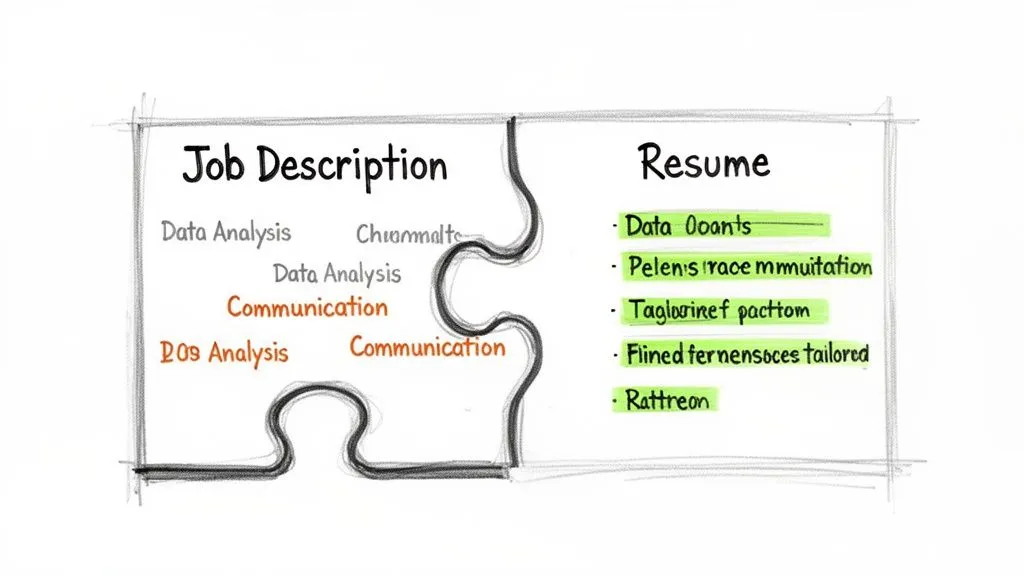
The goal is strategic alignment. Don't just stuff keywords to trick a bot. Thoughtfully map your experience to the company's needs. Connect the dots for the recruiter. Make it impossible for them to ignore you.
From Generic to Targeted: Real-World Examples
- For a Data Analytics role: Emphasize your stats coursework and a Python project analyzing sales data. Not your lifeguarding job.
- For a Product Management position: Highlight group project collaboration and user research you did for a class.
- For a Software Engineering role: Feature the specific languages (React, Java, SQL) from the job post and link them to your GitHub projects.
How to Tailor Your Resume
Customizing is fast. Keep a "master resume" with everything. Then, for each application:
- Analyze the Job Description: Find the key skills and responsibilities.
- Mirror Their Language: If they say "stakeholder communication," you say "stakeholder communication."
- Reorder Your Bullets: Put the most relevant achievements at the top of each section.
- Swap Experiences: Only include projects that address the role's needs.
This targeted approach shows you’re a thoughtful candidate. Dive deeper into tailoring your resume to the job description to make your application stand out.
3. Leverage Transferable Skills from Non-Traditional Experience
Your part-time retail job, campus club, or group project matters.
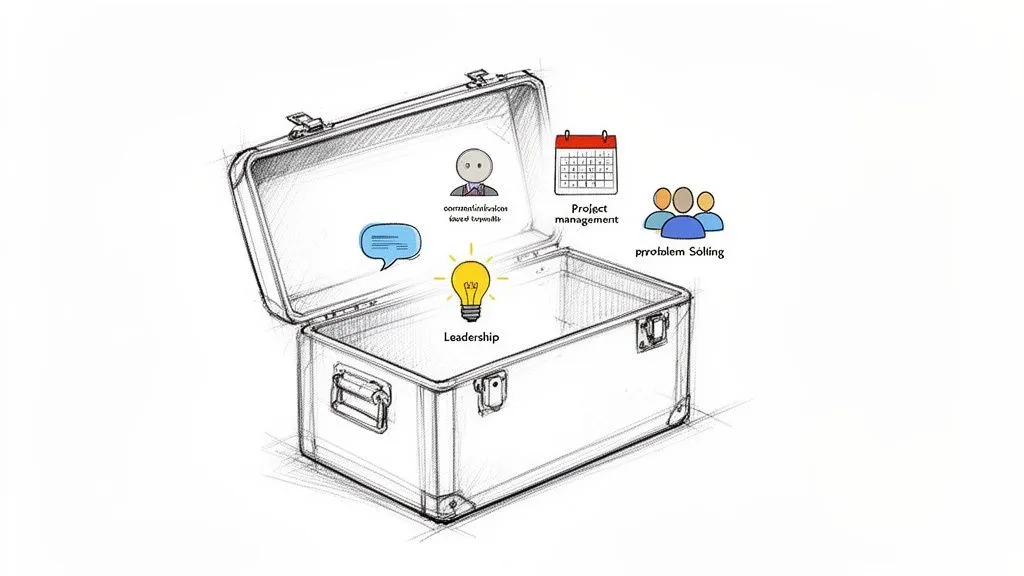
Don't dismiss it. Students often think only formal internships count. This is a huge mistake. Employers hire for skills, not just job titles. Those "unrelated" roles are packed with leadership, project management, and communication skills.
This is one of the most effective resume tips for college students. It teaches you to translate everyday experience into business-relevant language. Your campus club role wasn't just organizing meetings; it was budget management. Your retail job wasn't just stocking shelves; it was customer conflict resolution.
From Activities to Assets: Real-World Examples
- Before: President of the Marketing Club.
-
After: Led a 15-member team to boost event attendance by 30%, managing a $5,000 budget and securing two corporate sponsorships.
-
Before: Worked on a group project for class.
-
After: Coordinated a 4-person team to deliver a semester-long market analysis project, presenting findings to a panel of 3 professors.
-
Before: Part-time barista.
- After: Managed high-volume customer flow during peak hours, resolving 98% of issues on the spot and training 4 new team members.
How to Uncover Your Skills
Think like a hiring manager. What problems did you solve?
- Use Business Verbs: Coordinated, Managed, Negotiated, Optimized, Spearheaded.
- Detail the Task: What were you specifically doing?
- Prove the Outcome: Connect your actions to a result. Use numbers to show growth, efficiency, or success.
Ask yourself: "Who did I work with?" "What was the budget?" "How did I make things better?" An estimated impact is better than no impact at all.
4. Include Relevant Coursework and Projects Strategically
Your academic work is valuable real estate. But listing "Intro to Marketing" is a waste of space.
Showcase specific projects and case studies that prove you have the skills. This is one of the most effective resume tips for college students because it turns theory into tangible proof.
The key is selectivity. Don't dump your whole transcript. Curate your academic achievements to match the job requirements. This shows recruiters you understand what they want.
From Course Names to Career-Ready Proof
- Before: Coursework: Data Analytics
-
After: Capstone Project: Built a predictive model in Python analyzing 50K+ customer records, achieving 87% forecast accuracy.
-
Before: Marketing Major
-
After: Case Competition Winner: Developed and presented a go-to-market strategy for a fintech startup to an executive panel.
-
Before: Computer Science Projects
-
After: GitHub Portfolio: Created 5+ full-stack projects using React/Node.js, including an application with over 1,000 active users.
-
Before: Relevant Skills: Salesforce, Google Analytics
- After: Certifications: Salesforce Administrator, Google Analytics IQ, HubSpot Inbound Marketing (all completed 2024).
How to Showcase Your Academic Wins
- Be Selective: Only include projects or coursework relevant to the job.
- Use Specific Titles: Create a clear title for each project, like a professional role.
- Link to Your Work: Add links to your GitHub, online portfolio, or published work.
- Highlight Skills and Outcomes: Focus on the tech you used (Python, React) and the results you achieved.
5. Optimize for Both Bots and Humans
Your resume has two audiences: a machine and a person. Ignore one, and you fail.
Many students create resumes that either fail the bot scan or bore the human. The solution isn't to pick a side. It's to create a resume that works for both. An effective resume passes the Applicant Tracking System (ATS) filter, then engages a human with clear achievements.
This is a critical resume tip for college students. A resume that pleases the machine but fails the human is useless.
From Bot-Friendly to Human-Readable: Real-World Examples
-
Font Choice:
- Before: A cool, custom font.
- After: A standard font like Calibri, Arial, or Georgia. It ensures the ATS can read it.
-
Job Title:
- Before: Sales Rep (Top Performer) ⭐
- After: Sales Representative. Keep titles clean. Save achievements for the bullet points.
-
Keyword Integration:
- Before: Skills: Salesforce, HubSpot, CRM.
- After: Weave keywords in naturally: Managed 500+ leads using Salesforce CRM.
How to Build a Dual-Purpose Resume
It doesn’t require complex tricks. Just a clean, logical approach.
- Use Standard Section Headers: Experience, Education, Skills. No creative titles the ATS won't understand.
- Avoid Complicated Formatting: Tables, columns, and graphics confuse the bots. A single-column layout is safest.
- Integrate Keywords Naturally: Pull keywords from the job description and embed them in your achievement bullets.
- Save as a PDF: It preserves your formatting. What you see is what the recruiter gets.
Learn more about how to build my perfect resume to ensure it’s built for impact.
6. Use Specific Numbers to Quantify Impact
"Improved efficiency" is resume kryptonite. It's vague and forgettable.
The antidote is quantification. Numbers make your achievements concrete. They prove you delivered real value. This is one of the most powerful resume tips for college students because it validates your skills, even with limited experience.
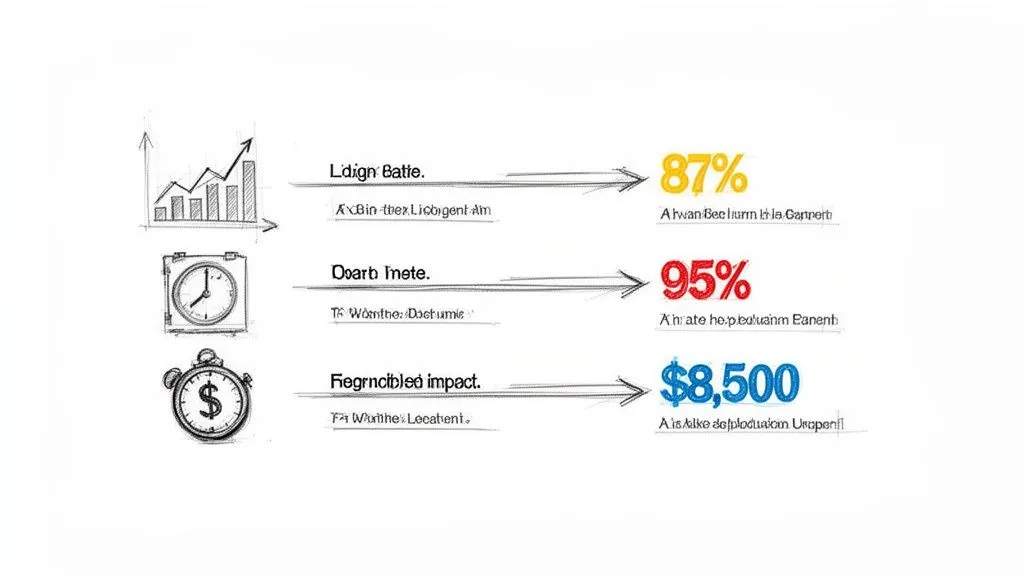
Numbers transform your resume from a list of claims into a portfolio of evidence. A recruiter will always choose the candidate who grew a fund by 20% over one who just "helped with fundraising."
From Vague to Valuable: Real-World Examples
- Before: Improved customer satisfaction.
-
After: Increased customer satisfaction score from 7.2 to 8.7/10 (20.8% improvement) based on post-interaction surveys.
-
Before: Reduced errors in data entry.
-
After: Implemented a new data validation process that cut entry errors by 35%, saving an estimated 4 hours of correction work per week.
-
Before: Helped with a campus fundraiser.
- After: Coordinated a campus fundraiser that raised $8,500, exceeding the goal by 20%.
How to Find Your Numbers
Finding metrics is easier than you think.
- Start Tracking Now: Don't wait. Note down key metrics for any project as you go. You'll forget the details later.
- Use the Right Metric: Percentages for efficiency gains. Absolute numbers for scale. Timeframes for growth.
- Estimate Conservatively: A well-reasoned estimate is better than nothing. Just be prepared to explain it.
- Quantify the Scope: If you can't find a result, quantify your responsibility. “Managed a team of 8 volunteers” or “Coordinated a project with 12 campus organizations.”
7. Tell a Coherent Career Story
Your resume isn't just a log of jobs. It's a marketing document. It should tell a story about where you’ve been and where you're going.
Hiring managers want to see how your experiences connect. A strong narrative can link unrelated internships, projects, and part-time jobs into a compelling professional identity. This is one of the most powerful resume tips for college students.
A coherent story helps recruiters understand your logic. It explains why a finance intern is now applying for a tech role. Without a narrative, your resume is just a random collection of tasks. The recruiter won't connect the dots for you.
From Disconnected Roles to a Clear Path: Real-World Examples
- Before: A list showing a finance internship, a coding bootcamp certificate, and a role as a campus tour guide.
-
After: A summary states: "Driven by an interest in user-centric financial technology, I leveraged my analytical background to develop practical development skills. Seeking a product analyst role to combine quantitative insights with a passion for building great user experiences."
-
Before: A resume with experiences in retail, event planning, and a marketing class project.
- After: The experience section highlights customer interaction and project coordination, framed by a summary focused on a career in brand marketing.
How to Build Your Narrative
This is about strategic presentation, not fabrication.
- Write a Professional Summary: Start with a 2-3 sentence summary. This is your pitch. It frames your entire story.
- Order Experience Thematically: If it strengthens your story, group relevant projects together instead of using strict chronological order.
- Use Consistent Language: Weave common keywords and themes throughout. If your story is about data analysis, use words like analyzed and quantitative in multiple sections.
Think of yourself as the protagonist. Each bullet point should move your character toward the job you want.
8. Show a Growth Mindset and Continuous Learning
Employers don’t just hire you for the skills you have now. They invest in who you’ll become.
Showing you actively seek new knowledge proves you're adaptable, motivated, and a low-risk hire. This is a powerful strategy in our list of resume tips for college students. It shifts the focus from limited experience to unlimited potential.
Frame your experiences as a story of continuous improvement. Don't just list a skill. Describe how you acquired it and applied it to create value. This shows initiative and curiosity.
From Static Skills to Dynamic Growth: Real-World Examples
- Before: Used Salesforce for data entry.
-
After: Taught myself Salesforce automation, reducing manual data entry by 10 hours/week and improving accuracy by 15%.
-
Before: Social Media Intern.
-
After: Advanced from intern to managing paid ad strategy after self-directed learning in analytics led to a 20% increase in campaign ROI.
-
Before: Worked in a support role.
- After: Identified a training gap and created onboarding documentation that cut new hire ramp-up time by two weeks.
How to Showcase Your Learning Journey
Proving your growth mindset is about connecting learning to outcomes.
- Lead with Initiative: Start with phrases like Taught myself, Self-directed learning in, or Identified an opportunity to.
- Name the Skill: Clearly state what you learned (e.g., Google Analytics, Python).
- Demonstrate the Application: Explain how you used that new skill to solve a problem or improve a process.
To tell a coherent career narrative, present a clear picture of your development. Reviewing a comprehensive checklist, like a Medical School CV Checklist, can help ensure all key accomplishments highlighting your journey are presented. A dedicated "Certifications" section can also neatly package your efforts.
8-Point Comparison of Resume Tips for College Students
| Approach | Implementation Complexity 🔄 | Resource Requirements ⚡ | Expected Outcomes ⭐📊 | Ideal Use Cases 💡 | Key Advantages ⭐ |
|---|---|---|---|---|---|
| Lead with Impact, Not Just Duties | Moderate 🔄: needs reflection and reframing | Low ⚡: time + mentor feedback | High ⭐📊: clearer achievements, stronger interview narratives | Students with limited formal work; internship applicants | Differentiates applicants; aligns with hiring manager evaluation |
| Tailor Your Resume to the Job Description | High 🔄: customize per application | Moderate ⚡: time per application, ATS tools | Very High ⭐📊: higher ATS pass-through and callbacks | Competitive roles; varied-role applications | Makes qualifications immediately relevant; boosts callbacks |
| Leverage Transferable Skills from Non-Traditional Experience | Moderate 🔄: translate soft skills to business language | Low ⚡: inventorying experiences, brief validation | Medium‑High ⭐📊: expands usable experience, shows breadth | Students without internships; career changers | Maximizes value of diverse experience; shows cross-functional skills |
| Include Relevant Coursework, Projects, and Certifications Strategically | Low‑Moderate 🔄: selective curation and presentation | Low ⚡: links, brief descriptions, cert records | Medium‑High ⭐📊: demonstrates job-readiness and technical skills | Technical internships; early-degree candidates | Validates skills with projects/certs; substitutes limited work experience |
| Optimize for Both ATS and Human Readers—Not One or the Other | Moderate‑High 🔄: formatting + keyword integration | Moderate ⚡: testing tools, formatting time | High ⭐📊: balanced pass-through and readability | Large-company applications; high-volume roles | Preserves authenticity while improving ATS compatibility |
| Use Specific Numbers and Metrics to Quantify Impact | Moderate 🔄: gather/estimate data and embed metrics | Low ⚡: tracking time, conservative estimates | Very High ⭐📊: concrete, credible, memorable achievements | All roles—especially data/impact-focused positions | Makes accomplishments defensible and attention-grabbing |
| Tell a Coherent Career Narrative, Not Just a List of Tasks | High 🔄: strategic ordering and thematic framing | Low‑Moderate ⚡: self-reflection, possible coaching | High ⭐📊: explains transitions, shows direction | Diverse backgrounds; applicants changing fields | Conveys intentional growth and better cultural fit |
| Demonstrate Growth Mindset and Continuous Learning | Moderate 🔄: ongoing documentation of learning+application | Moderate ⚡: time for courses, certifications, practice | Medium‑High ⭐📊: signals adaptability and initiative | Fast-evolving industries; entry-level roles | Shows initiative, resilience, and upskilling potential |
Stop Building. Start Writing.
You've read the list. Now get the words on the page.
It's easy to get lost tweaking, searching for the "perfect" template, or waiting to add one more project. This is a trap. A resume isn't a final project. It's a key that unlocks a conversation.
The core lesson from these resume tips for college students isn't about mastering a format. It's about shifting your mindset. You aren't just listing experiences. You're building a case for your potential. You're translating projects and part-time jobs into a clear story of value.
Your Resume Is a Story, Not a Database
If you remember nothing else, focus on these three things:
- Quantify Everything: Numbers cut through the noise. “Managed social media” is forgettable. “Grew Instagram followers by 25% in three months” is a result.
- Tailor Aggressively: A generic resume is a deleted resume. Every application deserves a few minutes of customization. Match the language in the job description.
- Frame Potential, Not Just Experience: Your resume’s job is to show your capacity to learn and create value. Highlight projects to prove initiative. Use strong action verbs.
This isn't just about landing your first job. It's about learning professional storytelling. A skill that will serve you your entire career. Your resume is the first chapter. Make it count. The goal isn't to list what you've done. It's to show what you can do.
Articulating your story is hard. Instead of fighting with blank templates, let StoryCV be your guide. We ask the right questions to uncover your achievements and help you write a resume that opens doors. Start telling your story at StoryCV.