Your resume isn't just a list of jobs. It's a sales pitch. And right now, it’s probably failing.
It says things like "managed territory" or "sold products." So does everyone else's. It reads like a job description, not a performance review. That’s why it’s getting ignored.
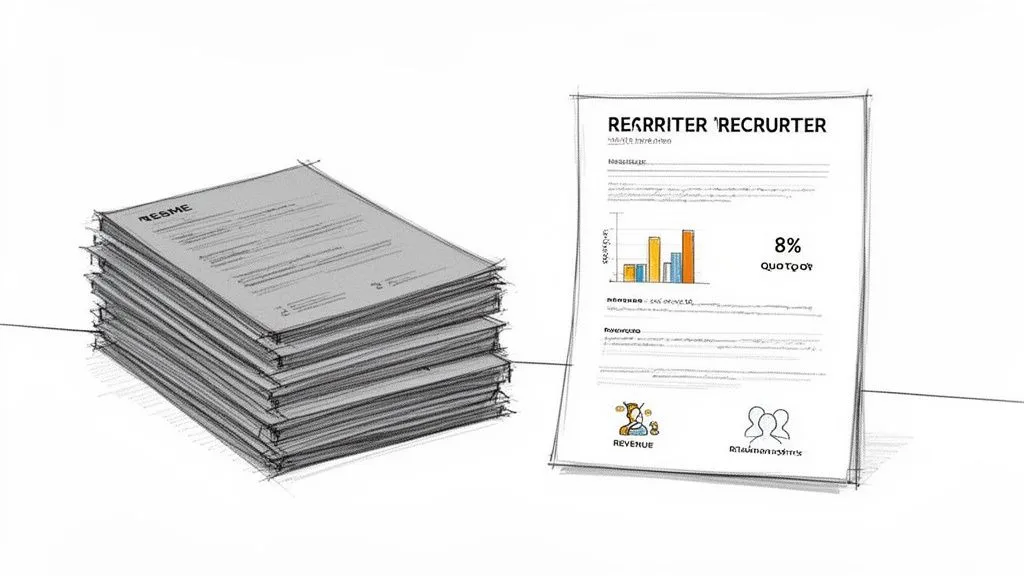
Hiring managers in medical sales don't care what you were supposed to do. They care what you did. They spend six seconds on a resume hunting for one thing: numbers. Proof you can make them money.
Let’s fix that.
Why Your Medical Sales Resume Fails
Your resume blends in. It's filled with vague duties instead of sharp, metric-driven wins. This is a fatal mistake in a field where performance is everything.
The Problem with Generic Resumes
Most resumes are just boring lists. They're passive and uninspired.
Think about these common, useless phrases:
* Responsible for managing accounts in the tri-state area.
* Tasked with selling a portfolio of surgical devices.
* Promoted products to healthcare professionals.
These statements are noise. They describe the basic function of any sales role but offer zero proof of your skill. This forces the recruiter to guess how good you are. They won't. They’ll just move on.
A great medical sales resume isn't a history of your job duties. It's a highlight reel of your wins, backed by data.
Shifting from Duties to Impact
The fix is to reframe everything around results. Every bullet point must tell a story of value. Focus on the metrics that matter:
- Quota Attainment: Did you hit your numbers? By how much? For how many quarters?
- Market Share Growth: Did you steal business from competitors? How much did you grow your territory?
- Revenue Generation: How much new business did you close? What was the total contract value?
- Rankings: Were you a top performer? Where did you rank on your team, in your region, or nationally?
This is the only change that matters. It’s the difference between a resume that gets deleted and one that gets you the interview.
The Blueprint of a Winning Medical Sales Resume
Forget templates. Templates are a trap. They force your unique career into a generic box.
Your resume is a sales document. The product is you. It needs a logical flow that makes a rock-solid case for why you’re the person who can crush a number. Think of it as a blueprint, not a form to fill out.
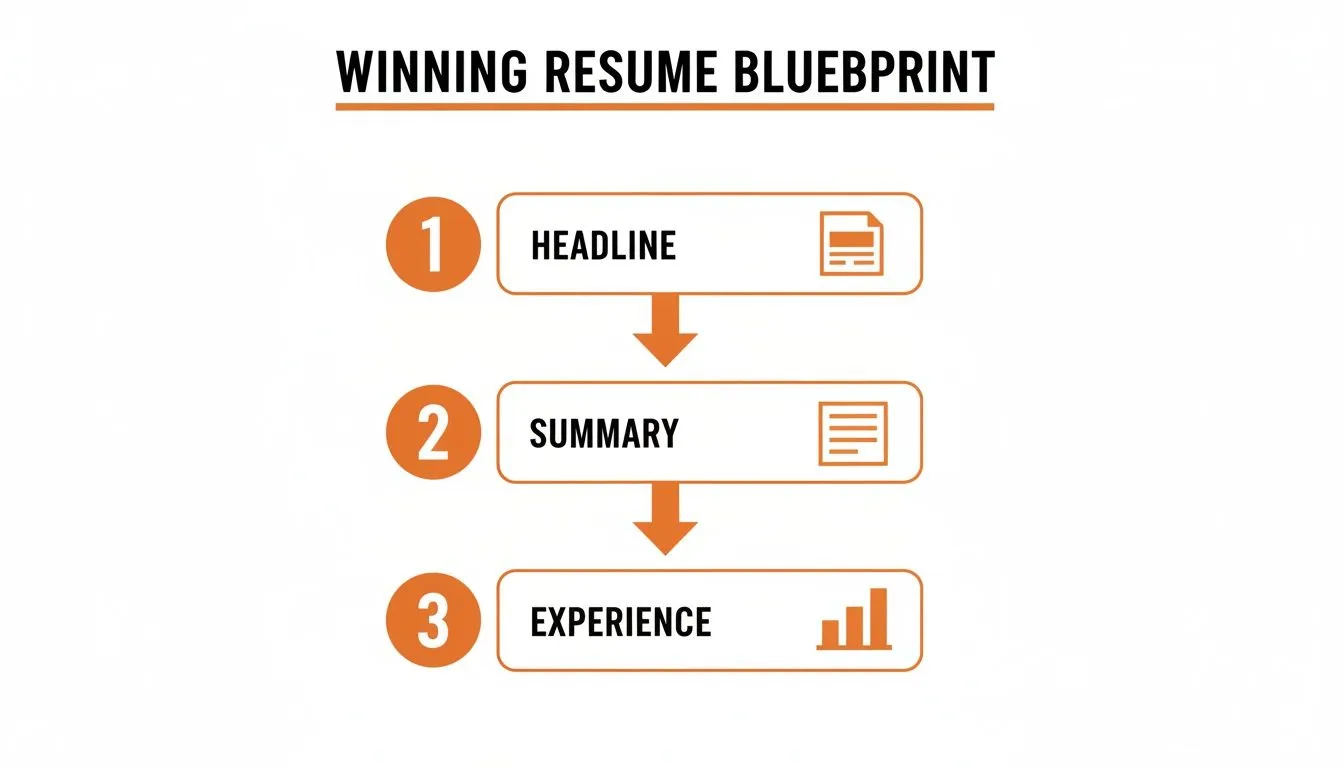
1. Your Headline and Contact Information
This is the top of the page. Keep it clean and simple.
- Full Name: Make it the largest text. No question who this is about.
- Title/Headline: Frame yourself instantly. Not "Medical Sales Representative." Be specific. "Senior Orthopedic Device Sales Specialist" or "Top-Ranking Pharmaceutical Sales Rep" tells a much stronger story.
- Contact Info: Phone number, professional email, and a link to your LinkedIn profile. That profile needs to be more than a copy of your resume. Your goal is to create an actionable LinkedIn profile that wins clients.
2. The Professional Summary
Ditch the "Objective" statement. Nobody cares what you want. They only care what you can do for them. Your summary is your three-sentence elevator pitch.
It must answer three questions:
1. Who are you? (e.g., "A top 5% ranked medical device sales leader...")
2. What’s your core expertise? (e.g., "...with 8 years of experience driving market share growth in cardiovascular.")
3. What’s your single best quantifiable achievement? (e.g., "Achieved 145% of quota in FY2023 by securing contracts with three major hospital networks.")
This section is your hook. If it’s weak, the rest of your resume won’t get read. For more tips, check out our guide on perfecting your resume.
3. Experience Section: The Core of Your Story
This is where you prove the claims from your summary. List jobs in reverse chronological order. No boring laundry lists. Each role needs metric-driven achievement bullets. We’ll get to the formula next.
4. Skills and Certifications
This section is for two audiences: the Applicant Tracking System (ATS) and the human reader. Make it a clean, scannable list.
Don’t waste space on vague soft skills like "communication." Focus on hard skills that matter in medical sales: Territory Management, Salesforce CRM, Surgical Device Integration, KOL Development, and clinical knowledge like Orthopedics or Oncology.
This is also the spot for relevant certifications. They show commitment and give you an edge.
The medical sales field is exploding. The global medical devices market is projected to hit $850 billion by 2030. That growth means more opportunities, but only for reps who prove their value on paper first.
Writing Achievement Bullets That Actually Sell
This is where your resume lives or dies.
Starting a bullet point with "Responsible for..." is the fastest way to the 'no' pile. It's passive and lazy. Your experience section isn't a chore list; it’s a scoreboard.
Recruiters hunt for impact. They want numbers—quota, market share, new accounts, product launches. If your bullets don't have metrics, you're just making empty claims.
The Problem-Action-Result Formula
The simplest way to write a killer bullet point is the Problem-Action-Result (PAR) framework. It’s a mini-story that hiring managers get instantly.
Here's a simple flowchart:
- Problem (The "Why")
- Stagnant territory growth? Fierce competitor? New product launch?
↓
- Stagnant territory growth? Fierce competitor? New product launch?
- Action (The "How")
- Developed a new KOL plan? Targeted high-volume accounts? Created a physician training program?
↓
- Developed a new KOL plan? Targeted high-volume accounts? Created a physician training program?
- Result (The "What")
- Increased market share by 15%? Secured $500K in new contracts? Hit 130% of quota?
This structure forces you to focus on outcomes, not activities. You go from saying "I sold things" to "I drove $1.2M in revenue by doing X." That's the difference between getting an interview and getting ignored.
From Generic Duties to Impactful Achievements
Let's see this in action. The table below shows how to reframe weak bullets into high-impact statements.
| Generic Duty (The 'Before') | Impactful Achievement (The 'After') |
|---|---|
| Managed sales of spinal implants in the Chicago territory. | Grew spinal implant market share by 18% in a competitive Chicago territory by building exclusive relationships with 5 key orthopedic surgeons, resulting in a $750K revenue increase. |
| Responsible for promoting a new cardiovascular drug. | Executed a successful launch for a new cardiovascular drug, exceeding territory prescription goals by 35% in the first six months by securing formulary acceptance at 3 key hospitals. |
| Sold diagnostic imaging equipment to hospitals and clinics. | Closed $2.1M in new capital equipment contracts by demonstrating a 20% improvement in diagnostic accuracy, displacing the primary competitor in three major hospital systems. |
See the difference? The "after" examples are specific, quantified, and focused on business results. They instantly answer the "so what?" question.
These examples are your new standard. They tell a story of success. For a deeper dive, read this guide on framing Accomplishments on Resume.
Quantifying your success is non-negotiable. Even if you don't have exact sales figures, use percentages, rankings ("#1 rep in the region"), or comparisons. Stop telling them what you did. Show them what you’re worth.
For a more detailed breakdown, see our guide on how to write achievements in a resume.
How to Tailor Your Resume for Specific Sales Roles
Submitting the same resume for a pharma job and a surgical device role is a rookie mistake. It signals you don’t get it. One-size-fits-all is lazy.
A pharma role involves navigating PBMs and influencing prescribing habits. A surgical role requires you to be comfortable in an OR, guiding a surgeon's hands. Your resume must show you know the difference. Tailoring isn’t optional.
Deconstruct the Job Description
Before you touch your resume, become an expert on the role. Print the job description. Get a highlighter. This is your map to the interview.
Your mission is to pull out the specific keywords, skills, and qualifications. Dissect every line.
- Pinpoint core duties: Is it new business development or account management? A product launch or defending market share?
- Identify required skills: Look for specific terms like “KOL development,” “capital equipment sales,” “surgical case coverage,” or “managed care contracting.”
- Note the clinical area: Is it “orthopedics,” “cardiovascular,” “oncology,” or “diagnostics”?
These are the phrases the Applicant Tracking System (ATS) is programmed to find. More importantly, they’re the language of the hiring manager. Mirror their language to signal you belong.
A tailored resume isn't about tricking a bot. It's about speaking the same language as the person who wants to hire you.
Adjust Your Summary and Bullets
Now, perform surgery on your resume. Focus on your summary and achievement bullets.
Your summary is your 15-second pitch. It must align perfectly. If the job is for a Senior Surgical Device Specialist, your summary must establish you as one in the first line.
Generic Summary: "Top-performing sales rep with 8 years of experience."
Tailored Summary: "Top 5% ranked Senior Orthopedic Device Specialist with 8 years of experience driving adoption of spinal implants in high-volume surgical centers."
Do the same for your bullets. Find accomplishments that mirror the job's priorities. If the description emphasizes “displacing competitors,” then the bullet where you grew market share by 15% by stealing business from a rival needs to be front and center.
Quick checklist:
- Pharmaceutical Sales: Focus on quota attainment, formulary wins, prescription volume, and physician relationships.
- Surgical Device Sales: Highlight OR support, surgeon training, case coverage numbers, and experience with specific procedures.
- Capital Equipment Sales: Zero in on C-suite negotiations, large contract values ($1M+), and building a compelling ROI.
This isn’t about making things up. It’s about being a strategist. It takes an extra 15 minutes, but it's what separates the ignored resumes from the "must-call" list.
Real Medical Sales Resume Examples, Dissected
Theory is useless without action. Let's break down three resume examples: a career changer, a mid-career rep, and a senior leader. I'll show you why they work.
Example 1: The Career Changer
This person comes from B2B tech sales. Their hurdle is proving they have the drive and transferable skills for healthcare.
Professional Summary
High-achieving B2B sales professional with 4 years of experience exceeding quota in competitive tech SaaS. Seeking to apply proven skills in complex sales cycles and rapid product adoption to a career in medical device sales. Completed intensive medical sales training, including 40+ hours of OR shadowing and hands-on cadaver lab experience.
Why It Works
* It tackles the transition head-on. It doesn't hide the career change; it frames it.
* It highlights proactive training. The OR shadowing and cadaver lab are gold. It shows serious investment and lowers the "no experience" risk for a hiring manager.
* The language is a bridge. "Complex sales cycles" and "rapid product adoption" translate tech experience into language that resonates with med-tech managers.
Example 2: The Mid-Career Sales Rep
This rep has a few solid years under their belt. The goal is to show consistent high performance and readiness for a bigger role.
Experience: Medical Device Specialist | Medtronic | 2020 – Present
* Ranked in the top 10% of the national sales force for performance against quota in FY2023.
* Grew territory revenue by $1.2M (28% year-over-year) by securing exclusive contracts with two major hospital systems previously dominated by a competitor.
* Successfully launched a new orthopedic implant, achieving 140% of the territory's launch goal within the first six months.
* Trained and mentored 15+ orthopedic surgeons on the proper use of the new implant, ensuring safe adoption and leading to zero product-related complaints.
Why It Works
* It's all numbers. Every bullet is anchored to a hard metric. No fluff.
* It shows competitive wins. The detail about the territory being "dominated by a competitor" adds crucial context. This is a strategic victory.
* It balances sales and clinical skill. The bullets prove they can sell (revenue, quota) and support the product in a clinical setting (training surgeons).
Example 3: The Senior Sales Leader
This candidate wants a Regional Sales Manager role. Their resume must pivot from their own wins to their team's performance.
Experience: Regional Sales Manager | Stryker | 2018 – Present
* Led a team of 12 sales representatives across the West Coast to achieve a collective 115% of a $25M annual quota.
* Developed and executed a new market penetration strategy that captured 15% market share from the primary competitor in the first year.
* Recruited, hired, and coached 4 new reps, with 3 achieving President's Club status within their first two years.
Why It Works
* The focus is on leadership. The metrics are about the team's performance ($25M quota), not their own.
* It highlights strategic impact. "Developed and executed a new market penetration strategy" shows they're a planner, not just a follower.
* It proves they can build talent. The final bullet is powerful. It demonstrates they can build a winning team, which is the most important job of a sales leader.
Your Top Resume Questions Answered
Let's clear the air. Here are the direct, no-BS answers to the questions we get all the time.
How long should my medical sales resume be?
One page. That's it.
If you have under 10 years of experience, a single page is non-negotiable. It forces you to be ruthless and cut the fluff. The only exception is for senior leaders with a long track record of wins that can't be squeezed onto one page. For everyone else, brevity wins.
Should I put a photo on my resume?
No. In the U.S., Canada, and the UK, a photo is a rookie mistake. It introduces unconscious bias and can get your resume tossed for compliance reasons. Your resume is about your achievements, not your appearance.
Focus every inch of your resume on performance. Anything that distracts from your ability to drive revenue—like a headshot—is a waste of space.
How do I write a resume with no direct medical sales experience?
You have to prove transferable achievements. If you're from B2B sales, don't just say you "managed accounts."
- Talk about the complex, multi-stakeholder deals you’ve closed.
- Quantify your success in a consultative selling environment.
- Showcase your ability to master a technical product.
Use your summary to frame your career pivot. Connect past wins to the demands of a medical sales role. Show them you have the raw sales talent; they know they can teach you the clinical specifics.
What are the most important keywords to include?
Stop guessing. The best keywords are in the job description for the role you want. Read it and mirror its language.
That said, some high-value terms show up repeatedly. Weave these into your summary and achievement bullets naturally.
- Performance Metrics: Quota Attainment, Market Share Growth, Territory Growth, President’s Club.
- Sales Activities: New Business Development, Product Launch, KOL Development, Surgeon Relationships.
- Tools & Knowledge: Salesforce CRM, specific product categories (e.g., Orthopedics, Cardiovascular, Robotics), and clinical procedures.
Don’t just list these in a skills section. Integrate them into your achievement stories to prove you’ve actually used them to get results.
Tired of wrestling with your resume? StoryCV is a Digital Resume Writer that interviews you to uncover your real impact. We turn your experience into a narrative that opens doors. Stop tweaking templates. Start landing interviews. Get your professional-quality resume draft today.