Resume writing for veterans boils down to one thing: translation. You have the skills. Hiring managers want them. But they don't speak military. Your resume's job is to bridge that gap.
It turns your service into a story of civilian value. Let's get it done.
Why Your Military Experience Isn’t The Problem
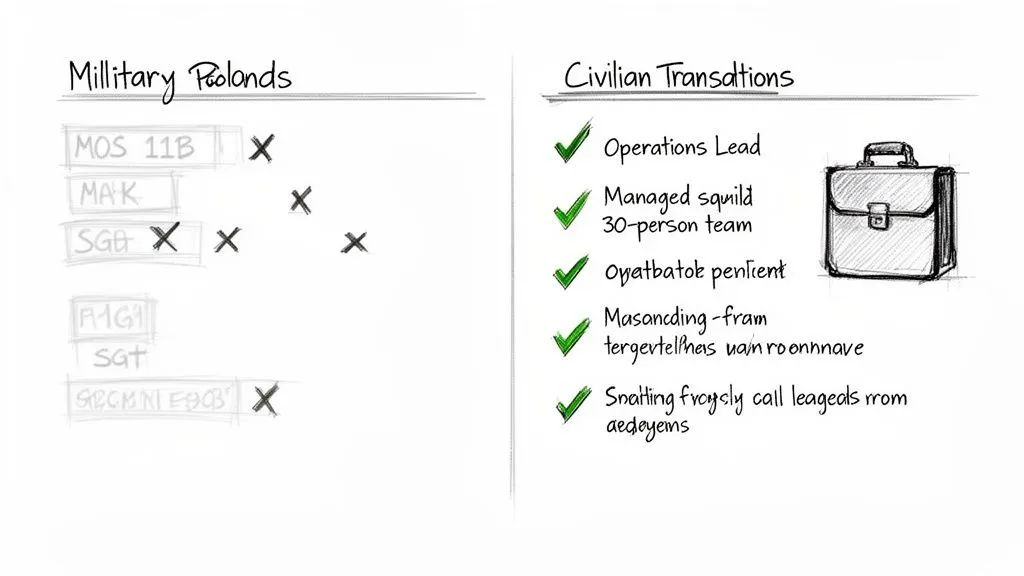
Your military experience is a massive asset. Not a liability. You’ve managed complex projects, led diverse teams under pressure, and handled millions in critical equipment. The problem isn’t your background. It’s how you explain it.
Hiring managers spend seven seconds scanning a resume. They don't have time to Google your MOS. They hunt for keywords: "project management," "logistics," "risk assessment," and "team leadership."
If your resume reads like a performance eval, you’re sabotaging yourself. It lists duties, not accomplishments. A common, critical mistake.
The Translation Trap
About 200,000 vets transition to civilian life each year. Underemployment is a huge issue. I see it constantly: skilled vets in jobs far below their capabilities. Why? Their resume failed to connect the dots. Dig deeper with these insights from experts in military-to-civilian careers.
You know your worth. Your resume is speaking a foreign language.
Your resume doesn’t just list what you did. It proves you can solve a company’s problems. It tells a story of impact.
Generic templates make it worse. They encourage you to fill in boxes with bland descriptions. A surefire way to be overlooked. You're not a machine. Your story shouldn't come from pre-made parts.
A New Way To Tell Your Story
Stop thinking about what you did. Focus on why it mattered. Look at the difference.
Instead of your rank, describe the leadership responsibility.
-
Don't say: "Platoon Sergeant for an infantry unit."
-
Do say: "Supervised and mentored a 40-person team, overseeing performance, training, and operational readiness."
Instead of military jargon for equipment, describe its value.
-
Don't say: "Maintained an M1 Abrams tank."
-
Do say: "Managed maintenance schedules and diagnostics for mission-critical equipment valued at over $8 million."
It's not about exaggerating. It's about providing context a hiring manager understands. Reframing service from a list of tasks into a portfolio of achievements.
Here’s a quick table to translate common duties into civilian impact.
Military Jargon vs Civilian Impact
| Military Term / Duty | Civilian Translation (Impact-Focused) |
|---|---|
| NCOIC/OIC | Project Manager / Operations Supervisor |
| Squad Leader | Team Lead / First-Line Supervisor |
| MOS (e.g., 25B) | IT Specialist / Information Systems Analyst |
| Unit Training Manager | Corporate Trainer / Learning & Development Coordinator |
| Supply Sergeant | Logistics Manager / Inventory Control Specialist |
| Conducting reconnaissance | Market Research / Competitive Analysis |
| OPORD (Operations Order) | Project Plan / Strategic Initiative Briefing |
| Risk mitigation | Risk Assessment & Management / Safety Compliance |
See the pattern? We’re not changing what you did. We're changing how you describe its value.
This isn’t fluff. Your career gave you the skills. Now tell the story that gets you the job.
Deconstruct Your Service To Find Civilian Wins
Breaking down your military career is like a mission debrief. You're not just listing events. You're extracting the intel that secures your next win. Forget your formal duties. Focus on the problems you solved.
This isn’t padding. It’s a strategic inventory of your skills. You managed people. You ran projects. You were trusted with high-stakes equipment. It’s time to put that into concrete terms a hiring manager values.
The Mission Debrief For Your Career
Think about your last major role. Don't just recall the title. Ask better questions to uncover the wins. This is how you shift from "Platoon Sergeant" to "Operations Leader."
Answer these for each significant role:
-
People: How many people did you lead? Train? Were you involved in reviews, promotions, or conflict resolution?
-
Projects: What was the objective? The timeline? The budget—or the value of equipment involved?
-
Process: Did you create a new tracking system? Improve a safety protocol? Write an SOP that made the team more efficient?
-
Impact: Did your actions save time? Reduce costs? Improve readiness or safety? Did they measurably increase your team's performance?
Don't self-censor. Write down everything. The goal is data collection. We'll shape it into resume bullets later. This is about building a complete inventory of your wins.
This exercise gathers the evidence of your capabilities. You'll be surprised how much you've accomplished when you look at it this way.
From Military Role To Civilian Skillset
Once you have your raw data, group these accomplishments into civilian skill categories. This is the core of translation.
Your military experience is packed with skills companies want. Here’s a list to help categorize your achievements:
-
Leadership & Management: Supervising, mentoring, training, or evaluating personnel.
-
Project Management: Planning and executing missions, overseeing logistics, managing timelines, and coordinating teams.
-
Operations & Logistics: Managing supply chains, inventory control, maintenance schedules, and transportation.
-
Risk Assessment & Mitigation: Implementing safety protocols, conducting readiness assessments, and making critical decisions under pressure.
-
Technical Proficiency: Expertise with specific software, hardware, or complex machinery.
Many vets feel they have "no civilian experience." This is a framing problem, not an experience problem. You can learn how to write a CV with no experience and apply the same principles.
Deconstructing your service this way creates an arsenal of quantifiable achievements. You’ll have an evidence-based list of strengths ready to deploy. For more on this, check our guide on listing strengths on a resume.
Write Accomplishment Bullets That Deliver Impact
This is where the mission succeeds or fails. Most resumes are boring job descriptions. They list duties. They state responsibilities. They put hiring managers to sleep.
Your resume must show impact. Every bullet is evidence you can solve a company’s problems. If a bullet doesn’t scream, “I create value,” it’s wasting space.
Forget listing what you did. Focus on why it mattered. The secret is shifting from passive duties to active accomplishments. It’s the difference between "I was in charge of supplies" and "I managed a $1.5M inventory with zero loss for two consecutive years." Both are true. Only one gets the interview.
This three-step process helps you deconstruct your service and find high-impact stories.
Debrief to gather data, inventory your skills, then translate them. This turns memories into a career narrative.
Use The CAR Method To Frame Your Wins
The CAR method—Challenge, Action, Result—is a simple framework for powerful accomplishment bullets.
-
Challenge: What was the problem or goal?
-
Action: What specific steps did you take?
-
Result: What was the measurable outcome?
Most people only list the Action. That’s a job duty. The magic is in the Result. It’s your proof of impact.
Don't just state what you did. Prove it was worth doing. The Result is your evidence. No result, no impact.
Even without hard numbers, you can show results. Did you improve a process? Make a system safer or more efficient? These are all powerful results.
Quantify Everything You Can
Numbers cut through the noise. They're the language of business. They provide concrete evidence. Your goal is to find a number for every bullet point.
Think in terms of:
-
Scale: How many people led? Size of budget managed? Value of equipment maintained?
-
Frequency: How often did you perform a task? Daily, weekly, monthly?
-
Improvement: By what percentage did you increase efficiency? How much time or money did you save?
A well-reasoned estimate is fine. Use words like "approximately," "over," or "estimated." The goal is context and scale. Our guide on how to write achievements in your resume offers more strategies.
Before And After Veteran Resume Bullets
Let’s put this into practice. The difference between a duty and an accomplishment is stark. Showcase your top professional achievements examples, don't just list responsibilities.
Here’s how to transform weak bullets into compelling, quantified achievements.
| Military Role | 'Before' Bullet (Weak) | 'After' Bullet (Impactful) |
|---|---|---|
| Infantry NCO | Responsible for the welfare, fitness, and training of a 9-man infantry squad. | Led a 9-person cross-functional team through a 6-month project in a high-pressure environment, achieving all objectives 15% ahead of schedule and under budget. |
| Logistics Specialist | Managed and distributed supplies and equipment for the company. | Oversaw a $2.5M inventory system, implementing a new tracking protocol that reduced equipment loss by 95% and improved deployment readiness by 30% over 12 months. |
| Intelligence Analyst | Conducted analysis of intelligence reports to provide situational awareness. | Analyzed over 500 disparate data sets per week to identify critical trends, delivering concise daily briefings that informed strategic decisions and reduced operational risk by 20%. |
Each "After" example uses the CAR method. It presents a challenge, details an action, and gives a quantified result. This is how you move from a list of duties to a portfolio of wins.
Build A Resume For Scanners And Humans
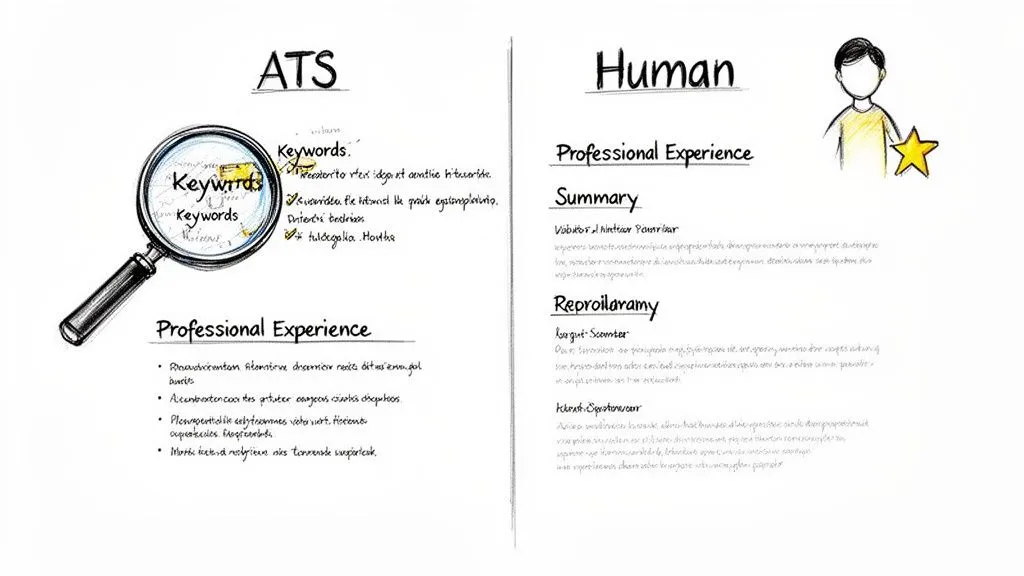
Your resume has two audiences: a machine and a human. You have to win over both.
Ignore the Applicant Tracking System (ATS), and a person may never see your resume. Write only for the machine, and you get a keyword-stuffed mess no one wants to read. It's a balancing act.
Nail The Fundamentals First
Before keywords, get the structure right. Clarity and readability are all that matter.
Start with the basics:
-
Format: Stick to a reverse-chronological format. It's what recruiters expect and what the ATS parses best.
-
Section Headers: Use clear, simple headers. "Professional Experience," "Skills," "Education." Don't get clever.
-
Contact Info: Name, city/state, phone, email, and your LinkedIn URL. Clean and at the top.
These create a predictable, scannable document for both software and the human with seven seconds to spare.
Ditch The Objective, Write A Summary
The "Objective Statement" is dead. Nobody cares what you want. They care about what you can do for them.
Replace it with a Professional Summary. A 3-4 line elevator pitch at the top. It frames your value and connects your military background to the civilian role.
It should quickly answer:
-
Who are you? (e.g., "Operations leader with 8 years of experience...")
-
What are your top skills? (e.g., "...in logistics management, process improvement, and team leadership.")
-
What's your key value? (e.g., "Proven record of reducing operational costs by 15%.")
This summary is prime real estate. Make it count.
Your resume is a sales document. You are the product. The Professional Summary is the headline that makes them want to read more.
Keep It Lean And Scannable
Resume length is a constant debate. The rules are simple.
-
Under 10 years of experience: One page. No exceptions. Be ruthless.
-
Over 10 years of experience: Two pages is acceptable, but only if every line is high-impact.
Use a clean font like Calibri or Arial in a 10-12 point size. Use white space. Short paragraphs and bullet points are your friends. A crowded resume gets tossed.
Weaving In The Right Keywords
Now, the ATS. Your resume needs keywords from the job description. The trick is to do it without sounding like a robot.
Read the job description. Pull out key skills and qualifications. Look for nouns like "project management," "data analysis," or "supply chain."
Work these exact phrases into your Summary and accomplishment bullets. If the job description asks for "vendor negotiation," don't say "Managed supplier relationships." Tweak it to say "Negotiated contracts with 15+ vendors..."
This isn't tricking the system. It's speaking the same language as the employer. It shows the machine—and the human—that you're a perfect fit.
Customize Your Resume For Every Mission
Sending the same generic resume everywhere is lazy and ineffective. If you’re tired of getting ghosted, understand this: customization is the entire game.
This doesn't mean rewriting your history every time. It’s a 15-minute tune-up that proves you are the direct solution to their specific problem.
Have one comprehensive “master resume”—your personal database of every accomplishment. From there, each application gets its own targeted version. A specific loadout for the mission ahead.
Mirror The Language Of The Job Description
You have to speak their language. Print out the job description and grab a highlighter. Circle the key skills and responsibilities.
Are they asking for a "project manager with logistics experience"? Your summary better reflect that exact phrase. Don’t make them connect the dots; draw the line for them.
-
Scan for keywords: Look for specific nouns and verbs like "supply chain optimization," "risk mitigation," or "cross-functional team leadership."
-
Weave them in naturally: Sprinkle these exact phrases throughout your summary and accomplishment bullets.
-
Match the tone: If the company is fast-paced, don’t write a dry, formal report.
This shows you've done your homework. It signals: "I get what you need, and I can deliver."
Reorder Your Bullets For Maximum Impact
Not all accomplishments carry the same weight for every job. Put your most impressive, relevant wins front and center.
Applying for an operations manager role? The job is about process improvement. Your master resume might have a killer bullet about team leadership at the top. For this application, move it down. Lead with the bullet about how you redesigned an inventory system to cut waste by 20%.
Your resume isn’t a historical document; it's a marketing tool. The most relevant information always goes first. Assume the reader will only scan the top two bullets for each role. Make them count.
This takes less than five minutes but completely changes how a recruiter sees you. You’re guiding their eyes to the evidence that matters most to them. Find more tips in our guide on tailoring your resume to the job description.
Align Your LinkedIn Profile
Consistency is everything. After you tweak your resume, take five minutes to make sure your LinkedIn tells the same story. If they're interested, they're going to look you up.
Focus on a few key spots:
-
Headline: Tweak your headline to match the roles you're targeting. "Operations & Logistics Leader | Process Improvement | Project Management."
-
About Section: Make sure the first few lines match your resume's summary.
-
Featured Section: Pin projects or media that showcase relevant skills.
This alignment creates a cohesive, professional narrative. It shows you’re deliberate and strategic. It’s about controlling the story a potential employer sees.
Your Toughest Resume Questions, Answered
Let's cut through the noise. When it comes to writing a veteran resume, the same questions pop up again and again. Here are the direct, no-BS answers you're looking for.
How Far Back Should My Military Experience Go On A Resume?
Stick to the last 10-15 years. That’s the sweet spot where your experience is still fresh and relevant.
If you have a long career, resist the urge to cram it all in. For service older than 15 years, add an optional section: "Early Military Career." Just list your roles, branch, and dates—no bullets needed.
Prioritize recent, high-impact experience that lines up with the job you want now. Relevance beats volume, every time.
Should I Include My Rank And Awards?
Yes, but translate them. A hiring manager won’t know the difference between an E-5 and an O-3. They shouldn't have to Google it.
Translate your rank into a civilian equivalent. "Squad Leader" becomes "Team Supervisor." "Platoon Sergeant" is an "Operations Manager." This instantly clarifies your leadership scope.
The same rule applies to awards. Don't list every ribbon. Be selective.
-
Choose wisely: Pull out significant, merit-based awards that prove exceptional performance or leadership.
-
Give it context: A Bronze Star Medal isn't just an award; it's recognition for "leading a complex, high-pressure project to success." Frame it that way.
-
Keep it clean: Tuck these under a simple "Awards & Recognition" heading.
Your rank and awards are hard-earned proof of excellence. Just present them in a language the civilian world understands.
How Do I Handle Security Clearances On My Resume?
Your security clearance is a massive asset, especially for government, defense, and tech roles. Don't bury it.
List it somewhere prominent. Give it its own section under your summary, or include it with your contact info.
Be direct:
-
State the clearance level clearly (e.g., "Active Top Secret/SCI Security Clearance").
-
Mention the granting agency if relevant (e.g., "Department of Defense").
That’s it. No need for polygraphs or investigation dates. A simple statement of your active clearance is all you need. For the right employer, that single line makes you a valuable candidate before they’ve even read a bullet point.
What If I Have Gaps In My Resume After Service?
Don't panic. A short gap after you transition is normal. Recruiters get it. It takes time to decompress and figure out what’s next.
If the gap is over six months, it’s not a dealbreaker. Own the narrative. Frame it as a productive period.
Account for it with a single line in your work history:
Professional Development & Civilian Transition | 2023 - 2024
- Completed certifications in Project Management (PMP) and CompTIA Security+ while navigating the transition to a civilian career.
This approach is honest and proactive. It shows you were actively preparing for your next chapter. Be ready to talk about it positively, focusing on what you learned and how it prepared you for the role you're applying for.
Stop letting your military experience get lost in translation. StoryCV is a Digital Resume Writer that interviews you to uncover your real-world impact. We turn your service into a compelling story that civilian hiring managers understand, helping you land the job you deserve. Build your first role for free at https://story.cv.