A director resume fails for a simple reason. It reads like a job history when it needs to read like proof.
Hiring teams don't need another list of duties. They need to see scope, judgment, and outcomes fast. That's why the strongest director level resume isn't written from a blank page. It's built by asking better questions, then turning the answers into evidence.
Why Most Director Resumes Read the Same
A hiring partner skims six director resumes on a Tuesday afternoon and sees the same dead phrases on all of them. Led cross-functional teams. Drove strategic initiatives. Improved efficiency. None of that is wrong. It's just invisible.
The core issue isn't writing. It's remembering and framing. Most directors did serious work, but they're too close to it to separate the decision from the noise. So they describe motion instead of impact.
Practical rule: if a bullet could belong to ten other directors, it's not a director bullet yet.
The usual advice to “quantify everything” misses the point. Throwing a percentage onto a vague sentence only makes the vagueness louder. Quantification without context is decoration. Hiring teams want the full chain, decision, mechanism, outcome. That's the shift senior hiring has made, from “what did you own?” to “what did you decide, how did you move it, and what changed at scale?”
That's why the modern director level resume is treated as a 2-page document in major market guidance, with 3 pages reserved for exceptional scope, and why many resume guides recommend keeping older experience to the last 10–15 years while emphasizing reverse chronological order and recent leadership roles modern director resume guidance. Senior hiring wants the current role first, fewer bullets per role, and proof that you've moved beyond task management into enterprise ownership.
A resume is not an archive. It's an argument.
The Four Sections a Director Resume Actually Needs
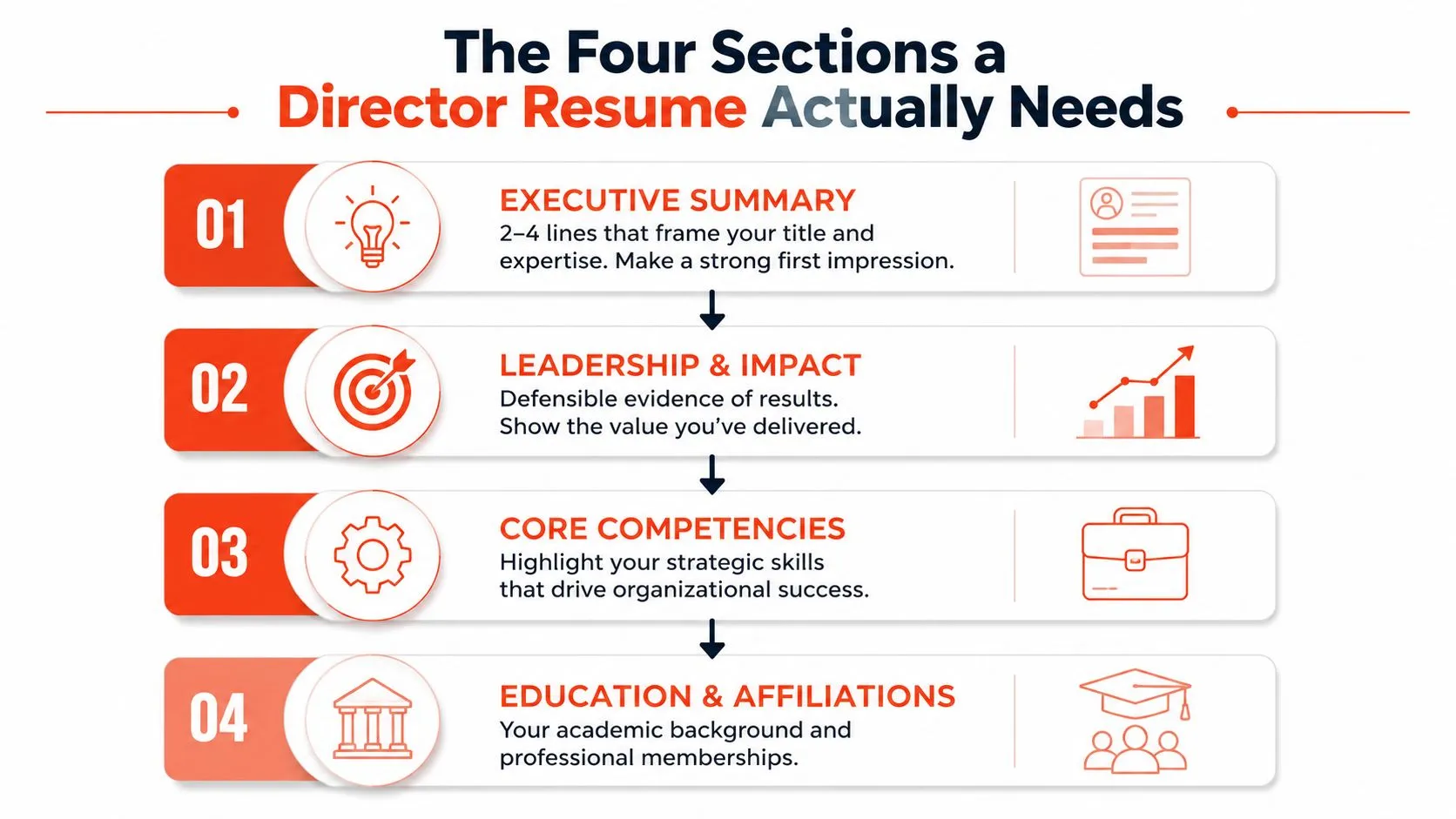
Most director resumes are cluttered because they try to include everything. That's amateur behavior. A serious resume needs four blocks, and each one has a job.
Start with a short executive summary
Your summary should be 2 to 4 lines, or at most 2 to 3 sentences, depending on the format you use Indeed director resume guidance. It should name your title, your years, your specialty, and one or two high-signal achievements. Nothing else belongs there.
Add a scope statement under each role
Most resumes collapse here. A director role needs a quick scope line that tells me what you owned, such as team size, budget, business unit, or market coverage. That line gives the bullets below it meaning. Without it, I can't tell whether your “big win” happened inside a large operation or a tiny team.
Keep selected achievements tight
The strongest director resumes usually use 3 to 6 results-focused bullets per role, and some executive formats go even leaner with 3 to 4 or 2 to 3 impact bullets Enhancv director resume guidance. That's enough. More usually means you're repeating yourself. Older roles should shrink fast, not sprawl.
Finish with a targeted competencies block
A good skills block is small and selective. One practical approach recommends 8 to 15 skills, while another recommends pulling 6 to 10 high-value keywords from the posting TopResume director resume guidance. Don't dump every tool you've ever touched. Match the language of the role.
For a clean category structure, this also pairs well with the way StoryCV organizes resume categories for different career paths, because director resumes still need discipline even when the content is complex.
Before and After The Bullet Rewrite That Changes Everything
A bad director bullet usually sounds busy and empty at the same time. You've seen this one before.
“Responsible for leading operations across three regions and driving efficiency improvements.”
That sentence tells me almost nothing. It says you had a job, not that you made decisions. Here's the rewrite shape that works.
Before
Responsible for leading operations across three regions and driving efficiency improvements.After
Operations Director for a 140-person, $48M P&L across three regions, redesigned the escalation process, rebalanced regional ownership, and cut repeat handoff failures by tightening accountability across sales, supply chain, and service.
The second version works because it gives me scope first, then the decision, then the mechanism, then the outcome. That's what senior hiring reads as leadership. It doesn't just say you were involved. It shows how you moved the system.
The same logic works when the number is messier. A People or Strategy director may not own revenue directly. Fine. Then don't fake it. Frame the work accurately.
Example for indirect impact
People Strategy Director for a multi-site workforce. Launched a manager enablement program, aligned HR and operations on the same review cadence, and reduced avoidable escalations by changing how leaders handled performance issues.
That bullet is credible because it names the scope and the mechanism. It doesn't pretend the director personally “owned” every outcome. It shows influence, which is what senior roles require.
For more phrasing patterns like this, a useful companion is resume bullet points examples, because the problem usually isn't effort. It's translation.
Turning Vague Leadership Into Defensible Evidence
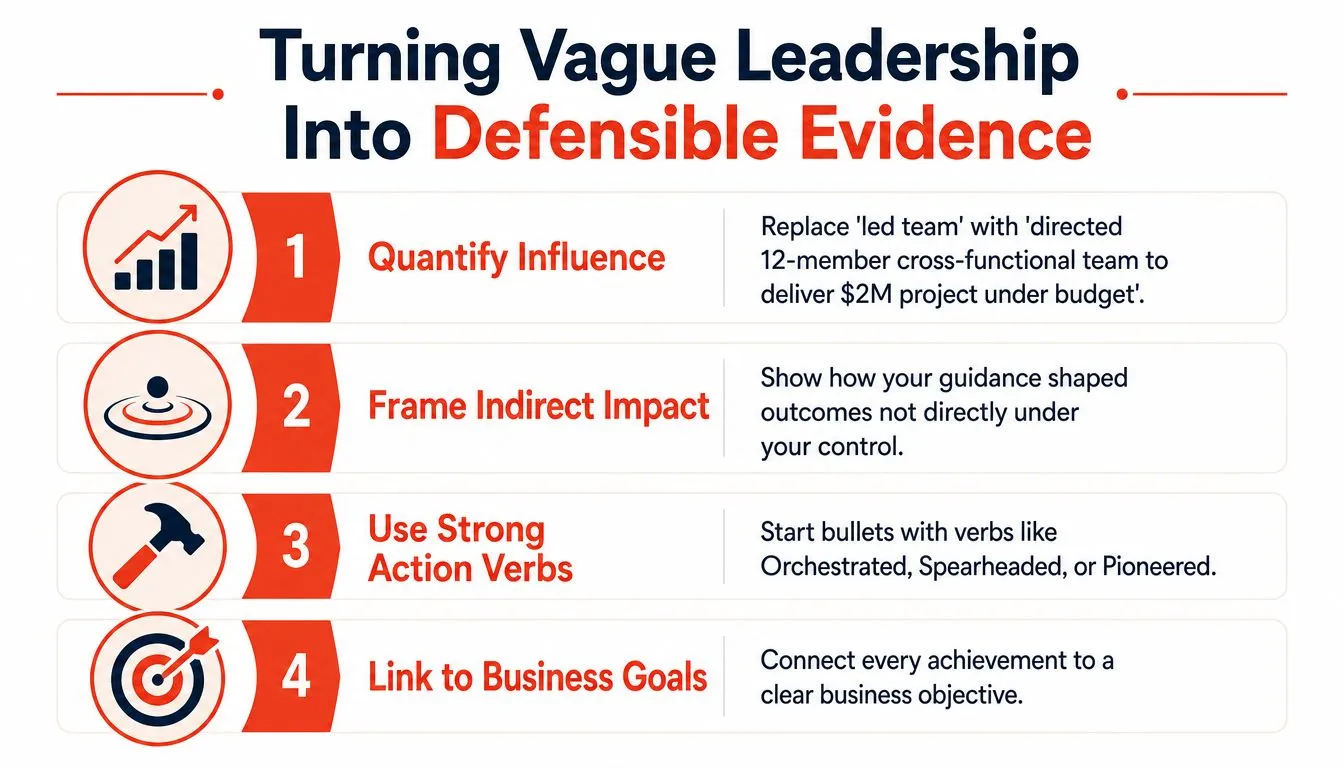
A lot of director work is indirect, shared, or spread across a long timeline. That's exactly why generic bullets fail. If you can't own the final number directly, you still need a defensible way to show judgment.
Use the scope you held
Start by naming the lane you controlled. You can defend budget influence, headcount led, markets covered, time-to-launch, retention, error reduction, or cycle time if those were part of your remit. The point is not to claim credit for everything. The point is to show the size of the system you were trusted to shape.
“I didn't own the whole revenue line, but I did own the process that changed how the line behaved.”
That is the director story in many roles.
Use before and after without pretending causality you can't prove
If your work changed the business over time, frame it as a comparison. “Before I joined” and “after I joined” is often enough, as long as you're honest about what changed and what you influenced. Don't overstate causation. Hiring managers can smell that immediately.
Use the decision you killed
This is the most underused move in senior resumes. If you prevented a bad launch, avoided a compliance issue, or stopped a broken process, say what you rejected and what it prevented. Judgment is leadership. Resumes rarely say that plainly.
A strong way to think about it is decision, mechanism, outcome. That matches how director hiring teams think about real ownership. One guide on director and VP resumes also emphasizes quantified business impact and scope, not just individual output, and it recommends numbers that reflect organizational scale rather than isolated effort director and VP resume guidance.
For a deeper look at how leadership signals are framed across roles, leadership examples for resume is a practical companion.
ATS Without the Cargo Cult
ATS matters, but people overrate it. It's the easy part. If your resume breaks parsing, you're dead on arrival. If it parses cleanly, you've only cleared the first gate.
The moves that matter are boring and effective. Use clean headings, standard job titles, and reverse chronological order. Mirror the posting with a few natural keywords, not a stuffed keyword graveyard. Skip tables and weird columns that confuse parsers. That's enough for most senior applications.
What doesn't matter much is all the junk people obsess over online. Hidden text tricks are pointless. Density scores are mostly theater. “ATS-friendly” templates often produce ugly documents that humans hate to read. At director level, that's self-sabotage. You're not trying to game a robot. You're trying to be understandable in two systems, machine first, human second.
If you want a quality headshot for the rest of your profile materials, a polished headshot gallery for Atlanta professionals can help you keep the visual side of your presence consistent with the resume. But don't confuse presentation with substance.
One more hard truth. If your resume says the right keywords but still sounds like a responsibility list, ATS won't save you. It's table stakes, not the strategy.
DIY Templates vs Human Writers vs a Guided Interview
DIY templates are cheap and fast. They also make you do the hardest part alone, which is framing. Most directors can do the work, but they can't always explain it cleanly on demand. A template gives structure, not judgment.
Traditional human writers give you polish, but they often come with a long intake process, slow turnaround, and a price that doesn't make sense if you just need sharper narrative. And plenty of them still write generic senior resumes because they don't understand director scope.
A guided-interview digital writer sits in the middle. StoryCV uses a short interview process to pull out decisions, scope, and outcomes, then turns them into resume content. That's the right model for directors who know they've done strong work but can't always surface it cleanly in one sitting.
Use this comparison honestly
- If budget is tight, use a template only if you already know how to frame scope and impact.
- If time is tight, use a guided interview system that helps you surface the material quickly.
- If narrative quality is the priority, choose the option that asks better questions, not the one that just gives prettier formatting.
This isn't about software worship. It's about matching the method to the problem. Directors usually don't need more blank boxes. They need a better interview.

Your Director Resume Plan for This Week
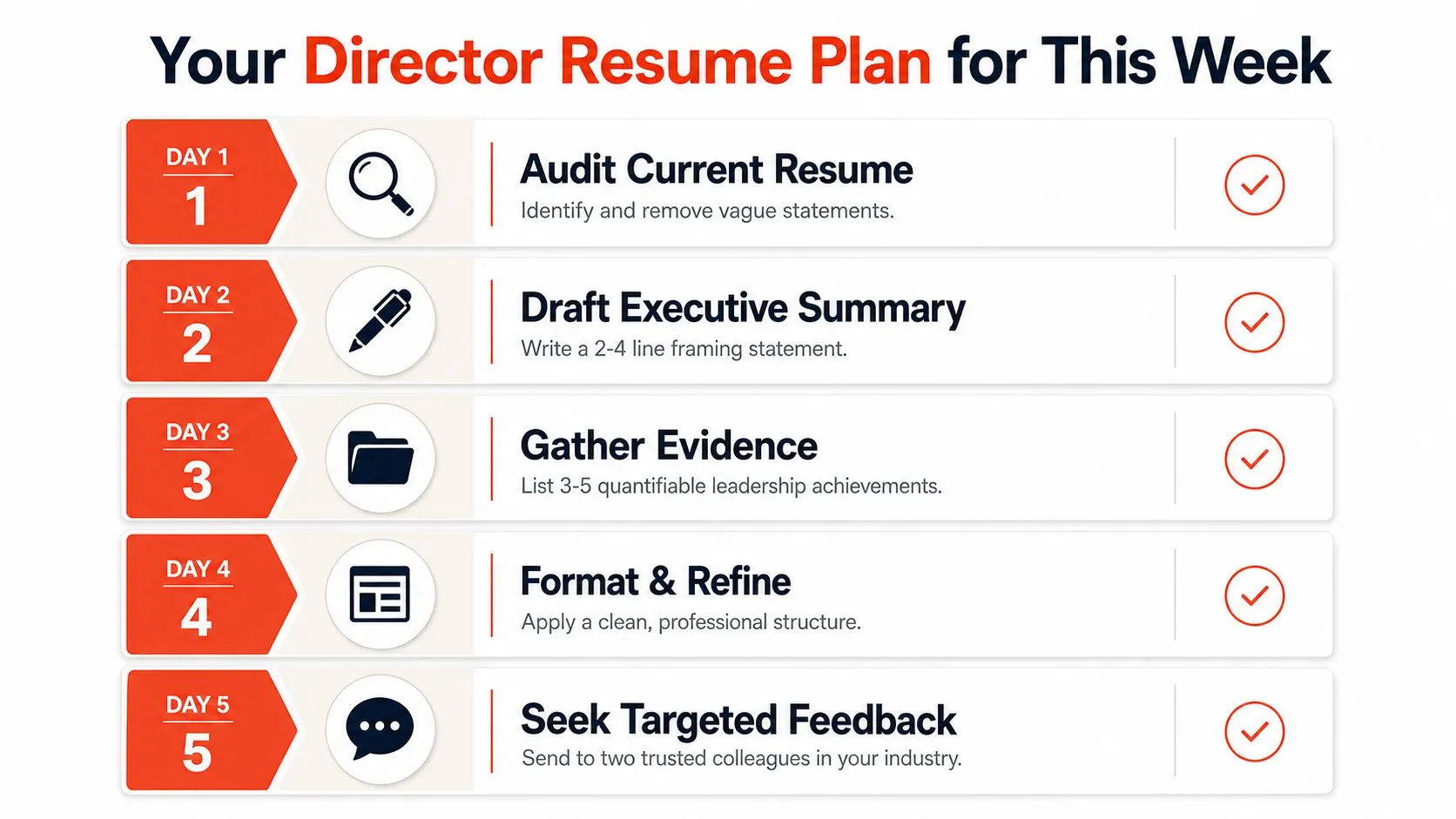
Stop treating this like a rewrite project. Treat it like a cleanup with a deadline.
- Audit the summary. Cut anything that doesn't name title, specialty, and seniority fast.
- Add a scope line to your current role. Team size, budget, market coverage, or business unit. Pick one.
- Rewrite three bullets. Use decision, mechanism, outcome. No duties. No filler.
- Trim the skills block. Keep it tight and matched to one specific posting.
- Ask one director-level reviewer. Not a friend. Someone who hires or has hired at that level.
That's enough to change the document from vague to credible. A director resume isn't a record of what you did, it's an argument for what you're ready to do next.
StoryCV helps you turn messy career experience into a sharp director level resume without starting from scratch. It uses a guided interview to pull out scope, decisions, and outcomes, then turns that into clean resume language you can use. If your current draft sounds like a job description, visit StoryCV and build the version that reads like leadership.