The duties of an overnight stocker include unloading freight, stocking and merchandising shelves, checking inventory, using equipment safely, maintaining the floor, solving overnight problems, and handing off accurate status information before opening. Some roles require frequent lifting up to 40 pounds and occasional lifting up to 50 pounds, while others expect continuous lifting up to 30 pounds with help for heavier items, so this is operational work with real physical and accuracy standards, not casual shelf-filling (physical demands in overnight stocker postings).
The part people miss is the overnight part. The store opens on your work. In some operations, night stocking starts at 12:01 a.m. five nights per week, and the whole shift is built around finishing the stocking cycle and handing off priority information before customers arrive (Safeway night-stocking schedule and handoff expectations). That's a credential.
It also means the role is bigger than the title suggests. Current descriptions consistently tie overnight stocking to unloading trucks, opening containers, stocking shelves, running overstock, rotating product, monitoring miss-picks and wrong deliveries, taking inventory, and keeping the store clean and organized for the morning shift (overnight stocker role breakdown). If you've done the job, recover the two numbers you know from memory: cases per hour and truck unload time. Those are the numbers that turn “stocked shelves” into evidence.
If you remember the work but can't pin down the details that prove it, that's exactly where a guided interview helps. StoryCV asks about the shift itself, what arrived, what you handled, what went wrong, what had to be ready by opening, then turns that into resume-ready language. Try StoryCV when your memory has the work but not yet the wording.
There's also a human cost to night operations that good employers ignore at their own expense. If you manage or support overnight teams, it's worth reading this practical guide to employee energy.
1. Unload and Stock Freight from Delivery Trucks
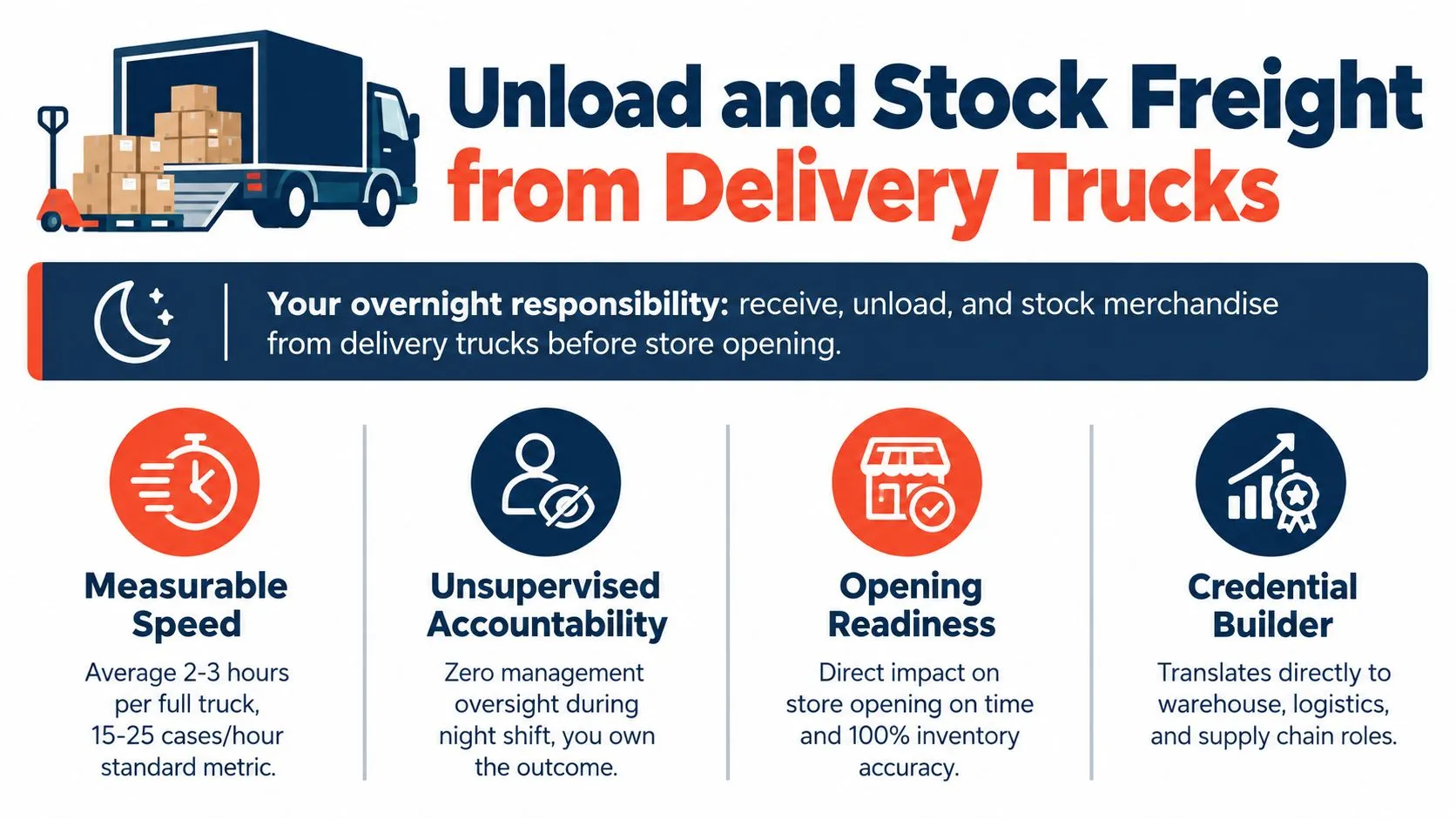
Overnight freight work is opening-readiness work. If your section was ready at 6 a.m., you did more than stock shelves. You received product, checked what arrived, staged it fast, and got it to the right location without a manager standing over you.
That combination matters. Retailers expect stockers to unload trucks, verify freight against shipping paperwork, rotate dated product, and place merchandise accurately enough to support the next day's sales floor (freight handling and FIFO expectations in retail receiving). On an overnight shift, those tasks sit with the crew on the floor. That is direct operating responsibility.
Turn truck work into resume proof
Write this duty like a warehouse or logistics job, because that is what the work resembles. Hiring managers care about throughput, accuracy, and readiness by deadline.
Use language like this:
- Weak: Stocked shelves overnight.
- Stronger: Unloaded delivery trucks, sorted freight by department, and stocked assigned aisles before store opening.
- Better: Completed overnight truck unload, verified freight against shipment paperwork, staged product by department, and replenished shelves accurately to support on-time store opening.
Add numbers if you have them. Cases per hour and truck unload time carry more weight than generic retail phrasing. Those are operating metrics. They show pace, reliability, and workload capacity.
What to pull from memory
- Cases per hour: Normal throughput on a standard freight night.
- Unload-to-floor time: Time from trailer arrival to sorted staging or shelf-ready freight.
- Freight scope: Grocery, frozen, dairy, produce, seasonal, or general merchandise.
- Receiving accuracy: Shortages, overages, damaged cases, or misdelivered items caught before product hit the floor.
- Rotation work: FIFO handling for dated or perishable stock.
Good resume bullets show ownership. The overnight crew does not just move boxes. It carries the store from delivery to opening, and that translates cleanly into warehouse, inventory, and logistics language.
2. Maintain Inventory Accuracy and Cycle Counts
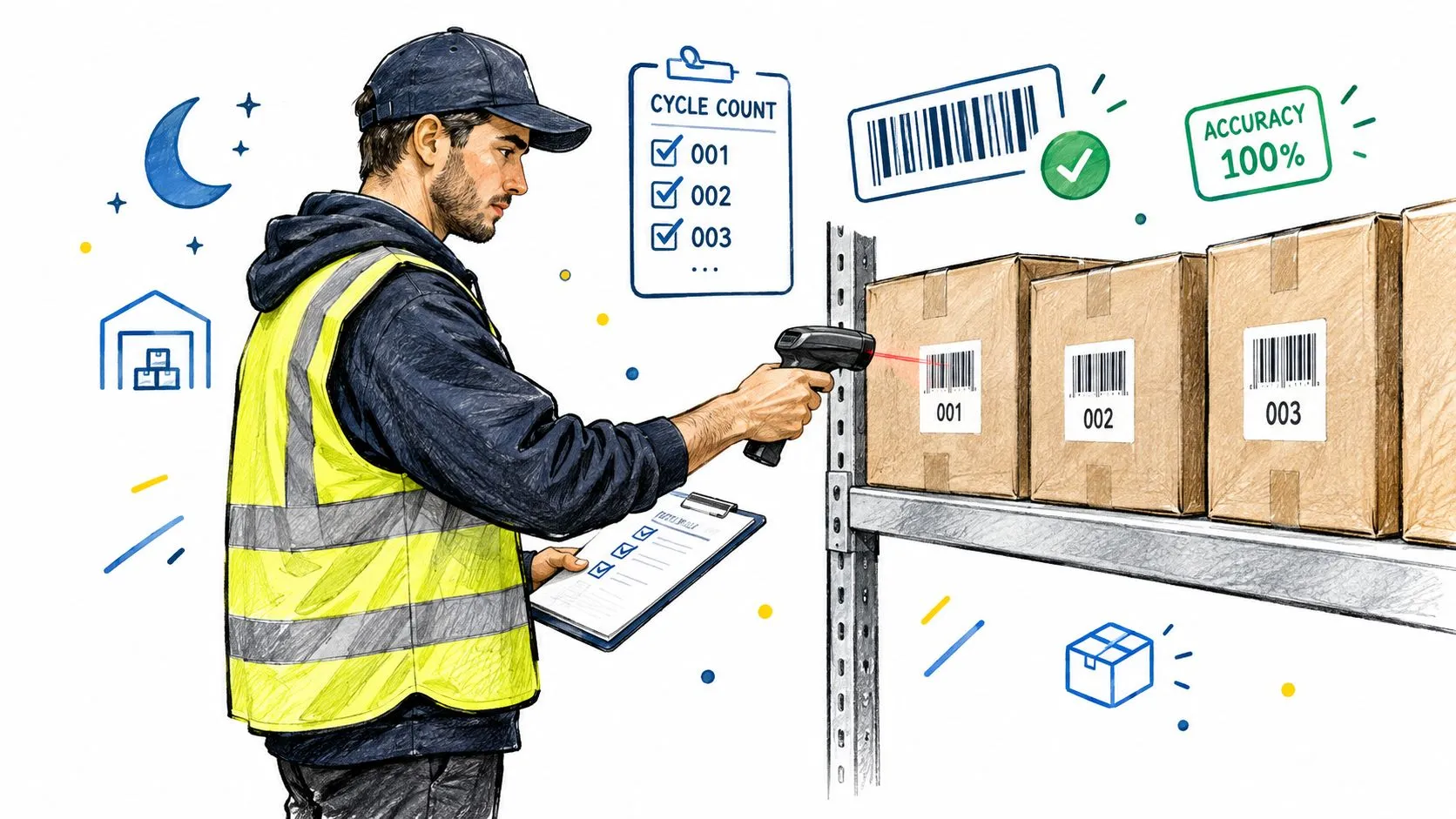
A strong overnight stocker catches problems before the day team inherits them. That includes count errors, damaged product, wrong labels, misplaced stock, and anything that will blow up later during counts or ordering.
Research on nighttime shelf stocking shows the work is time-sensitive enough to require formal scheduling models. The performance standard isn't just speed. It's throughput accuracy, planogram compliance, and getting the store sales-ready without disrupting daytime operations (night stocking as a scheduling and operations problem).
Accuracy is part of the job, not extra credit
That changes how you write the role on a resume. Inventory accuracy isn't a side duty. It's built into the shift.
A better bullet sounds like this:
- Weak: Helped with inventory.
- Stronger: Verified item counts against freight paperwork and flagged discrepancies during overnight replenishment.
- Better: Used handheld scanning and physical count checks to catch inventory discrepancies, isolate damaged goods, and keep assigned sections ready for morning handoff.
Good stockers don't just move cases. They stop bad counts from becoming tomorrow's problem.
If you supported cycle counts, say so plainly. If you handled returns, shrink prevention, spoilage checks, or FIFO rotation in perishables, that belongs in the bullet. Grocery and perishables-heavy stores depend on rotation discipline because freshness affects waste and on-shelf availability. Write that as operational judgment, not just neatness.
3. Organize and Merchandise Products for Sales and Store Layout
Opening readiness lives or dies on shelf discipline.
Overnight stockers do more than fill holes. They set the sales floor so the store can open on time, sell cleanly, and avoid preventable rework after sunrise. That means matching shelf sets, keeping facings consistent, rotating dated product correctly, and fixing aisle conditions before customers arrive. In food and consumables, first-in, first-out rotation is standard merchandising practice because it protects freshness and reduces waste (FIFO merchandising guidance from CStore Decisions).

Merchandising counts as operational control
Planogram compliance affects sales, substitutions, and labor. A full shelf in the wrong location still creates errors. Poor facing hides inventory. Bad rotation turns sellable product into markdowns or spoilage. On an overnight shift, you are fixing those problems with limited supervision and leaving a department ready for the entire next business day.
That is resume material.
If you need help phrasing it, these retail resume examples and formats show how to turn shelf work into evidence of execution, ownership, and opening readiness.
Use examples like:
- Weak: Organized shelves.
- Stronger: Stocked, faced, and arranged merchandise to match store layout and product rotation standards.
- Better: Reset assigned aisles to planogram, maintained front-facing presentation, rotated dated product using FIFO, and left departments sales-ready for opening.
What hiring managers should hear
Write this section like operations, because that is what it is. Overnight stockers work without a manager on the floor and carry responsibility for the condition of the store at open. If you handled endcaps, promotional placement, seasonal resets, or category cleanup, say so directly.
Hiring managers in warehouse, logistics, and inventory roles read that as layout discipline, independent judgment, and reliable handoff quality. That is stronger than "stocked shelves," and it is closer to the job.
4. Operate Warehouse Equipment and Tools Safely
Equipment use is a trust signal.
An overnight stocker who can move freight with pallet jacks, scanners, case cutters, labeling tools, and stock carts without creating safety problems is doing more than basic store labor. They are protecting the opening, the team, and the inventory while working with limited supervision. That reads well on a resume because warehouse and logistics managers already know what it means.
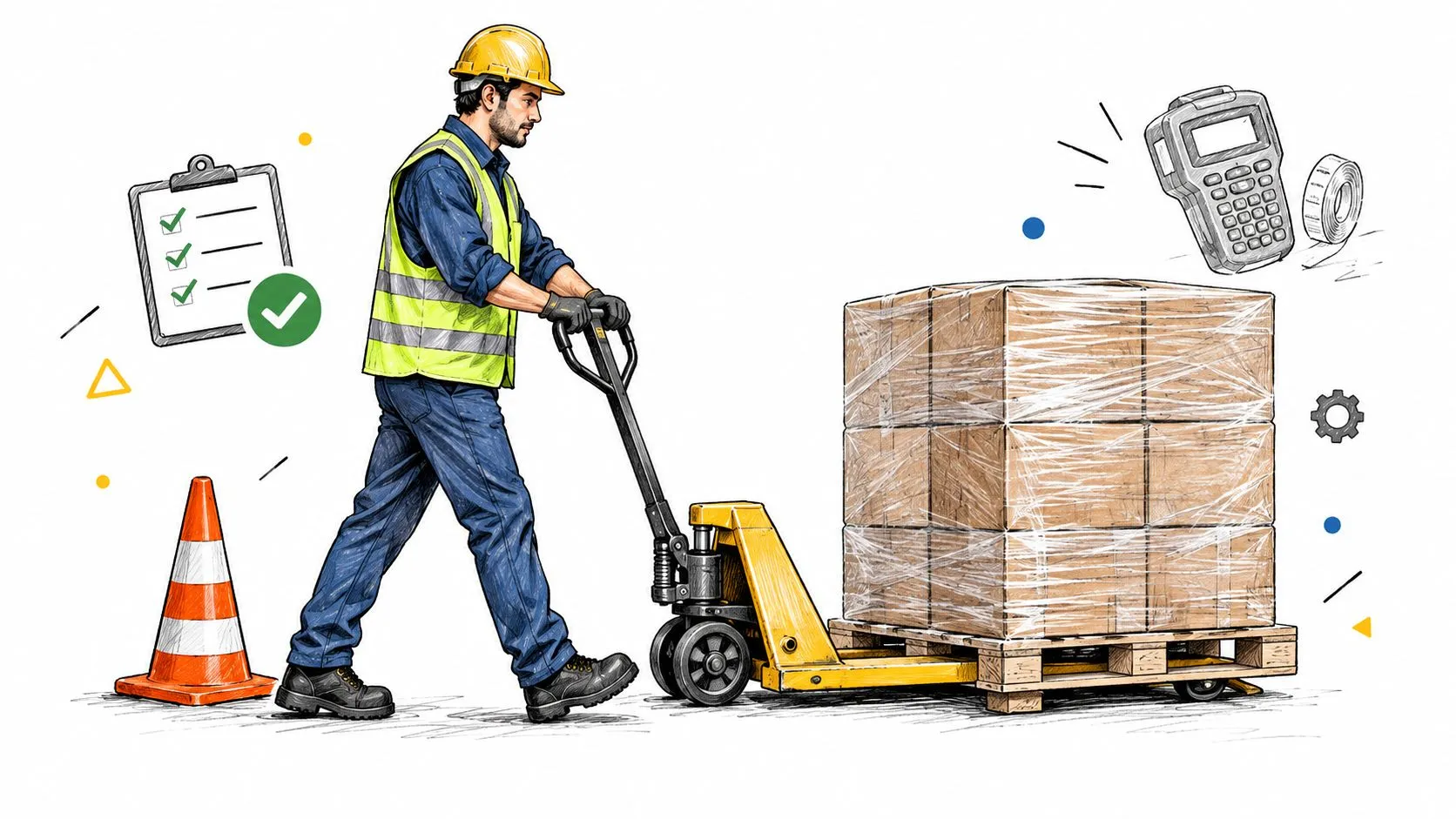
Hiring managers do not care that you “used a pallet jack.” They care whether you used equipment to keep freight moving, aisles clear, and the store ready to open on time. That is the stronger translation.
Use language like this:
- Operated pallet jacks, stock carts, scanners, and case-cutting tools to stage and replenish overnight freight safely.
- Moved product from receiving to assigned departments while keeping travel paths clear and reducing floor hazards before opening.
- Used handheld scanners and labeling tools to place product accurately and support clean inventory handling during overnight replenishment.
If you want better phrasing, study how strong forklift operator resume examples frame equipment use, safety, and throughput.
Safety matters more on nights because the shift often runs with fewer people on the floor. A blocked aisle, unstable pallet, dull cutter, or rushed turn can delay opening or injure a coworker. Teams that work in low-supervision conditions should regularly review workplace lone worker incidents.
A quick visual breakdown helps here:
StoryCV is useful for turning that equipment work into plain, credible bullets. Focus on what you operated, what freight you moved, how you handled the pace, and what condition you left for opening. That is how overnight stocking becomes proof of warehouse discipline, safe execution, and independent responsibility.
5. Problem-Solve and Adapt to Shifting Priorities Without Management
Overnight stocking is proof of independent judgment. You are not waiting for a supervisor to assign every next step. You are protecting the opening.
That changes how this duty should read on a resume. Do not write “adapted to a fast-paced environment.” Write what changed, what you decided, and what result your decision protected. Overnight crews work against a fixed deadline with lean coverage, and the shift still has to hand a sellable, safe, organized store to the morning team, as noted earlier in the article.
A strong bullet sounds like a decision under pressure:
Prioritized high-volume freight, rerouted delayed pallets, and resolved overnight floor issues to keep the store ready for opening.
That works because it shows ownership. It also translates well beyond retail. Warehouse, logistics, and inventory employers want people who can sort urgency, make sound calls without constant oversight, and keep operations moving when the plan breaks.
Skip the generic wording. Use a simple decision formula from this guide on writing stronger impact statements for resumes:
- Name the disruption.
- State the action you took.
- End with the operational result.
Examples:
- Reprioritized freight by department when truck delivery ran late, keeping core aisles stocked before opening.
- Flagged damaged or mispicked cases, separated affected product, and adjusted stocking sequence to avoid inventory errors.
- Shifted labor to high-priority areas when workload changed mid-shift and completed floor prep on time.
- Worked independently to resolve overnight stocking issues and left clear status notes for unresolved exceptions.
Overnight stocking becomes a credential. You handled the shift without a manager on the floor, carried responsibility for the morning opening, and made decisions that affected labor use, inventory flow, and shelf readiness. Put that responsibility in plain language. It is stronger than “helped stock shelves.”
6. Maintain Store Cleanliness and Safety Standards
Clean, safe aisles are part of the job output. An overnight stocker is helping deliver a full store opening, and that means the floor has to be ready for customers, equipment, and the day team before sunrise.
Housekeeping on this shift is operational control. Break down boxes fast. Remove shrink wrap and pallet debris as you go. Keep cutters, carts, and staged freight out of travel paths. Clean spills right away. Report hazards before they turn into injuries, damaged product, or a delayed opening.
A good resume bullet should show that standard clearly.
Weak: Kept area clean.
Stronger: Maintained clear aisles, removed packaging waste, and followed store safety procedures during overnight stocking.
Better: Maintained clean work zones, cleared freight debris, addressed spill and trip hazards, and left sales floor areas safe and opening-ready by end of shift.
Use this section to show trust. Overnight stockers often work with limited supervision and still carry responsibility for a safe handoff into the morning. That matters to warehouse, logistics, and inventory employers. It shows you can protect throughput without creating preventable risk.
Include specifics if you have them:
- Maintained safe staging areas for pallets, carts, and backroom freight during overnight replenishment
- Removed cardboard, plastic wrap, and damaged packaging throughout shift to keep aisles clear for stocking and opening prep
- Reported floor hazards, damaged fixtures, and unsafe product placement before store open
- Completed heavy stocking in cooler, freezer, or high-traffic sections while keeping work areas clean and compliant
Training supports that standard. Teams that want fewer avoidable mistakes should invest in creating compliant training content, especially for equipment use, cleanup routines, hazard recognition, and lifting practices.
Do not write this duty like janitorial filler. Write it like risk control tied to output. If you stocked the store and left it safe for customers, coworkers, and equipment by opening time, that is measurable operational ownership.
7. Communicate Status and Handoff Information to Day Team
Overnight stocking counts only when the store opens cleanly. That makes handoff part of the job, not an extra courtesy.
This is one of the clearest signs of trust on the overnight shift. You work with limited supervision, make decisions that affect opening, and leave the next team a floor they can act on right away. That translates well to warehouse, logistics, and inventory roles because it shows operational ownership, not just physical output. The Joint Commission outlines the basics of effective shift communication in its guidance on handoff communications.pdf). The setting is different, but the standard is the same. Pass along accurate status, open issues, and clear next actions.
Make the handoff usable
Weak handoffs waste the first hour of the day shift. Good ones protect opening time.
Use language that shows what you finished, what is still blocked, and what needs action first:
- Weak: Updated day team.
- Stronger: Communicated stocking status, inventory discrepancies, and priority follow-up items to the incoming team.
- Better: Documented completed aisles, backstock locations, damaged product, unresolved count issues, and opening priorities so the day team could start work without delay.
That is resume value. It proves you did more than stock cases. You closed the shift.
Better example bullets
- Responsibility only: Stocked shelves overnight and helped morning team.
- Resume-ready: Completed overnight replenishment and left clear handoff notes on freight status, out-of-stocks, damaged items, and priority tasks for store opening.
- Transferable version: Maintained accurate cross-shift communication on freight completion, inventory exceptions, and floor readiness to support on-time morning operations.
Hiring managers notice this fast. A stocker who can unload, replenish, and hand off a full store opening with usable notes is already doing work that overlaps with warehouse coordination, inventory control, and shift operations.
7-Point Comparison: Overnight Stocker Duties
| Task | 🔄 Implementation complexity | ⚡ Resource requirements & efficiency | 📊 Expected outcomes | 💡 Ideal use cases | ⭐ Key advantages |
|---|---|---|---|---|---|
| Unload and Stock Freight from Delivery Trucks | High 🔄, unsupervised, time-sensitive coordination | Physical labor, pallet jacks; measured by cases/hour (15–25) ⚡ | Fully stocked store at opening; measurable throughput and low shrink 📊 | Nightly full-truck deliveries; gateway to warehouse roles 💡 | Quantifiable output and unsupervised accountability ⭐ |
| Maintain Inventory Accuracy and Cycle Counts | Medium–High 🔄, systems‑based, detail oriented | Handheld scanners, system access, time-intensive; training required ⚡ | High cycle-count accuracy; reduced shrink and audit readiness 📊 | Shrink prevention, audits, inventory-control roles 💡 | Demonstrates precision, systems thinking, audit value ⭐ |
| Organize and Merchandise Products for Sales and Store Layout | Medium 🔄, planogram adherence + visual standards | Planograms, signage, time for facing/rotation; moderate labor ⚡ | Improved presentation; higher featured-category sales and FIFO compliance 📊 | Promotional displays, seasonal resets, visual merchandising 💡 | Links stocking to sales strategy; visual merchandising skill ⭐ |
| Operate Warehouse Equipment and Tools Safely | Medium–High 🔄, certification and safety protocols | Specialized equipment (forklift/pallet jack), PPE, maintenance; certification overhead ⚡ | Faster unloading, fewer damages, reliable equipment operation 📊 | High-volume pallets, material-handling roles, certified operator needs 💡 | Certification boosts hireability, pay, and safety record ⭐ |
| Problem-Solve and Adapt to Shifting Priorities Without Management | High 🔄, real-time judgment with incomplete info | Experience, autonomy, communication tools; minimal supervision ⚡ | On-time openings despite disruptions; maintained operational continuity 📊 | Unpredictable schedules, missed shipments, staffing gaps 💡 | Shows leadership potential, ownership, and decision-making under pressure ⭐ |
| Maintain Store Cleanliness and Safety Standards | Low–Medium 🔄, routine but mandatory compliance | Cleaning supplies, time, adherence to OSHA/store standards ⚡ | Zero incidents, audit compliance, safer workplace environment 📊 | Safety audits, foundation work enabling other tasks 💡 | Reduces accidents and liabilities; builds reliability ⭐ |
| Communicate Status and Handoff Information to Day Team | Low–Medium 🔄, documentation and clarity required | Shift logs, notes, brief handoffs; few tools but time at close ⚡ | Smooth day shift start; fewer errors and rework, clearer priorities 📊 | Shift transitions, multi-team operations, continuity planning 💡 | Demonstrates professionalism, teamwork, and operational continuity ⭐ |
Turn the Shift Into Proof
The duties of an overnight stocker are easy to list and easy to undersell. Don't stop at duties. Collect evidence.
Start with what you know. Truck unload time. Cases per hour. Which departments you owned. Whether you handled grocery, frozen, dairy, produce, seasonal, or general merchandise. Your cycle-count or count-verification work. Your safety record. The times you fixed a bad label, a wrong delivery, a damaged case, or a late-night priority change without waiting for a manager.
If you're a student or early-career applicant, emphasize reliability, stamina, safety, and measurable shift output. If you're changing careers, connect overnight accountability to warehouse, logistics, and inventory work. If you're already mid-level, lead with process ownership, discrepancy resolution, handoff quality, and operational judgment. That's the part that reads like progression, not just labor.
Here's the shift in writing:
- Weak: Stocked shelves overnight.
- Stronger: Replenished assigned departments during overnight shifts and prepared the floor for morning opening.
- Best: Managed overnight freight, verified counts, stocked and rotated product, resolved shift issues independently, and left accurate handoff information so assigned areas were opening-ready.
That final version works because it follows the logic hiring managers trust. Responsibility, context, action, outcome.
If that still feels harder than it should, that's normal. You remember the work in scenes, not in bullets. StoryCV helps by asking about the shift, what arrived, what you handled, what changed, what had to be ready by morning, then turning those answers into resume-ready writing. Tell your overnight story.
If your overnight stocker resume still sounds like a task list, StoryCV can help you turn the shift into stronger bullets. It asks the right questions about truck unloads, floor readiness, inventory checks, and handoffs, then writes from that evidence. Use it when you know what you did but need better words for it.