
Hospitality resumes don't win because they look polished. They win when a recruiter can see the operation, the decision, and the result in a few seconds. The industry is enormous, with about 330 million workers in 2023, or 10.2% of global employment (world hospitality employment data), so your resume has to act like proof, not decoration.
That's why a strong hospitality resume example reads like a compact business case. Show the room count, seat count, guest volume, revenue responsibility, systems you used, and what changed after you stepped in. If you're shaping that story from scratch, StoryCV's guided interview approach helps pull the context out of your experience instead of stuffing it into generic bullets. And if you want to see how industry teams think about hospitality tech, this is a useful place to leverage hospitality tech trends.
These seven examples are models to adapt, not scripts to copy. Use them to translate service work into evidence. The bullets matter because they turn “I was busy” into “I solved a real operating problem.”
1. Front-of-House Manager Resume
A front-of-house manager sits where service breaks first. The job is guest-facing, but the work is trade-offs, staffing, and control. A weak resume says you “managed the floor.” A strong one shows how you handled a packed dining room, a shaky host station, and a guest issue without letting the shift fall apart.
Practical rule: lead with the guest result, then the workflow fix, then the team effect.
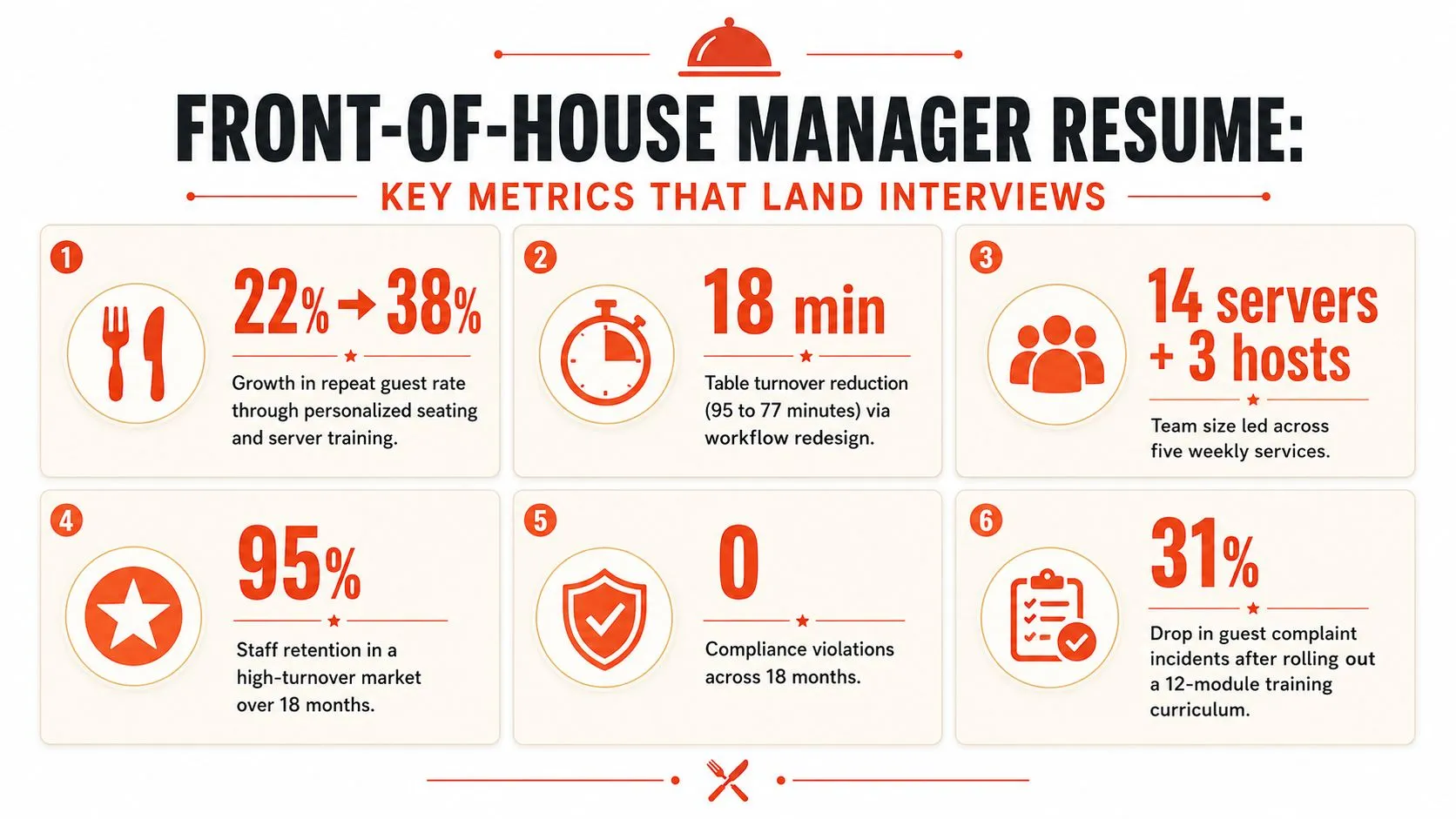
Use the strongest proof first. For example, “Managed front-of-house operations for a 150-seat upscale restaurant; grew repeat guest rate from 22% to 38% through personalized seating preferences and server training overhaul.” That one line gives scale, action, and outcome. It tells a manager you understand both hospitality and business.
If you need a second angle, show efficiency. “Reduced table turnover time by 18 minutes by redesigning host station workflow and implementing reservation optimization software; increased covers by 12 per service.” That's the kind of detail hiring teams read fast because it signals judgment, not just effort.
What to emphasize
- Guest loyalty: repeat visits, online ratings, complaint recovery, and return bookings.
- Flow control: turn times, covers per service, wait management, and reservation coordination.
- Leadership: team size, shift coverage, training, and compliance.
If you trained staff, say what changed. If you used a POS or reservation platform, name it. Recruiters for hospitality roles are screening for operational thinking, not a list of duties. The more your bullet reads like a solved problem, the more credible you sound.
The industry guide for hospitality resumes says measurable financial impact and tenure/stability get heavy weight in screening, and it also looks for leadership language and role-specific keywords like restaurant manager, hotel general manager, executive chef, and food and beverage director (hospitality resume screening guidance). That's a clue. Your front-of-house resume should sound like someone who can keep a floor moving and protect the guest experience at the same time.
2. Hotel General Manager Resume
A hotel GM resume should read like a property-level business case. The job is not to sound active. It is to prove you can hold revenue, brand standards, and labor control at the same time.
Lead with the operating problem, the decision, and the result. “Grew RevPAR from $68 to $89 per night over 24 months by implementing dynamic pricing strategy, enhancing loyalty program, and launching corporate partnership deals; increased annual revenue by $890K.” That works because it ties pricing choices to cash flow. It also shows you understand the levers behind hotel performance.
Use a second line to show control, not just growth. “Reduced operating expenses by 12% through LED retrofit, renegotiated vendor contracts, and labor optimization while maintaining guest satisfaction score of 4.6/5.0.” That is the right balance for a GM. Cost cuts matter only when guest experience stays stable.
What makes a GM resume credible
- Property context: name the room count and hotel type.
- Turnaround or repositioning: show a change, not just steady management.
- Scope: if you managed multiple properties, say so plainly.
- Brand credibility: mention loyalty programs, standards, and recognitions if they are real.
A reopen or renovation deserves its own proof line. “Led full renovation and repositioning of 150-room property during COVID closure, reopened with new F&B concept and meeting space, and achieved 87% occupancy within 6 months.” That is leadership under pressure. It shows scope, decision-making, and outcome in one sentence.
A hotel GM resume should sound like someone who can defend a P&L, not just manage a lobby. Keep the language tight. Keep the numbers real. Keep the focus on property-level results.
3. Executive Chef Resume
An executive chef resume should sound like a kitchen business file, not a menu brochure. Good food matters, but hiring committees also want to know how you handled cost, staffing, service volume, and training. A chef who can't control the numbers is a risky hire, even in a beautiful kitchen.
Make the kitchen economics visible
“Developed 40-item seasonal menu for 180-seat fine-dining restaurant; increased average check from $78 to $94 and grew repeat guest rate to 42% through wine pairing and tasting menu offerings.” That's strong because it links creative work to revenue. It proves the menu wasn't just well received, it changed guest spending behavior.
“Reduced food cost from 34% to 28% over 18 months by implementing inventory tracking system, renegotiating supplier contracts, and training line cooks on portion consistency; saved $80K annually without quality loss.” That's the sort of bullet that tells a hiring manager you understand kitchen economics. It also shows process discipline, which matters just as much as taste.
If you've built a team, say how large it got and what you changed. “Built kitchen brigade from 3 to 12 cooks; designed training curriculum covering knife skills, sauce technique, and plating standards; achieved 94% staff retention and zero health code violations across 36 months.” That's leadership, systems, and compliance in one line.
Keep the adjectives out. “Innovative” and “creative” are cheap words. Food cost, retention, and ticket performance are real.
Use real kitchen context. Seat count, cover volume, and budget size help a reader place you fast. If you worked under a known chef or in a recognized restaurant, mention the environment clearly, then make your own contribution unmistakable. That's how you turn pedigree into proof.
4. Housekeeping Director Resume
Housekeeping is the hotel's quiet operating system. Guests only notice it when standards slip, so a housekeeping director resume has to show control, not polish. Treat each bullet like a business case. State the problem, the decision, and the result.
“Supervised housekeeping team of 18 across 200-room property; reduced room turnover time from 35 to 28 minutes per room through workstation redesign and cleaning method optimization; maintained 97% guest satisfaction on cleanliness.” That works because it ties labor scope to process changes and guest results. It shows you can run the floor, not just inspect it.
Training matters when turnover is the problem.
“Developed new-hire training program with 8-module curriculum; reduced initial turnover from 38% to 18% within the first 90 days; created mentorship structure that retained 6 experienced staff as floor supervisors.” This is the kind of detail hiring managers trust. It shows you fixed a staffing leak with a system, then kept experienced people in place.
Labor control belongs in the same frame. “Decreased labor cost per occupied room from $14.20 to $11.80 by implementing time-motion studies, supply ordering system, and predictive scheduling; maintained zero safety incidents and improved audit scores from 92% to 98%.” That bullet connects cost control with compliance. It proves you improved efficiency without letting standards slide.
Keep the adjectives out. Words like “novel” and “creative” are cheap. Labor cost, retention, and audit scores are real.
Use the details that let a reader place your work fast, room count, team size, audit results, safety record, equipment changes, scheduling software, and green cleaning if it changed performance. The point is not to sound polished. The point is to show you kept rooms ready, teams steady, and standards high.
5. Restaurant Operations Manager Resume
A restaurant operations manager is the person who keeps the entire machine from slipping. Food quality, labor, compliance, inventory, and guest experience all hit your desk, often at the same time. Your resume should reflect that pressure with hard numbers and plain language.
“Reduced food cost from 32% to 28% of revenue through menu engineering, portion standardization, and renegotiated supplier contracts; maintained guest satisfaction scores above 4.5 stars throughout implementation.” That's a clean ops story. You solved a cost problem without damaging the dining experience.
“Managed day-to-day operations for 3-unit casual dining group with 480 seats combined; implemented centralized scheduling system that reduced labor cost by 6% and improved schedule compliance from 68% to 94%.” This is the kind of line that reads like leadership, because it proves you controlled a multi-unit operation, not just a single shift.
A third bullet can show loss prevention. “Redesigned inventory system and implemented cycle counting; reduced shrink from 3.2% to 1.8% of COGS; trained all managers on inventory procedures and created weekly loss-prevention reporting.” That says you don't wait for problems, you build systems that stop them.
The most useful resume language here is operational, not decorative. Mention health department scores, certifications, audit results, scheduling software, inventory platforms, and training systems. If you're writing this from scratch, the internal guide on resume bullet points for operations manager is a useful reference point for turning duties into outcome-led bullets.
6. Event Manager / Catering Director Resume
Event and catering resumes should read like business cases. Show the operating problem, the decision you made, the result, and the scale you handled. A hiring manager wants to see control over guests, vendors, budgets, and timing, not vague service claims.
“Managed 120+ catering events annually with $1.2M total revenue across 3 venues; grew repeat business from 32% to 58% through personalized follow-up and custom menu innovation; increased average event value from $9.2K to $11.8K.” This works because it ties client retention to revenue growth and shows the kind of commercial judgment event leaders need.
Complex events need tighter proof. “Coordinated logistics for 45-person destination wedding with 3-day itinerary across 2 venues; managed vendor team of 22 and delivered event on $68K budget with zero service delays and 9.2/10 client satisfaction.” That line shows scope, vendor control, and execution under pressure.
For corporate accounts, show how you grew the relationship. “Developed and executed corporate events program for Fortune 500 client; managed 8 events annually for 250 to 500 guests each; increased contract value by 28% over 3 years through tiered upsells, wine pairings, and ancillary services.” That is a clear operating win, not just coordination.
Event managers should also prove they can recover fast when plans break. A cancelled vendor, a late shipment, or a venue issue belongs on the resume if you fixed it cleanly and kept the event on track. Use the same logic in this event coordinator resume sample: state the scale, name the constraint, then show the result.
Watch how a hiring manager scans an event resume in this walkthrough.
7. Guest Services / Concierge Manager Resume
A concierge or guest services manager lives on speed, tact, and problem-solving. The work is often invisible when it goes well, which means the resume has to prove it through volume, response time, languages, and guest recovery. This is the point where service becomes measurable.
“Managed concierge operations for 500-room luxury hotel; achieved 9.2/10 guest satisfaction for concierge services and processed 6,500+ guest requests annually with 98% same-day resolution rate; reduced complaint escalations by 34%.” That's a strong opening because it shows scale and service quality together. It also proves you can keep issues from climbing.
If you build vendor relationships, quantify them. “Built partnership network with 80+ local restaurants, attractions, and services; negotiated preferred rates for spa bookings, dining reservations, and activities; increased ancillary revenue from concierge upsells by $52K annually.” That tells a manager you're not just answering questions, you're expanding the guest experience and the property's revenue.
Languages matter here too. “Fluent in English, Spanish, Mandarin, and French; served as primary concierge for international guests; increased loyalty program enrollment among international visitors from 18% to 44% through personalized cultural recommendations and follow-up.” That's not padding. That's direct commercial value tied to guest trust.
If a service problem disappeared before management noticed it, write the prevention work, not the drama. Hiring teams still care about the outcome.
If you trained other concierges, mention it. If you created VIP welcome packets, emergency protocols, or cultural guides, include them when they support the role. A guest services resume works best when it shows calm judgment, not just nice manners. For more phrasing ideas, the customer service resume bullet points guide helps you turn recovery work into outcomes.
7-Role Hospitality Resume Comparison
| Role | 🔄 Complexity | ⚡ Resources (staff/budget/tech) | 📊 Expected outcomes | 💡 Ideal use cases | ⭐ Key advantages |
|---|---|---|---|---|---|
| Front-of-House Manager Resume | Moderate, real-time guest ops, multi-shift coordination | Team ~8–14, POS/reservation platforms, scheduling tools | ↑ guest satisfaction and repeat visits; ↓ table turnover (e.g., -15–25%); ↑ covers/check avg | High-volume restaurants, upscale dining, pathway to general management | Operational metrics recognized by recruiters; measurable guest+ops impact |
| Hotel General Manager Resume | High, property-level P&L, capital projects, brand compliance | Property budget $2M–$15M+, full departmental staff, CAPEX oversight | RevPAR/ADR growth, operating-cost reduction, occupancy & ROI improvements | Full-property leadership, turnarounds, multi-property promotion | Demonstrates financial ownership and scalability across departments |
| Executive Chef Resume | High, culinary leadership plus business management | Food budget $200k–$600k+, brigade size, suppliers, kitchen tech | Improved food-cost %, higher average check, menu-driven revenue, awards | Fine-dining, menu innovation, culinary brand building | Culinary credentials + measurable revenue and cost control |
| Housekeeping Director Resume | Moderate, process-driven, highly measurable | Rooms/day 100–200+, housekeeping headcount, cleaning equipment/tech | Faster room turns, higher audit/cleanliness scores, lower labor cost/room | Hotels prioritizing cleanliness, efficiency projects, brand compliance | Objective metrics (audit scores, time/room) and strong compliance focus |
| Restaurant Operations Manager Resume | Moderate–High, multi-priority operations, possible multi-unit | POS/inventory systems, scheduling software, multi-shift staff, vendors | Reduced food & labor %; lower waste/shrink; consistent service quality | Multi-unit groups, chains, operations optimization roles | Data-driven cost control and scalable processes; compliance-savvy |
| Event Manager / Catering Director Resume | High, logistics + sales + vendor coordination | Event budgets ($k–$100k+), vendor network, cross-functional teams | Event revenue growth, higher repeat-booking rate, on-time delivery | Catering, hotel events, high-revenue event programs | Direct revenue impact; strong client-facing and problem-solving skills |
| Guest Services / Concierge Manager Resume | Moderate, high-touch, reactive problem-solving | Multilingual staff, PMS/CRM, vendor partnerships, concierge tech | Higher concierge NPS/satisfaction, faster request resolution, ancillary revenue | Luxury hotels, international markets, loyalty-driven properties | Drives guest retention/advocacy; languages and vendor network add value |
Turn Hospitality Work Into Evidence
Edit the resume in this order. First, choose the metrics you tracked. Then add the operating context, like seat count, room count, guest volume, or team size. After that, rewrite each duty as problem, action, result. Keep only the bullets that support the role you want.
Early-career candidates should use scope and transferable outcomes when direct metrics are thin. Show how many shifts you covered, what systems you used, what problems you handled, and what changed because of your work. Senior professionals should narrow in on revenue, efficiency, leadership, and turnaround stories. Career changers should translate prior experience into service, coordination, and control without forcing fake hospitality language.
Do not manufacture numbers. If you didn't track a metric, say what you observed, what process you improved, or what responsibility you owned. That's enough when it's honest and specific. A good hospitality resume example doesn't pretend every role produced perfect data. It shows enough context for a hiring manager to trust the candidate.
StoryCV helps you pull that context out through a guided interview, then turns it into clean resume language that still sounds like you. The point isn't decoration. It's evidence, and you're responsible for verifying every claim before you send it out.
Build your hospitality resume around the work you did, not the filler you can paste from a template. If you want help turning shifts, service recovery, team leadership, and operating results into a stronger story, visit StoryCV and start with a guided draft that makes the proof easier to see.