That career objective at the top of your resume? It’s probably wasting space. If it starts with "Seeking a challenging role," you've already lost the hiring manager.
They don’t have time for fluff. They scan, they don't read. Your first line is prime real estate. A vague opener gives them a reason to move on.
Think of it like this: your resume is your pitch. That top section is your headline. Wasting it on a generic statement is like starting a pitch with, "I'd like to sell you something." It signals you haven’t done your homework.
The Real Purpose of a Career Objective
A sharp objective does one thing: it frames your value, fast.
-
It tells them who you are and what problem you can solve.
-
It’s packed with keywords from the job description, so you get past the bots.
-
It gives them a reason to keep reading.
This isn't about what you want. It's a strategic move to position yourself as the only choice from line one. Your 10-second elevator pitch.
Why Your Current Objective Fails
Most objectives are selfish. They talk about what the candidate wants—growth, challenges, a dynamic environment.
Newsflash: the company doesn't care about your personal development. They care about their problems.
A strong objective flips the script. It focuses on what you can deliver. This is what separates a resume that gets interviews from one that gets archived. A recent LinkedIn analysis found hiring managers spend just 7.4 seconds on an initial scan. Your opening line is critical.
Tailoring your objective can boost interview callbacks by up to 40%. It’s a serious advantage.
To stand out, your objective needs to support your professional brand. Investing in your story is a game-changer, and professional personal branding services can help you define it.
Let's look at the difference.
Generic vs. Impactful Career Objectives
| Component | Generic (What to Avoid) | Impactful (What to Aim For) |
|---|---|---|
| Identity | "A motivated professional" | "Product Manager with 5+ years in B2B SaaS" |
| Value | "seeking to utilize my skills" | "who scaled a product from 10k to 100k MAU" |
| Target | "in a challenging role" | "to drive user engagement for Acme Corp's new platform" |
| Focus | "I want..." | "I can deliver..." |
See the difference? One is a passive request. The other is a confident statement of value.
A generic objective says, "I need a job." A specific one says, "I am the solution to your problem."
Stop filling out forms. Start showing what you can do.
A Simple Formula for a Powerful Objective
Writing a great objective isn't about word choice. It's about strategy. Forget soul-crushing templates that make everyone sound the same. This is a framework for thinking.
Your objective has one job: connect who you are, what you can do, and where you're going to the company’s needs. That’s it. Anything else is noise.
The formula is simple: [Who You Are] + [What You Do Well] + [Where You're Going].
Part 1: Who You Are
Start with your professional identity. No fluff like "motivated professional." Be specific.
State your title and years of experience. This sets the context.
-
"Senior Product Manager with 8 years of experience…"
-
"Data Analyst with 4+ years in e-commerce…"
-
"Certified Public Accountant (CPA) with a decade of experience…"
This is your headline. It tells the recruiter and the bots that you’re a relevant candidate.
Part 2: What You Do Well
Next, add your top skills or achievements that match the role. Don't just list them; frame them as accomplishments. Show, don't tell.
Scan the job description for their biggest problems. Are they trying to boost user retention? Cut costs? Enter a new market? Connect your wins to those problems.
A powerful objective doesn’t list your duties. It showcases the results of those duties. It positions you as a problem-solver.
Instead of claiming "strong leadership skills," say you "led a cross-functional team to launch three major features ahead of schedule." Numbers make your claims real.
Part 3: Where You're Going
Finally, state your goal. This isn’t about what you want. It's about what you intend to do for them. Get specific. Name the role and the company.
This part is non-negotiable. It proves you’ve done your homework and aren’t just spamming applications. It turns a generic statement into a targeted pitch.
-
"...seeking to drive revenue growth as a Sales Director at Acme Corp."
-
"...to leverage data-driven insights to optimize marketing campaigns for Innovate Inc."
When you put it all together, it tells a compelling story. It says who you are, proves you can do the job, and confirms you want to do it for them.
This visual guide shows the shift from a generic statement to a tailored, impactful one.
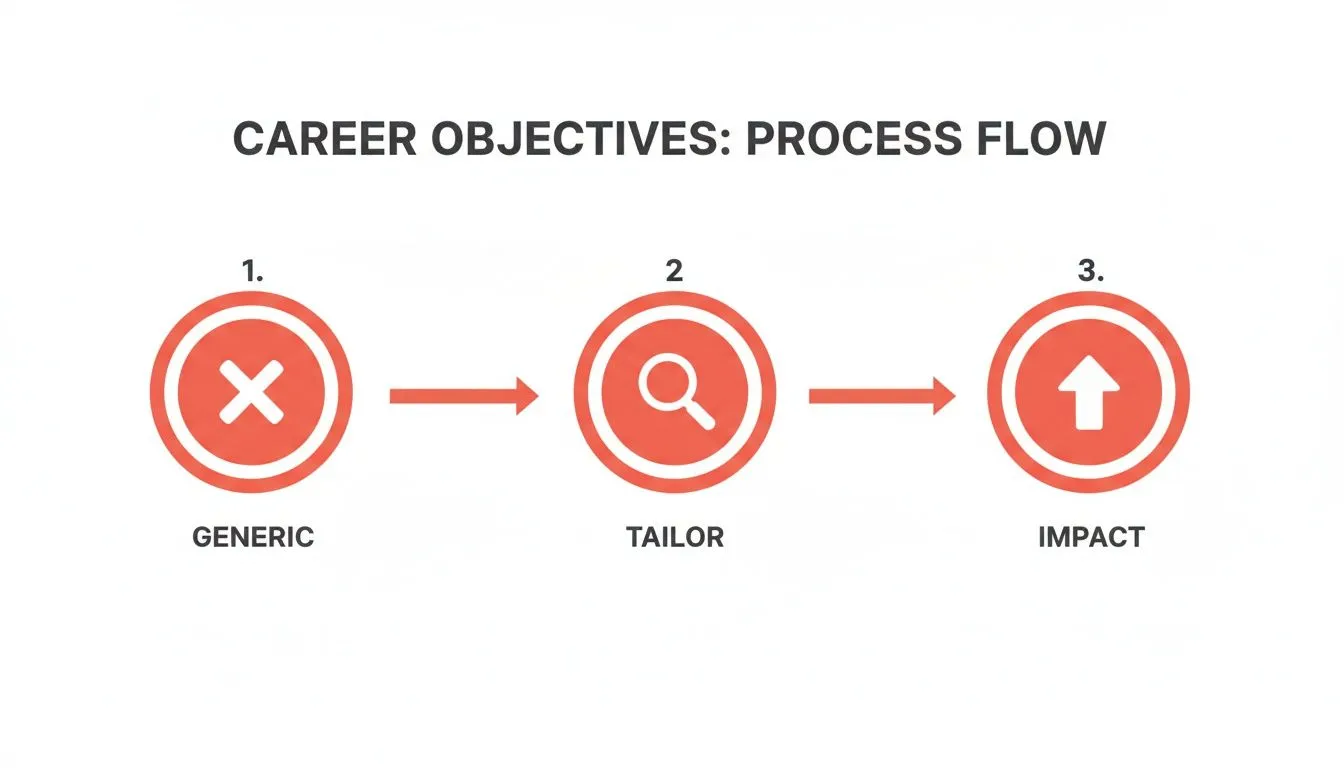
The key is moving from a self-focused statement to a company-focused one that highlights real impact.
Crafting a career objective uses clear, persuasive language, much like the principles of compelling website copy. As you polish your opener, learn how to describe yourself in a resume to keep your story consistent.
This isn't a fill-in-the-blank template. It's a structure to guide your thinking. It respects the recruiter’s time and positions you as the solution they need.
Tailored Career Objective Examples That Actually Work
Theory is useless without practice. Let's look at real-world examples that don't sound like a machine wrote them. This isn't a list to copy-paste—that’s a fast track to rejection.
Think of these as frameworks. Each one proves value, states a goal, and does it fast. We'll break down why they work so you can apply the logic.
The goal isn't to mimic. It's to internalize the thinking. Craft an objective that is yours and undeniably effective.
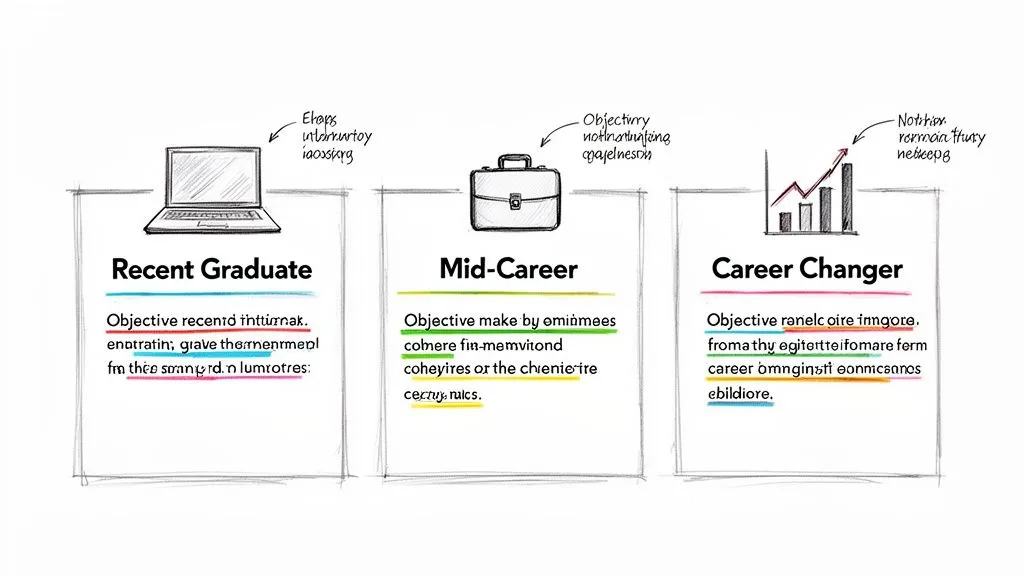
For the Mid-Career Professional
You have a track record. Your objective needs to be a sharp summary of your biggest wins. Focus on leadership, impact, and metrics. Show you can solve expensive problems.
-
Example 1 (Operations Manager): "Operations Manager with 8+ years of experience in supply chain optimization for CPG companies. Proven ability to reduce operational costs by 15% through process re-engineering and vendor negotiation. Seeking to leverage strategic planning skills to enhance efficiency and drive profitability as the Senior Operations Manager at [Company Name]."
- Why it works: It’s packed with authority—8+ years, a 15% cost reduction, and industry-specific language (CPG, supply chain) that shows you belong.
-
Example 2 (Senior Accountant): "CPA with over 10 years of experience in corporate finance, specializing in M&A due diligence and financial modeling. Led the financial analysis for a $50M acquisition, identifying $3M in post-integration synergies. Aiming to apply rigorous analytical skills to support the strategic growth initiatives at [Company Name] as a Senior Financial Analyst."
- Why it works: It uses powerful credentials (CPA), quantifies the scale of work ($50M, $3M), and speaks the language of the business. It’s all signal, no noise.
For the Career Changer
You are a translator. Your objective must connect the dots for the hiring manager. Show how skills from another field are valuable here. Focus on transferable skills in the context of the new industry.
For career changers, the objective is the most critical part of the resume. It's your one chance to reframe your history before the recruiter makes a snap judgment based on irrelevant titles.
-
Example 3 (Teacher to Corporate Trainer): "Accomplished educator with a decade of experience designing curricula and leading workshops for diverse audiences of 30+ individuals. Expert in creating engaging learning modules and measuring performance outcomes. Seeking to transfer skills in instructional design and adult learning theory to drive employee development as a Corporate Trainer at [Company Name]."
- Why it works: It reframes "teaching" as "instructional design," using corporate language to bridge the gap.
-
Example 4 (Journalist to Content Marketer): "Former journalist with 7 years of experience crafting compelling narratives and meeting tight deadlines for a major news outlet. Skilled in audience research, SEO best practices, and creating content that drives engagement. Eager to apply storytelling and analytical abilities to build brand authority for [Company Name] as a Content Marketing Specialist."
- Why it works: It translates journalism skills (narratives) into marketing assets (storytelling) and includes keywords recruiters want (SEO).
Industry-Specific Examples
Smart tailoring is industry-specific. The language in tech is different from business operations or creative fields.
Tech and IT Objectives
-
Example 5 (Cybersecurity Analyst): "Certified Information Systems Security Professional (CISSP) with 6 years of experience in threat detection and incident response. Successfully mitigated a major phishing attack, preventing potential data loss valued at over $200k. Seeking to protect and secure network infrastructure at [Company Name]."
-
Example 6 (Product Manager): "Product Manager with a 5-year track record in the B2B SaaS space, specializing in user-centric design. Led a product overhaul that resulted in a 25% increase in user retention and a 10% lift in NPS. Looking to drive product innovation and user satisfaction for [Company Name's] flagship platform."
Business and Operations Objectives
-
Example 7 (Project Manager): "PMP-certified Project Manager with 9 years of experience delivering complex, cross-functional projects on time and 15% under budget. Expert in Agile methodologies and stakeholder communication. Aiming to lead strategic initiatives and improve project outcomes for the team at [Company Name]."
-
Example 8 (HR Generalist): "SHRM-CP certified HR professional with 4 years of experience managing the full employee lifecycle. Reduced time-to-hire by 20% by implementing a new ATS workflow. Seeking to foster a positive and productive work environment as an HR Generalist at [Company Name]."
Marketing and Creative Objectives
-
Example 9 (Digital Marketing Manager): "Digital Marketing Manager with a history of developing multi-channel campaigns that increased lead generation by 40% year-over-year. Proficient in SEM, email automation, and content strategy. Looking to drive revenue growth through targeted marketing efforts at [Company Name]."
-
Example 10 (UX/UI Designer): "UX/UI Designer with 5+ years of experience creating intuitive and engaging interfaces for mobile and web applications. Redesigned a mobile app checkout flow that decreased cart abandonment by 18%. Eager to enhance the user experience and contribute to [Company Name's] design-centric culture."
The data backs this up. A global workforce report showed that resumes with quantified, forward-looking objectives achieve 52% higher advancement rates for mid-level pros. After analyzing 20 million applications, the report found that 70% of rejected resumes lacked specific metrics. Meanwhile, those citing impacts like 'boosted revenue by 10%' passed ATS 83% of the time. You can discover more insights about these findings on 1millionresume.com.
The common thread is specificity. They use numbers, name titles, and address what the employer needs. By tailoring your resume to the job description, your objective makes the recruiter’s job easier—and makes you unforgettable.
Common Mistakes That Get Your Resume Ignored
Knowing what to do is half the battle. Knowing what not to do keeps you in the game. Even great experience can be derailed by clumsy mistakes at the top of your resume. These aren't just typos; they are strategic errors.
The career objective has changed. Before 2000, only 12% of resumes had one. Now? With 75% of Fortune 500 companies using screening software, that number is up to 62% for mid-career professionals. This prime real estate is too valuable to get wrong. You can explore the full history and data behind resume trends to see how much has changed.
Let's break down the common traps.
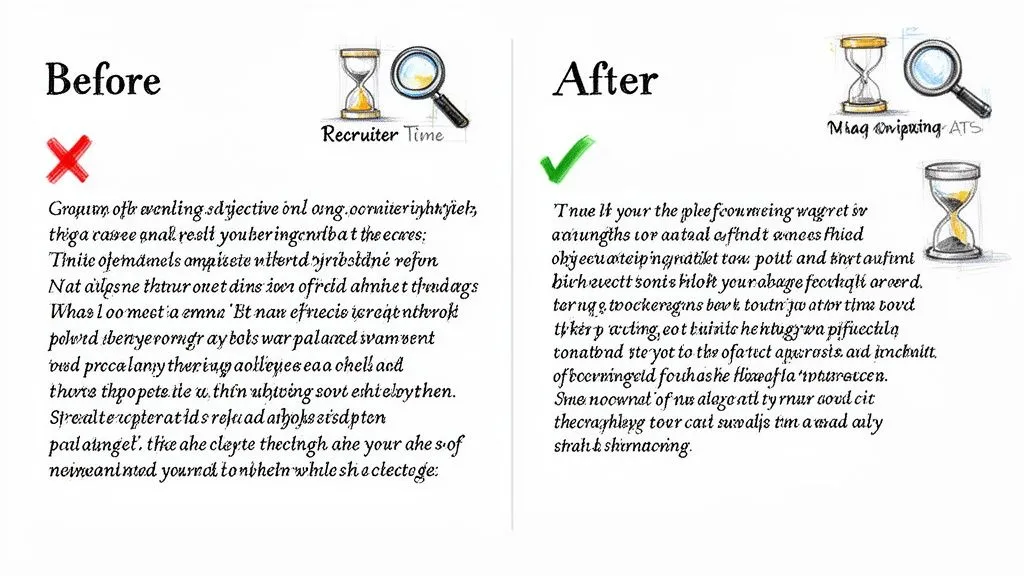
Being Vague and Generic
This is the #1 killer of objectives. Vague statements are a red flag. They tell the hiring manager nothing and scream, "I'm sending this to 50 other companies."
-
Before: "Seeking a challenging role in a dynamic company where I can utilize my skills for growth and success."
- This is junk mail. It’s stuffed with empty buzzwords and focuses entirely on what you want.
-
After: "Data Analyst with 5 years of experience in e-commerce, skilled in SQL and Tableau. Seeking to leverage data visualization to drive customer retention strategies for Shopify."
- This is a direct pitch. It's specific. It names the role, experience, tools, and target company.
Using Lifeless Clichés
Recruiters have seen "results-oriented" and "team player" thousands of times. These phrases are so overused they've lost all meaning. They are placeholders for people who can't articulate what they've actually done.
When you use a cliché, you're telling the recruiter you're just like everyone else. Show them how you're different.
-
Before: "A results-oriented team player with excellent communication skills looking for a position in project management."
-
After: "PMP-certified Project Manager who has led cross-functional teams to deliver $2M projects 15% under budget. Aiming to apply Agile methodologies to improve project outcomes at Google."
The "after" version swaps vague claims for hard evidence. It proves you are "results-oriented" without ever using those tired words.
Making It Too Long
Your objective is a headline, not a paragraph. If it stretches into four sentences, no one will read it. Brevity shows confidence and respect for the reader's time.
Aim for two to three powerful sentences, max.
-
Before: "I am a seasoned marketing professional with over a decade of experience in various aspects of digital marketing, including SEO, content creation, and social media management. I have successfully managed large budgets and led teams to exceed their goals. I am now seeking an opportunity to bring my expertise to a forward-thinking company where I can continue to drive growth and innovation."
- This is a short story. It’s bloated and buries the point.
-
After: "Digital Marketing Director with 10+ years of experience driving 40% YoY lead growth through integrated SEO and content strategies. Eager to lead the marketing team at HubSpot to capture new market share."
- Sharp, direct, and packed with value.
Forgetting to Proofread
This sounds obvious, but it happens all the time. A single typo can disqualify you. It signals a lack of attention to detail—a fatal flaw.
Read your objective out loud. Run it through a tool like Grammarly. Have a friend read it. Do whatever it takes to make it 100% error-free. There are no second chances.
Quick-Fix Checklist for Your Career Objective
Run your objective through this quick audit before you hit 'send'.
| Check Point | Yes/No | Action if 'No' |
|---|---|---|
| Is it tailored to a specific job and company? | Rewrite to include the job title and company name. | |
| Does it lead with your strongest skill or achievement? | Reorder the sentence to put your biggest impact first. | |
| Is it 2-3 sentences long? | Cut any filler words or sentences that don't add value. | |
| Does it include at least one number or metric? | Find a way to quantify an achievement (%, $, #). | |
| Is it 100% free of clichés like "team player"? | Replace clichés with specific examples of your work. | |
| Is it 100% free of typos and grammar errors? | Proofread it one more time, ideally out loud. |
If you're answering 'No' to any of these, your opening pitch isn't strong enough.
Are Career Objectives Still Relevant?
Let's clear the air. Some experts say the objective is dead, replaced by the professional summary. This debate is about labels, not substance. It misses the point.
The real question is about strategy. Are you using that prime real estate at the top of your resume to look backward or forward?
Objective vs. Summary: What Is the Real Difference?
A professional summary is a retrospective. A highlight reel of your past wins. It’s useful, but it’s backward-looking. It tells a recruiter what you have done.
A modern career objective is a forward-looking statement. It's your strategic pitch, connecting your value to the future you want to build at their company. It tells a recruiter what you intend to do for them.
A summary says, "Here's the value I've created before." An objective says, "Here's the value I'm going to create for you next."
That distinction is everything. A well-crafted objective is sharper and more direct. For a deeper dive, you can explore more professional summary examples for a resume to see how they differ.
When an Objective Outperforms a Summary
A summary works when your career path is a straight line. But for many, the path isn't so linear. A forward-looking objective is more powerful in three scenarios:
-
You're a career changer. A summary of your teaching job won’t click for a corporate training role. An objective bridges that gap by translating your skills and stating your new goal.
-
You're targeting a specific role. An objective shows you've done your homework. It screams focused intent, not just another casual application.
-
You’re leveling up. Moving from manager to director? An objective frames your experience in the context of the strategic responsibilities you're ready for.
The old argument that objectives are selfish is based on an outdated model. The old "Seeking a challenging role..." is dead. A modern objective isn't about your needs; it’s a confident declaration of your intended contribution. It's one of the sharpest tools you have.
Frequently Asked Questions About Career Objectives
You have the formula, but tricky questions always come up. Here are the practical, last-minute checks.
Should I Use a Career Objective or a Professional Summary?
It’s about picking the right tool.
An objective is best when you need to connect the dots for the recruiter. Use it if you’re:
-
Pivoting into a new industry.
-
Aiming for a very specific role.
-
Early in your career and selling potential.
An objective is forward-looking. It says, "Here's my goal and how I'll achieve it for you."
A professional summary is for when your career path is a straight line. It highlights your past wins and works best when you have years of directly relevant experience.
A modern objective can blend the best of both. Start with a past achievement for credibility, then pivot to your future contribution.
How Long Should a Career Objective Be?
Keep it brutally short. Two to three sentences. A maximum of 50-60 words.
Hiring managers scan. Anything longer defeats the purpose. If you can't say it in three sentences, you're not writing an objective. Brevity signals confidence.
Do I Need to Change My Objective for Every Application?
Yes. Every. Single. Time. No way around it.
A generic objective screams laziness. A one-size-fits-all approach doesn't work anymore.
Tailoring is non-negotiable for two reasons:
-
It gets you past the bots. Keywords from the job description are your first line of defense against the Applicant Tracking System (ATS).
-
It impresses the human. Seeing their company’s name and the specific job title proves you’re serious about this opportunity, not just any opportunity.
You wouldn't give the same sales pitch to two different clients. Why do it with employers?
Where Does the Objective Go On My Resume?
Right at the top. The first thing a recruiter sees after your name and contact info.
This is strategic. Your objective is the thesis statement for your resume. It frames how the reader interprets your experience, telling them what to look for. Your opening line. Make it count.
Stop wrestling with what to say. StoryCV is a Digital Resume Writer. We interview you, uncover your real impact, and turn it into a powerful narrative. We help you articulate your value so you can stop filling out boxes and start telling your story. Build your career story with StoryCV and see the difference.