Most human resource director resumes fail for the same reason. They read like a list of duties when the hiring team is looking for a business case. That gap matters because the market is crowded, with HR Director roles averaging 78 applicants per opening in one dataset, compared with 58 applicants per position across broader human resources roles, and HR Executive positions rising to 95 applicants per opening (Resumetarget resume data). At that level, nobody is impressed by “responsible for employee relations.” They want to see scope, leadership, and measurable outcomes fast.
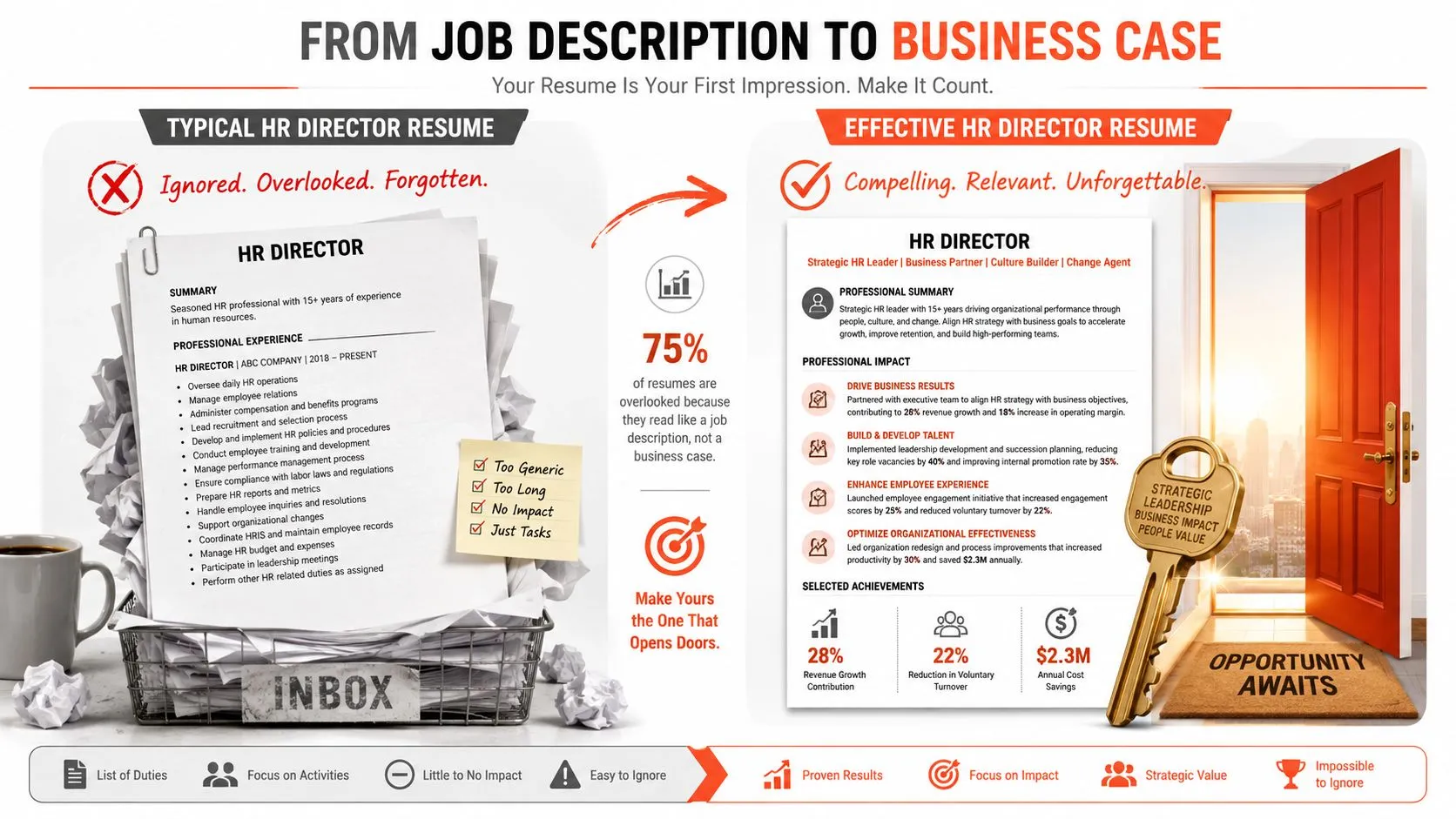
The right way to write a human resource director resume is simple. Lead with the size of the business you touched, then show the change you drove, and only then mention the task itself. If you need a useful companion piece on the strategic side of HR leadership, the HR leader guide to total rewards is a solid reference point.
The Real Job of an HR Director Resume
A director-level resume isn't a biography. It's an argument for trust. If your first bullets sound like an org chart cleanup, you've already lost the room.
The hiring committee is scanning for a few things in the first pass, whether they admit it or not. Can you handle scale? Can you influence leaders? Can you show results that matter to the business, not just to the HR function? The example metrics used in senior resume guidance make the point clearly, with roles supporting 2,000+ employees, leading an HR team of 15, driving a $500M acquisition, and reducing turnover from 32% to 19% over 3 years (JobScoutly example guidance). Those aren't decorations. They're the proof.
Practical rule: if a bullet doesn't show scope or outcome, it belongs lower on the page or out of the resume entirely.
That's why generic duties fail at this level. “Managed employee relations” tells me you did some work. It doesn't tell me whether you were advising executives, covering multiple locations, or stabilizing a difficult culture. Director resumes have to signal strategic ownership quickly, because that's what separates an administrator from a leader.
For a useful structural reference, the internal breakdown at director-level resume guidance shows how senior resumes are usually framed, but the key lesson is this. Scope first, impact second, tasks last. That's the spine of a serious human resource director resume.
The Structure That Works at Director Level
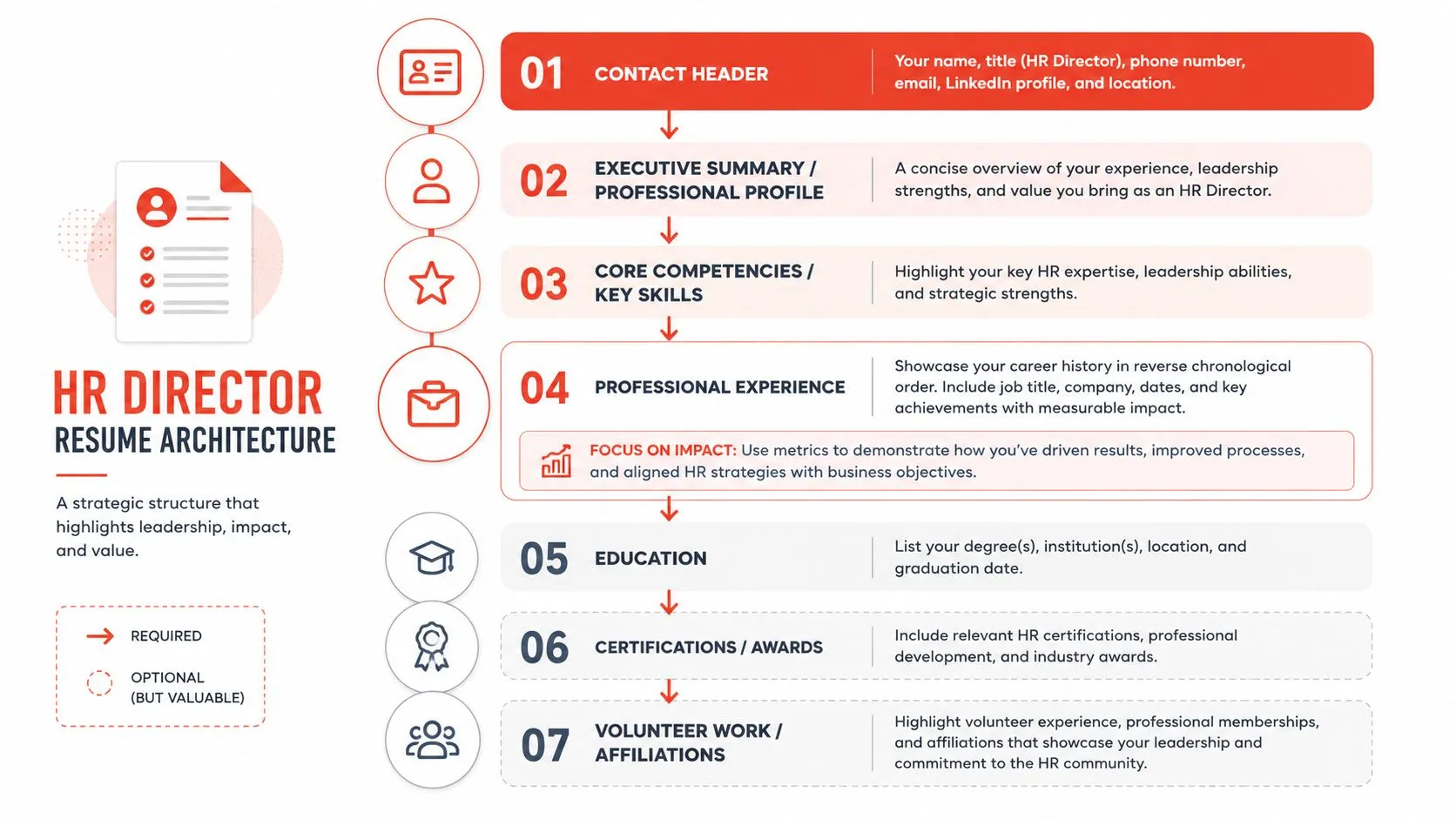
Start with the parts hiring teams expect, then make every section justify its place. For a human resource director resume, the default order is contact header, executive summary, core competencies or skills, professional experience in reverse chronological order, education, and certifications. Optional additions like board involvement, industry affiliations, or selected leadership highlights can help if they support the story, but they should never crowd the page (CVCraft resume structure guidance).
Keep the page count disciplined
For most senior HR leaders, 1 to 2 pages is the right range. That limit is not arbitrary, it forces judgment. Earlier roles usually need only 2 to 3 bullets, while the most recent roles can earn 4 to 5 bullets when the work is relevant and strong. If you are stretching to fill a third page, you are probably repeating yourself (HR University formatting guidance).
Reverse chronology works because it puts your current level of responsibility at the top, where recruiters expect to find it. A clean, ATS-friendly layout matters just as much, so skip tables, columns, headers, and footers that can confuse parsing systems. Use structure to make the file easy to read and easy to parse.
Do this: put the most senior, most measurable role first.
Don't do this: hide your best scope behind a decorative layout or a soft summary.
For drafting, an AI resume builder can help organize sections quickly, but only if you already know what story you are telling. Automation should speed up judgment, not replace it. If you want a practical sequence for building those sections, the internal guide on director-level resume guidance pairs well with this structure.
The Scope and Impact Bullet Formula
Most HR directors already have the raw material for strong bullets. They bury it under task language. The fix is a formula that makes every line read like a business decision, not a duty log.
Use this order every time
- Scope first. Open with the business size, team size, sites, or budget you touched.
- HR lever second. Name the work, such as restructuring, HRIS migration, total rewards redesign, or talent strategy.
- Action third. Use a strong verb and say what you did.
- Result last. Close with the outcome, even if it is a retention, process, or leadership result rather than a hard financial number.
That order keeps the bullet grounded. It also tells the reader whether you have led at enterprise scale or just supported a function from the sidelines.
A weak bullet sounds like a job description. A strong one reads like evidence.
- Weak: Managed acquisition integration and employee communications.
-
Strong: Supported a 500M acquisition, coordinated HR integration across teams, and stabilized employee communications through the transition.
-
Weak: Improved performance management process for managers.
-
Strong: Redesigned the performance management process for a multi-site leadership group, clarified manager accountability, and improved adoption across the organization.
-
Weak: Reduced turnover through employee engagement work.
- Strong: Led retention work for a large employee population, rebuilt manager support routines, and reduced turnover over time.
The point is not to cram every bullet with numbers. It is to make the bullet feel like a leadership decision with a business effect. If you need a clean reminder of how to translate operational work into outcomes, the examples of performance dashboards resource helps you think in metrics, and the internal guide on how to write bullet points in a resume stays close to the practical writing side.
Retire lazy verbs. Responsible for, handled, assisted, and supported do almost no work at director level. Use them only when the sentence already carries weight.
A fill-in-the-blank version looks like this:
[Scope] + [HR lever] + [action verb] + [measured result].
Use that pattern across the resume, and the bullets start sounding like a leader wrote them.
Writing an Executive Summary That Earns the Top Third
The summary is the first filter. If it reads like a recycled personal statement, a director-level reader skips it.
Write for two audiences at once. The recruiter needs a fast read on scope and fit. The hiring leader needs proof that you can run people strategy, not just support it. That means your summary has to balance ATS-friendly language with a clear executive story, because a block of vague adjectives helps neither side.
Build it in three moves
Start with scale. State the size of the organization, the complexity of the workforce, or the breadth of the remit you have owned. Then name two or three signature wins that match the role you want. End with the value you bring next, not with a claim that you are “experienced” or “passionate.”
A strong template looks like this:
HR director with [scope], experienced in [core function], known for [result 1] and [result 2], now focused on [next-level value].
Use that structure to write a summary that sounds senior without sounding inflated. By the end of the second line, the reader should know whether you are a people leader, a transformation leader, or both.
Here's a sample for a fictional candidate:
Human resources director with experience supporting a multi-site workforce and leading cross-functional HR initiatives across talent, employee relations, and organizational change. Known for aligning managers, tightening HR processes, and translating workforce needs into practical leadership decisions. Brings a disciplined mix of strategic HR execution, executive communication, and measurable people outcomes.
That version works because it reads like a business case. It gives scope, names the operating areas, and shows how the role creates value for leadership. It is better than a list of functions, and it is better than a praise-heavy paragraph packed with adjectives. Leave out phrases like “dynamic,” “results-driven,” and “highly motivated” unless the rest of the summary proves them.
A weak summary usually fails in one of three ways. It lists every HR function the person has touched. It uses soft language and no evidence. Or it gets so cautious that nothing specific lands. Cut all three habits.
Write the summary after the experience section, not before. Once your bullets are sharp, the summary becomes obvious.
Keep the opening tight, readable, and specific. The summary should help a recruiter understand the file fast and give a hiring executive a reason to keep reading, without sounding stuffed for software.
ATS Keywords Without Sounding Like a Machine
ATS still matters, but keyword stuffing is amateur behavior. An HR director resume should be readable by software and believable to a senior HR peer. That balance is often overlooked.
The keywords that matter fall into four groups. First, HRIS platforms such as Workday and SAP SuccessFactors. Second, compliance language like FMLA, ADA, FLSA, and EEOC. Third, core HR functions such as talent acquisition, total rewards, organizational design, and L and D. Fourth, leadership signals like board reporting and M and A integration. Those terms belong because they map to how director roles are evaluated, not because they sound impressive.
| Category | Examples | Best Placement on Resume |
|---|---|---|
| HRIS Platforms | Workday, SAP SuccessFactors | Summary, skills block, strongest experience bullet |
| Compliance Frameworks | FMLA, ADA, FLSA, EEOC | Experience bullets, skills block |
| Core HR Functions | Talent acquisition, total rewards, organizational design, L and D | Summary, skills, experience |
| Leadership Signals | Board reporting, M and A integration | Summary, top bullets, leadership highlights |
Place the terms where they read naturally. The summary can carry the highest-level language. The skills block can hold the technical keywords. The bullets should prove the terms in context. Don't spray them everywhere, and don't claim a system or framework you haven't used.
That matters even more for HR leaders, because integrity is part of the job. If you overstate a certification or fake fluency with a platform, you're not just hurting your resume. You're weakening your credibility as someone who evaluates other people's claims.
If you want a practical reminder of how ATS logic works without turning the page into keyword soup, the internal guide on AI resume screening keeps the focus where it belongs. Use the exact terms that fit your history, then back them with outcomes.
A Full Sample HR Director Resume
A strong sample should feel usable, not decorative. Here's a fictional version written in reverse chronological order and shaped for a two-page format.
Maya Reynolds
Human Resources Director
m.reynolds@email.com | (555) 218-9041 | Chicago, IL
Executive Summary
Human resources director with broad experience supporting a multi-site workforce and leading HR strategy across employee relations, talent, and organizational change. Known for improving manager execution, tightening people processes, and aligning HR work with business priorities. Brings executive-ready communication, steady judgment, and a practical approach to leadership.
Core Competencies
Workday, SAP SuccessFactors, FMLA, ADA, FLSA, EEOC, talent acquisition, total rewards, organizational design, board reporting, M and A integration, employee relations, leadership development
Professional Experience
Human Resources Director
Northstar Operations, Chicago, IL
2021 to Present
- Led HR support for a multi-site employee population, aligning managers and business leaders around workforce priorities.
- Directed an HR team across talent, employee relations, and policy execution, improving consistency in manager support.
- Partnered on acquisition integration work and helped standardize HR processes after the transition.
- Briefed senior leaders on workforce issues, escalation patterns, and people risks.
Senior HR Manager
Northstar Operations, Chicago, IL
2017 to 2021
- Rebuilt the performance management process for managers and employees across several business units.
- Improved policy clarity and manager accountability during restructuring cycles.
- Supported recruiting, retention, and employee relations work for a growing workforce.
- Worked closely with finance and operations on workforce planning and headcount priorities.
HR Manager
Lakeview Manufacturing, Milwaukee, WI
2013 to 2017
- Managed employee relations, onboarding, and compliance routines in a fast-moving environment.
- Supported benefits administration and policy communication for managers and employees.
- Helped improve the consistency of HR documentation and escalation handling.
Education
Master of Science in Human Resource Management, DePaul University
Bachelor of Science in Business Administration, University of Wisconsin-Milwaukee
Certifications
SHRM-SCP
This version works because the top of the page tells a coherent story right away. The summary leads with scope. The skills block is concise and relevant. The first role carries the most strategic weight. Even the certification sits where it adds credibility instead of distracting from the work.
A condensed one-page version makes sense for someone earlier in the director track. Cut the older role, trim each bullet to the strongest two, and keep only the skills that match the target posting. Don't compress by deleting the story. Compress by deleting repetition.
Editing, Checklist, and How StoryCV Fits In
The final pass should be ruthless. Check the formatting first. Then the bullets. Then the keywords. A clean resume that's vague is still a weak resume.
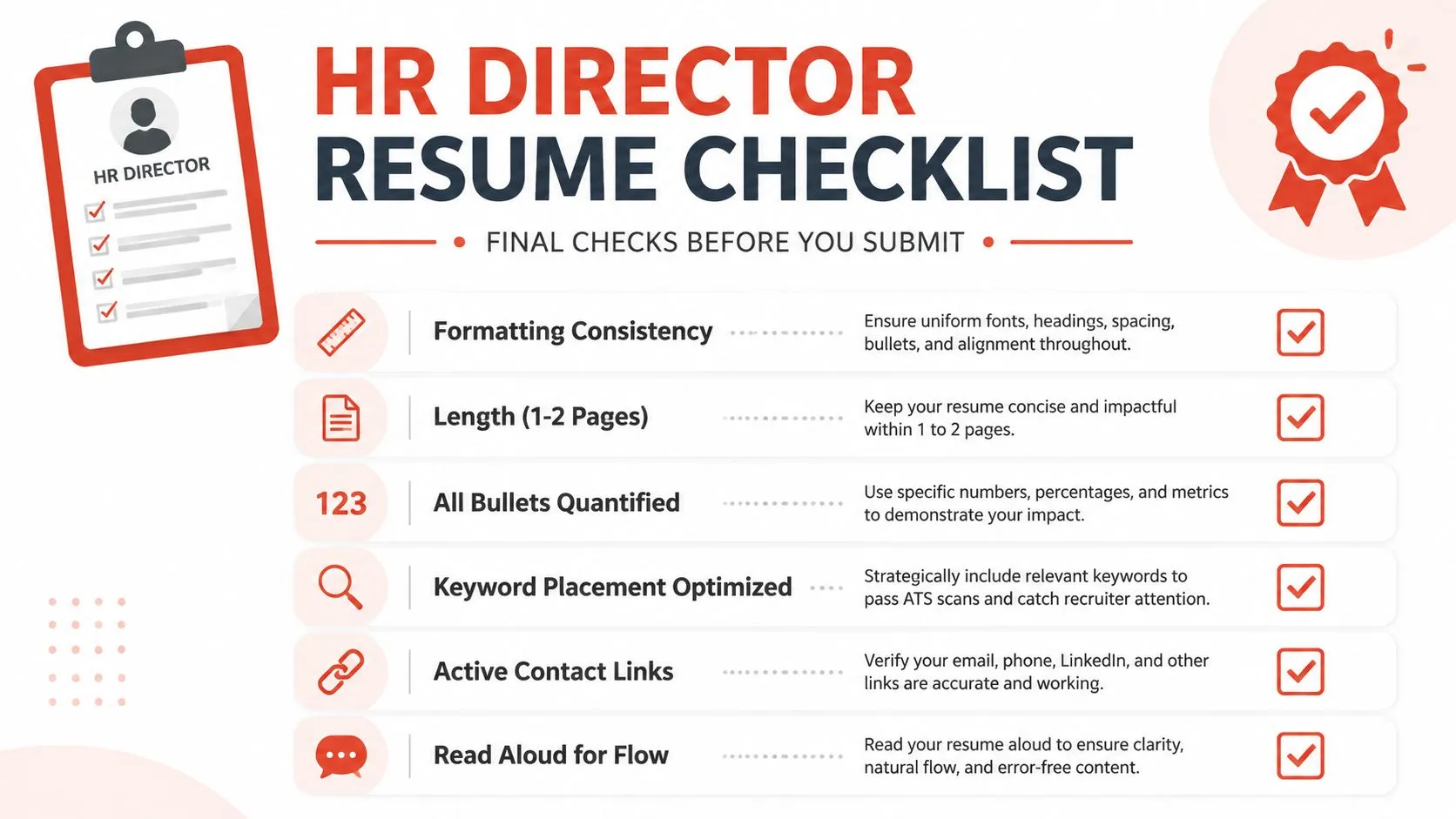
Pre-send checklist
- Formatting Consistency: Keep fonts, spacing, and headings uniform.
- Length Discipline: Stay within 1 to 2 pages unless the role genuinely justifies more.
- Quantification: Make sure each major bullet shows scope or outcome.
- Keyword Placement: Put exact role language in the summary, skills, and top bullets.
- Contact Links: Verify that email, phone, and any professional profile links work.
- Read Aloud Flow: If a bullet sounds clunky out loud, rewrite it.
StoryCV fits naturally into the drafting and editing step because it pulls out the context most candidates forget under pressure. It's an online resume writer that uses a guided interview to turn role details, scope, and achievements into resume language, which is a better starting point than a blank page or a generic template.
Keep updating the resume as the job changes. A director resume should evolve with new scale, new systems, and new leadership wins. Treat it like a living business case, not a one-time file.
If you want a sharper human resource director resume without stuffing it into a template, StoryCV will help you pull the scope, outcomes, and leadership story out of your experience. Start with one role, clean up the language, and build a resume that reads like a senior professional wrote it, because that's the standard your next interview should meet.