Most advice on a human resources assistant resume is bad. It tells you to cram in keywords, polish a template, and list duties like that counts as evidence.
It doesn't.
Hiring teams already know what an HR assistant does. They know the job includes records, onboarding, scheduling, recruiting support, and employee communication. If your resume just repeats that, you've written a generic job description for yourself.
A strong resume does one thing better. It shows how your admin work made HR run better.
Your HR Assistant Resume Is Probably Boring
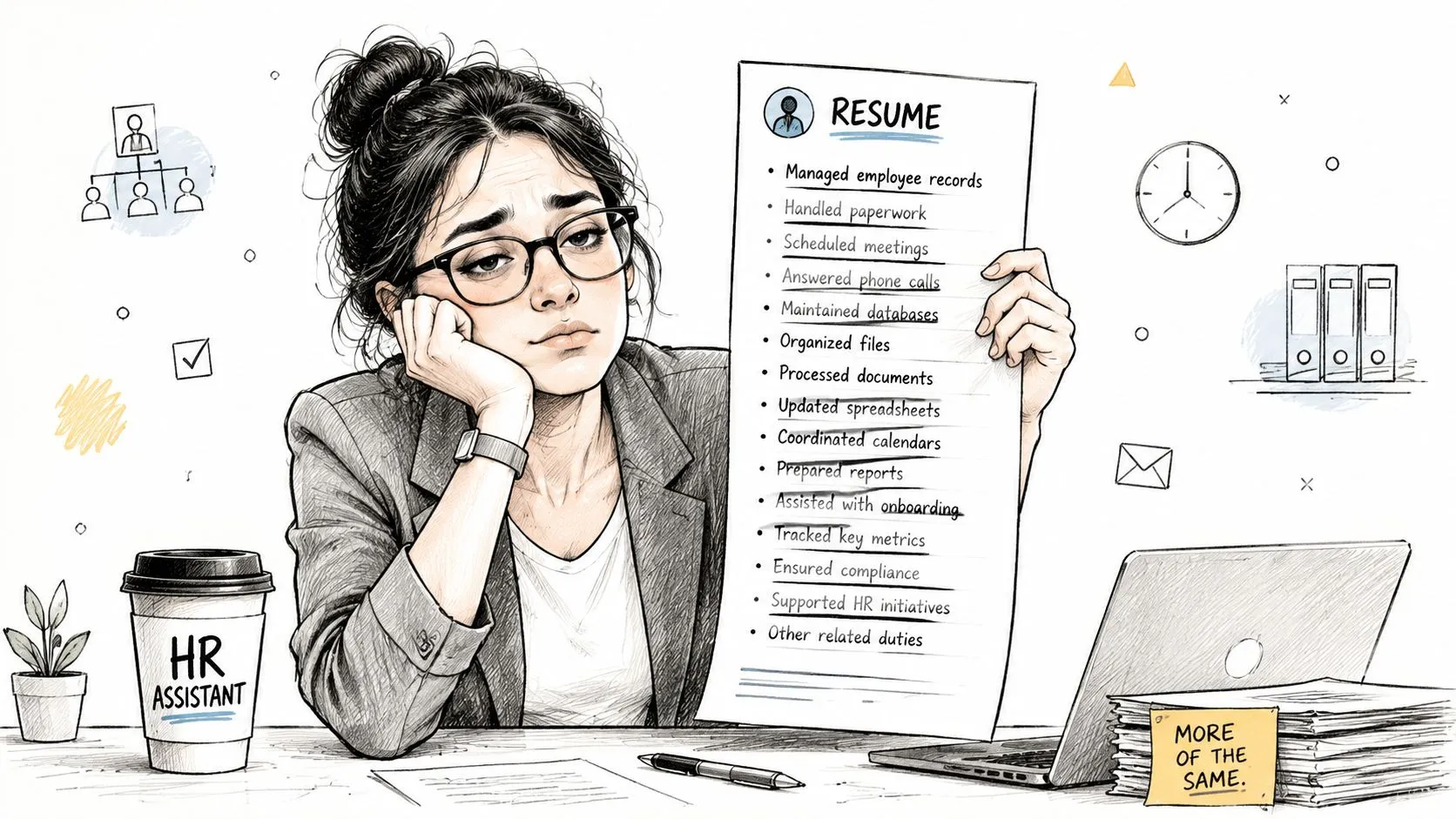
Most HR assistant resumes die for the same reason. They read like a compliance checklist.
“Maintained employee records.”
“Assisted with recruitment.”
“Supported onboarding.”
“Handled confidential documents.”
That's not a resume. That's a pile of expected tasks.
The popular advice is incomplete
Yes, you should match relevant keywords. Yes, you should reflect the language of the job description. But that advice falls apart when it turns your resume into a stiff list of buzzwords.
As Resume Now's HR assistant guidance points out, many resume guides push keyword matching and mirroring job descriptions, but they rarely explain how to balance that with credible human storytelling. That's the fundamental problem.
Your human resources assistant resume has to sound like a person who can be trusted with sensitive work, not a machine that copied the vacancy.
Recruiters don't need more proof that you know the words “onboarding,” “HRIS,” or “employee relations.” They need proof that you used those things well.
What hiring managers actually look for
They scan for three things fast:
-
Operational reliability
Can you handle detail-heavy work without creating messes for payroll, managers, or employees? -
Business usefulness
Did your work save time, reduce friction, improve coordination, or keep processes moving? -
Context
What kind of environment were you supporting: hiring volume, employee population, systems, compliance work, or cross-team coordination?
If your resume hides those answers under vague bullets, it will blend in with every other HR assistant application.
The fix isn't a prettier format. It's better judgment about what belongs on the page.
Stop Listing Tasks Start Showing Impact
Most HR assistant resumes die in the experience section.
They read like job descriptions. Filed records. Scheduled interviews. Answered employee questions. That tells a hiring manager you were present. It does not tell them you were useful.
In HR support roles, your value shows up in what your work prevented, improved, sped up, or kept accurate. Administrative work carries business consequences. Clean records protect payroll and compliance. Fast scheduling keeps hiring from stalling. Organized onboarding reduces first-week confusion and manager frustration. If your resume skips that context, you flatten real work into forgettable chores.
Task versus achievement
Use this test. If the bullet only describes the activity, rewrite it until the business effect is obvious.
| Boring Task (Before) | Impactful Achievement (After) |
|---|---|
| Managed employee records | Maintained accurate employee records across onboarding, status changes, and offboarding, helping HR stay organized and prepared for audits |
| Assisted with recruitment | Coordinated interview scheduling, candidate communication, and screening logistics to keep hiring moving without avoidable delays |
| Handled onboarding paperwork | Organized onboarding documentation and new-hire setup so employees had system access, forms, and basic information in place before day one |
| Responded to employee questions | Served as the first contact for routine HR questions, cutting manager interruptions and freeing senior HR staff for higher-priority issues |
| Updated applicant tracking system and standardized screening steps | Improved ATS workflow and standardized screening steps to save time, reduce manual follow-up, and keep recruiting activity consistent, as shown in published examples from Kickresume's HR assistant resume samples |
Good admin bullets work the same way strong administrative resume examples work. They show control, judgment, and results, not a pile of errands.
What to measure in HR support work
You do not need inflated metrics. You need proof that your work changed something that mattered.
Use these categories:
-
Volume
Hires supported, interviews scheduled, employee files maintained, inbox requests handled, managers or locations supported. -
Speed
Faster interview coordination, quicker onboarding turnaround, fewer scheduling gaps, shorter response time for routine employee issues. -
Accuracy
Fewer document errors, cleaner HRIS records, more reliable payroll inputs, better completion rates for onboarding paperwork. -
Process improvement
Standardized forms, cleaner filing systems, clearer communication steps, better handoffs between recruiting, HR, payroll, and managers. -
Risk reduction
Better recordkeeping, more consistent documentation, fewer missed compliance steps, stronger audit readiness.
One rule matters here. If a bullet could fit any HR assistant in any company, it is too weak to keep.
Stop underselling admin work
Bad resume advice tells HR assistants to sound broad, polished, and keyword heavy. Ignore that.
A better resume shows how routine support work holds the function together. Interview coordination affects time to hire. Record accuracy affects payroll, compliance, and employee trust. Onboarding setup affects first impressions and manager workload. Apprenticeship or early-career experience can count too, especially if you can show process ownership and follow-through, as discussed by Next Level Online College on apprenticeships.
Write your bullets like someone whose work kept things from breaking. Because that is usually what good HR assistants do.
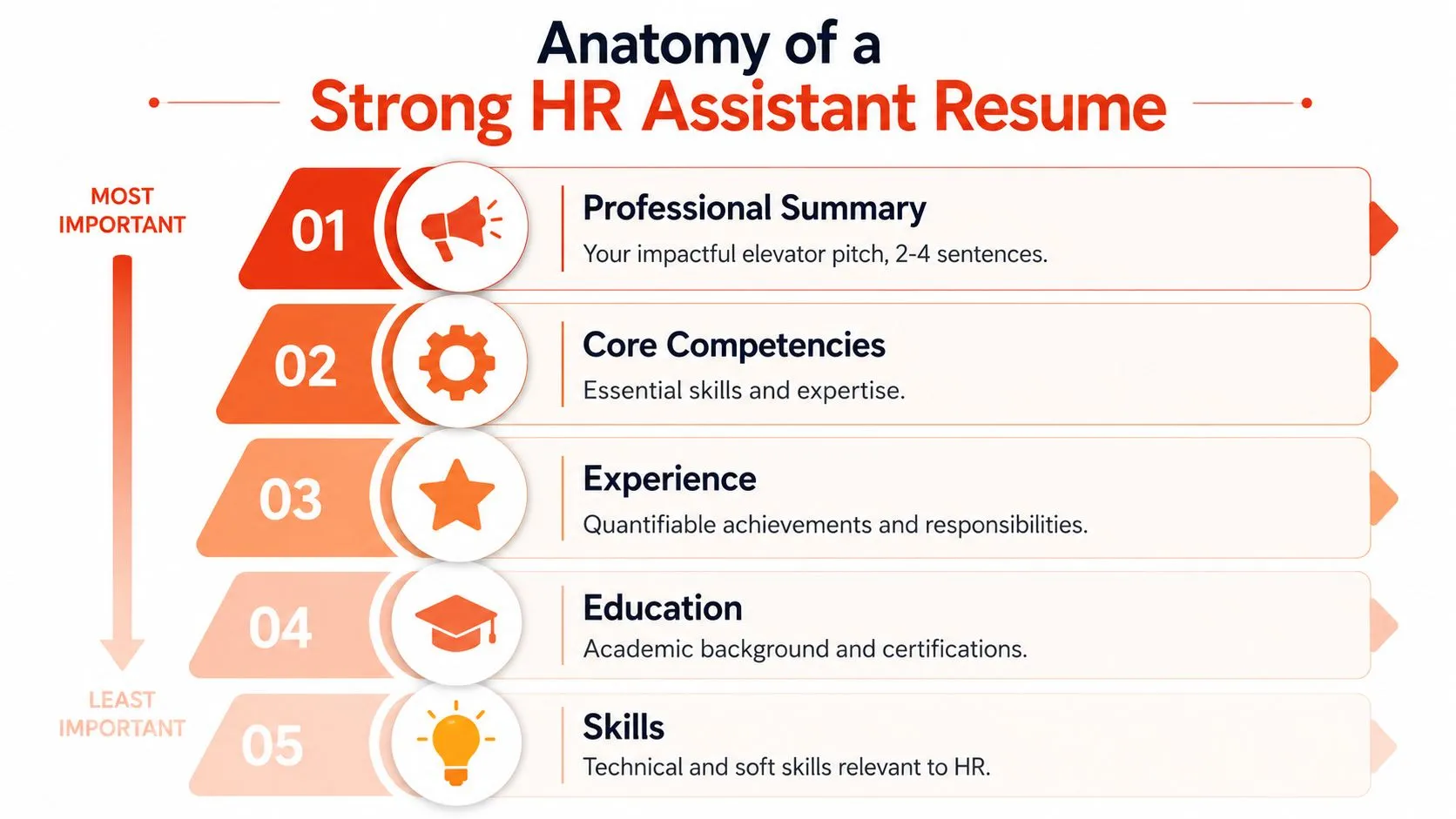
Anatomy of a Strong HR Assistant Resume
Fancy design is a distraction. Clean structure wins.
A strong human resources assistant resume should be simple, readable, and built for both software screening and human scanning. Teal's HR resume guidance recommends a structurally simple document: reverse chronological order, one page for most candidates, bullet points, and no tables or graphics. It also stresses surfacing ATS-compatible keywords and HR systems proficiency early.
Put the right things at the top
Your top third matters most.
Teal notes that 87% of HR recruiters find a concise professional summary helpful, and that failing to list specific HRIS proficiency is the second most common mistake found in 58% of resumes for HR roles in the source's cited guidance. So don't waste prime space on a vague objective.
Use this order:
- Header
- Professional summary
- Core competencies or skills
- Professional experience
- Education
- Additional certifications if relevant
What each section should do
Professional summary
This is not an objective. It's a compact argument for why you're useful.
Good summary:
HR assistant with experience supporting recruiting, onboarding, employee records, and day-to-day HR operations. Known for accurate documentation, clear employee communication, and strong follow-through across high-detail administrative work. Proficient with HRIS and ATS workflows, including tools such as Workday, ADP, or BambooHR where relevant.
Experience
This is the proof section. Reverse chronological. Tight bullets. Real outcomes.
If you've held adjacent admin roles, include them if they show confidentiality, coordination, records management, scheduling, or stakeholder support. That's especially useful for candidates coming through nontraditional routes, including training pathways like Next Level Online College on apprenticeships, where structured work experience may come from applied programs rather than classic HR titles.
Skills
List systems and functional skills, not empty personality traits.
Use real terms:
- HRIS
- ATS
- Workday
- ADP
- BambooHR
- Onboarding
- Employee records management
- Benefits administration
- Interview coordination
- Compliance support
If you need a broader benchmark for layout and admin-role positioning, review these examples of administrative resumes.
If your skills section says “communication” but never names the systems you've used, it's weak.
How to Write Achievement Focused Bullets
Candidates often freeze when they try to turn routine work into strong bullets. They think they need huge wins. They don't. They need sharper framing.
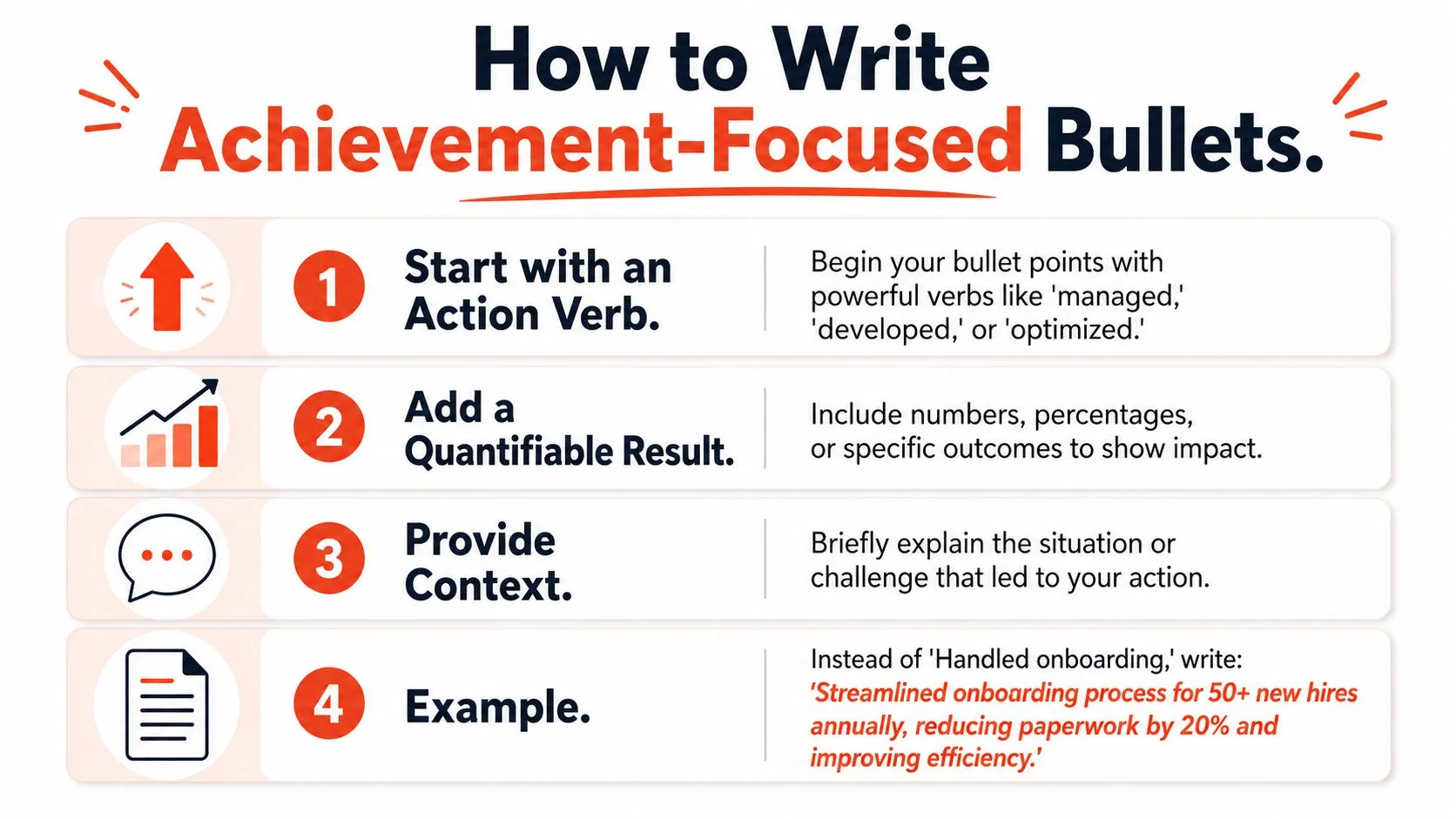
Use this formula:
Action verb + scope or result + context
That's it.
The formula in practice
Bad:
- Assisted with onboarding
- Managed files
- Helped recruiters
- Answered employee questions
Better:
- Coordinated onboarding documentation and pre-start logistics for new hires, ensuring employees arrived with complete paperwork and system access in place
- Maintained organized digital and physical personnel files, improving record retrieval and reducing administrative friction for the HR team
- Supported recruitment operations through interview scheduling, candidate communication, and ATS updates across active hiring cycles
- Served as the first point of contact for routine HR questions, resolving common issues and routing sensitive matters appropriately
Here's a useful walkthrough before you rewrite your bullets:
Good verbs for HR assistant work
Use verbs that imply ownership and control.
- Coordinated interview schedules, onboarding tasks, or meetings
- Administered records, benefits paperwork, HR systems, or forms
- Maintained confidential files and data accuracy
- Optimized repetitive processes or documentation steps
- Facilitated onboarding sessions, employee communications, or internal handoffs
- Tracked status changes, candidate progress, or compliance items
- Resolved routine issues before they became manager problems
Examples you can adapt
Here are stronger sample bullets for a human resources assistant resume:
- Coordinated candidate scheduling and interview logistics across multiple stakeholders, keeping recruitment activity organized and responsive
- Administered new-hire paperwork, document collection, and employee file setup to support a smooth onboarding experience
- Maintained confidential personnel records with a strong focus on accuracy, completeness, and timely updates
- Supported benefits enrollment and related employee communication, helping staff complete required documentation correctly
- Prepared HR reports, trackers, and status updates that gave managers and HR partners clear visibility into active processes
- Improved administrative workflows by standardizing forms, checklists, or filing practices, reducing avoidable follow-up work
If you want a tighter method for turning vague duties into stronger bullets, this guide on how to write achievements in resume is worth reading.
Write bullets that answer this silent question: what got better because you did the work?
ATS Is a Filter Not the Goal
People talk about ATS like it's the final exam. It's not. It's a gate.
Treat it like basic hygiene.
What ATS actually needs
Your human resources assistant resume should use:
- Standard headings like Professional Experience and Skills
- Simple formatting with one column and readable fonts
- Relevant keywords taken from the actual job posting
- Specific systems such as Workday, ADP, BambooHR, or the employer's listed platform
- Reverse chronological order unless your background demands otherwise
That's enough for most cases.
Where people go wrong
They chase keyword density and destroy readability. The result is a resume full of repeated phrases and no signal.
A recruiter doesn't hire a keyword list. A recruiter hires a person who looks competent, organized, and credible. If you want a grounded view of what screening systems do before a human reads your file, this explainer on AI resume screening is useful.
Don't optimize yourself into sounding fake.
A clean resume gets through the filter. A persuasive resume gets the interview.
Your Next Step Is a Conversation Not a Template
Templates push you toward shallow writing. They give you boxes, and boxes make people list duties.
That's why so many decent professionals end up with flat resumes. They've done real work, but nobody has helped them extract the context, the judgment, and the business value from it.

The better approach is conversation. Ask what changed because of your work. Ask what you handled that others depended on. Ask where you prevented delays, confusion, or errors. That's where strong resume material comes from.
And once you start getting interviews, you still need to say this stuff out loud without sounding rehearsed. For that, this guide on how to develop speaking confidence with ChatPal is practical.
Your resume should sound like a capable adult who understands how HR operations work. Not like someone filling in blanks.
StoryCV is a Digital Resume Writer, not a template library. It uses a guided interview to pull out the value in your experience, then turns that into a clear, ATS-friendly, human-sounding resume. If you're tired of stuffing keywords into dead bullets, start there.