Stop pretending your problem is that you don't have enough consulting experience. You probably have enough raw material. What you have is a description problem, and a bad one. Most management consulting resumes fail because they list activity, not judgment, and recruiters can't hire “worked on a case” or “helped with a deck.”
That's the gap. Not a fake gap in prestige. A real gap in translation.
A strong management consulting resume doesn't need a client badge to look serious. It needs to show that you can take an ambiguous problem, decide what matters, and turn that into a recommendation. That's the same signal whether the work happened in a client room, a student consulting club, a case competition final, or an internship deck review. Yale's consulting guidance pushes candidates to quantify outcomes and prioritize the strongest results, because consulting firms want evidence, not autobiography, and modern consulting resumes are built around measurable impact rather than task lists (Yale consulting resume guidance).
The Real Problem With Most Consulting Resumes
You don't have a “thin experience” problem. You have a bad framing problem.
A recruiter scanning a consulting resume is not asking whether your experience happened inside McKinsey or in a student club room. They're asking whether the bullet shows structured thinking under ambiguity. That's why the strongest guidance keeps pushing the same thing, a one-page, high-density format with only a few quantified bullets per role, reverse chronological order, and a ruthless focus on results (Management Consulted consulting resume guide). If a bullet doesn't show what problem was there, what you did, and what changed, it's just noise.
Stage is not the signal
A case competition can absolutely count. So can a club project. So can a summer internship where you mostly built slides and pulled data. The prestige level changes. The underlying judgment doesn't. Consulting recruiters care whether you can convert messy work into crisp evidence of value, because that's the job.
Practical rule: If a bullet reads like “participated in,” “supported,” or “helped with,” it's weak. If it reads like “identified,” “sized,” “recommended,” or “delivered,” it starts sounding like consulting.
The most common mistake is psychological. People assume they need to sound more senior than they were. They don't. They need to sound more precise. A student project described accurately can still look sharp if the thinking is clean.
That's the frame for the rest of this. Don't inflate the stage. Upgrade the description.
The One-Page Format and Section Priority
A consulting resume should be one page unless you've earned the rare exception. That isn't aesthetic snobbery. It's signal control. Recruiters don't read these resumes like novels, they scan them fast, and dense pages give them less garbage to sift through. If your page feels crowded, that's usually a feature, not a bug, as long as the right things are crowding the page.
Start with the obvious header. Name, phone, email, location, and one clean professional profile if you use one. Then put education near the top if you're early-career, because school still matters in consulting. Keep GPA, honors, and relevant coursework only if they help. If they don't help, cut them.
What earns space and what doesn't
Your experience section is the center of gravity. That's where recruiters look for evidence that you can think, structure, and produce outcomes. Leadership and activities can support the story, especially for students and early-career candidates, but they don't outrank actual work. Skills belong at the bottom as a thin footer, not a junk drawer.
A professional summary is usually a waste of space for early-career applicants. It rarely adds anything the bullets don't already say. If you're not bringing several years of directly relevant work, skip it and use the space on stronger bullets.
Simple test: If a section doesn't help a recruiter answer “Can this person do consulting work?”, it probably doesn't deserve prime real estate.
For formatting and section order, a clean consulting resume template can help you avoid obvious layout mistakes, and StoryCV has a consulting resume template that shows the kind of compressed structure recruiters expect. Use that as a reference point, not as a crutch.
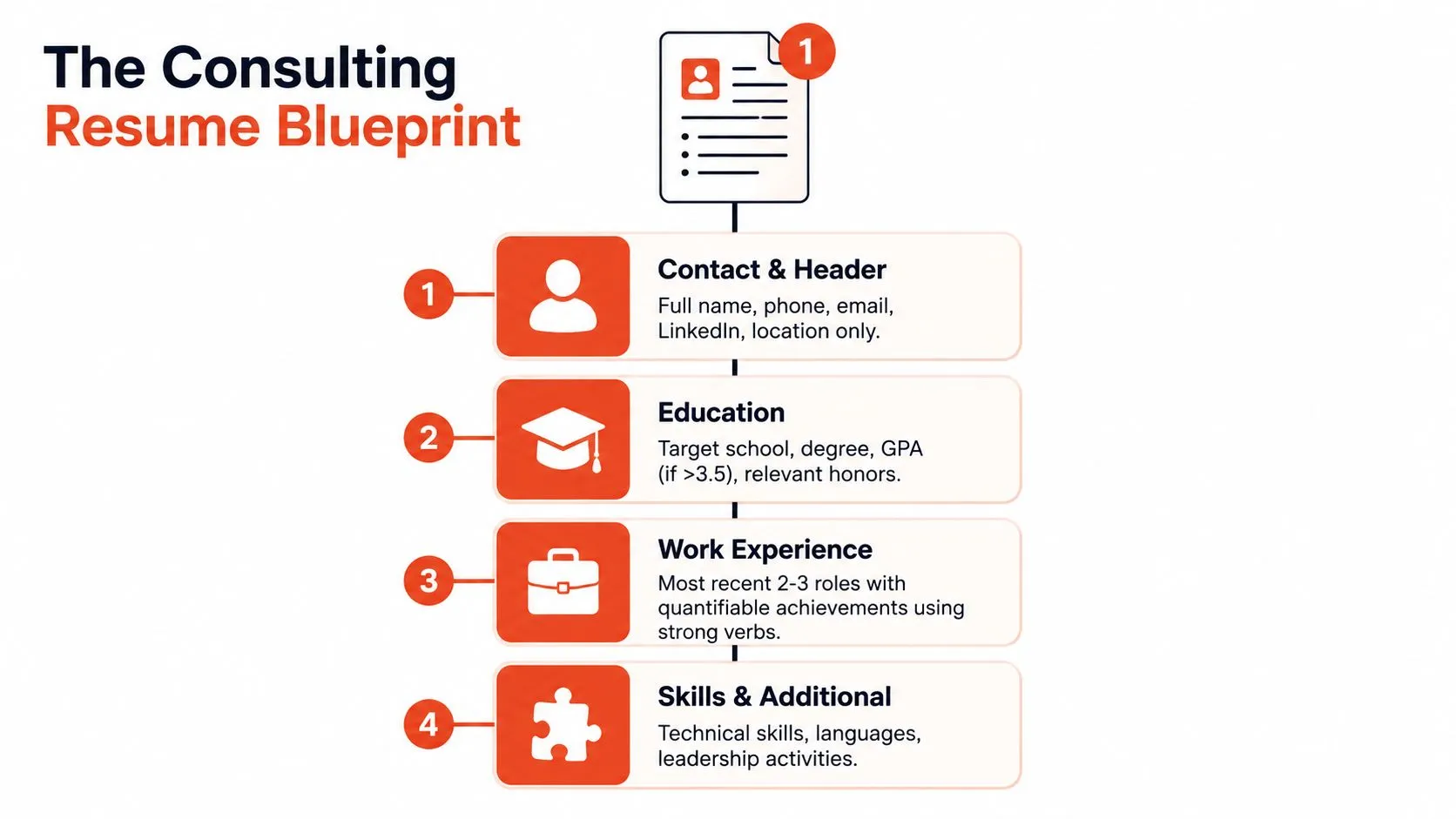
Optional sections need discipline. Languages can stay if you have them. Certifications stay if they're relevant. Interests stay only if they do something useful, like showing breadth or client-facing polish. If they're decorative, they're dead weight.
The PARC Bullet Structure and Why It Works
Consulting bullets work best when they follow Problem, Action, Result, Context. That's the whole game. It tells a recruiter what was broken, what move you made, what changed, and how big the thing was.
A bullet with only action and result can sound like a brag. A bullet with only context can sound like a title. You need all four pieces because consultants don't just execute, they frame the issue, choose the lever, and defend the outcome.
What each piece does
Problem gives the ambiguity.
Action shows the analytical move, not just the task.
Result gives the outcome, ideally quantified.
Context makes the outcome meaningful.
This is basically the same logic behind a skills-first resume structure, where the point isn't to list duties but to show what you can do with evidence. If you want a close cousin to this approach, HiredBySkill's skills-first STAR resume shows the same principle in a different frame.
Here's the difference in plain English.
Weak: “Researched market trends and presented findings to the team.”
Better: “Analyzed a fragmented local services market, identified the highest-margin customer segment, and recommended a narrower go-to-market plan that the team used in the final presentation.”
The second version works because it has a real problem, a real move, a real recommendation, and enough context to make the work legible.
A worked rewrite
Before: “Worked on a club project for a nonprofit and helped with strategy.”
After: “Helped a student consulting team assess donation drop-off for a nonprofit, mapped the main friction points in the intake process, and recommended a simpler follow-up workflow that the client could implement without extra staff.”
That's not fluff. It's sharper truth. The bullet still says what happened, but now it sounds like consulting work because it shows how the thinking unfolded.
The rule is simple. Don't describe the activity. Describe the decision-making.
Rewriting Case Competition and Club Bullets With Real Examples
Most candidates write case-competition bullets like they're trying to impress a stranger who already knows the brand name. Bad move. The reader can't evaluate a ranking or a title by itself. They need to see the reasoning.
Case competition example
Before: “Finalist in a case competition.”
After: “Built a recommendation for an ambiguous growth problem by segmenting the market, testing three demand assumptions, and steering the team toward the most defensible pricing and channel strategy.”
That after version works because it shows the actual judgment. It doesn't pretend the competition was a client engagement. It doesn't borrow fake seniority. It says: I took an unclear problem, broke it down, and defended a recommendation.
Student consulting club example
Before: “Member of student consulting club, worked on nonprofit project.”
After: “Analyzed a local nonprofit's volunteer scheduling bottlenecks, identified where no-shows were hurting throughput, and proposed a revised intake and reminder flow that the team could explain clearly to the client.”
That bullet is honest. It names the scope and the kind of issue. It doesn't claim the student team transformed the organization. It shows that the candidate understood the problem structure and could recommend something practical.
Internship example
Before: “Interned at company and supported research and deck creation.”
After: “Synthesized market research for an internal strategy team, translated scattered findings into a clear recommendation, and built the supporting slides for a manager review.”
If you want more sample framing for this kind of rewrite, StoryCV also has a consultant resume sample that shows how consulting-style bullets read when they're done cleanly.
The point across all three examples is the same. Don't inflate the stage. Do describe the thinking. If your internship was mostly research, say that. If your club project was small, say that too. Small doesn't mean weak if the logic is tight.
What to pull from thin-sounding experience
Use the facts that matter:
- The problem space, what was unclear or broken
- Your analytical move, how you broke it apart
- The recommendation, what you told the team or client
- The scale, team size, audience, or scope, stated clearly
That's enough. You don't need to cosplay as a partner.
Three Honest Mistakes That Get Resumes Rejected
The fastest way to lose trust is to overstate scope. I see this constantly, and it's almost always a panic response. Candidates think they're fixing thin experience. They're creating credibility risk.
Mistake 1, inflating the stage
"Led a cross-functional team of 12" sounds impressive until someone asks what that means. If the project was a three-person club case, that language is too big. Reviewers notice that mismatch fast, and interviewers notice it even faster.
Write the truth. If you were one of four people, say that. If the group was informal, say that. The resume isn't the place to borrow authority you don't own.
Mistake 2, hiding your actual role
A bullet that names the club or competition but hides your role is basically unreadable. The recruiter can't tell whether you drove the work or just showed up.
Honesty at the resume stage protects you later. Anyone serious about hiring will cross-check your bullets against the live case and the interview conversation.
Mistake 3, leaning on prestige labels
“Finalist.” “Top team.” “Highly selective.” Fine, but so what? Those labels are empty unless the bullet shows what you did. Prestige can open the door. It can't carry the whole resume.
What those labels usually signal is insecurity. The candidate hopes the ranking will do the work that the bullet didn't. It won't.
Keep the story honest and the scope specific. That makes the resume stronger and the interview less dangerous.
Tailoring to the Firm and Passing the ATS
Different firms read the same resume through different lenses. Don't write one generic version and blast it everywhere. That's lazy, and consulting recruiters can smell lazy fast.
Match the firm, not just the job title
MBB-style generalist roles tend to reward broad problem-solving, leadership, and crisp analytical structure. Big 4 advisory often leans harder on project execution, data analysis, and implementation language. Boutique strategy shops may care more about niche expertise or industry familiarity. Internal strategy roles usually care about business judgment and stakeholder management.
That doesn't mean you rewrite your life story for every application. It means you change the lead verb and the emphasis. One bullet might start with “synthesized” for a strategy role and “coordinated” for an advisory role, if that better reflects what the target firm values.
ATS is real, but keyword stuffing is dumb
A recent consulting resume scoring study says candidates should quantify about 64% of their bullets and highlights “show your thinking, not just your tasks” as the fix people miss most (ResumeOptimizerPro consulting resume examples). That's the useful part. Not keyword spam. Quantified, coherent bullets.
The ATS is there to filter. It's not there to admire your vocabulary. Use standard section headings. Put the keywords in your bullets, not in a fake wall of skills. A skill line can help, but it can't replace evidence.
If you want a concrete checklist for ATS-safe bullet language, StoryCV has an ATS resume bullet points guide worth looking at for structure, not for gimmicks.
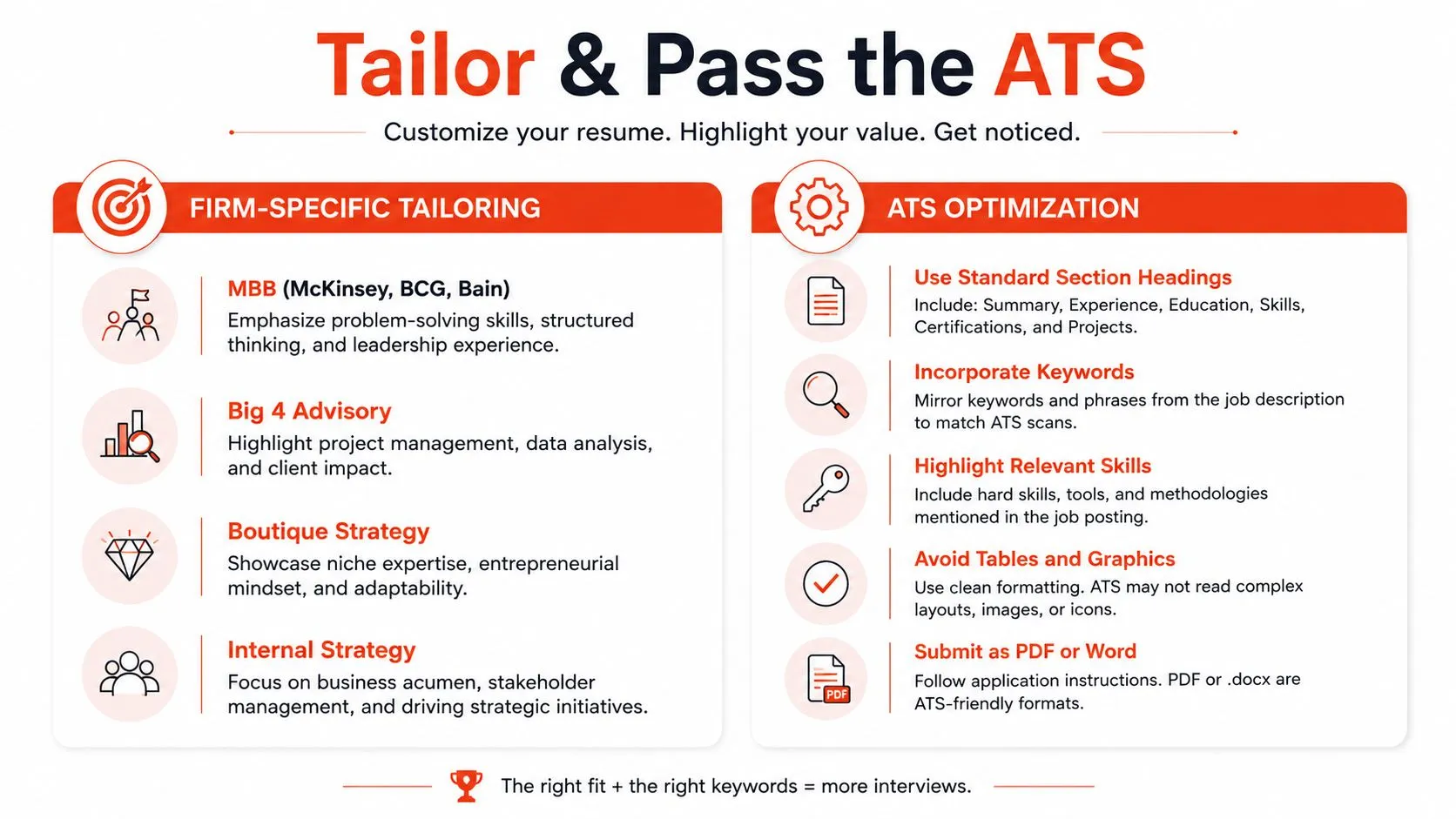
Use a simple file name, save as PDF unless the employer says otherwise, and don't get cute with fonts or tables. If the resume looks hard to parse, you've already lost ground.
What Comes After the Resume Sends
Your resume doesn't end the conversation. It starts the proof. The cover note should be short and targeted, not a warm bath of generic enthusiasm. Name the practice or industry you're aiming at, then connect one or two bullets to the kind of problem that team solves.
That same logic shows up in the interview. A consulting case is just live version of the resume test. If a bullet says you structured an ambiguous problem and recommended a path forward, be ready to tell that story clearly and defend the tradeoffs. If you can't talk through your own bullets, they were never strong enough.
For a deeper angle on how senior candidates frame themselves in interviews, Intonetic's guide for senior professionals on interviews is useful because it pushes the same principle, evidence first, spin second.
A management consulting resume at any experience level is being judged on the same thing, whether the candidate can take an ambiguous problem, structure a recommendation, and defend it with evidence. The stage is smaller early in a career. The judgment is the same.
StoryCV helps you turn case competitions, club projects, and internships into bullets that sound like real consulting work because they're built on real judgment. If your resume keeps underselling what you did, start with StoryCV and turn the raw experience into something a recruiter can read in one pass.