The worst marketing assistant resumes read like a chores log. Scheduled posts. Pulled reports. Managed inboxes. Fine. That's the work, but it's not the story hiring managers want to read.
A resume bullet is a decision, not a description. That's the shift most early-career marketers miss, and it's why so many marketing assistant resume drafts feel flat even when the person behind them did solid work. If you can spot the moment you caught something, improved something, or prevented a problem, you already have better material than most candidates use.
Why Your Marketing Assistant Resume Feels Empty
Entry-level marketing work can feel like busywork. You schedule posts, pull reports, answer the shared inbox, update a spreadsheet, and keep the machine moving. None of that sounds glamorous, and none of it comes with obvious accomplishment language attached.
That's exactly why resumes at this level go dead on the page. People write the task and stop there. A hiring manager doesn't care that you “assisted with reports” unless the line shows what you noticed, fixed, or influenced.
The real problem is usually the writing, not the work
Think about the modern standard for the role. Resume guides push candidates to lead with measurable impact, not job duties, and one marketing-resume guide says performance metrics in bullets led to 4.2x more interview requests than metric-free descriptions Resumebold. That doesn't mean you need fake seniority. It means you need to write the decision inside the task.
If you're working through adjacent material too, the logic behind understanding prerendering APIs is a decent parallel. The thing looks technical on the surface, but the value is in what it enables. Marketing support work is the same. The useful part is often hidden inside a routine action.
Practical rule: if a bullet can be copied onto five other candidates' resumes without changing the meaning, it's too vague.
This is why your resume feels empty. Not because you lack experience, but because you're writing support work as if it were a task list instead of a record of judgment. The fix is straightforward, and it starts with structure.
The Structure a Hiring Manager Actually Expects
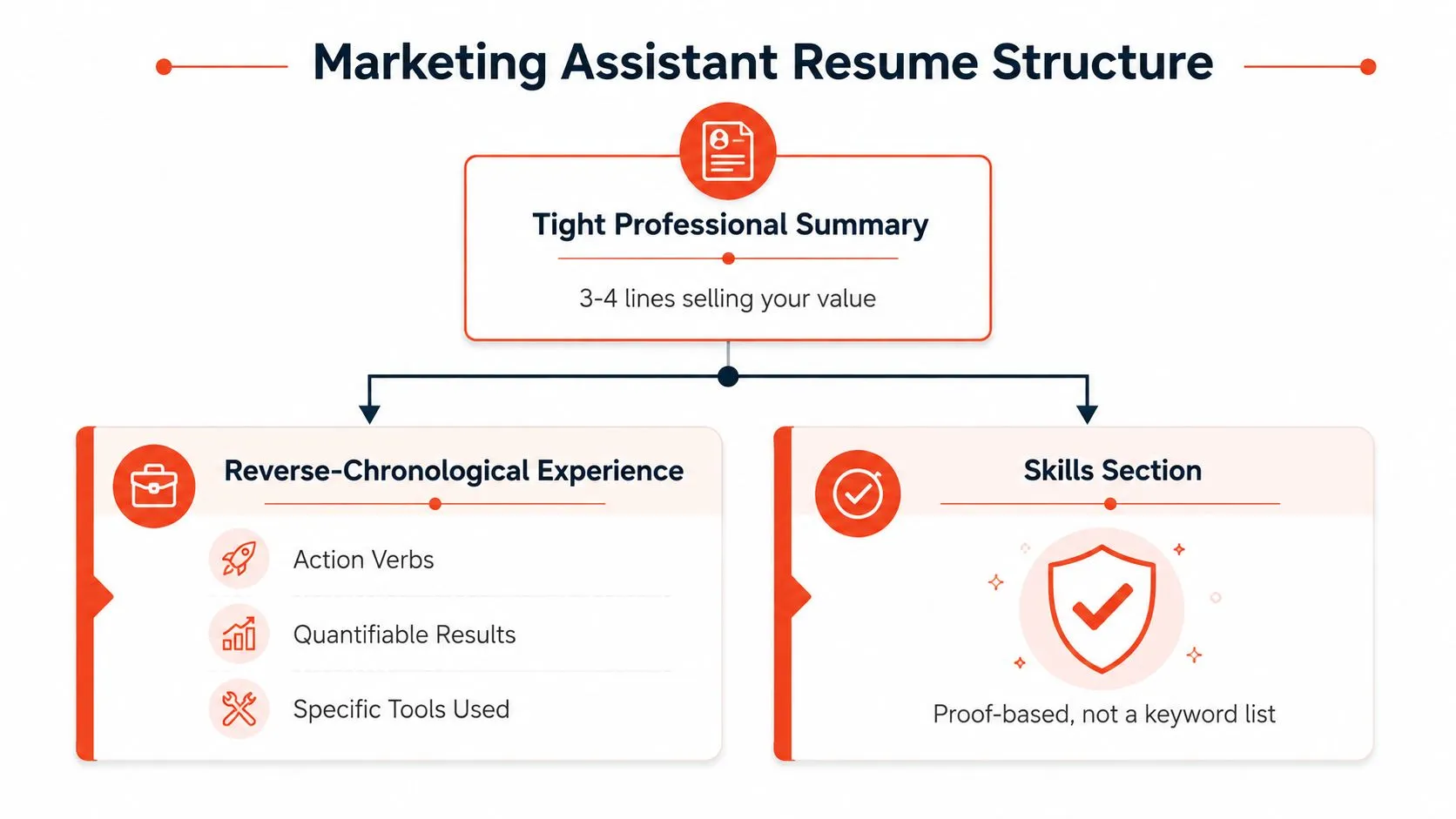
A strong marketing assistant resume format does not need tricks. It needs order, and it needs proof. Reverse-chronological experience, a tight summary, skills that point to real tools, and the standard core sections are enough for most assistants and coordinators.
Keep the bones simple
Start with contact details, then add a short profile or summary. Use it to say what kind of marketing support you provide and what proof backs that up. If you are early in your career, a summary still works, but it should sound like someone who has handled real work, not a slogan machine.
Then come the skills, and they should be concrete. “Analytics,” “content creation,” and “CRM software” work because they map to actual tasks and show up often in job posts Resumebuilder. A random pile of buzzwords does nothing. Skills should read like evidence of tools you have used and work you can support.
Use the layout recruiters can scan fast
Reverse-chronological order is the safest choice for a marketing coordinator resume or assistant-level application because it puts the most recent evidence first and makes growth easy to follow Jobscan. Keep it to one page if you are entry to mid level, use standard fonts, and skip tables or complex columns so both ATS software and humans can read it cleanly. That is not style advice. That is basic readability.
The other sections are basic for a reason. Education belongs there. Certifications belong there if they matter. Extra sections like projects or volunteer work can help if they show real initiative, which is especially useful for a marketing resume examples search or a junior digital marketing resume examples search Resumetemplates.
If you need a cleaner way to turn vague duties into useful bullets, this guide on stronger bullet points is worth using.
Bottom line: one page, reverse chronological, standard sections, no visual nonsense. Let the writing do the work.
Turning Busywork Into a Bullet That Shows Judgment
The fastest way to improve a marketing coordinator resume or assistant resume is to stop describing the task and start describing the decision inside the task. That sounds abstract until you see it in practice.
Take a weekly performance report. The dull version sounds like this:
Before: Pulled weekly marketing performance reports for the team.
That's true. It's also forgettable. It tells me you did the thing, but not what you noticed, changed, or protected.
A better version shows what you did with the information
Now rewrite it around judgment:
After: Reviewed weekly performance reports, caught a tracking error before distribution, and flagged the fix so the team avoided sending incorrect numbers to the client.
That's a different bullet. It shows attention, escalation, and prevention. It proves you didn't just move data around, you protected the team from a visible mistake.
If you want a second angle, use the same pattern with workflow improvement:
Before: Created weekly social media reports.
After: Standardized weekly social media reports so the team could compare channels faster and spend less time cleaning data.
The point isn't to sound bigger than your role. The point is to show the part where your brain was engaged. A marketing assistant doesn't need to own strategy to show value. Small decisions matter when they save time, catch errors, or make the next step easier.
For more phrasing patterns like this, this guide on turning vague responsibilities into strong bullet points is worth keeping open while you draft. Use it as a mechanical check, not a writing crutch.
How to Find the Decisions Hiding in Routine Work
Most support work contains a decision. You just have to stop staring at the task title and look at the moment around it. A marketing assistant resume and a marketing coordinator resume both get stronger when the bullet shows what you noticed, changed, or protected.
Look for the moment that changed the outcome
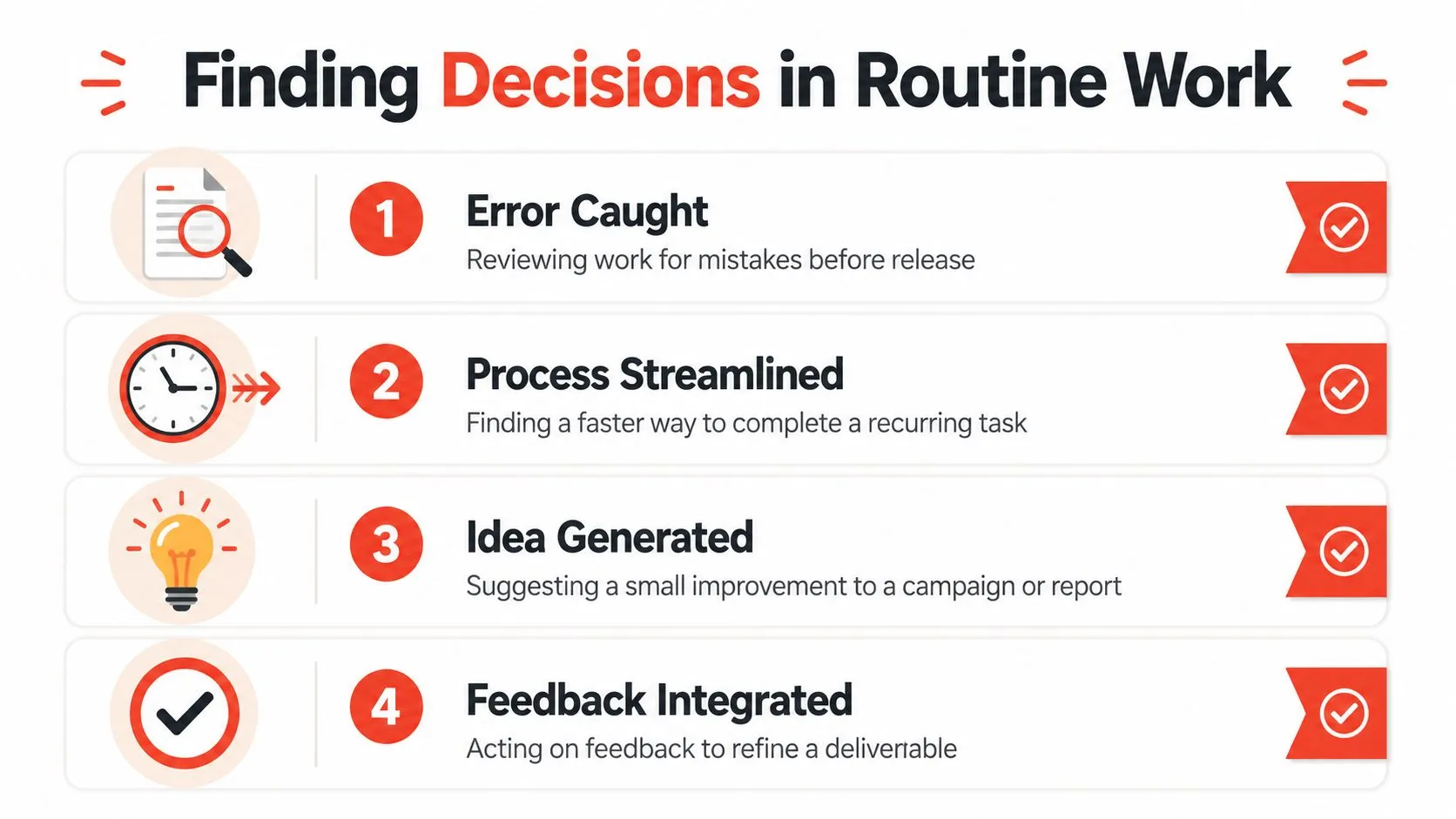
These are the kinds of moments that count:
- Error caught: You noticed a wrong date, broken link, duplicate asset, or off-brand caption before it went live.
- Process optimized: You found a faster way to pull reports, organize files, or route approvals.
- Idea generated: You suggested a better subject line, channel mix, or content format.
- Feedback integrated: You revised the deliverable after comments and improved the final version.
None of those require a fake title. They require attention.
If you're reviewing your own work, ask these trigger questions on every line:
- What did I choose?
- What did I catch?
- What did I improve?
- What would have happened if I hadn't been there?
That last question matters. It gets you out of task language and into consequence language. Once you can answer it, you can usually write a stronger bullet.
Use the same lens on digital work
This also fits a digital marketing resume. Maybe you didn't own the campaign, but you noticed a template underperforming, recommended a swap, or flagged a scheduling conflict before a launch. That's still judgment. It's just judgment at support level.
If you want a deeper framework for converting that thinking into resume language, this impact-statement guide gives a clean way to move from action to result without inflating anything.
The reason this works is simple. Hiring managers don't just want someone who can execute. They want someone who notices problems before they become messes.
Writing Bullets That Pass the ATS Without Sounding Like One
ATS software sorts and parses. It's not magic, and it doesn't hire anyone. A strong file still needs a human to read it, but sloppy formatting or missing keywords can keep that human from ever seeing it.
Use role language without stuffing it
Use the terms the posting uses, like campaign support, content creation, analytics, SEO/SEM, social media, and CRM software. Put them where they fit. Don't cram them into one bullet like a junk drawer.
Bad: Supported marketing projects with content, analytics, SEO, and CRM tasks.
Better: Supported campaign content in HubSpot, tracked performance in weekly reports, and updated social posts based on engagement feedback.
The second version reads like a person. It still gives the ATS useful terms, but it doesn't sound like keyword soup. That's the balance.
Tailor the resume to the posting
You do not need to rewrite the entire resume each time. You do need to tune the summary, skills, and top bullets to the job description. If the posting leans into social media, foreground social scheduling and content support. If it leans into CRM, foreground list hygiene, reporting, or campaign tracking.
For a tighter method, use ATS-friendly bullet point guidance to keep the wording aligned with the posting without turning the resume into a keyword dump.
Several guides also recommend quantifying marketing achievements with hard numbers where possible Zety. That helps when the number is real. If the bullet is about judgment, keep it clean and concrete instead of forcing a metric.
Practical rule: keyword match the posting, but write for a human who hates generic bullets even more than ATS software does.
Do Not Borrow Seniority You Did Not Earn
Inflating scope is a bad trade. It might sound stronger on the page, but it usually collapses in the interview when someone asks you to explain the work in detail. Then you're defending borrowed seniority instead of your actual contribution.

The better move is to stay close to reality and write the decisions you made inside your scope. That works for a marketing assistant resume, a marketing coordinator resume, and any general digital marketing resume where the candidate supported work without owning the whole machine.
A guided drafting process helps here because it pulls out the context you'd normally skip. StoryCV does that by interviewing you about your work, then turning the answers into resume bullets you can defend in a room. That matters more than sounding senior for five seconds.
Honest bullets age better
Honest bullets sound like this:
- Coordinated event materials and flagged a timeline conflict before print deadlines slipped.
- Updated CRM records and spotted duplicate entries that would have skewed follow-up lists.
- Scheduled social posts, then adjusted timing after noticing a recurring drop in engagement.
Each one is modest. Each one is credible. And each one tells an interviewer exactly where your judgment showed up.
There's a reason some resume advice for early-career applicants points people toward projects, coursework, and transferable work, especially when direct marketing experience is thin Wozber. That's not a license to invent seniority. It's a reminder to translate adjacent experience authentically.
What to keep in mind
A one-page resume with clear sections, clean formatting, and real bullets does more for you than a puffed-up summary ever will. If you need a broader starting point for candidates with limited experience, CV advice for UK adults has a useful angle on framing work without overreaching.
What Separates a Forgettable Resume From a Memorable One
A forgettable entry-level marketing resume lists tasks. A memorable one lists decisions. That's the whole game.
If you remember nothing else, remember this. Use a tight structure. Write bullets around what you caught, changed, or improved. Tailor the terms to the job post. Keep the scope honest. That combination works for a marketing assistant resume example, a marketing resume example, a marketing coordinator resume example, and any candidate trying to make support work sound like what it really is, valuable judgment in small moments.
The resume that gets ignored looks busy. The resume that gets interviews makes it obvious you noticed things other people missed.
StoryCV turns real work into clear resume language without forcing you into generic templates. If you're writing a marketing assistant resume and don't want to fake seniority, start with StoryCV and turn the decisions in your work into bullets you can stand behind.