Most advice about contract resumes is backwards. It tells you to make short gigs look less visible, when the better move is to make them look more valuable.
Contract work isn't the liability. Weak framing is. A strong resume for contract work should make one thing obvious fast. You get dropped into messy situations, solve specific problems, and leave behind a result someone can point to.
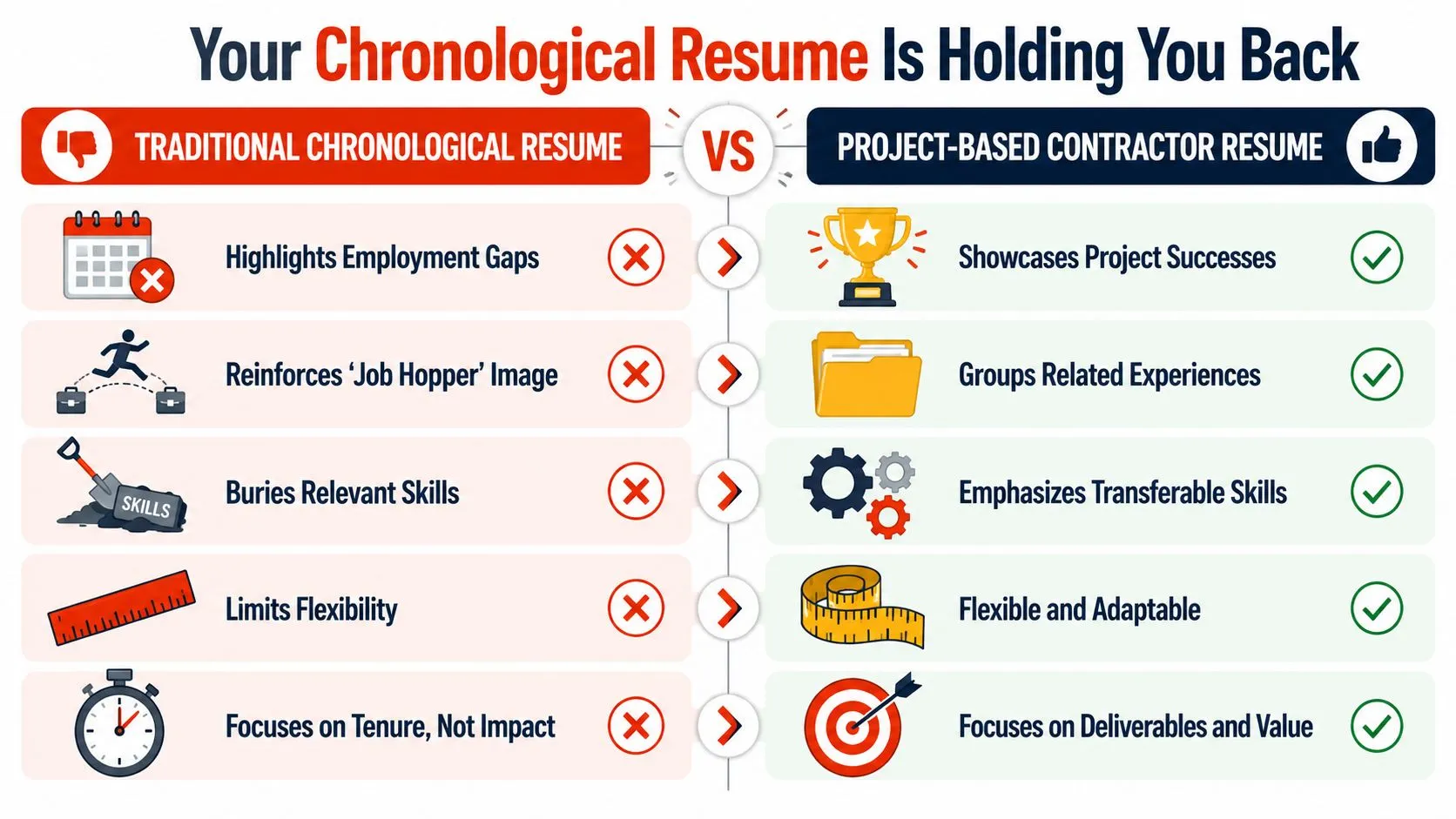
Your Chronological Resume Is Holding You Back
The standard reverse timeline was built for stable payroll careers. It works fine when someone spends four years at one company, gets promoted twice, and can coast on recognizable brand names. Contractors don't get that luxury.
If your resume reads like this, recruiters start making the wrong story for you:
- Three months here
- Five months there
- Seven months somewhere else
- Another short stint after that
That doesn't read as range. It reads as friction.
Recruiters don't buy timelines. They buy patterns
A hiring team doesn't need your life in date order. They need proof that your weird-looking path makes sense. That's the job of the document.
Data from recent resume optimization studies indicates that 65% of failed contract applications were rejected within the first 15 seconds due to a lack of specific metrics, and listing contract roles sequentially can negatively impact ATS scores and human perception if not framed as a cohesive career of specialization rather than job hopping (reference noted here). That's the whole game.
If you do contract work, your resume is not a diary. It's positioning.
Practical rule: Stop asking, "What happened next?" Start asking, "What do these projects prove about me?"
Use a structure that matches the way you actually work
For most contractors, a hybrid or umbrella format beats a strict chronology. You still show dates. You just stop making dates the headline.
A better structure looks like this:
| Resume approach | What it signals |
|---|---|
| Traditional chronology | Frequent exits, fragmented history, unclear progression |
| Hybrid or umbrella format | Consistent specialization, repeatable delivery, clear focus |
That shift matters for ATS too. If you're weighing formats, this guide on functional resume vs chronological resume is worth reading because contractors often need the strengths of both.
There's also a legal and practical reason to get the relationship right. If you worked through an agency, umbrella company, or as an independent consultant, the details matter. A quick read on understanding worker classification helps you present the work accurately without blurring who hired you and who paid you.
The reframe that fixes everything
You're not trying to hide movement. You're showing serial high-impact delivery.
That means your resume should make permanent employees look slow, not make you look unstable. Different clients. Different systems. Different politics. Same result. You land, diagnose, ship, improve, move on.
That's not job hopping. That's a specialty.
Frame Your Gigs as High-Impact Projects
The fastest way to tank a contractor resume is to write it like an employee handbook.
"Managed stakeholders."
"Supported implementation."
"Worked with cross-functional teams."
Nobody cares. Those bullets say you were present. They don't say you mattered.
Every contract should read like a contained win
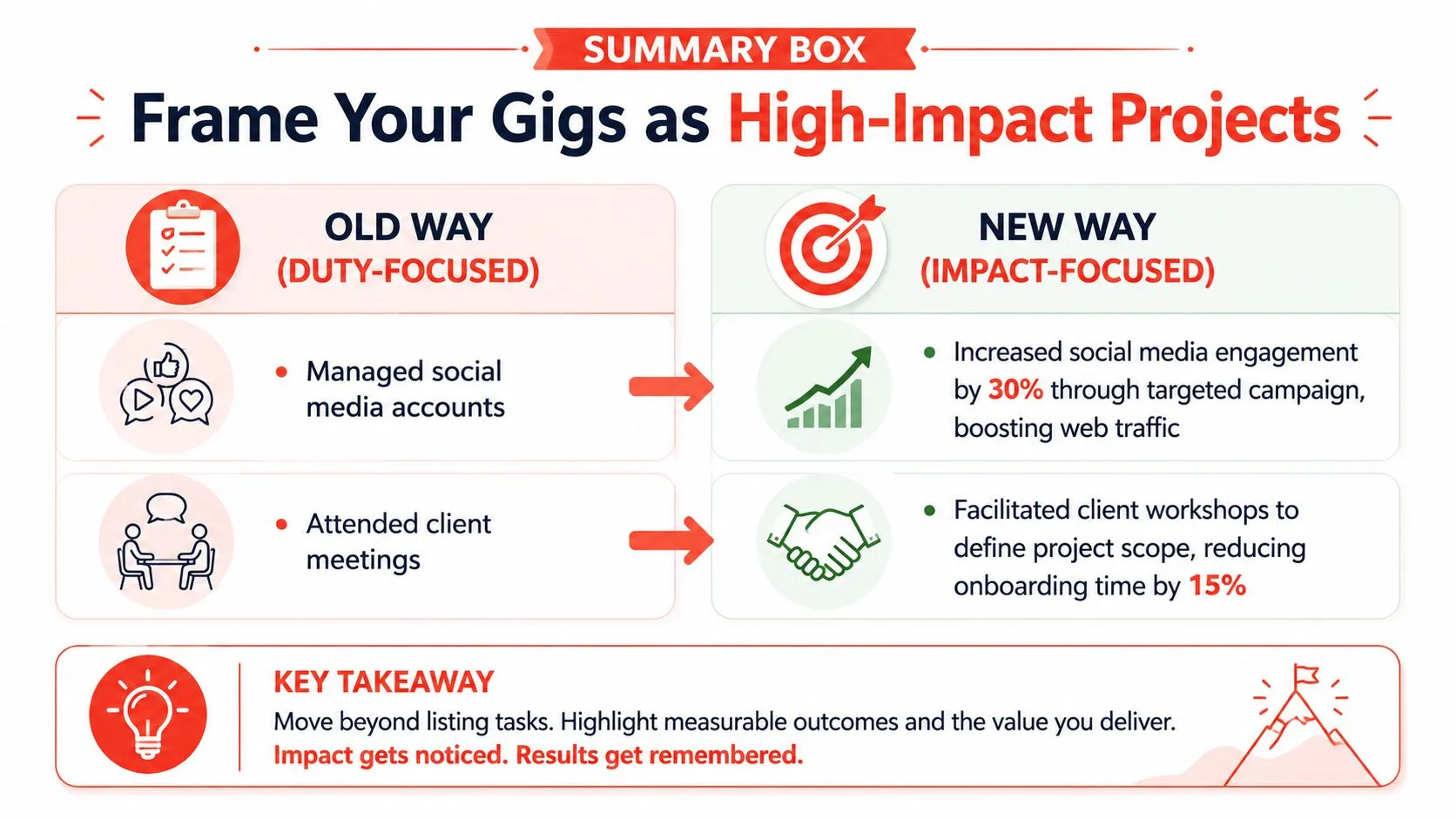
The standard is simple. The industry standard for listing contract work requires achievement-based bullet points with quantifiable metrics to shift the narrative from temporary employment to high-impact delivery (Teal's guidance explains the format).
That means each contract entry needs three things:
- The problem you were brought in to solve
- The action you took
- The result you delivered
Not job description filler. Evidence.
Here's the difference.
Weak
- Managed social media accounts for client brands
- Attended client meetings and coordinated deliverables
- Helped with onboarding and campaign setup
Better
- Built and ran content calendars for three client brands, increasing engagement through targeted campaign planning
- Led client workshops to define scope, unblock approvals, and speed up project launch
- Optimized onboarding materials and handoff process to reduce startup friction for new campaigns
The second version sounds like a contractor. It implies speed, ownership, and outcomes.
"A contractor bullet should answer the question the hiring manager is already asking: why did they bring you in?"
Name the employer correctly, then show the client context
Formatting matters more than people think.
If a staffing agency employed you, list the agency as the employer. If you were self-employed, say Independent Contractor or Consultant. If the end client matters, add it underneath or within the project line. Don't pretend payroll worked differently than it did.
A clean format looks like this:
Independent Contractor | Operations Consultant
Remote | 2022 to 2024
- Client: B2B SaaS company. Redesigned support workflows and documented escalation paths for a fast-moving product team
- Client: logistics firm. Built reporting process for weekly operations reviews and standardized issue tracking
- Client: healthcare provider. Coordinated implementation work across vendor and internal teams during system rollout
Or this:
Robert Half | Business Analyst Contractor
2023 to 2024
- Client: regional bank. Mapped process gaps across reporting workflows and proposed changes adopted by finance stakeholders
- Client: insurance provider. Supported requirements gathering and translation between operations and engineering teams
Don't write like you're apologizing for the contract label
Contractors often weaken their own resumes by over-explaining the arrangement. Bad move. Label the work clearly, keep the structure clean, and spend the words on outcomes.
Use active verbs that sound like delivery:
- Built
- Led
- Reduced
- Launched
- Resolved
- Implemented
- Improved
- Standardized
Avoid soft verbs that sound like attendance:
- Assisted
- Helped
- Participated
- Supported
- Was responsible for
A contractor is hired to change something. Your bullets should read like proof that you did.
Show Proof with Metrics and Portfolio Links
Saying you're effective isn't proof. Numbers are proof. Samples are proof. A clean portfolio link is proof.
Most contractor resumes fall apart because they make claims but offer nothing to back them up.
Put numbers in the bullets, not just in your head
The inclusion of 3 to 4 specific bullet points per contract role, each containing at least one tangible number, is a mandatory requirement for 78% of top-tier contract job descriptions, with resumes lacking specific metrics receiving 3x fewer interview requests (Zety details that benchmark here).
So yes, numbers matter. A lot.
Bad bullet:
- Improved reporting process for client leadership
Better bullet:
- Reduced reporting turnaround time by consolidating weekly updates into a single executive reporting workflow
Bad bullet:
- Worked on onboarding improvements
Better bullet:
- Reworked onboarding documentation, shortened ramp confusion, and gave new hires a clearer path through setup tasks
If you have real metrics, use them. Time saved. Error reduction. Volume handled. Team size. Stakeholders supported. Deliverables shipped. If you don't have clean numbers, use tangible scope. Name the system, process, audience, or output.
For a deeper breakdown, read StoryCV's guide to metrics in resume writing.
Add portfolio links with intent
A portfolio link should support your case, not clutter the page.
Use it when you can show:
- Work samples such as decks, product writing, design work, or case summaries
- GitHub repos if you're technical
- Published work if you're in content, research, or strategy
- Project snapshots with enough context to show what changed
If you're building or upgrading that proof layer, this roundup that helps you compare portfolio website builders is useful.
What to link: Your best evidence, not your entire internet footprint.
Keep it simple. One portfolio URL in the header is enough. If a project is especially relevant, mention it in a bullet with a clear label like "Portfolio available on request" or include the link in the PDF if the format allows it cleanly.
Respect NDAs without weakening the story
You don't need to expose confidential clients to show value. Use labels like:
- Confidential FinTech client
- Enterprise healthcare client
- VC-backed SaaS startup
Then focus on the work. The point is credibility, not disclosure.
The Umbrella Strategy for Grouping Contracts
A contractor with five gigs in two years often sends the same bad signal by accident. Too many separate entries. Too many repeated dates. Too many tiny islands of experience.
That's why the umbrella strategy works.
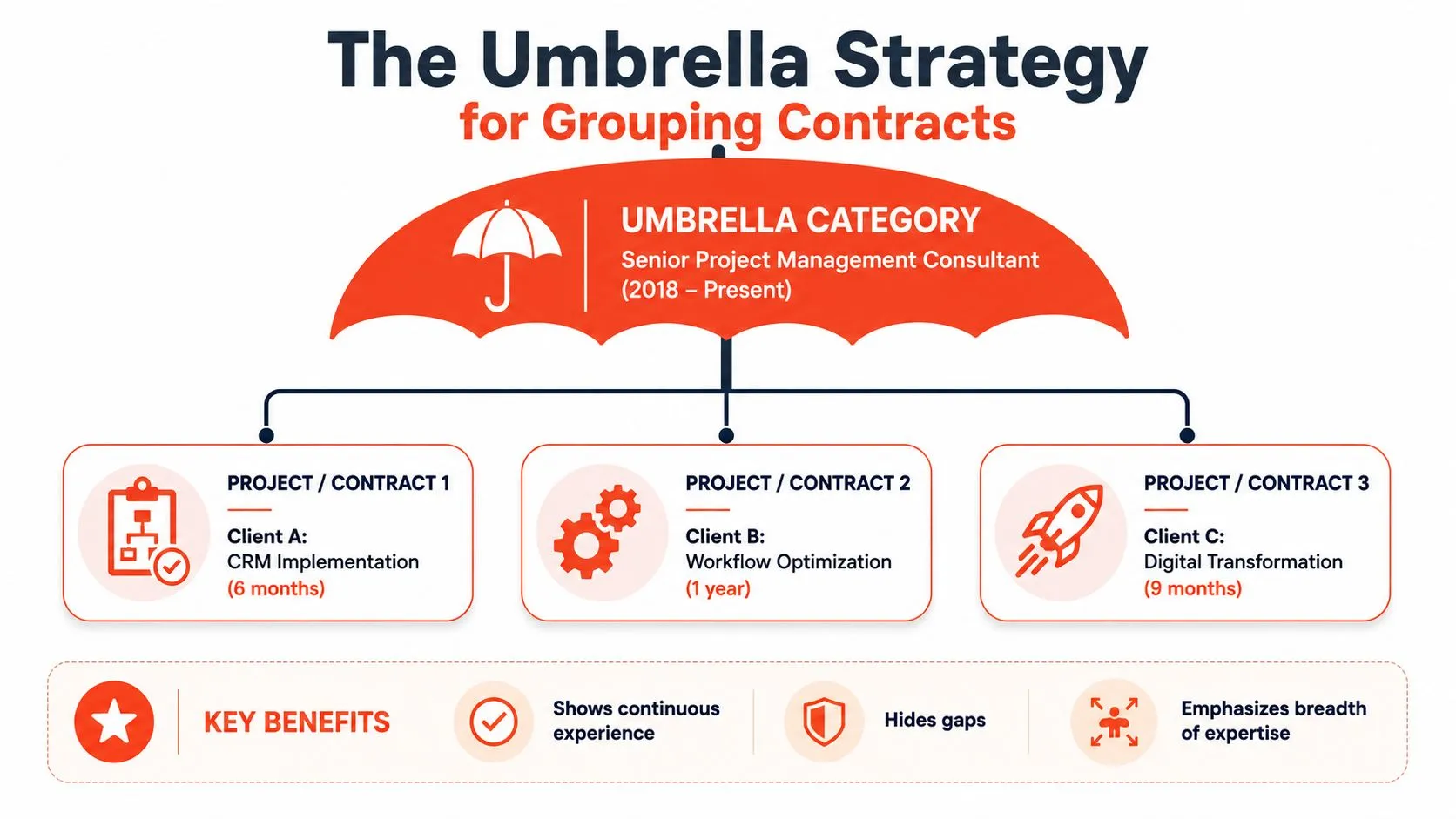
Before and after
Before
Product Consultant | Client A | Jan 2023 to Mar 2023
Implementation Lead | Client B | Apr 2023 to Jul 2023
Operations Analyst | Client C | Aug 2023 to Oct 2023
Program Manager | Client D | Nov 2023 to Feb 2024
Business Consultant | Client E | Mar 2024 to Jun 2024
That version screams instability, even when the work was excellent.
After
Independent Consultant | Operations, Systems, and Delivery
2023 to 2024
Selected contracts:
- Client A, product environment. Improved handoff between delivery and support teams during launch work
- Client B, implementation project. Coordinated rollout activities and clarified scope across stakeholders
- Client C, operations project. Standardized reporting and cleaned up recurring process issues
- Client D, program work. Managed dependencies across teams during a period of change
- Client E, business consulting. Diagnosed workflow friction and recommended execution fixes
Same career. Better story.
Why grouping wins
78% of hiring managers now auto-reject resumes with more than four distinct short-term contracts unless they are strategically grouped. A contrarian tactic that increases interview conversion by 22% is to leave up to 30% of short-term contracts off the resume entirely, focusing only on the most relevant ones (Dexian outlines that shift here).
That's brutal, but useful. It means curation isn't dishonest. It's competent.
Editorial rule: Your resume is not an archive. It's a filter.
What to group and what to cut
Use one umbrella entry when the contracts share one of these:
- Common function such as product, data, operations, marketing, or project delivery
- Common industry like healthcare, fintech, SaaS, or manufacturing
- Common technical stack such as Salesforce, NetSuite, SQL, Workday, or Power BI
Leave out weaker contracts when they do nothing for your target role. If an old short-term gig makes you look junior, scattered, or off-track, cut it.
A clean umbrella entry usually includes:
| Element | What to include |
|---|---|
| Main heading | Independent Consultant, Contract Consultant, or Agency Name |
| Time span | One continuous date range |
| Scope line | One sentence on the kind of projects you handled |
| Selected projects | Only the strongest and most relevant contracts |
| Bullets | Outcome-focused statements under the best projects |
The point isn't hiding. It's controlling the frame
Hiring managers don't need every stop. They need enough evidence to trust the pattern.
The umbrella strategy gives them continuity on top and variety underneath. That's exactly how strong contract careers work.
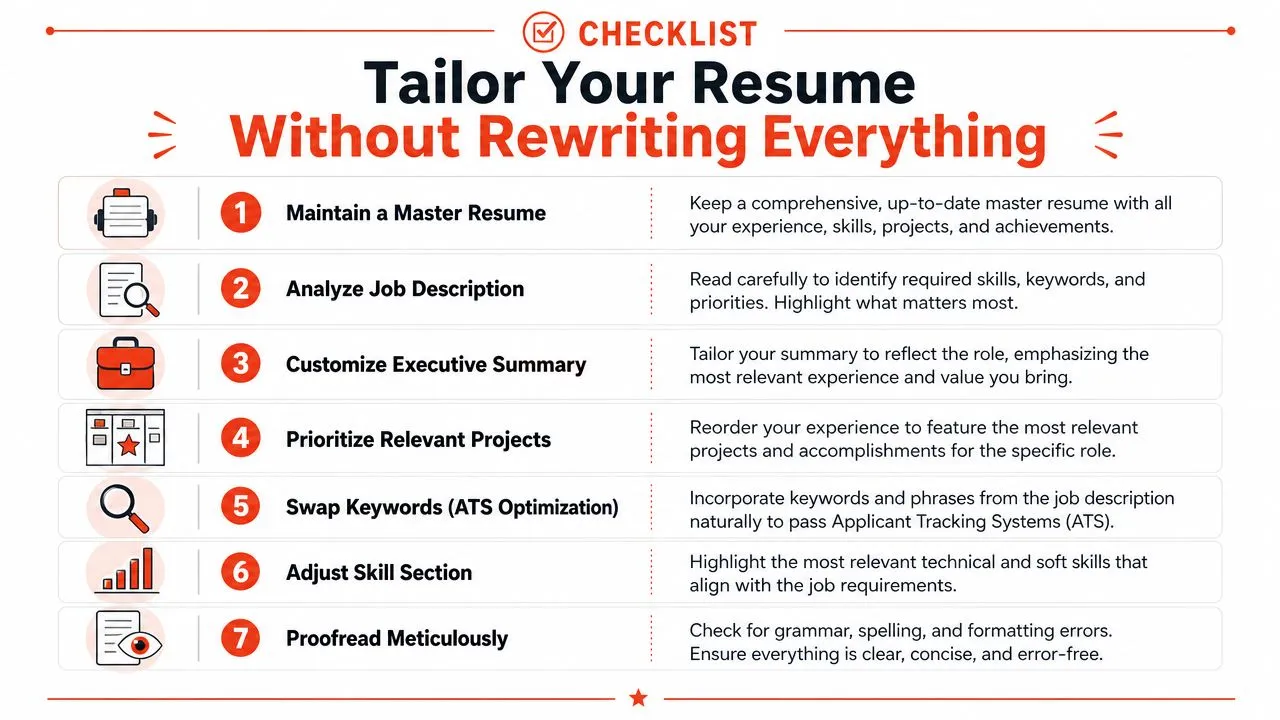
Tailor Your Resume Without Rewriting Everything
Tailoring doesn't mean starting over for every application. It means adjusting the angle so the right proof shows up first.
Contractors waste hours rewriting entire resumes because they think ATS only cares about keyword density. That's lazy advice. ATS looks for relevance, yes, but human readers still decide whether your story hangs together.
Start with the top of the page
The most effective resume format for contract talent prioritizes a skills-first approach where the top three most critical, overlapping skills from the job description are strategically placed at the top of the resume to escape the eliminator and appeal to the hiring manager (Bergman Brothers explains that approach here).
That means your tailoring process should start here:
-
Read the job description once for the actual problem
Are they trying to stabilize operations, clean up reporting, lead an implementation, or ship faster? -
Pull the top three skills that repeat naturally
Not every noun. Overlap terms. -
Move those skills to the top summary and recent project language
Don't stuff. Align.
If you want a structured process, StoryCV's guide on tailoring your resume to a job description breaks it down cleanly.
Use one master resume and one lean edit pass
Keep a master document with all your strong contract projects. Then customize only these parts:
- Headline and summary to match the target role
- Order of projects so the most relevant work appears first
- Skills section to mirror the language of the posting
- A few bullets to emphasize the matching problem set
Don't rewrite your whole work history. That's wasted motion.
Tailoring works best when the foundation is already strong. You're adjusting emphasis, not inventing a new identity.
A simple filter for every application
Before you send your resume for contract work, check four things:
- Does the top section match the job's core need?
- Do the first bullets prove that need with actual work?
- Are the contract labels clear and consistent?
- Does the resume read like a specialist, not a drifter?
If the answer is yes, you're doing what most applicants won't. You're making the reader's decision easy.
The need isn't for another template. It's for help turning scattered experience into a sharp story. StoryCV is an online resume writer that uses editorial judgment at software speed, so your contract work reads like evidence of value, not a list of short stays.