Most advice on a resume for networking starts in the wrong place. It treats the resume like a screening document, then wonders why a contact can't introduce you cleanly or explain what you do.
That's backwards. A networking resume is an introducer asset, not an ATS trophy. It has one job, make it easy for someone else to hand you off with confidence.
Why a Networking Resume Is a Different Document
A resume for networking gets judged in a trust-based context, not a cold-application one. That matters because referred applicants are 7.3 percentage points more likely to be interviewed and 2.4 percentage points more likely to receive an offer than non-referred applicants in a New York Fed/MIT study, even within the same employer and pipeline, and compiled hiring data says referrals often make up only 5% to 7% of applicants yet account for 30% to 50% of hires (New York Fed/MIT study).
Stop writing for a stranger
When someone forwards your resume, they're not trying to decode a life story. They're trying to answer one question fast, “Would I feel comfortable putting my name on this?”
That's why the document has to be skim-ready, easy to quote, and built around evidence that a contact can repeat in one sentence. The person introducing you doesn't need a long duty list. They need a sharp summary of fit, impact, and credibility.
Practical rule: if a contact can't describe you in one sentence after scanning your top third, the resume is too loose.
Networking data also shows how warm access changes the game. Referred candidates are often hired faster than job-board applicants, and one recruiting trend summary says referrals still play a disproportionate role in hiring outcomes across recent labor markets (Ashby referral trends). That's why the networking version of your resume should be written for forwarding, not filing.
Two Versions You Should Maintain
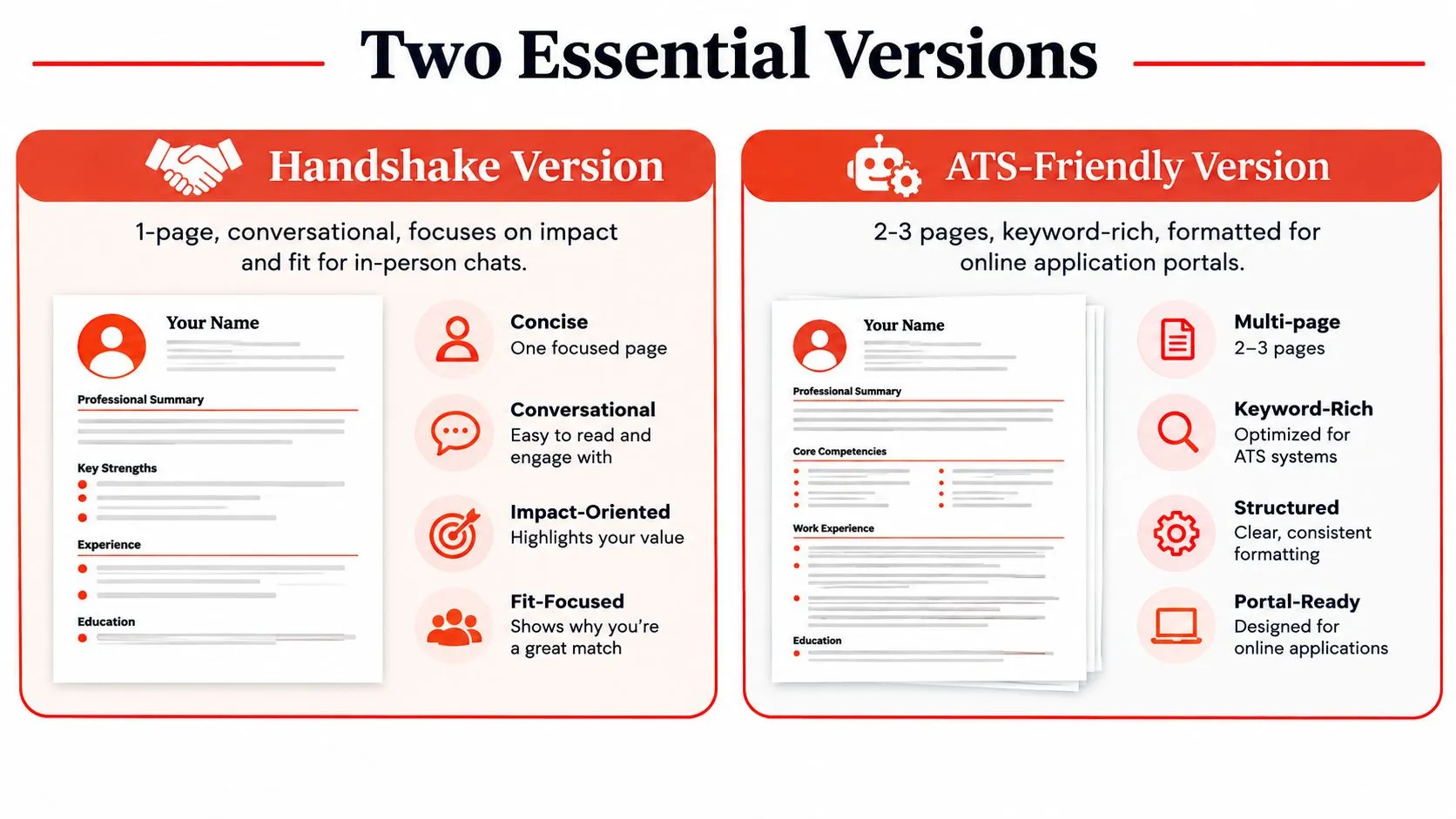
You need two files, not one compromised middle version. The first is a one-page handshake version for coffee chats, events, and direct intros. The second is a fuller resume for portals, follow-up, and situations where someone asks for more detail. Brevity matters here, and independent resume-length guidance supports a one-page format when networking in person, with experience-based ranges stretching longer only when the situation calls for it (expert roundup on resume length).
Build the handshake version first
For experienced candidates, keep the networking handout tight. Use the reverse-chronological structure if your path is clear, and keep only the roles and proof points that help a contact make the introduction. For junior candidates, a hybrid or project-focused layout can work better because it puts the strongest evidence up front instead of hiding it under weak job history (medium resume examples).
Use this version for:
- Coffee chats and warm intros, where the reader needs a fast narrative.
- Event follow-up emails, where the document may get opened on a phone.
- Referrals, where a contact may paste your summary into a message.
Keep these parts:
- Contact header, clean and boring.
- Target-role line, so the introducer knows exactly what you want.
- Evidence block, 3 to 5 bullets with outcomes.
- Most recent roles, trimmed hard.
- Selected projects, only if they sharpen your pitch.
Keep the fuller version for portals
The longer resume is for online submissions, not for the first handshake. It can carry more keywords, more platform names, and a broader skill matrix when needed. In networking contexts, though, don't force the long version into the first conversation. It reads like you're making the contact do extra work.
A contact should be able to forward your resume without adding context. If they need a paragraph of explanation, the resume missed its job.
Writing the One-Sentence Pitch That Sits at the Top
A vague objective line is dead weight. Replace it with a target-role line that sounds natural when a contact says it out loud. That line should read like a clean introduction, not a wish list.
Use this formula, role + scope + signature outcome + optional specialization. So instead of “Seeking growth opportunities in a challenging environment,” write something a human would repeat, like Operations analyst focused on process improvement, cross-functional reporting, and reducing manual handoffs.
Two rewrites that work
Weak:
- “Looking for a role where I can use my skills to grow.”
Better:
- “Project manager specializing in vendor coordination, timeline control, and launch execution for distributed teams.”
Weak:
- “Marketing professional with experience in many areas.”
Better:
- “B2B marketing manager focused on content systems, campaign ops, and pipeline support for SaaS teams.”
If you want a simple model for the top of the page, the structure used in a strong professional summary can help you think clearly about it, especially when you're translating career identity into one sentence. A useful internal reference is the professional summary examples for resume page, because the useful part is not the format, it's the discipline of saying less and meaning more.
Align the resume line with the spoken pitch
Your written line and your spoken introduction should match. If your contact tells a hiring manager, “She's an operations lead who cut friction across handoffs and reporting,” the top of the resume should support that exact framing. Don't make people invent your story for you.
If you want an external example of a job posting that rewards concise positioning, the Pitch Yourself Serotonin 8 job listing is a useful reminder that clarity beats clutter. The best networking resumes read like the first sentence of a strong introduction, not a buried bio.
Tailoring Across Four Readers Without Rebuilding
One resume won't serve every audience equally. Tailoring is not rebuilding from scratch, it's moving the spotlight to the right proof. That's where a common waste of time occurs, rewriting everything when only the framing should change.
Fit the document to the reader
| Persona | Lead with | Bullet angle |
|---|---|---|
| Students | Project-led | Show what you built, shipped, or improved, even if it came from class, club, or internship work. |
| Mid-level professionals | Outcome-led | Lead with the result, then the scope, then the method. |
| Career changers | Transferable-skill-led | Translate old work into new value, especially coordination, analysis, customer handling, or process control. |
| Network engineers | Domain-matrix-led | Group skills by routing, switching, security, cloud networking, automation, and monitoring, then attach outcomes. |
Use one before-and-after move per persona
Student:
- Weak, “Completed team project on data cleanup.”
- Better, “Built a team dashboard that reduced manual reporting and gave instructors cleaner weekly visibility.”
Mid-level:
- Weak, “Responsible for vendor communication.”
- Better, “Managed vendor coordination across launch cycles and reduced escalation churn.”
Career changer:
- Weak, “Handled customers and internal tasks.”
- Better, “Used client-facing work to spot process gaps and streamline handoffs between teams.”
Network engineer:
- Weak, “Worked on networking tasks and troubleshooting.”
- Better, “Supported routing and firewall changes, improving stability and reducing recurring incidents.”
The note on networking as a skill is simple. Don't list it as a standalone strength unless you can tie it to a result. “Good at networking” sounds flimsy. “Generated warm introductions that opened new partner conversations” sounds real.
Turning Your Real Wins into Networking Ready Bullets
Many don't have a writing problem. They have a recall problem. They remember job titles and forget the internships, side projects, process fixes, and relationship wins that make the story believable.
A guided interview works because it pulls those details out in order. StoryCV uses that kind of interview logic, and the same approach can help you turn messy experience into sharp resume bullets without sounding inflated. The trick is to ask about moments, not roles.
A five-question memory pass
Start with questions like these:
1. What did you keep fixing?
2. What got easier because of your work?
3. Who noticed the change?
4. What side project or extra responsibility matters most?
5. What would a teammate say you were relied on for?
That's how you get beyond duties. A resume bullet should show what changed because you were there.
Here's a simple StoryCV-style exchange:
- Question: What was a recurring problem?
- Answer: Weekly reporting took too long and people didn't trust the numbers.
- Question: What did you change?
- Answer: I cleaned the workflow, standardized inputs, and built a shared tracker.
- Question: What happened after that?
- Answer: Managers stopped chasing updates and meetings got shorter.
Now turn it into a bullet:
- Standardized reporting inputs and built a shared tracker that cut confusion across weekly updates and improved manager visibility.
Another:
- Question: What extra work did you do outside your title?
- Answer: I helped onboard new interns and organized the Slack channels no one was using well.
- Bullet: Created an onboarding path and cleaned up team channels so new interns could ramp faster and find answers without waiting.
And one more:
- Question: What did a side project prove?
- Answer: I built a small internal tool to track tasks.
- Bullet: Built a lightweight task tracker that gave the team a clearer view of ownership and follow-through.
If you want more structure for turning raw notes into proof points, the how to write impact statements guide is the right companion piece.
Memory prompt: internships, side projects, community work, cross-team fixes, customer saves, and informal leadership. Those are usually the strongest networking bullets.
The process video below mirrors that same logic, recall, quantify, dig, then craft:
What to Cut, Downgrade, or Rewrite
Networking context punishes bulk. If a contact wouldn't comfortably say it out loud, it probably doesn't belong. Long skill dumps, decorative formatting, and bloated role blocks all make the resume harder to forward and easier to ignore.
Cut the obvious clutter
- Dense skill matrices: Keep them only if they're domain-specific and readable. A wall of keywords doesn't help a referrer explain you.
- Generic summaries: “Hard-working team player” wastes space and says nothing.
- Ornamental formatting: Fancy boxes, icons, and visual tricks distract from the actual pitch.
- Overlong project notes: If a project needs half a page, it's not a resume bullet anymore.
- Bullets without outcomes: Replace tasks with results, scope, or change.
Rewrite examples:
- “Responsible for meetings and documentation” becomes “Kept cross-functional meetings on track and tightened documentation so decisions were easier to follow.”
- “Worked on many international teams” becomes “Supported cross-border collaboration across time zones and kept handoffs clear for remote teammates.”
That second rewrite matters. Global and cross-cultural collaboration is worth surfacing when it's real, but only as evidence. Don't slap on a buzzword and call it strategy.
The 60 Second Audit Before Any Coffee Chat
Run this check before you send anything:
1. The target-role line reads cleanly.
2. Your top three bullets start with outcomes, not chores.
3. The introducer can summarize you in one sentence.
4. You're sending the right version, handout or full resume.
5. Nothing confidential or off-message sits below the fold.
If you're preparing for a warm intro or interview follow-up, a second set of eyes helps. A good find an interview coach resource can help you pressure-test how your story lands before you hand it to someone else.
For a simple distribution workflow, the same principle applies when you move a resume into a profile or portal. The how to upload a resume in LinkedIn guide is useful because the file should still read clearly after you place it wherever the contact expects to see it.
Use this habit every time. If the resume can't be pitched in one sentence, it's not ready.
StoryCV turns your experience into a resume a contact can forward, because the wording comes from a guided interview instead of guesswork. If you want a resume for networking that sounds like you and gives your introducer something clean to say, visit StoryCV and build the version they can hand to a hiring manager with confidence.