Most relocation resume advice is weak. It tells you to slap “willing to relocate” somewhere near your contact info and hope a recruiter reads generously.
They won't.
A recruiter sees an out-of-area candidate and asks one question first: Are you serious, or are you making me solve a logistics problem? If your resume for relocation doesn't answer that fast, you get filtered out before your experience even gets a fair read.
Your Relocation Resume Is Being Ignored
“Willing to relocate” is lazy advice. It's passive. It sounds like you might move someday, for the right role, if everything lines up. That's not a plan. That's a shrug.
The disconnect is obvious in the data. A 2023 industry summary found that 62% of Americans say they're willing to relocate for work, but only 1.6% did move for a new job in 2022. The same summary says employer relocation support can range from $19,309 for new employee renters to $97,166 for current-employee homeowners, with some companies offering anywhere from $2,000 to $100,000 depending on the case, according to Zippia's relocation statistics roundup.
That's why local candidates get the benefit of the doubt. They look simpler. Faster. Lower risk.
Recruiters don't reject out-of-state applicants because they hate relocation. They reject uncertainty.
If you want interviews, your resume for relocation needs to do three things immediately:
- Show intent so no one wonders why you applied from another city.
- Show timing so they know when you'll be available locally.
- Show fit so your move looks strategic, not random.
Most candidates only do the first one, badly.
The better approach is to treat relocation as part of your professional story. Your move should read like a deliberate career decision tied to the market, the role, and the problems you solve. Not a personal footnote. Not an apology. If your current resume still reads like a generic document with a location problem, fix that first. A stronger narrative matters more than another formatting trick, and that's the same reason people look for a sharper AI resume writer in the first place.
Fix Your Contact and Location Information
Your header is where you either calm people down or make them suspicious.
Don't use a friend's address in the target city. Don't remove location entirely. Both moves look slippery. Employers know candidates play games with this, and it hurts credibility fast.
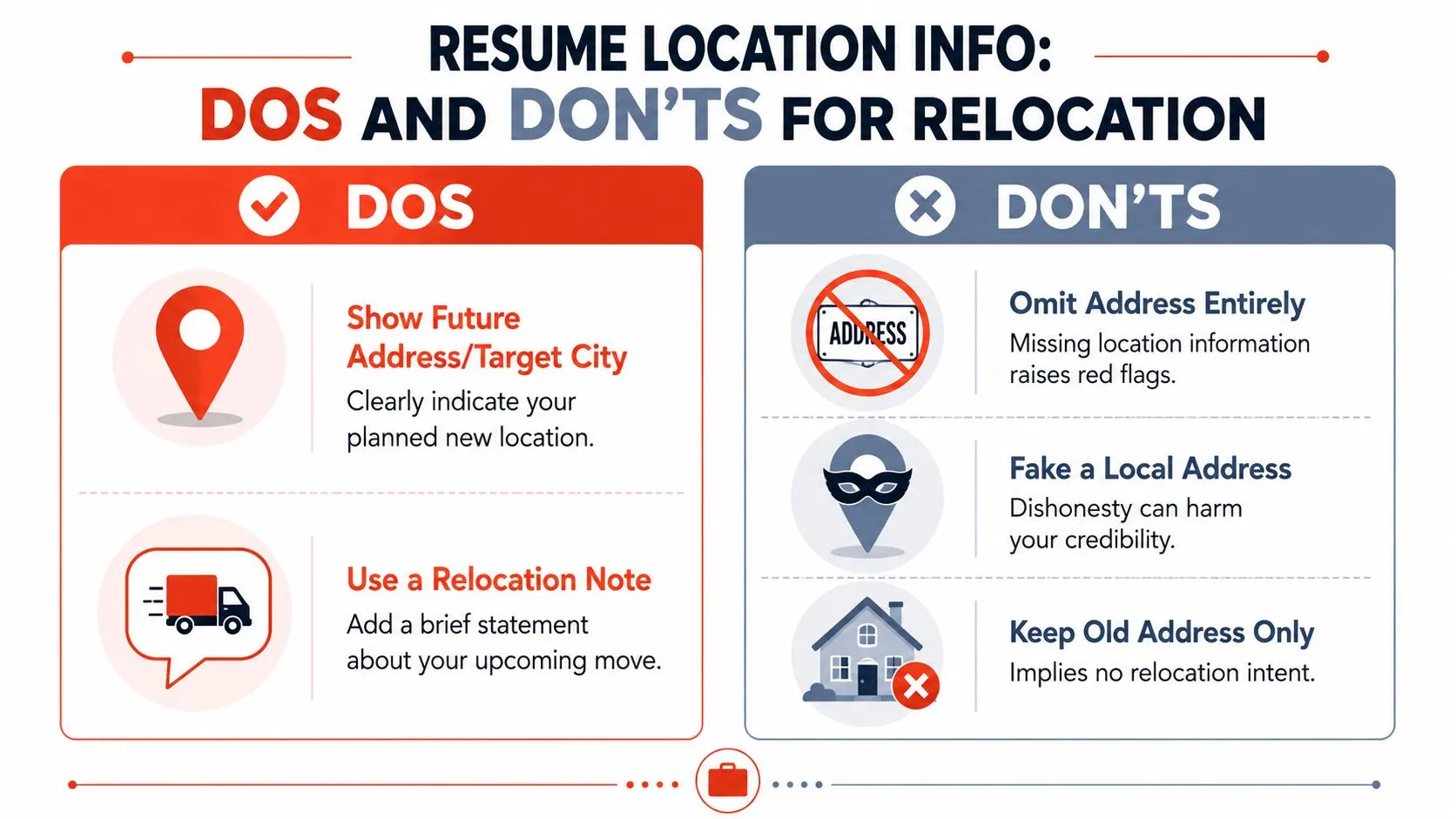
Put both truth and intent in the header
The cleanest format is simple:
| What to include | Example |
|---|---|
| Current location | Denver, CO |
| Relocation statement | Relocating to Boston, MA in October 2026 |
| Phone and email | Standard contact details |
| Optional target note | Open to interviews immediately |
That gives ATS and humans the same message. You're not pretending to be local. You're showing a concrete move.
Use this, not that
Good
- Denver, CO | Relocating to Boston, MA in October 2026
- Atlanta, GA | Moving to Seattle, WA by Q1 2026
- Toronto, ON | Targeting New York City relocation in August 2026
Bad
- Willing to relocate
- Open to opportunities nationwide
- Boston, MA if you don't live there yet
- No location listed
This isn't cosmetic. Resumes without clear, immediate relocation intent can see a 30 to 40% higher rejection rate in ATS screening, and vague wording like “willing to relocate” without a date can reduce credibility by 25% because recruiters can't judge readiness. If you're writing a resume for relocation, a timeline is not optional.
Practical rule: If a recruiter can't tell where you are, where you're going, and when you'll get there in five seconds, your header isn't doing its job.
One more thing. If licenses or certifications matter in that market, include them clearly. If you hold eligibility that works in the target location, surface it. Don't assume they'll infer it.
Weave Relocation Into Your Summary
Your summary has one job. Make your move sound intentional.
If your summary is still a generic paragraph about being a “results-driven professional with a proven track record,” you're wasting the most valuable real estate on the page. For a resume for relocation, the summary should answer the silent recruiter question: Why this city, this role, and this candidate?
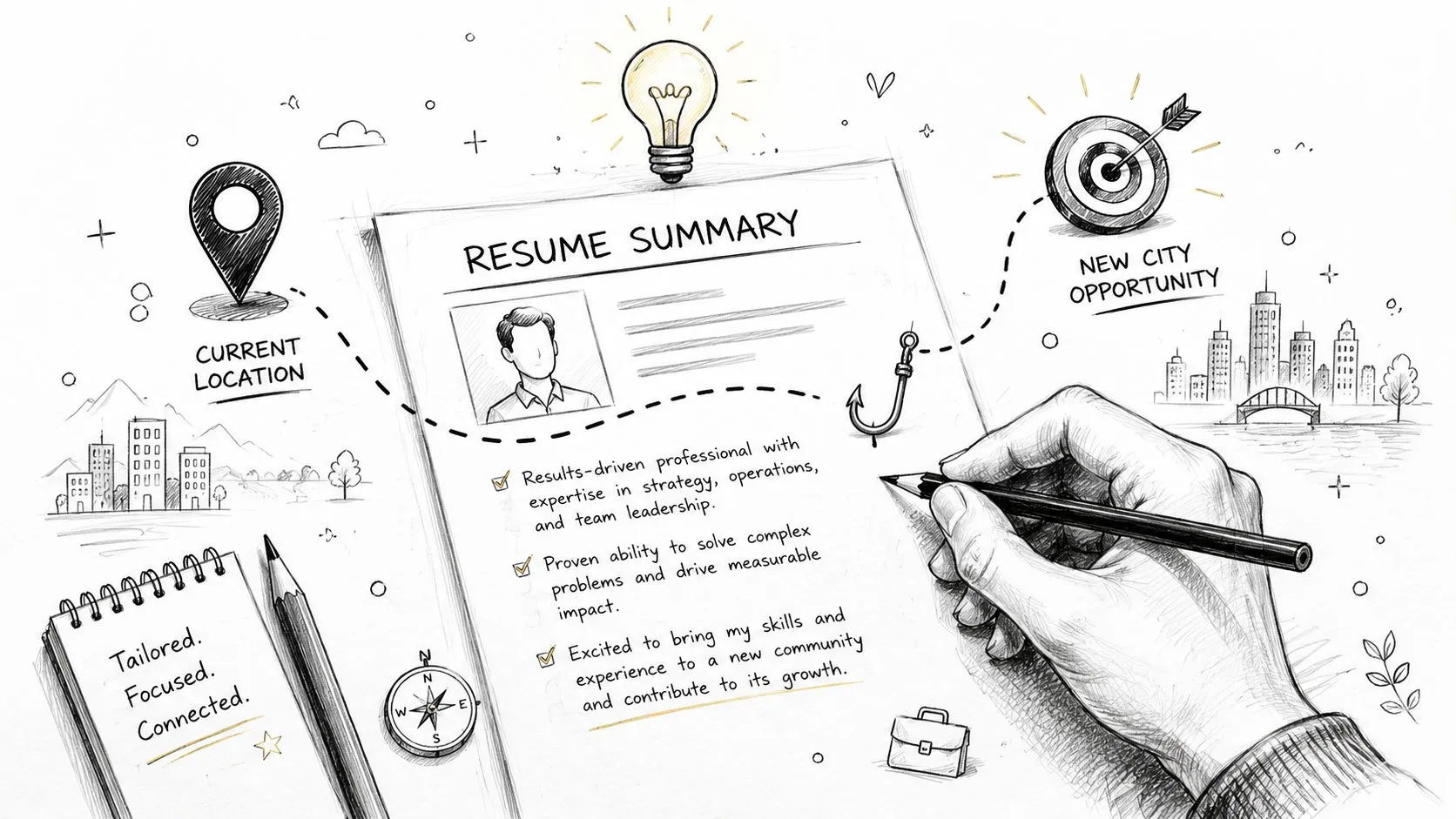
A 2025 analysis found that candidates who failed to tailor their skills to the target region's industry faced a 42% lower interview conversion rate. The same analysis found that explicitly stating a value proposition for that region increased the chance of a positive human review by 22%.
What a strong summary does
It combines four things in one tight block:
- Your level and specialty
- Your target location and timing
- The kind of role you want
- Why your background fits that market
That means your summary should sound specific, not portable.
Example rewrites
Weak summary
Operations leader with 8+ years of experience improving cross-functional performance, leading teams, and driving business growth. Seeking new opportunities in a dynamic organization.
Better summary for relocation
Operations leader with 8+ years of experience building process discipline across multi-site teams. Relocating to Raleigh in September 2026 and targeting operations leadership roles in logistics and industrial environments where supplier coordination, throughput improvement, and frontline execution matter.
Weak summary
Senior product manager with experience in SaaS, stakeholder management, and roadmap execution.
Better summary for relocation
Senior product manager relocating to Chicago in November 2026, bringing experience leading B2B SaaS launches across regulated workflows. Targeting product roles where customer research, platform simplification, and cross-functional delivery support complex enterprise users.
If your summary still sounds broad, rewrite it until it names the local context. That's what turns a move into a strategy. If you want help tightening that opening, these professional summary examples for resume writing are useful for seeing how a vague intro becomes a focused one.
Frame Your Experience for a New Market
At this point, many go wrong.
They update the header, tweak the summary, and leave the experience section untouched. That doesn't work. Your old bullets were written for a different context. If you're moving markets, changing industries, returning to work, or crossing borders, your experience needs translation.
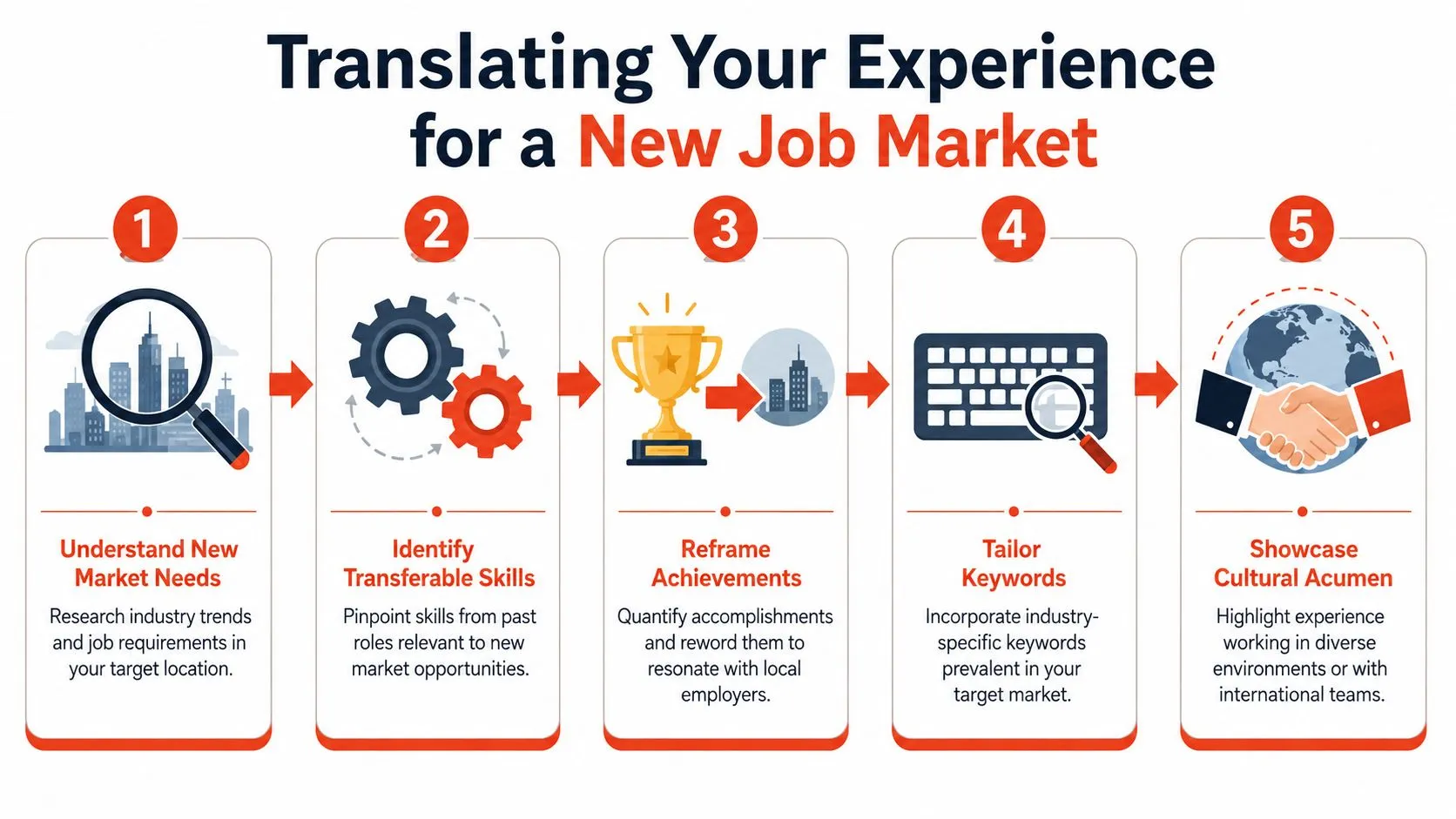
LinkedIn's 2025 Work Change report notes that 70% of professionals globally will consider a career pivot, yet employers still screen for local-fit signals, as cited in Dice's guidance on how to write a relocation resume. This is the core challenge. Portability isn't enough. Relevance wins.
Translate, don't transplant
Here's the audit I'd use before rewriting bullets:
-
Study the target market
Look at job descriptions in your target city. Not one. Several. Find the repeated language. Industries signal priorities through repetition. -
Pull out transferable wins
Don't start with responsibilities. Start with outcomes. What did you improve, launch, fix, reduce, standardize, negotiate, or lead? -
Swap generic language for local language
If your target market talks about compliance, patient workflows, plant efficiency, channel operations, enterprise procurement, or go-to-market alignment, your bullets should reflect that vocabulary where it's honest.
Before and after examples
Before
Managed cross-functional projects and improved internal workflows across multiple departments.
After for a new market
Led cross-functional process improvement work across finance, operations, and customer support, reducing handoff friction and improving execution in regulated service environments.
Before
Supported international stakeholders across multiple regions.
After for a new market
Coordinated delivery across distributed teams in North America and Europe, aligning timelines, requirements, and communication across cross-border stakeholders.
That second version matters for internationally mobile candidates. It makes global work sound useful, not exotic.
If a recruiter has to do the translation for you, they usually won't.
Different candidate types need different framing
- Career changers should emphasize problem overlap, not title overlap.
- Veterans should convert internal terminology into civilian business language.
- Returners should foreground readiness, recent relevance, and current tools.
- International candidates should state work eligibility clearly and show how their background adds range, not confusion.
If you're tailoring role by role, a guided writing process helps because it forces you to rewrite meaning, not just keywords. That's where things like tailoring your resume to a job description stop being a buzzword and become actual editorial work.
Relocation-Ready Resume Phrases and Examples
You don't need more theory. You need lines you can use.
Below are examples for a resume for relocation that sound clear, adult, and credible.
Header examples
- Nashville, TN | Relocating to Charlotte, NC in September 2026
- Phoenix, AZ | Moving to Minneapolis, MN by Q4 2026
- London, UK | Targeting relocation to Austin, TX in January 2027
- San Diego, CA | Relocating to Denver, CO. Available for interviews now
Summary examples
For a fixed move
Marketing leader with 6+ years of experience in lifecycle strategy, retention, and campaign operations. Relocating to Miami in October 2026 and pursuing senior growth marketing roles where CRM execution and customer segmentation drive revenue.
For a strategic industry move
Finance manager relocating to Houston in August 2026, bringing experience in budgeting, forecasting, and operational planning across multi-site organizations. Targeting roles where strong cost control and business partnering support energy or industrial growth.
For a career pivot
Project lead with a background in client delivery and process improvement, relocating to Boston in September 2026. Repositioning into healthcare operations roles where stakeholder coordination, workflow design, and execution discipline directly support patient-facing teams.
Experience bullet examples
- Built reporting routines used by field and executive teams, making performance trends visible across multiple locations ahead of planned relocation to a larger regional market
- Partnered with sales, operations, and customer success teams to standardize handoffs, a strength directly relevant to complex multi-team environments in the target market
- Maintained active certification eligibility across state lines to support immediate contribution after relocation
Skills section examples
A weak skills section says:
- Project management
- Leadership
- Communication
A better one says:
- Cross-functional program delivery
- Multi-site operations coordination
- Budget planning and variance analysis
- State-specific licensing eligibility
- Enterprise stakeholder communication
That's the difference between filler and signal.
Next Steps Beyond the Resume
A strong resume for relocation falls apart fast if the rest of your job search tells a different story.
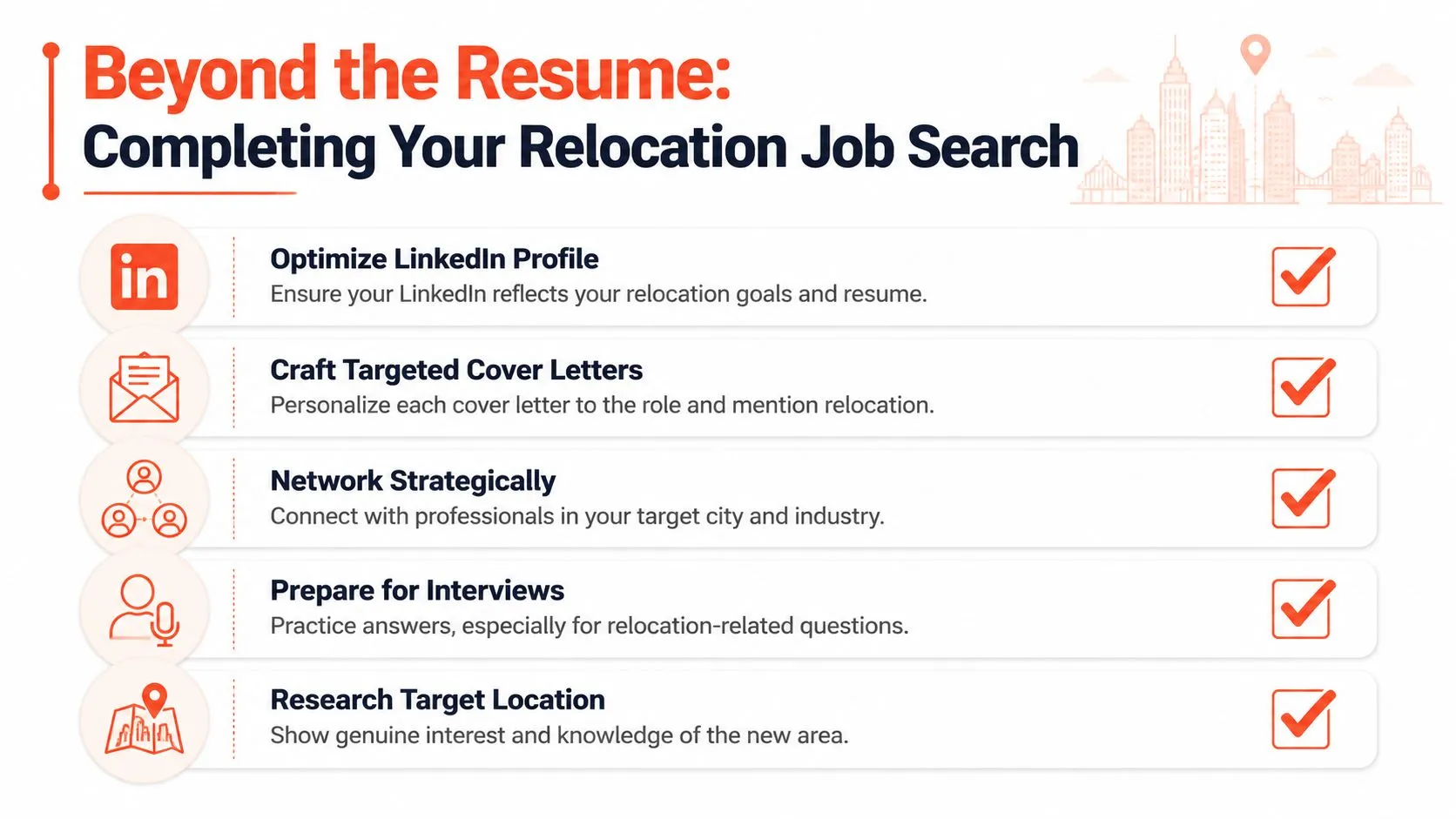
Keep the narrative consistent
Use this checklist right after you update the resume:
- Fix your profile headline so it matches the role and target market.
- Update your location language across professional profiles. Don't say one thing on the resume and another elsewhere.
- Open your cover letter with relocation context in one or two lines. Keep it crisp.
- Prepare your interview answer for “Why are you moving here?” It should sound career-driven and practical.
- Start local networking before the move so your application doesn't arrive cold.
If work eligibility is part of your story, say it plainly. For technical candidates navigating visa questions, this guide to US work authorization for engineers is a useful reference for understanding how to frame status clearly.
A good cover letter opener looks like this:
I'm currently based in Portland and relocating to Denver in October 2026. I'm targeting operations roles where my background in multi-site process improvement and team leadership fits the scale and pace of your environment.
Clean. Specific. No drama.
If you need help turning rough career history into a tighter, more credible relocation narrative, StoryCV works as a digital resume writer. It uses a guided interview to turn your experience into a clearer draft, which is useful when you know your background is strong but the story still reads flat.
A strong relocation resume doesn't beg for consideration. It removes doubt. If your current version still sounds like “please take a chance on me,” rewrite it until it sounds like “here's why this move makes business sense.” That's what gets noticed.