

The first person reading your resume for surgical tech usually isn't a surgeon. It's HR, a recruiter, or a staffing coordinator trying to sort a stack fast. They can confirm CST, BLS, specialty exposure, and whether your experience sounds solid under pressure. They can't personally judge whether your back table setup is sharp or your anticipation is excellent.
That's why so many surgical tech resumes miss. They're written like a case log for clinical insiders. The first screener needs something simpler. Clear certification. Clear specialty fit. Clear signs that you can handle volume, stay accurate, and not unravel when the room gets tense.
In the United States, this is a real hiring lane, not a niche one. The Bureau of Labor Statistics reported 110,320 employed surgical technologists in May 2023, with a mean annual wage of $62,250 and mean hourly wage of $29.93. It also projected 5% growth for surgical assistants and technologists from 2025 to 2035, with about 8,600 openings per year on average. That makes a sharper resume more important, not less, because employers have a steady stream of candidates to compare. You can review those figures in the BLS occupational data for surgical technologists.
Why Most Surgical Tech Resumes Look the Same
Most surgical technician resume drafts lead with the same pile of nouns. CST. BLS. ACLS. General. Ortho. Neuro. Cardiac. Fine. Necessary. Not persuasive.
A non-clinical screener sees that list and thinks one thing: qualified enough to keep reading. They do not think: this is the person I need to call first.
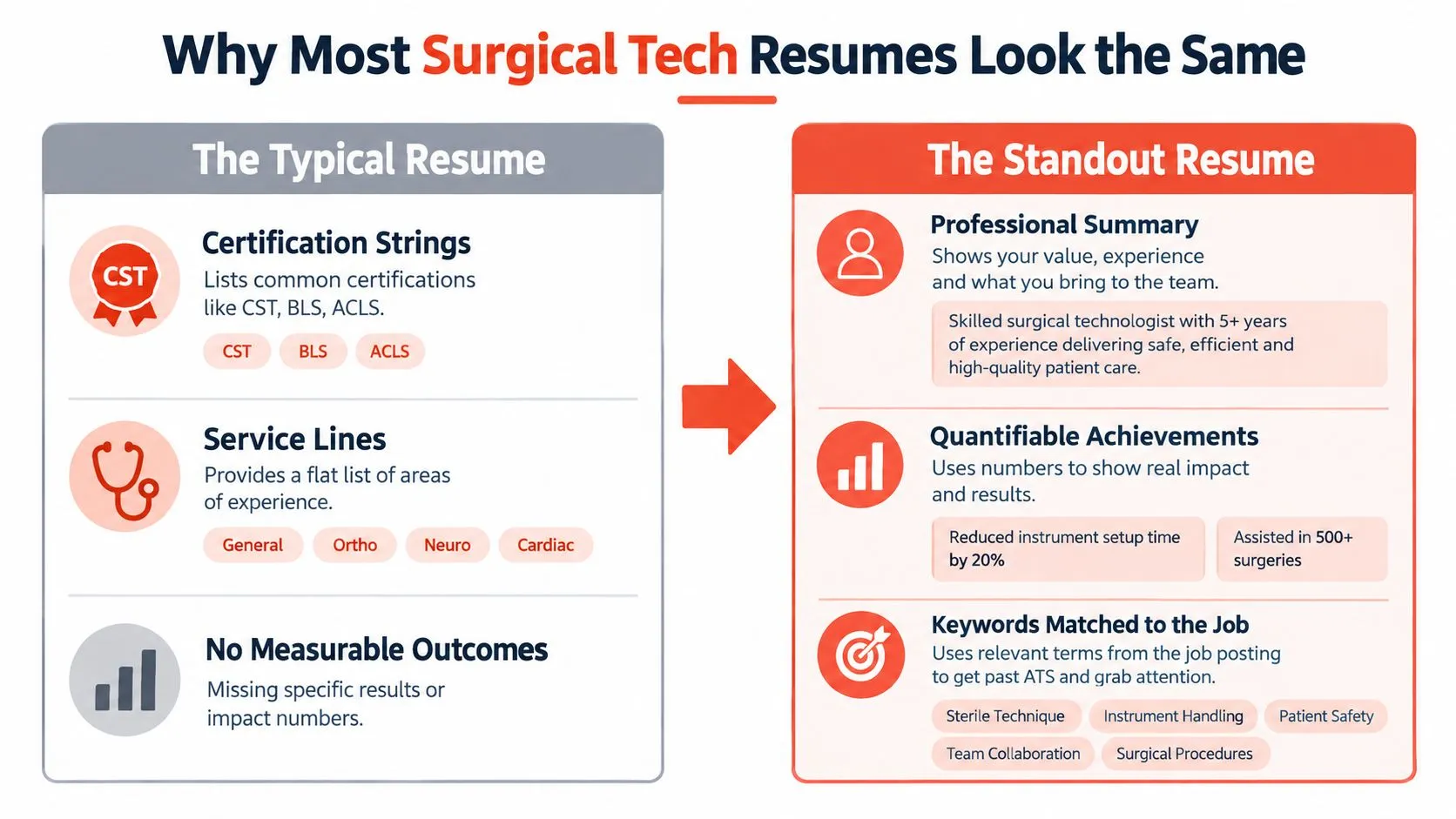
Table stakes aren't a strategy
A dedicated certifications section matters. Neutral resume guidance for this role consistently points to entries like Certified Surgical Technologist (CST) and Basic Life Support (BLS) as relevant inclusions in that section, as shown in Enhancv's surgical tech resume guidance. But that section is the floor, not the ceiling.
If every applicant has the same floor, stop trying to win there.
What separates an experienced surgical tech resume from a forgettable one is proof a first screener can understand without clinical translation:
- Volume signals like steady case load, high-throughput days, or broad specialty exposure
- Reliability signals like count accuracy, consistent turnover support, or calm handling of change
- Clarity signals like a clean summary and bullets that say what changed, not just what you were assigned
Practical rule: If your resume reads like a credential list plus a duty sheet, you're making the screener do work they won't do.
Write for the first reader, not the final one
A lot of surgical technologist resume examples go sideways. They try to impress the surgeon before getting past HR. Wrong order.
The first reader can judge whether you seem organized, specific, and credible. They can recognize lines like “supported a high volume of orthopedic cases with consistent instrument-tray accuracy” or “assisted in an extended trauma case requiring rapid adaptation to a changing surgical plan.” They don't need to know every step of the procedure. They just need to see composure, scope, and trust.
That's the frame for the rest of your resume for surgical tech. Keep the clinical depth. Translate the signal.
Anatomy of a Resume That Reads Clean
A good surgical technologist resume is easy to scan in order. Top to bottom. No puzzles. No decorative nonsense.
Start with a header that does its job
Your header needs your name, phone, email, city and state. That's it. Skip the full street address. Skip the photo. Skip the quote about patient care.
Mini-template
- Name
- City, State
- Phone
- Professional email
If your LinkedIn is clean, include it. If it's stale or mismatched, leave it off and fix it later.
Your summary gets three lines
This section should answer two questions fast. Who are you? What kind of surgical tech role fits you?
ATS-focused guidance for this role recommends using exact posting language naturally and prioritizing terms like CST, sterile technique, surgical instrumentation, patient positioning, surgical counts, infection control, and specialty areas such as orthopedics, cardiovascular, or neurosurgery. A practical method is to pull 8 to 12 terms from the job ad, place 3 to 4 high-value terms in the headline or summary, then support them in the rest of the resume. That recommendation is laid out in Resume Adapter's guide to surgical technologist resume keywords.
Mini-template
Certified Surgical Technologist with experience supporting orthopedic and general surgery cases in fast-paced OR settings. Strong in sterile technique, surgical counts, instrumentation setup, and room turnover. Seeking a surgical tech role where reliable case support and specialty depth matter.
Short. Sharp. Specific.
Skills need to be clinical, not fluffy
Independent resume guidance for this role repeatedly calls out sterile field setup, aseptic technique, surgical instrumentation, patient preparation, instrument counts, specimen handling, and room turnover as core skills for a surgical technician resume, as shown in Indeed's surgical technician resume examples.
Use a compact skills block. Focus on hard skills first.
Example skills block
- Core skills Sterile field setup, aseptic technique, surgical counts, patient positioning, specimen handling
- Equipment and workflow Surgical instrumentation, electrosurgical setup, room turnover, preference card review
- Specialties Orthopedic, OB, general surgery
If your skills section leads with “communication” and “teamwork,” you've wasted premium space.
Experience goes above education for most people
If you have more than a few years in the OR, your education belongs lower. Hiring teams care more about your case support than your classroom history.
Use this layout for each role:
Job Title
Hospital or Surgery Center, City, State
Month Year to Month Year
Then bullets. Not paragraphs.
One rule per block
- Header Keep it clean and current
- Summary Name your fit fast
- Skills Match the posting with hard skills
- Experience Show scope, action, and trust
- Certifications Keep them grouped and easy to spot
- Education Move it down once experience carries the weight
Certifications should be visible, but tight
Healthcare resume guidance also warns that ATS screening often fails when certifications are missing or technical claims aren't supported. It recommends a dedicated certifications or licensure section, naming specific systems, tools, or procedures where relevant, and pairing technical skills with concrete scope like case volume or instrument responsibility. That pattern is explained in Resume Optimizer Pro's healthcare ATS guidance.
List your certifications in one small section. Don't let them take over the page.
Mini-template
Certifications
CST | BLS
That's enough unless the job posting asks for more.
Rewriting Bullets So They Actually Prove Something
“Assisted in surgeries” says almost nothing. Every surgical tech resume says it. Same problem with “maintained sterile field” and “prepared instruments.” Duties aren't evidence.
The fix is simple. Build each bullet from responsibility, context, action, outcome. Even if you don't have a flashy result, you can still show scope and trust.
Before and after by experience level
| Experience Level | Weak Bullet | Strong Bullet |
|---|---|---|
| New grad | Assisted in surgeries during clinical rotations | Supported clinical rotations across multiple surgical services, preparing sterile fields, handling instrumentation, and completing surgical counts under supervision in hospital OR settings |
| About 3 years | Maintained sterile field during procedures | Maintained sterile field across a high volume of daily cases, supporting on-time starts and consistent count accuracy during orthopedic and general surgery procedures |
| 7+ years | Helped with trauma and complex surgeries | Assisted in extended trauma and specialty cases requiring rapid setup changes, steady instrument management, and calm adaptation to a changing surgical plan |
These are surgical tech resume examples that help a screener picture your work.
Use verbs that carry weight
“Helped” and “assisted” aren't banned. They're just weak when every bullet depends on them.
Try verbs that show control:
- Prepared for setup and readiness
- Maintained for sterile integrity and counts
- Coordinated for turnover and workflow
- Supported for high-volume case flow
- Adapted for unexpected changes
- Documented for implants, specimens, or count process
“Maintained sterile technique in orthopedic, neuro, and general surgery cases while supporting accurate counts and efficient room turnover.”
That sentence works because it gives the reader shape. Not just a task.
Ask yourself better questions
If you're struggling to write stronger bullets, don't start with wording. Start with memory. Good bullet writing usually comes from better recall.
Ask yourself:
- What kind of cases did I support most often?
- What made my room hard to work in?
- When did I have to adapt fast?
- What did people trust me to handle without hand-holding?
- What would a circulator or surgeon say I was reliable for?
That's the same reason guided writing works better than filling out a blank template. If you want a simple framework for this kind of rewrite, StoryCV's article on how to write resume bullet points is useful because it starts with experience details, not generic verbs.
Picking the Right Keywords Without Keyword Stuffing
Keyword stuffing is lazy. It also reads like lazy writing.
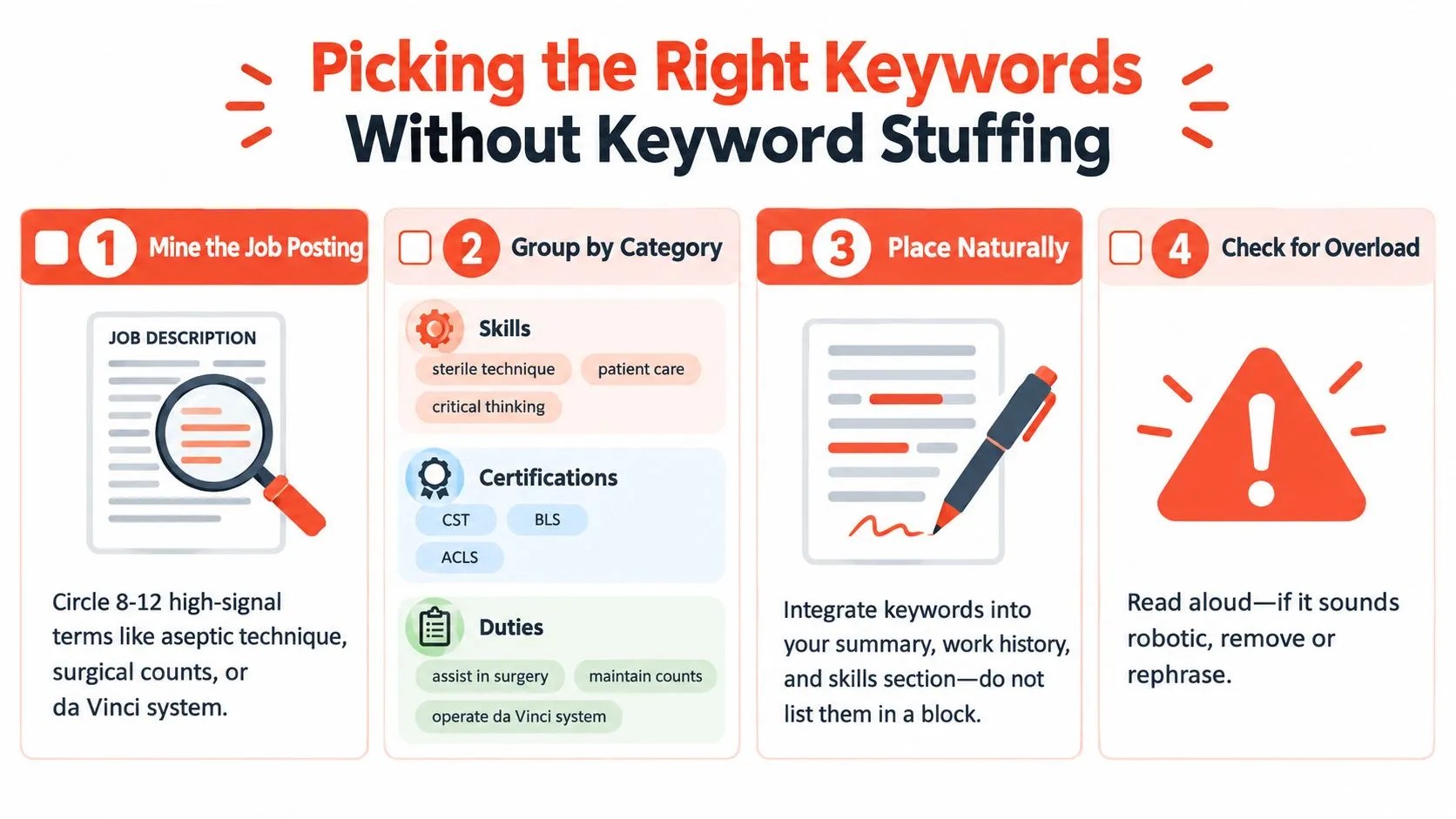
A surgical technologist resume should front-load role-specific terms in the summary, skills, and first experience bullet. The clean way to do it is simple: extract 8 to 12 terms from the posting, use 3 to 4 of the most important near the top, then support the rest with real context in your bullets. Missing certification keywords or unsupported technical claims is one of the easiest ways to get screened out.
Mine one posting, not the entire internet
Look at a single job ad and sort the language into three buckets:
- Hard clinical skills sterile technique, patient positioning, surgical counts, infection control
- Tools or systems instrument tracking software, EHR names, specialty equipment
- Credentials and specialties CST, orthopedic, cardiovascular, neurosurgery, OB, robotics
If the same phrase appears more than once, pay attention. That's probably not filler.
Put keywords where they belong
A clean placement pattern looks like this:
- Summary Put your best-fit terms here
- Skills block Add the concrete hard skills
- Experience bullets Use the remaining terms only where you can support them
Here's the check. If you write “robotic docking,” you should be able to talk about the cases. If you write “infection control,” it should appear in a real work context. If you can't support the term, cut it.
This short video breaks down the same problem from another angle.
What to avoid
- Repeating the same phrase Four uses of “maintained sterile field” isn't optimization
- Pasting hidden keyword blocks Some systems hate it, and humans hate it more
- Listing acronyms you can't explain If you get the interview, that trick collapses fast
For a cleaner approach, read StoryCV's guide on how to avoid keyword stuffing.
Specialty Focus and High-Pressure Moments in Plain Language
A resume for surgical tech shouldn't read like an operative note. It should read like proof that you can be trusted in the room.
That matters even more in a market where candidates need to compete on specificity, not generic “fast-paced OR” language. One labor outlook source describes the field as still growing, but moderately, with about 4.5% projected growth from 2024 to 2034 and about 7,000 annual openings in the U.S. Its point is the useful one: when demand is steady, employers can be selective, so resumes need to highlight OR readiness with real specifics. That framing appears in Wage Dex's outlook for surgical technologists.
Tailor the signal to the specialty
Different service lines reward different details.
- Orthopedic surgical tech resume Focus on total joints, fracture work, implants, power equipment familiarity
- Cardiovascular or cardiac resume examples for surgical technologist roles Emphasize long-case stamina, precision, and comfort with tightly sequenced workflows
- Neuro Show careful instrumentation handling and comfort with technically demanding setups
- OB surgical tech resume Highlight readiness for urgent case flow, rapid setup, and dependable count discipline
- Trauma Show calm adaptation, speed, and the ability to stay accurate during changing plans
- Robotics Name the system and your actual role in setup or support
Translate pressure into plain language
| Clinical phrasing | Plain-language rewrite | Why it reads better |
|---|---|---|
| Assisted in emergency surgeries | Supported emergent cases requiring rapid room readiness and accurate instrument handling under time pressure | The reader sees speed and reliability |
| Scrubbed complex ortho cases | Supported a high volume of orthopedic cases with consistent instrument-tray accuracy | Volume and precision are visible |
| Assisted in trauma procedures | Assisted in an extended trauma case requiring rapid adaptation to a changing surgical plan | Even a non-clinical screener can read composure |
| Worked in OB | Supported OB cases requiring fast setup, count accuracy, and steady coordination during urgent room changes | It shows what made the work demanding |
Enough detail to show why the case was hard. Not so much detail that the sentence needs a glossary.
That's the line. If a recruiter can follow the shape of the moment, you wrote it correctly.
ATS, Length, and Final Polish
Most surgical tech resumes don't fail because the candidate is weak. They fail because the document is messy.
For writing quality alone, keep it tight. A public-sector web writing guide recommends keeping each sentence under 20 words and using one idea per sentence, while Nielsen Norman Group advises using about half as much text as you would in print. That advice is summarized in Surrey County Council's web writing guide. It applies perfectly to resumes.
Length and layout rules
For most candidates, one page is enough. If you have under about seven years of experience, stop trying to justify page two.
Use standard headings:
- Summary
- Skills
- Experience
- Certifications
- Education
Use one readable font. Keep formatting plain. No text boxes. No tables for the layout. No headers and footers carrying key information.
The avoid list
These choices don't help your surgical technician resume. They hurt it.
- Objective statements They waste space
- Photos Not needed
- Decorative dividers and color blocks They break parsing and distract the eye
- “References available upon request” Obvious and useless
- Soft-skill padding “Communication” is not a differentiator without proof
A parser should be able to read your resume cleanly if you save it as plain text. If that version looks broken, the formatted version probably is too.
Final pass checklist
Before you send it:
- Check certification placement Put CST and BLS where they're easy to find
- Match dates and formatting Keep every date style consistent
- Vary bullet verbs Repetition makes strong work look flat
- Confirm specialty alignment If the role is OB, your OB experience should not be buried
- Run an ATS sanity check Use plain headings and simple structure
If you want a practical walkthrough of parser-friendly formatting, StoryCV's guide on how to optimize a resume for ATS is worth reading.
StoryCV is an Online Resume Writer that helps you turn real OR work into resume-ready bullets by asking the right questions first. If you know your cases, your specialties, and the pressure you handled but can't get that onto the page cleanly, StoryCV can help you turn that experience into a sharper surgical tech resume.