Most advice about keyword stuffing is stuck in the past. It treats writing like a word-count game. Add the phrase more times. Mirror the job description. Cram skills into every line. Done.
That advice is lazy, and it backfires.
If your page reads like it was written for a bot, search engines notice. If your resume reads like it was assembled from a spreadsheet, recruiters notice. Same mistake. Different audience. The fix isn't better stuffing. It's better articulation.
Stop Chasing Keywords You're Chasing the Wrong Thing
The obsession with keyword stuffing misses the core task. Your goal is not to cram in terms. Your goal is to make your value obvious.
Keyword stuffing means forcing repeated terms into a page or resume to game search rankings or ATS filters. On a website, that shows up as clunky copy and awkward links. On a resume, it shows up as bullets stuffed with skills but empty on outcomes. Same bad habit. Same result. Writing that looks engineered instead of credible.
The better standard is simple. Name the work, show the result, and use the language the field uses while you do it. If you led a product launch, say what shipped, who you worked with, and what changed. Relevant terms will show up on their own because they belong there, not because you jammed them in.
Stuffing is what people do when they can't explain impact clearly.
That applies beyond resumes. A smart LinkedIn posting strategy is built on clear points and specific insight, not repeating the same phrase until it goes numb.
If your resume is not getting traction, stop blaming missing keywords first. Weak framing is the usual problem. Generic summaries, vague bullets, and no proof. This guide on why your tech CV isn't getting responses gets at the core issue.
Why Keyword Stuffing Feels Necessary But Is Actually Harmful
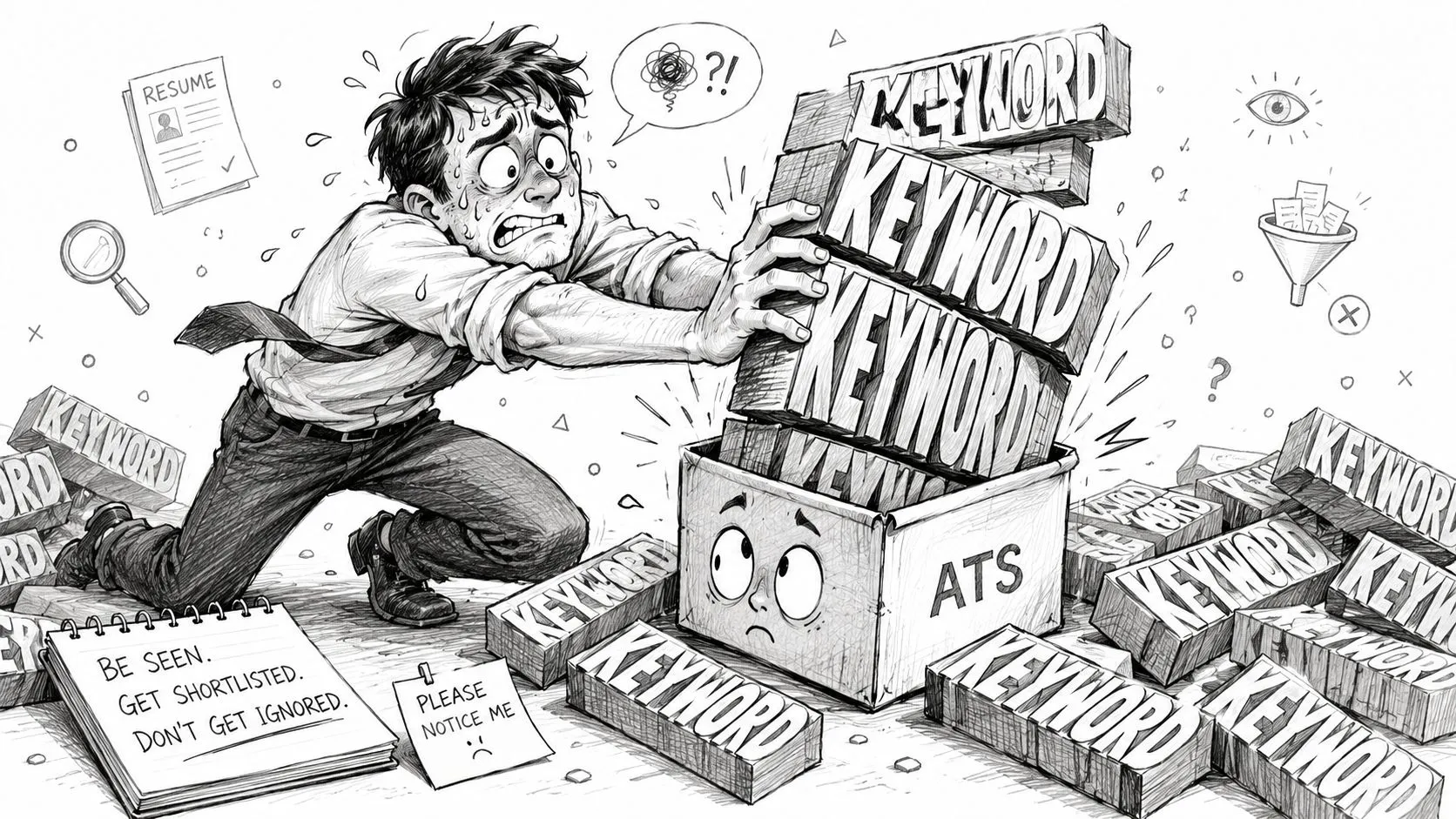
People stuff keywords for one reason. Fear.
You don't want the ATS to miss you. You don't want Google to ignore you. So you copy the exact phrasing from the job post or target keyword list and jam it everywhere. That instinct is understandable. It's also the move that makes your writing worse.
Why people do it
A lot of professionals still assume systems only reward exact matches. That belief leads to resume summaries like this:
Product Manager with product management experience in agile product management, product strategy, product roadmap ownership, stakeholder management, and product management leadership.
Every phrase is technically relevant. The sentence is still terrible.
Independent SEO guidance makes the smarter rule clear: keyword stuffing is best avoided by matching search intent and content quality. If text feels forced or grammatically wrong, it's likely over-optimized. For resumes, that means emphasizing concrete achievements and outcome-driven language, then using relevant terms only where they clarify expertise (RankMyApp on avoiding keyword stuffing).
What harm it causes
Stuffed writing creates three problems fast:
- It kills readability. The reader has to work harder to understand basic points.
- It strips context. You list skills, but you don't show when, why, or how you used them.
- It makes you sound generic. Everyone can paste in “data-driven,” “strategic,” and “results-oriented.” Few can explain what changed because of their work.
For resumes, this matters most in bullet points. If you're still writing keyword-only bullets, fix that first. These stronger ATS resume bullet point examples show the difference between naming a skill and proving it.
The better frame
Stop treating keywords as the content. They're labels. Signposts. Helpers.
The substance is the story underneath:
- the problem you handled
- the decision you made
- the skill you used
- the result you influenced
When that core is strong, relevant terms show up naturally. When that core is weak, stuffing is the bandage people slap on top.
How to Spot Keyword Stuffing in Your Own Writing
You usually don't need a fancy checker first. You need ears.
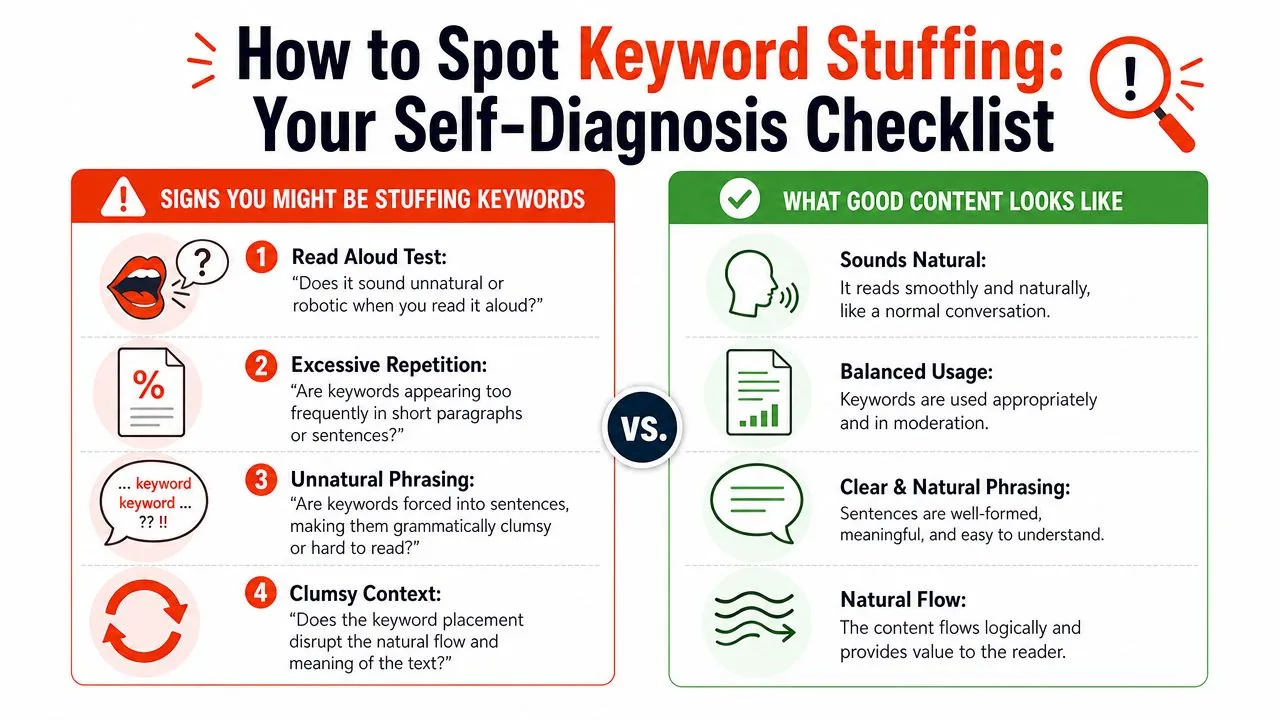
Read the paragraph out loud. If you sound like a malfunctioning search box, you've found the problem.
The fastest test
Ask yourself these questions while reading:
- Does this sound like normal speech? If not, it's probably stuffed.
- Did I repeat the same phrase in back-to-back sentences? That's a red flag.
- Would a hiring manager underline this as vague? Then rewrite it.
- Did I force exact wording where a simpler phrase would work better? That's usually where the damage starts.
Here's a bad example from resume-style writing:
Experienced operations manager with operations management experience leading operations management workflows, operations management reporting, and operations management improvements across operations teams.
Nothing is false. Everything is painful.
A cleaner version:
Operations manager who improved reporting workflows, tightened handoffs across teams, and brought more structure to day-to-day execution.
Same general meaning. Far less nonsense.
Use density as a backup check
If you want a number, fine. Use one. Just don't worship it.
A simple technical check is to count how many times the keyword appears, divide that by the total word count, and compare it to what feels normal in the category. One source recommends a 1 to 2% range as a safety benchmark, while another says it should not exceed 3%, with the keyword spread across the title, first and last paragraphs, and body instead of clustered in one spot (G2 on keyword stuffing checks).
| Quick check | What to look for |
|---|---|
| Read aloud | Clunky, robotic phrasing |
| Scan headings | Same phrase repeated in every heading |
| Review short paragraphs | Too many repeats in too little space |
| Check keyword spread | Terms distributed naturally, not piled together |
Practical rule: If the writing sounds forced before you run a density check, you already have your answer.
To understand how screening systems read context beyond surface phrasing, this explainer on AI resume screening is worth your time.
Rewriting for Humans First Then Machines
Deleting repeated keywords does not fix weak writing. It just gives you a shorter bad sentence.
What works is rewriting around meaning. That matters even more on resumes, where the goal is not to cram in terms. The goal is to prove you did work that mattered. Do that well and the right language shows up on its own.
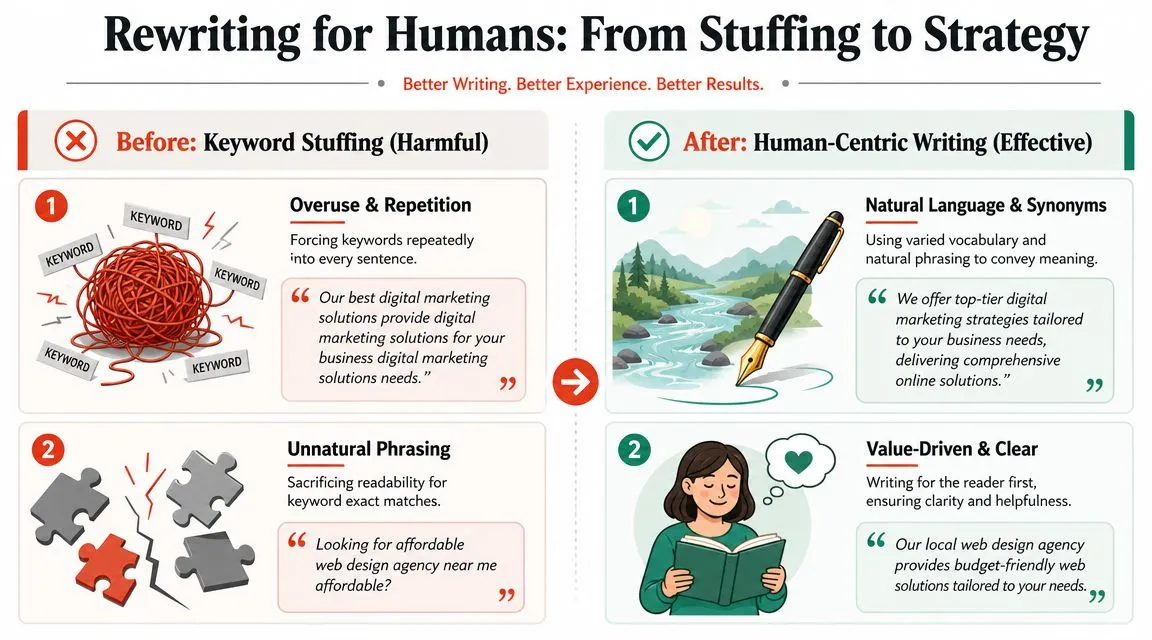
Rewrite the website copy
Bad version:
We provide digital marketing solutions for businesses needing digital marketing solutions that improve digital marketing performance through digital marketing strategy.
That sentence is trying to sound optimized. It ends up sounding empty.
Better version:
We help growth teams tighten their acquisition strategy, improve campaign messaging, and turn scattered marketing activity into a clearer system.
The topic is still obvious. The difference is that the sentence says something useful.
For search content, placement matters more than hammering the same phrase into every line. Use the main term where it helps orient the reader, then support it with plain language, related terms, and specifics. The same rule applies to resumes. An ATS can read role language, but a recruiter still has to believe you.
Rewrite the resume bullet
Bad version:
Led project management for cross-functional project management initiatives using project management tools to improve project management delivery.
That bullet says almost nothing. It repeats the label instead of showing the work.
Better version:
Led cross-functional delivery across product, design, and engineering, using Jira to keep scope, owners, and deadlines clear during a messy rollout.
Better still:
Led cross-functional delivery across product, design, and engineering, using Jira to clarify scope, owners, and deadlines during a complex rollout that had previously stalled.
Now the reader gets context, scope, and evidence. "Project management" shifts from a stuffed keyword to a believable role signal.
If you need a clearer read on how screening software fits into this, this application tracking system guide is a useful primer.
Notice what changed:
- The keyword supports the sentence instead of dominating it.
- Specifics carry the meaning.
- The bullet shows action, not just category labels.
- The language works for both software and humans.
Here's a useful mental model:
| Weak approach | Strong approach |
|---|---|
| Repeat the keyword | Expand the idea |
| List the skill | Show the skill in action |
| Match exact phrasing everywhere | Use related terms where they fit |
| Write for the scanner only | Write for the scanner and the reader |
A quick visual example helps:
The rewrite method that works
Use this sequence:
- Name the action. What did you do?
- Add the setting. Who was involved, or where did it happen?
- Use the relevant term once. Add it only if it clarifies fit.
- Replace repeats with proof. Tools, stakeholders, process, scale, outcome.
- Read it aloud. If it sounds stiff or fake, rewrite it.
Good writing includes the keyword. It refuses to make the keyword do all the work.
That is the standard. On a webpage, it improves clarity. On a resume, it does something more important. It shows impact, which is what gets interviews.
An ATS-Safe Keyword Strategy That Works
Your resume is not a landing page. You don't need “content optimization.” You need a sharp case for one role.
The cleanest strategy is simple. Pick one target role. Pull out the core language that defines that role. Then use those terms where they help a recruiter or ATS understand your fit.
Keep the keyword set tight
Semrush gives practical guidance here: target one primary keyword and only 1 to 5 secondary keywords per page, then place them naturally in key spots. The point is readability for users, not chasing a fixed density (Semrush on anti-stuffing workflow).
For a resume, the translation is straightforward:
- Primary keyword becomes your target role. Example: Senior Product Manager.
- Secondary keywords become the core skills or domains tied to that role. Example: roadmap, stakeholder management, experimentation, analytics, go-to-market.
That's enough. You don't need twenty more.
Put terms where they earn their keep
Use role-relevant language in places that matter:
- Headline or summary: Clarify the role and scope.
- Job titles: Keep them accurate. If needed, add a clarifying version in parentheses.
- Skills section: List the tools and capabilities cleanly.
- Bullets: Use keywords to support evidence, not replace it.
Bad bullet:
Stakeholder management across cross-functional stakeholder management initiatives.
Better bullet:
Coordinated product, engineering, and commercial stakeholders to keep roadmap decisions moving during a high-visibility launch.
The keyword is there. The proof is doing the heavy lifting.
Don't outsmart the system
A lot of ATS anxiety comes from not knowing what the software does. If you want a grounded overview, this application tracking system guide gives the basics without the usual fearmongering.
Your job isn't to game the parser. It's to make your fit obvious.
That means:
- match the role, not every stray phrase in the posting
- use the standard industry wording for tools and functions
- tie each important term to real work you performed
That's the version that survives software and still impresses the human on the other side.
Your Simple Audit Checklist to Avoid Keyword Stuffing
Before you publish a page or send a resume, run a five-minute check. Not a “maybe later” check. A real one.
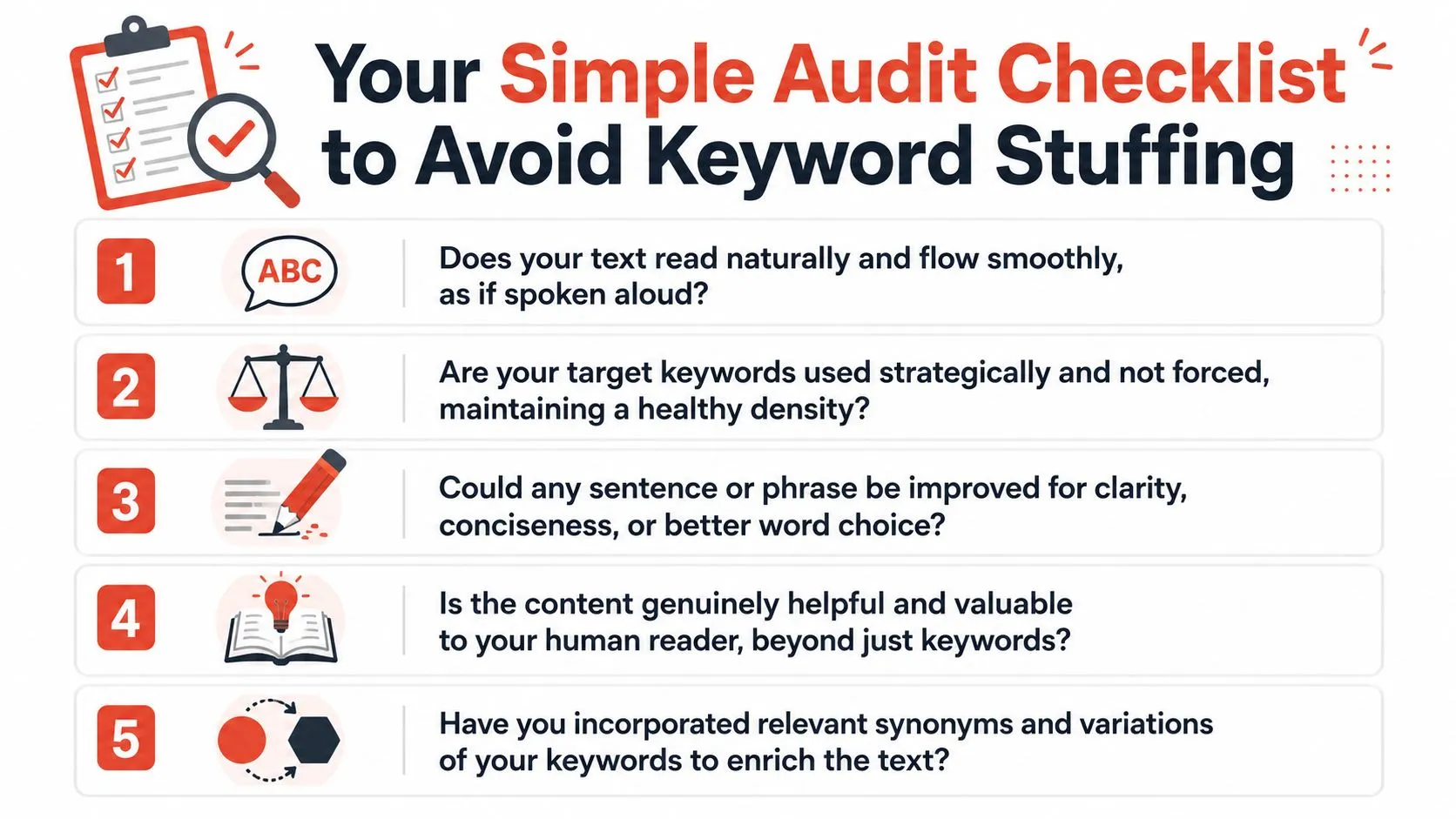
Ask these questions
-
Does this sound natural out loud?
If you wouldn't say it in a meeting, don't write it in a resume or article. -
Did I force the primary term into every heading or bullet?
Repetition isn't structure. It's clutter. -
Am I proving expertise or just naming it?
“SEO strategy.” Fine. “Built a clearer content structure and rewrote weak pages.” Better. -
Did I over-optimize non-body text?
Here, people often get sloppy. A common blind spot is image alt text, titles, headings, and anchor text. Guidance on this is clear: alt text is meant to describe the image for people who can't see it, so a keyword belongs there only when it's relevant, not mechanically appended (LowFruits on alt text and stuffing). -
Did I use variations, or did I just loop the same phrase?
Related terms create range. Repetition creates fatigue.
Use tools, but don't hide behind them
If you like checkers, use them for a final pass. Fine. Some automated SEO tools can help spot repetition patterns and on-page issues faster than a manual scan.
But don't hand your judgment to the tool. Tools can flag density. They can't tell you whether your writing sounds credible.
The best anti-stuffing filter is still simple. Read it back. Cut what sounds fake. Keep what proves something.
If you want the short version of how to avoid keyword stuffing, here it is. Write one clear page for one clear intent. Use role-relevant language in obvious places. Back it up with specifics. Stop repeating yourself.
If your resume still sounds keyword-heavy because you're struggling to turn real work into clear proof, StoryCV helps you do the hard part. It acts like a digital resume writer, using guided prompts and editorial judgment to turn your experience into sharp, ATS-safe writing that still sounds human.