Most sample banking resume pages hand you a polished PDF and call that help. That's backward. A banking resume only works when every line proves a decision, a result, or a regulated skill, because recruiters don't hire nice formatting, they hire evidence.
The problem is easy to spot. Too many resumes say processed transactions, supported clients, or assisted with daily operations, then stop there. In banking, that reads like filler. Recruiters in major financial institutions want measurable impact, and resume guidance for banking roles consistently points candidates toward numbers such as transaction volume, client counts, portfolio growth, compliance outcomes, and processing speed, because those details show scale and judgment, not just activity. That's also why executive search guidance aimed at banks focuses on roles that can clearly define and fill executive roles, not just list responsibilities.
A useful sample banking resume should do something else entirely. It should show the thinking behind the bullet, the evidence that made it worth keeping, and the structure that lets a human read it fast. That's what separates a clean layout from a persuasive document.
Why Most Banking Resume Samples Fall Flat
Most banking resume samples fail for the same reason, they model duties instead of decisions. A line like “managed client relationships” tells me nothing about portfolio size, retention, cross-sell, or risk. A line like “processed daily transactions” only matters if it shows scale, accuracy, or compliance.
The usual problems are obvious
The first issue is a bloated skills section. If a banking resume leads with soft traits like team player, self-starter, or hardworking, it wastes valuable space on claims that nobody can verify. The stronger version names hard skills such as financial analysis, credit evaluation, loan processing, account reconciliation, KYC/AML, and the actual systems used on the job.
The second issue is summary language that sounds like a LinkedIn tagline. Recruiters do not need a brand statement. They need a quick read on level, segment, and proof. A decent summary says who you are, what you handle, and what makes you credible, then gets out of the way.
Practical rule: if a bullet does not contain a number, a license, or a clear decision, it is probably too soft for banking.
The third issue is that most samples flatten the role differences. Retail banking, commercial banking, and investment banking do not use the same emphasis, and a generic template hides that. If you are writing for a senior banking role, you need evidence that matches the segment, not recycled phrasing from a teller sample. That is also why executive search guidance aimed at banks focuses on roles that can clearly define and fill executive roles, because that work starts with the mandate, the scope, and the proof required.
The fix is simple. Stop copying the sample. Start reverse-engineering it.
The Banking Resume Skeleton Every Sample Shares
Start with the part a recruiter reads first
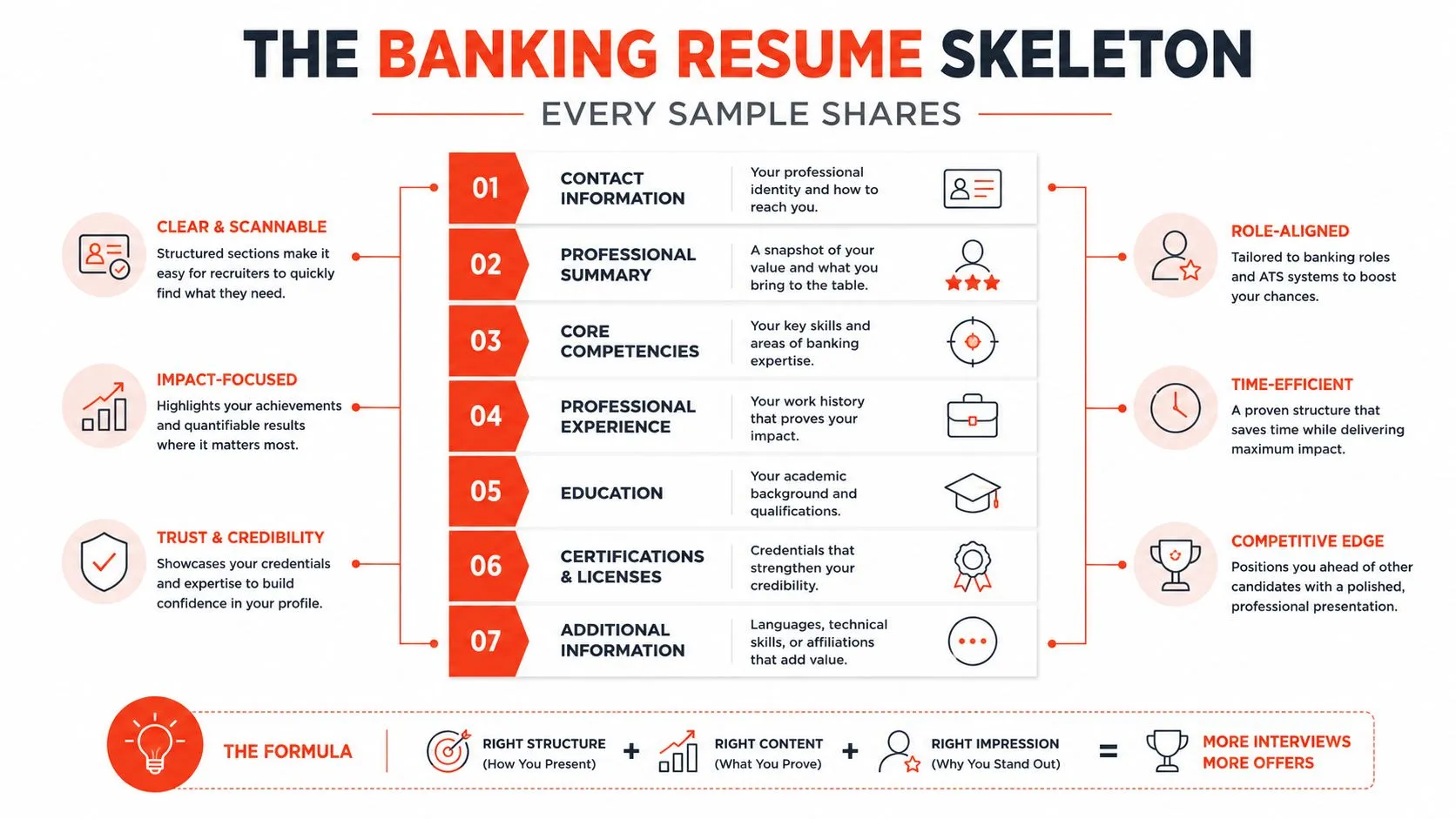
A solid banking resume starts with contact information, a headline, and a two-to-three-line summary. That's followed by experience in reverse chronological order, then education, then certifications or licenses, and finally a hard-skills section. For early-career candidates, education can carry more weight. For experienced bankers, the experience section should lead.
The safest baseline for most retail, commercial, and relationship management tracks is still a one-page, reverse-chronological format with bullet lists. That matches common banking resume guidance, and it fits the way hiring teams scan quickly through recent results, licenses, and segment fit. A resume guide for banker roles also recommends putting work experience ahead of detailed skills and listing credentials such as FINRA Series 7/63, CFA, CPA, or AML/KYC training where relevant.
Here's the clean skeleton:
- Header. Name, phone, email, location.
- Headline. Level plus function plus a few specific tools.
- Summary. Two or three lines, no fluff.
- Experience. Reverse chronological, bullet driven, quantified.
- Education. Relevant coursework or honors if you're earlier in your career.
- Certifications and licenses. Visible if they matter to the role.
- Skills. Hard skills first, software second, soft skills only when they support execution.
A banking resume is a map. If the map doesn't point to scale, risk, and tools, it's decorative, not useful.
The format debate is real, though. Investment banking samples often push education-first layouts for analysts, while broader banking samples lean summary-first or experience-first for seasoned people. That contradiction isn't a flaw, it's the point. The right format depends on segment and seniority, not a universal template.
For a clean way to tighten the writing in that skeleton, how to master your lists is worth studying, because the bullet structure matters as much as the words inside it.
Sample One Entry Level Banking Analyst

This sample is for a recent graduate aiming at a banking analyst track. The point is not to fake seniority. It is to show readiness through coursework, internship context, technical fluency, and outcomes a recruiter can audit quickly.
Name
Maya Chen
Headline
Banking Analyst | Credit and Risk | Excel, Python, Bloomberg
Summary
Recent finance graduate with regional bank internship experience, strong quantitative coursework, and hands-on work in reconciliation, reporting, and client support. Known for catching mismatches early, documenting cleanly, and handling regulated processes without drama.
Experience
Banking Intern, Regional Bank
- Reconciled 800+ daily wire transactions across two ledgers with zero discrepancies over six consecutive months.
- Reviewed account support tickets and escalated exceptions before cutoff times, which kept the team out of avoidable rework.
- Helped prepare weekly reporting for branch leadership using Excel-based tracking and cleaner data validation checks.
Retail Operations Assistant
- Assisted customers with account questions and transaction issues while keeping records accurate and complete.
- Supported cash-handling workflows and corrected documentation errors before they reached the back office.
- Trained a new part-time hire on branch procedures, then reduced avoidable handoff mistakes in daily shifts.
Education
Bachelor of Science in Finance
Relevant coursework, Financial Analysis, Banking Operations, Risk Management, Statistics
Skills
Excel, Python, Bloomberg Terminal, Financial Analysis, Account Reconciliation, Credit Basics, Customer Service
The annotation matters more than the wording. Each bullet answers a StoryCV-style interview question, like “Tell me about a time a number didn't match. What did you do?” or “What did you handle that needed the most accuracy?” That is the move. The resume is not inventing a story, it is compressing one.
The education line works because it stays focused. No long list of clubs, no filler honors, no high school once the degree exists. That matches the same guidance you will see in entry-level banking samples, where relevant coursework and technical proof matter more than broad personality claims.
If you are trying to understand the market value of analytical finance work, the cost to hire a financial analyst is a useful lens. HireAccountants gives that context without the resume fluff.
Sample Two Mid-Level Commercial Banker or Relationship Manager
This is the version most mid-career bankers need. The summary doesn't say what the candidate wants. It says what the candidate already does for clients, portfolios, and risk.
Name
Jordan Patel
Headline
Commercial Relationship Manager | Middle Market | Credit, Deposits, CRM Systems
Summary
Commercial banker with several years of experience managing business relationships, coordinating credit work, and supporting deposit growth. Brings a clean record on portfolio oversight, client communication, and follow-through across lending, renewals, and issue resolution.
Experience
Relationship Manager, Regional Bank
- Managed a $180M middle-market loan portfolio across 42 clients in manufacturing and healthcare, with a strong renewal record and no covenant issues in the period reviewed.
- Coordinated cross-sell conversations with treasury and deposit teams, then aligned product recommendations to client use rather than generic pitches.
- Escalated risk items early, documented covenant status clearly, and kept internal stakeholders aligned on exceptions.
Commercial Banking Associate
- Supported portfolio reviews, credit memos, and client meeting prep for senior bankers.
- Helped improve responsiveness on follow-up items by keeping notes, next steps, and owner assignments organized.
- Worked directly with relationship teams on deposit conversations, service issues, and client retention work.
Licenses and Training
FINRA Series 7/63
AML/KYC Training
Skills
Credit Analysis, Portfolio Management, Deposit Growth, Risk Review, Client Relationship Management, Salesforce, Excel
The big shift here is tone. The summary no longer introduces a future goal. It signals fit. That's what a mid-level banking resume should do. The experience section also stacks the right metrics together, portfolio scale, client count, renewal results, and risk control, instead of scattering them across the page.
One practical note. A mid-level banker doesn't need every soft skill stuffed into the skills section. Communication and judgment matter, but they should show up in the bullets, not sit there as decoration. The strongest versions of these resumes keep the section lean and let the client numbers do the talking.
This is also where format decisions matter more than people admit. A one-page resume still works well for many commercial and relationship roles, but only if the bullets are sharp and the evidence is specific. That's why banking samples that blur role types become useless fast, especially when they try to use one template for both entry-level and mid-career applicants.
For a practical comparison of bullet writing styles, metrics in resume writing is worth keeping in mind when you tighten your own draft.
The Section Craft Behind Every Strong Sample
Headline, summary, and bullets need different jobs
A strong headline does three things fast. It names the level, the function, and one or two real tools. Commercial RM | Middle Market | Salesforce, Excel is better than “Experienced Banking Professional” because it tells a recruiter exactly what bucket to place you in.
The summary should do less, not more. Use one number if you have it, one segment, and one differentiator. A line like “Commercial banker supporting middle-market clients with credit, deposit, and relationship management work” is direct. A line like “Driven, results-oriented professional seeking growth” is dead weight.
Practical rule: one bullet, one decision, one result. If the line tries to do three jobs, it usually does none of them well.
Experience bullets should follow the skill-action-result pattern. Start with the action, include the context, and end with the outcome. That's why a line like “Reviewed exceptions, escalated risk items early, and kept stakeholders aligned” works better than “Responsible for risk management.” It shows what happened, not just what the title implied. For a practical comparison of bullet writing styles, metrics in resume writing helps when you tighten the lines that need proof, not filler.
Skills, education, and credentials should be selective
The skills section should lean hard toward technical execution. For banking, that means financial analysis, risk assessment, regulatory compliance, loan processing, credit evaluation, account reconciliation, financial modeling, and named systems like Fiserv, Oracle Flexcube, SAP for banking, Bloomberg Terminal, and Excel. Soft skills can appear, but only where they reinforce the work.
Education belongs where it helps most. For entry-level candidates, coursework and honors can carry real weight. For experienced bankers, keep education tighter and let the work history do the heavy lifting. Certifications like FINRA, CFA, or CPA should be visible if they help establish credibility.
If you need a check on how to make bullets cleaner, how to tailor a resume to a job description is the right lens, because banking resumes succeed when the words mirror the role, not when they sound broad. If you want a second pass on list structure itself, how to master your lists is useful for keeping each bullet readable and specific.
ATS Reality Without Making It Your Whole Resume
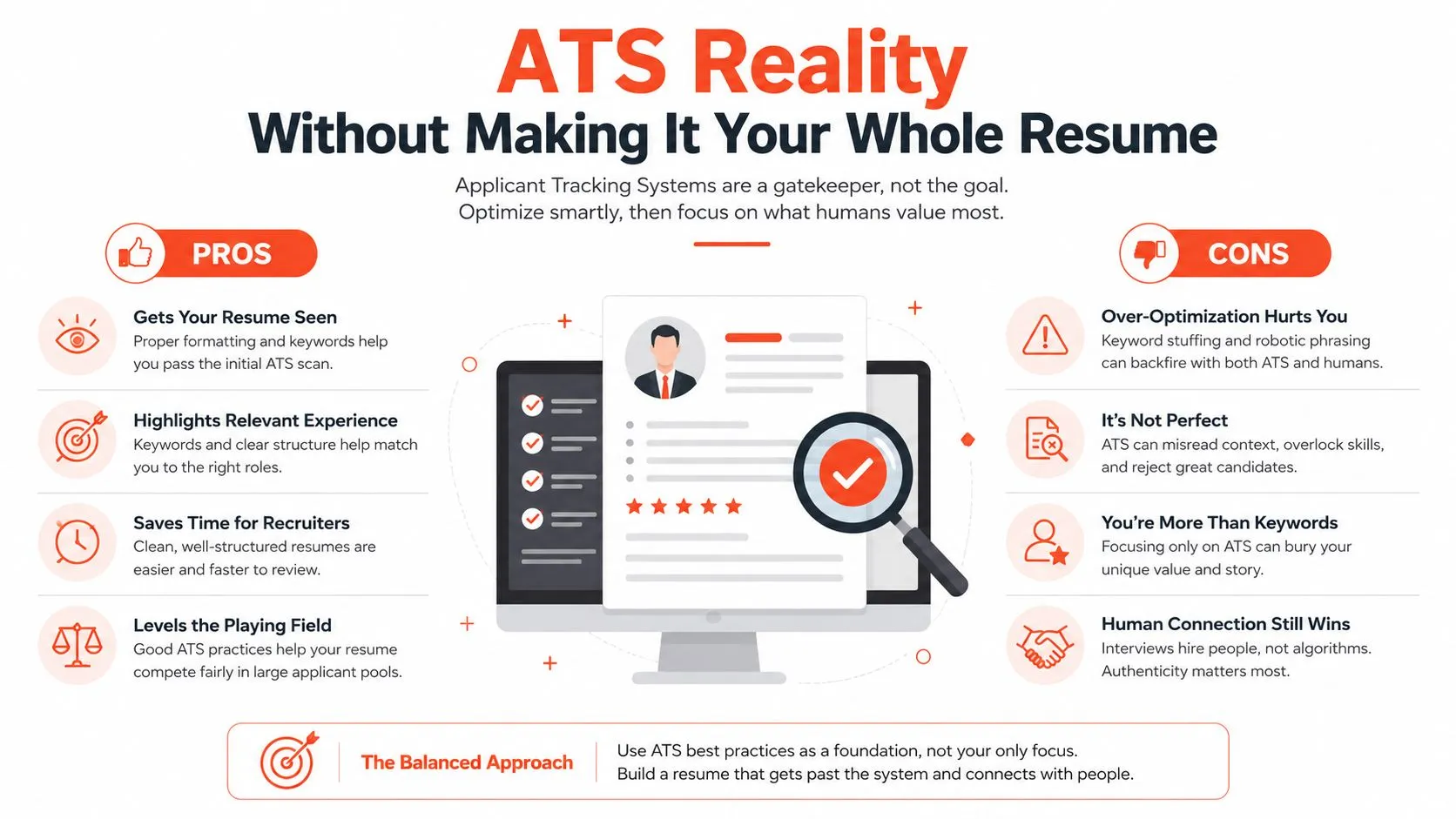
ATS is not the villain. It's a parser. It sorts keywords, reads basic structure, and passes a file along if the layout doesn't confuse it. A high ATS score only proves the file was parseable. It doesn't prove the resume was good.
The three rules that matter are simple. Use standard section headings. Avoid tables or columns for core content. Include real keywords from the posting, such as KYC, AML, credit analysis, loan servicing, or portfolio management when they match your work. A resume that parses well but says nothing useful is still a bad resume.
The mistake is spending too much time trying to game the parser. The human read is what matters. Recruiters still scan for hierarchy, clarity, and proof, which is why a clean one-page layout with strong bullets usually beats a messy design with more formatting tricks.
If you want a tighter grip on bullet construction for parseability and readability, ATS resume bullet points is the right place to refine the wording. Keep the structure simple, then make the content earn its place.
Adapting These Samples to Your Own Story
Start with the work you can defend. What size portfolio or workload did you handle? What went wrong once, and what did you do next? What risk, compliance, or control issue did you catch? What cross-sell, deposit, or growth result can you defend? What would you change now if you had the same situation again?
Each answer maps to one part of the resume. Portfolio scale and growth belong in experience bullets. The mistake or exception belongs in a judgment line. Compliance or risk work supports credibility. The “what would you change” answer helps you strip out weak phrasing and keep only the parts that show decision-making. If a bullet does not help a recruiter understand your judgment or your effect on the business, it probably does not belong.
Use the samples as a filter, not a script. Tailor the wording to the role with Tailoring your resume to the job description, then make each line earn space by showing scope, action, and result. A banker with a smaller book can still write a strong resume if the bullets show disciplined ownership. A banker with a larger book still needs to explain what changed because of the work.
Run this checklist tonight.
- One page only: keep it tight unless you've got a very senior story.
- Reverse chronological order: put the newest role first.
- Three to five bullets per recent role: enough to prove impact, not enough to ramble.
- One number per bullet: if you can't quantify it, rethink it.
- Hard skills first: keep the skills section technical.
- Licenses visible: don't bury credentials that matter.
- No high school after a bachelor's: cut the clutter.
The samples above are not magic. They are the visible result of better questions and sharper editing. Copying the layout without that thinking gives you a polished file with weak proof. Using the questions first gives you content a banker can defend in an interview.
If you want a banking resume that sounds like a real banker wrote it, StoryCV turns your experience into clear, interview-driven copy without the template sludge. Visit StoryCV and build a sample banking resume that proves impact instead of just listing duties.