
The popular advice is backwards. A degree gets you into the accounting conversation. Your ERP experience and close-cycle ownership determine whether the conversation continues.
A staff accountant resume shouldn't read like a job description copied into bullets. It should show that you can enter a specific environment, use its systems, protect the ledger, and deliver a clean close without needing constant supervision. That's the proof hiring teams look for, especially when ATS software screens applications before a person sees them. Accounting resume keyword guidance repeatedly emphasizes financial reporting, general ledger work, reconciliations, AP/AR, GAAP, Excel, and ERP platforms as recurring signals.
The Hidden Reality of Accounting Hiring
Many candidates lead with their degree, then list duties such as “prepared reports,” “managed accounts,” and “assisted with month-end close.” That approach feels safe. It also makes experienced work look interchangeable.
Hiring teams aren't only asking whether you studied accounting. They're asking a sharper question: How quickly can this person operate in our accounting environment? A bachelor's degree in accounting or finance appears frequently in staff accountant postings, but employers vary widely on their experience requirements, with some asking for 1–3 years, others 2+ years, and some 5+ years. Indeed's staff accountant job description reflects that variation.
The degree establishes a foundation. It doesn't prove that you know the company's ledger structure, close calendar, approval controls, or reporting workflow. Your systems experience gets closer to that proof.
The two signals that survive the first screen
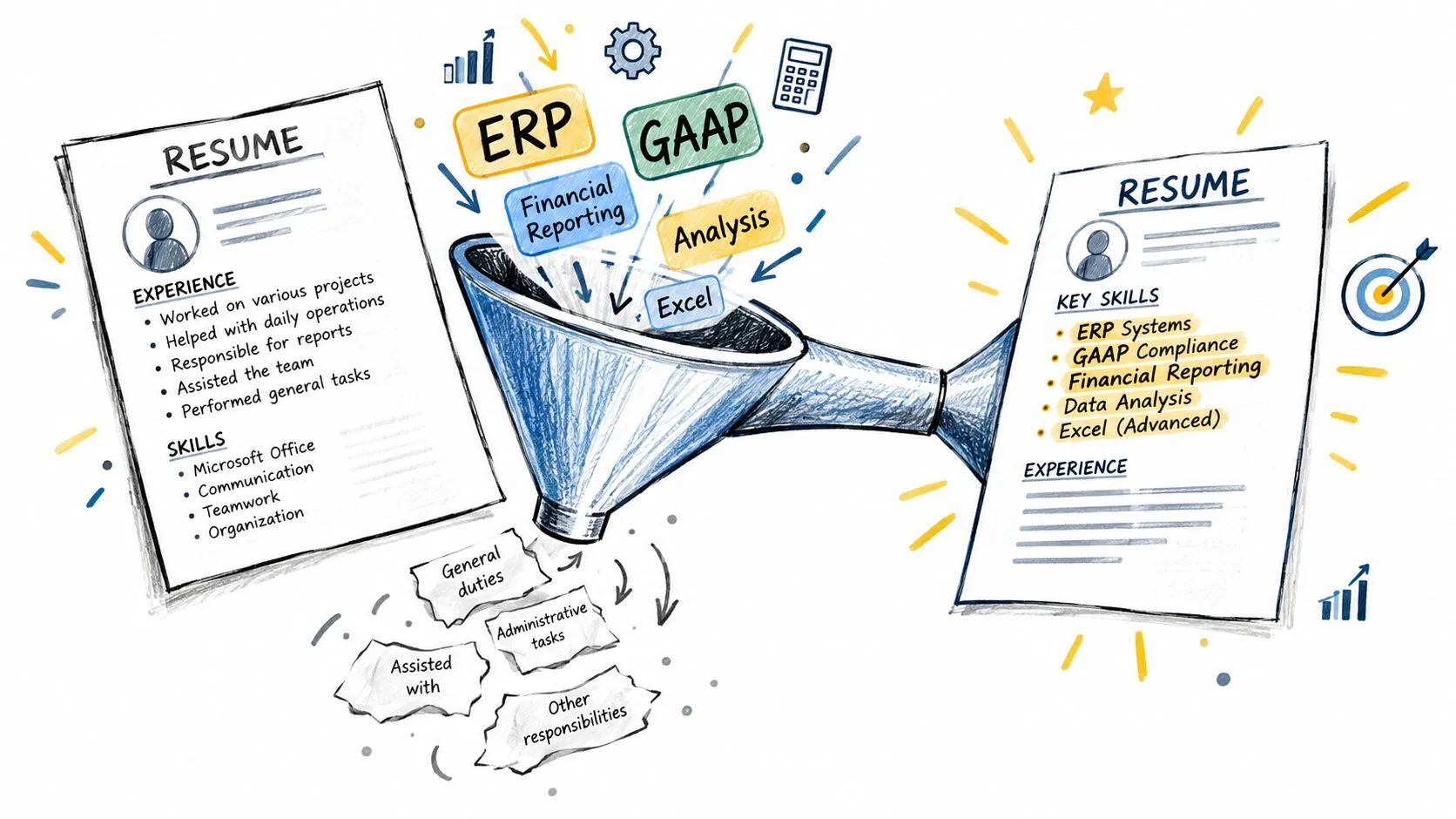
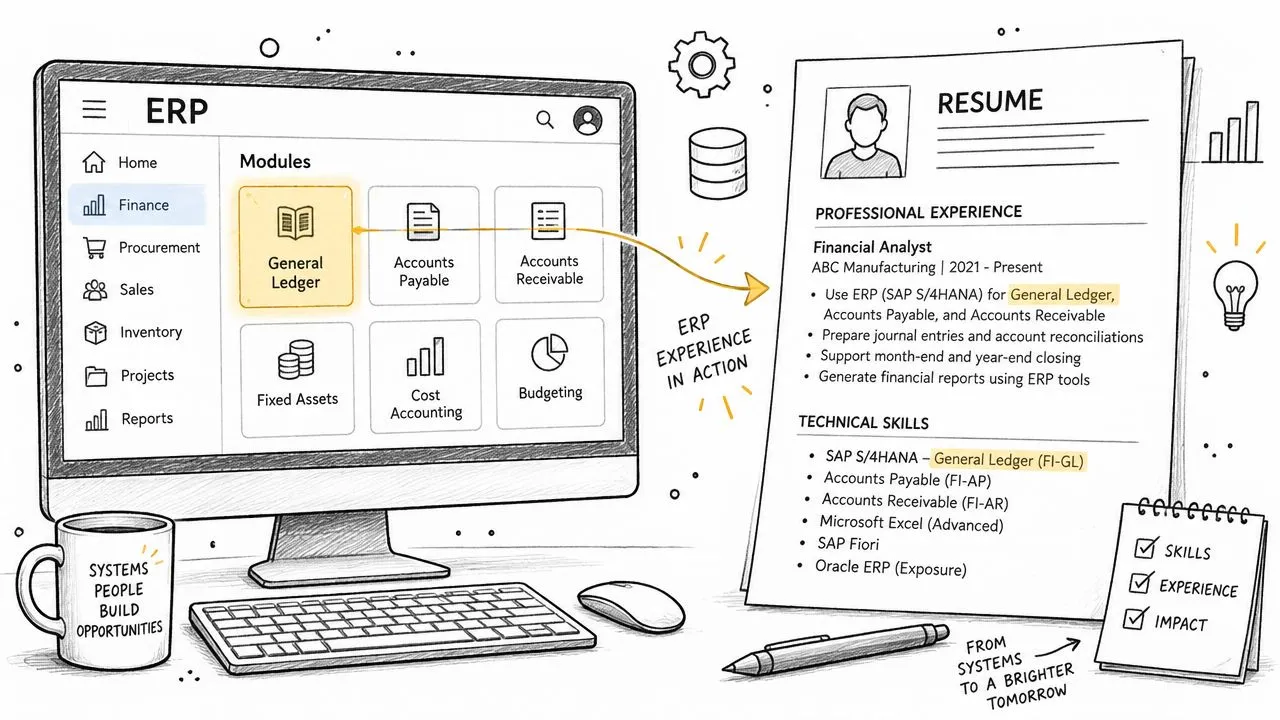
ERP familiarity is one signal. Name NetSuite, SAP, Oracle, Sage, or QuickBooks when you've genuinely used them. Then add the version and modules if you know them. “ERP experience” is vague. “NetSuite, General Ledger, Accounts Payable, Fixed Assets” gives a reviewer something usable.
Close ownership is the other. Staff accountants become senior-ready when they own parts of the close, not merely assist with them. A bullet such as “supported month-end close” hides your level of responsibility. A bullet describing the reconciliations you owned, deadlines you met, and issues you resolved shows it.
Practical rule: A responsibility tells the reader where you stood. An outcome tells the reader why you mattered.
Strong resumes translate accounting work into scale, accuracy, and speed. That might mean the accounts reconciled, reporting periods supported, journal entries prepared, or close deadlines managed. The exact evidence depends on your work, but the principle stays constant. Replace familiarity with proof.
Structuring Your Staff Accountant Resume
A resume is not a biography. It's a fast operating brief for a hiring decision. Put the information in the order a reviewer needs it, not the order you happened to collect it.
Use this hierarchy:
- Header and targeted headline
- Three-line summary
- Themed skills block
- Professional experience
- Education and credentials
- Additional relevant information
Your headline should position you around the role's work, not personality. “Staff Accountant | Month-End Close | NetSuite | Financial Reporting” is more useful than “Detail-Oriented Accounting Professional.” The first version tells the reader what to search for.
The summary should connect your accounting scope to the target role. Mention your strongest processes, core system, and clearest result. Don't fill it with soft claims such as “hardworking” or “team player” unless the job posting makes them unusually important.
Put skills where they can work
A skills section near the top can help when the posting is system-specific. Group terms by theme rather than dumping them into one long line:
- Accounting operations: General ledger, journal entries, account reconciliation, month-end close
- Reporting and controls: Financial statement preparation, GAAP, variance analysis, audit support
- Systems: NetSuite, SAP, Oracle, Sage, QuickBooks, Excel
- Transaction flows: Accounts payable, accounts receivable, fixed assets
This structure serves both readers and parsers. It also forces you to separate real capabilities from keywords you've only encountered.
Make experience carry the argument
Use reverse chronological order and give each role bullets that show responsibility plus evidence. The accountant resume workflow recommended by Resume Optimizer Pro starts with repeated requirements from 5–10 target postings, then maps those requirements into the summary, skills, and experience sections.
That workflow is practical because a generic resume tries to represent every version of you. A targeted resume makes one clear case. Keep the degree visible, but don't let it occupy the strongest real estate if your ERP and close experience are more relevant to the vacancy.
Why ERP Systems Beat Generic Experience
Accounting software isn't decoration at the bottom of a resume. It tells a hiring manager which environment you can enter with less translation.
A firm hiring for NetSuite doesn't need to know only that you “prepared financial reports.” It wants to know whether you understand how that work happens in NetSuite, which modules you touched, and how much of the workflow you handled. The same logic applies to SAP, Oracle, Sage, and QuickBooks. System familiarity can function as a hard filter, because the employer is reducing ramp time on a defined operating environment.
Write the system in three layers:
- Platform: NetSuite, SAP, Oracle, Sage, or QuickBooks
- Version: Include the version when you know it and it's relevant
- Modules or functions: General Ledger, Accounts Payable, Accounts Receivable, Fixed Assets, reporting, consolidation, or another module you used
Then put the strongest platform in the summary and repeat it naturally in a relevant experience bullet. Don't hide it in a skills list where it looks like an unverified inventory.
What specificity looks like
Weak:
Used accounting software to process transactions and prepare reports.
Stronger:
Used NetSuite General Ledger and Accounts Payable modules to post journal entries, investigate account variances, and support monthly financial reporting.
The stronger version doesn't claim a result you haven't established. It names the operating context and the work performed. Add a measurable outcome only when you can verify it.
ERP experience also needs judgment. Don't list every application you've opened once. A short, credible systems section beats a crowded one. For a useful counterpoint on why platform knowledge and industry context should be evaluated carefully, see why industry experience in erp is overrated. The takeaway isn't to hide experience. It's to describe what you did inside the system.
If remembering those details is the hard part, StoryCV's resume skills section guide offers a useful way to organize skills around real work rather than unsupported labels.
Transforming Duties Into Quantified Achievements
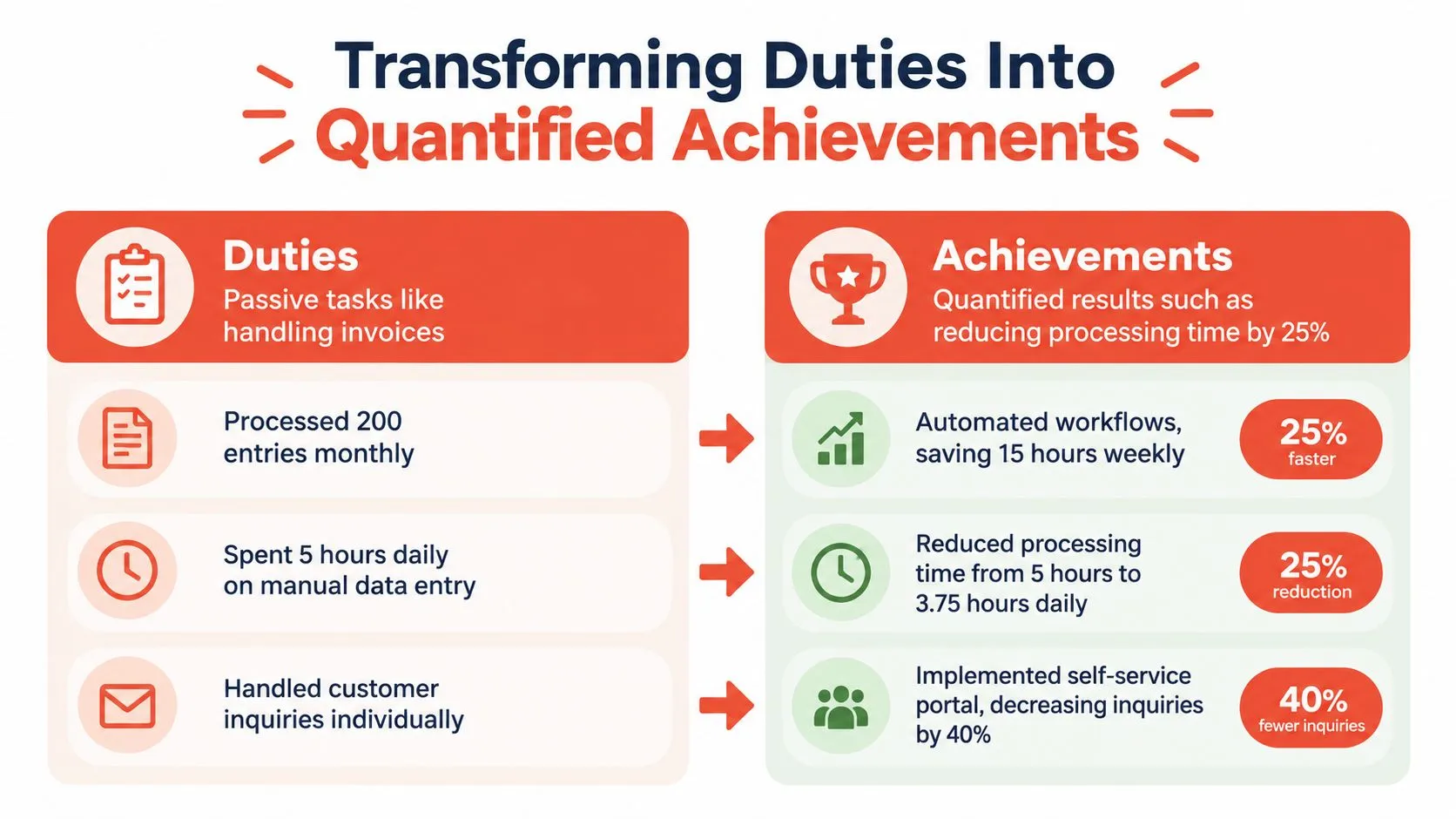
The bullet is where a staff accountant resume either earns attention or disappears. A duty says what occupied your time. An achievement shows the context, action, and outcome of that work.
Start with the weak version. Then ask three questions:
- What was the accounting environment or scale?
- What did you personally do?
- What changed because of your work?
Reconciliations
Weak:
Reconciled balance sheet accounts.
Stronger:
Reconciled [your verified number] balance sheet accounts during month-end close, investigated variances, and documented corrective entries before reporting deadlines.
Use the bracketed prompt as a drafting aid, not as text to leave in the resume. If you know the number, include it. If you don't, describe the account categories, frequency, or reporting responsibility without inventing a figure.
Journal entries and reporting
Weak:
Prepared journal entries and financial statements.
Stronger:
Prepared recurring and adjusting journal entries in [your ERP], reviewed supporting schedules, and contributed to monthly financial statement preparation under GAAP.
This version establishes the system, entry types, control behavior, and reporting framework. It gives the reader more evidence without pretending that every task produced a dramatic financial result.
Close ownership
Weak:
Assisted with month-end close.
Stronger:
Owned assigned month-end close activities, including journal entries, reconciliations, variance review, and escalation of unresolved issues before management reporting.
If you reduced the close from eight days to five, write it plainly:
Reduced month-end close from eight days to five by standardizing reconciliation schedules and resolving recurring posting issues.
That kind of result is stronger than a paragraph of duties because it shows ownership of the process. It also signals readiness for a senior role, where the question shifts from “Can you complete close tasks?” to “Can you control the close?”
The guidance on writing resume achievements follows the same useful distinction. Don't add numbers for decoration. Add them when they clarify volume, time, accuracy, cost, or process impact.
Mastering ATS Keywords and Formatting
ATS software looks for language that matches the vacancy. A recruiter then decides whether that language is supported by credible experience. You need both parts.
The core keyword cluster for a staff accountant resume includes general ledger, month-end close, account reconciliation, financial statement preparation, GAAP, AP/AR, fixed assets, and variance analysis. These terms recur across staff accountant guidance and ATS-focused examples, including staff accountant resume component recommendations from ResuFit.
Use the exact term when it accurately describes your work. Don't replace “account reconciliation” with “financial data cleanup” because it sounds more polished. Accounting hiring is specific. Specific language helps the right reader find you.
Build a readable keyword pattern
Place important terms in more than one credible location:
- Summary: State your operating identity and strongest process
- Skills: Group technical terms for quick scanning
- Experience: Prove each important term through a real bullet
Avoid keyword stuffing. Listing SAP, Oracle, and NetSuite doesn't help if the experience section never shows how you used them. It can raise questions about credibility.
Formatting matters because a parser has to read the document before a person evaluates it. Use clear headings, standard section names, conventional bullet points, and a simple reverse chronological layout. Avoid text boxes, decorative graphics, complex columns, and unusual icons that can separate labels from their content.
This guide to ATS resume optimization is useful for the mechanical side. Keep the larger principle in view: ATS compatibility gets your evidence into the system, but evidence still has to persuade the human reviewer.
Avoiding Common Resume Pitfalls
Most weak staff accountant resumes aren't weak because the candidate lacks experience. They're weak because the document makes the reviewer reconstruct that experience.
The first problem is a generic summary. “Detail-oriented accountant with strong analytical skills” could describe almost anyone. Name the work instead: close ownership, reconciliations, financial reporting, GAAP, and the ERP that matters for the role.
The second is a duty-only experience section. “Processed invoices” doesn't tell the reader whether you handled routine volume, resolved exceptions, improved controls, or followed instructions. Add context and consequence.
The mistakes worth removing
- Burying the ERP: Move the relevant system into the summary, skills block, and supporting bullet.
- Using unsupported claims: Don't write “expert” unless your experience demonstrates depth.
- Ignoring the posting's wording: Mirror accurate terms such as “fixed assets” or “variance analysis” instead of relying on loose synonyms.
- Overloading education: Keep the degree clear, but give more space to recent accounting execution.
- Using a decorative template: Templates often prioritize visual boxes over the details a hiring manager needs to find.
- Inventing metrics: A precise false number damages trust. A truthful qualitative description is stronger.
Tailoring doesn't mean rewriting your history for every employer. It means choosing the evidence that answers this employer's question. Extract repeated requirements from the target postings, then select bullets that prove those requirements.
Your credentials also need accurate status. The CPA licensing path includes a bachelor's degree, 150 semester hours with accounting coursework, and at least two years of professional accounting experience according to Indeed's explanation of staff accountant qualifications and CPA licensure. Write “CPA candidate” or “CPA exam progress” if that's your status. Don't present licensure as complete when it isn't.
From Responsibilities to Real Impact
Take one line from your current resume and test it.
“Responsible for account reconciliations and month-end close.”
That sentence describes an obligation. It doesn't show ownership, scope, system, or result. Ask yourself what changed because you did the work. Did you resolve recurring variances, create a cleaner schedule, protect a reporting deadline, or take ownership of a defined portion of close?
A stronger version might be:
Owned assigned month-end close activities in [ERP and modules], completing account reconciliations, preparing journal entries, and escalating unresolved variances before financial reporting.
Add the verified measure when you have it:
Reduced month-end close from eight days to five by standardizing reconciliation schedules and addressing recurring posting issues.
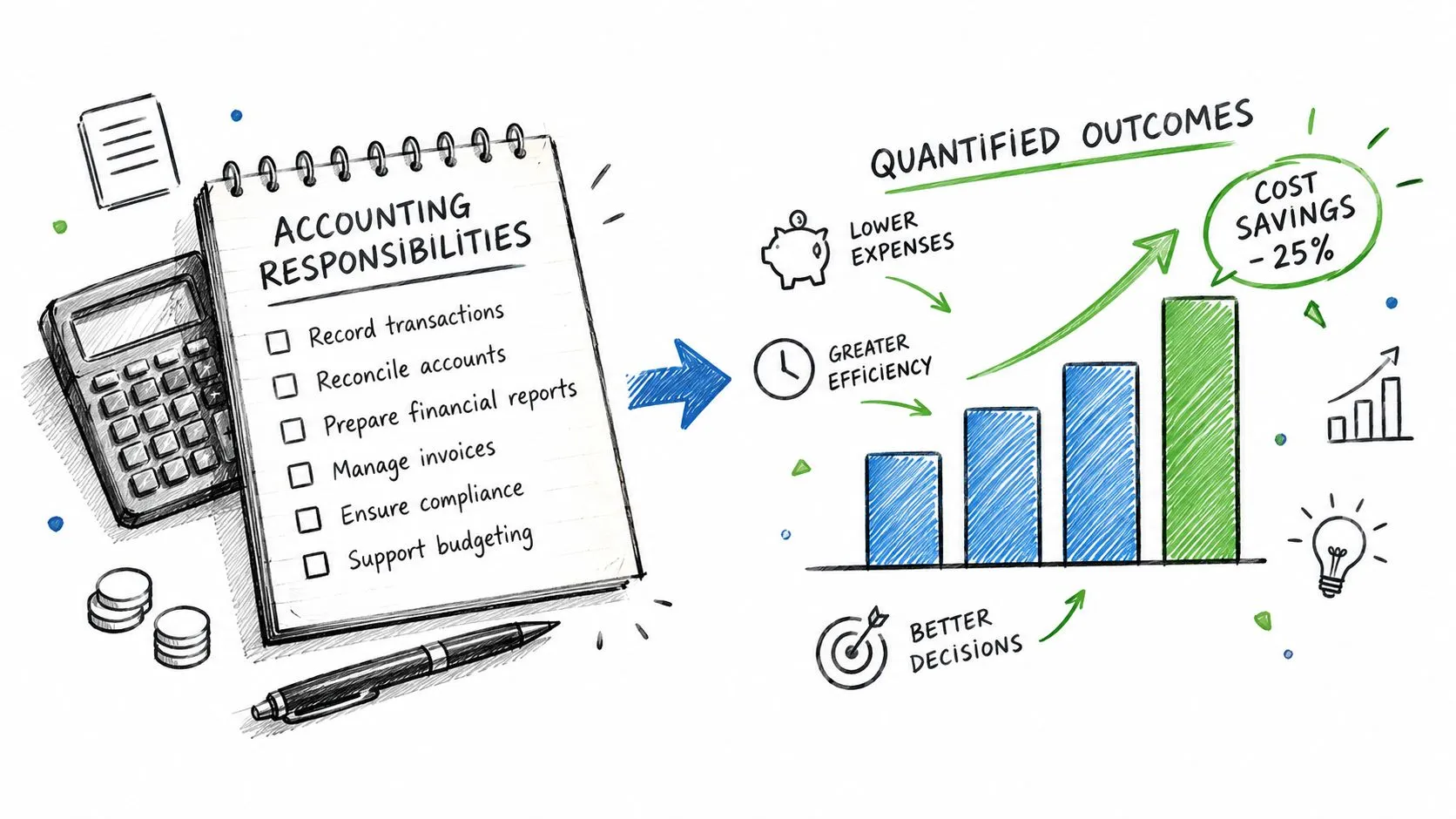
Your summary can follow the same logic: role, systems, core processes, and evidence. Your bullets should make clear what you changed, not only what you were assigned.
That's the work StoryCV is designed to support. It asks about the accounting work you did, helps recover the context and outcomes you may have forgotten, and turns your answers into resume-ready writing.
Tell your accounting story through StoryCV, starting with the ERP systems, close responsibilities, and results you can verify. Use it to turn each duty into a clear bullet that shows what you changed, not just what you handled.