This is the typical advice given about resumes:
Paste your resume into a grader, chase a higher score, and assume the number means you're getting closer to an interview.
Usually, you're getting closer to a cleaner-looking version of the same weak story.
That's the split in StoryCV vs Resume Worded. This isn't just one resume app against another. It's a fight between two ideas. One says resume writing is an optimization problem. The other says it's an articulation problem.
If your resume already says the right things and just needs a mechanical pass, scoring can help. If you're still struggling to explain what you did, score-chasing is a distraction.
| Category | StoryCV | Resume Worded |
|---|---|---|
| Core philosophy | Narrative extraction | Scoring and draft analysis |
| Best for | People stuck before the first strong draft | People who already have a draft |
| Workflow | Guided, interview-driven writing | Paste resume and job description, then get feedback |
| Main output | Resume content shaped from context, decisions, constraints, and outcomes | Match Score and editing suggestions |
| Setup | Low-setup workflow with a free single-role entry point and full plan at roughly $10 for 1 week pass | Built around analyzing existing material rather than generating it from scratch |
| My take | Better for fixing substance | Better for checking surface issues |
Your Resume Score Is a Lie
Resume scores sell certainty to people who want direction. That's why they work.
A number looks objective. It feels cleaner than wrestling with fuzzy questions like, 'What did I change?' or 'Why did that work matter?' But the number is only grading the evidence you already gave it. If the resume is vague, incomplete, or written in dead corporate language, the score doesn't expose the problem. It just tidies the disguise.
That is the scam.
Candidates usually are not failing because they missed one keyword. They fail because the resume strips the work of tension, judgment, and consequence. Good work gets flattened into duties. Hard decisions disappear. Results show up as generic claims. Then a grader shows up and treats the problem like a phrasing issue.
The most persuasive resumes don't sound optimized; they sound true.
Why score-chasing breaks the process
A grader reacts to text. It does not recover missing context. It cannot ask what was broken before you stepped in, what constraints you had, what trade-offs you made, or why the outcome mattered to the business.
So people start writing for the grader. They swap verbs, stuff in keywords, and polish safe lines that sound professional and reveal nothing. The resume gets more compliant and less convincing.
A resume score is a formatting-and-keyword opinion dressed up as career advice.
That is why the bigger split in StoryCV vs Resume Worded is philosophical, not cosmetic. Resume Worded grades the draft in front of you. StoryCV tries to pull the substance out of work you have not described well yet. If you are still stuck at the "how do I explain what I did?" stage, a scoring dashboard is the wrong first move. A tool built to help you extract the story does more for you than another meter. For a wider look at that category, this guide to an AI resume writer is a better use of time than chasing another score.
The same logic shows up in hiring. Recruiters do not need cleaner filler. They need signal they can trust. Tools built as an AI assistant for recruiters exist for that reason.
The actual choice
Pick the tool based on your real bottleneck.
-
Polish mode fits people with a strong draft who want surface feedback.
-
Discovery mode fits people who know they did good work but cannot yet explain it sharply.
-
Translation mode fits people whose experience was valuable, but whose resume still reads like task management.
Resume Worded is built for polish mode. StoryCV is built for discovery and translation. That difference matters more than any score.
Scoring Words vs Extracting Value
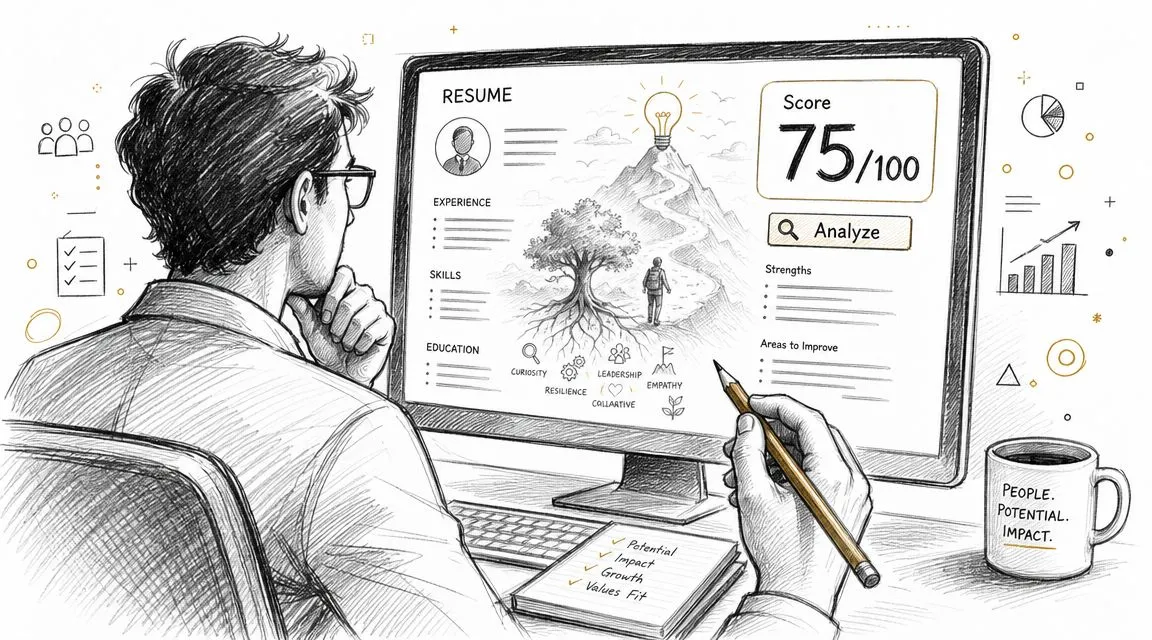
Resume Worded's model is easy to understand. You paste in your resume. You paste in a job description. It analyzes the draft, gives you a score, and points out gaps.
Fair enough. That can be useful.
Third-party comparisons describe Resume Worded as measuring resumes against more than 100 recruiter-informed data points, with job-description matching that sorts missing requirements into hard skills, soft skills, and qualifications, while StoryCV is described as doing upstream content extraction through a guided interview that turns role context, decisions, constraints, and outcomes into ATS-compatible bullets quickly, according to CVAnywhere's overview of Resume Worded.
The technical strength is also the philosophical weakness
That scoring layer is Resume Worded's advantage. It's also the limit.
It assumes the draft is already close to truth and just needs refinement. But many resumes aren't rough diamonds. They're incomplete evidence. The candidate left out the underlying tension, the trade-offs, the ugly before-state, and the outcome that made the work matter.
A score can't find omitted value.
It can only tell you that your current wording isn't satisfying the rubric. So users end up in a loop:
-
Paste draft
-
Get score
-
Make cosmetic edits
-
Re-check score
-
Repeat until the document sounds less human
That's not writing. That's appeasing a grader.
Why this matters to a human reader
A recruiter or hiring manager isn't hiring your keyword density. They're trying to infer judgment, ownership, and relevance from a small amount of text. That's a different task.
If you work with hiring teams, you already know software can help sort information but can't replace judgment. That's why tools built for actual communication matter more than dashboards alone. The same pattern shows up outside resumes too. An AI assistant for recruiters is useful because it helps teams respond with context, not just process volume.
For a closer look at this same problem in startup hiring language, this piece on an AI resume writer for startup experience gets at the same underlying issue.
Later in the process, a score can be a decent final check. Early in the process, it's a trap.
Here's a quick visual on that trap.
How StoryCV Uncovers Your Real Work
Resume writing usually gets treated like a text-editing task. Open a box. Fill a template. Improve wording. Repeat.
That's the wrong model.
For most mid-career people, the hard part isn't typing. It's remembering what mattered, separating signal from noise, and turning lived experience into a clear argument. That's why the guided reflection approach works better than blank-page tools for a lot of professionals.

It treats writing as thinking
Instead of grading your first attempt, the process asks better questions.
Not "Can you add a stronger verb?"
More like:
-
What was broken before you got involved
-
What constraint made the work difficult
-
What decision did you make that changed the outcome
-
What happened after your change shipped
That sounds simple. It isn't. It's editorial work. It forces detail out of vague memory.
Most resume tools assume you know your story and just need help typing it. A lot of professionals don't. They need help finding the story first.
That's the core distinction in StoryCV vs Resume Worded. One reacts to text. The other tries to uncover substance before the text hardens into filler.
A concrete example
Take this line:
Responsible for managing the software deployment process.
A scoring tool can tell you it's weak. That's true. It may push you toward something like:
Led software deployment processes globally.
That sounds more senior. It still says almost nothing.
A guided reflection process asks what happened during deployment. You remember the old release process caused recurring failures. Maybe every release came with a painful scramble. Maybe teams expected disruption. Maybe customers felt it.
Now the bullet has a spine:
Re-engineered a fragmented deployment pipeline to eliminate a recurring 4-hour system downtime baseline, achieving 99.9% release stability across consecutive product cycles.
That's not better because it's longer. It's better because it explains the problem, the intervention, and the result.
If you're comparing approaches across tools, this earlier take on Rezi vs StoryCV gets at the same divide. Cleanup tools improve presentation. Guided writing improves meaning.
Why this approach fits real careers
Mid-to-senior professionals usually don't need another template. They need translation.
Their work involved trade-offs, stakeholders, failure risk, weird constraints, and judgment calls. Templates flatten all of that. Guided reflection doesn't magically invent achievements. It just gives buried experience enough structure to surface.
That matters because the most persuasive resumes don't sound optimized. They sound true.
From Generic Phrasing to Proven Impact
Let's make the difference painfully obvious.
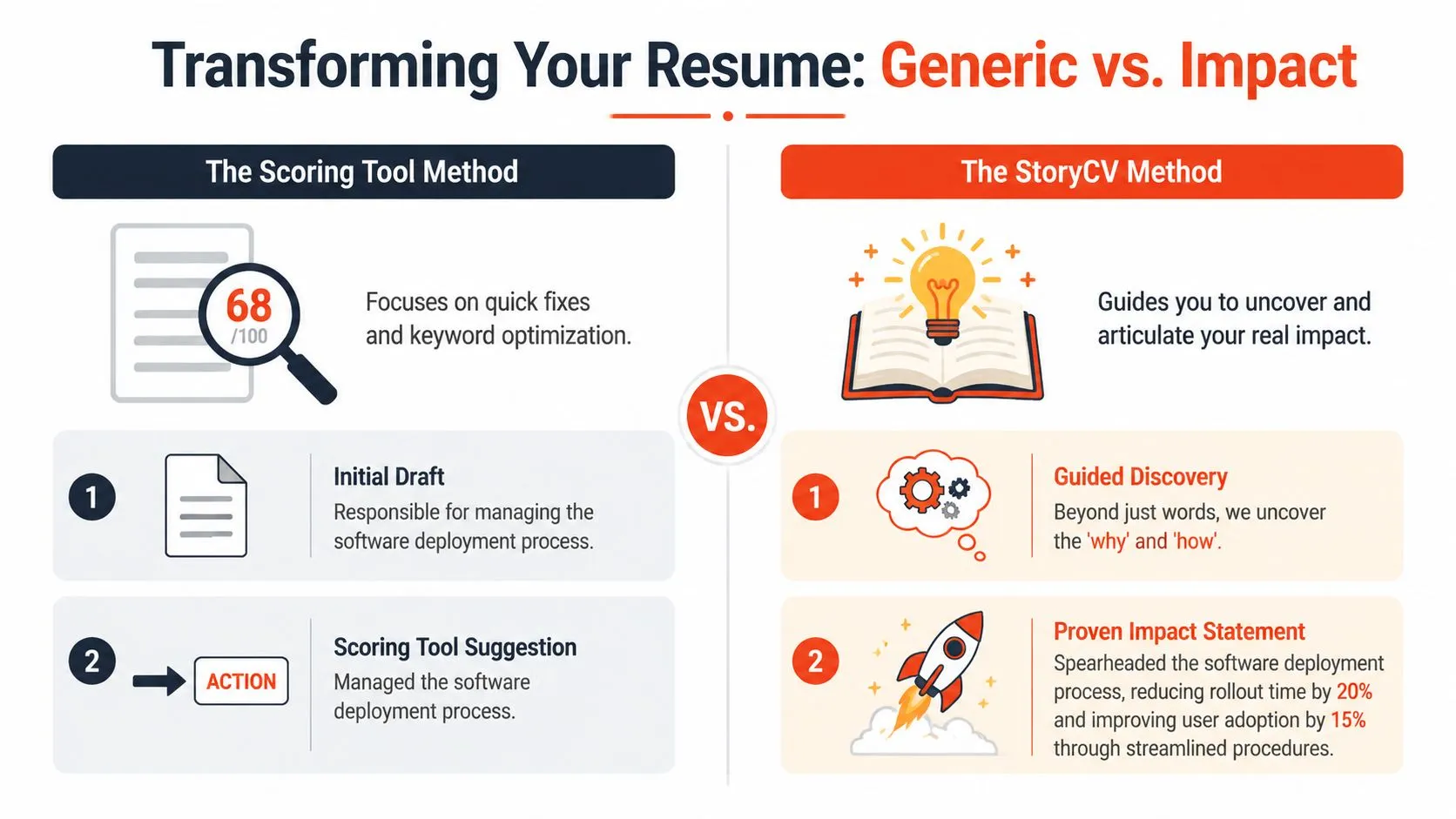
You start with a line that shows up on thousands of resumes:
Responsible for managing the software deployment process.
A scoring-first tool sees a weak bullet. Fair. It suggests stronger phrasing, maybe a cleaner verb, maybe some keyword alignment. The edited version becomes:
Led software deployment processes globally.
The sentence looks improved. The meaning hasn't moved.
Why generic edits fail
The problem with generic edits isn't that they're false. It's that they're empty.
A hiring manager reads "Led software deployment processes globally" and still doesn't know:
-
What was broken
-
What you changed
-
Why it mattered
-
Whether the work had any real stakes
That's why result statements matter. The absence of result statements is a deal-breaker for 34% of recruiters, according to Flair HR's resume statistics roundup.
So the issue isn't "Did you use a stronger action verb?"
It's "Did you prove anything?"
The stronger version starts before the sentence
Once the process asks better questions, the bullet gets specific fast.
Maybe the old system crashed for four hours on every release. Maybe rollback was chaotic. Maybe engineering had normalized failure because nobody had fixed the release path properly.
Then the rewritten bullet becomes:
Re-engineered a fragmented deployment pipeline to eliminate a recurring 4-hour system downtime baseline, achieving 99.9% release stability across consecutive product cycles.
Now the reader can infer something useful. You handled risk. You improved reliability. You changed an operating condition, not just a sentence.
Practical rule: If a bullet could describe ten different jobs equally well, it's not an achievement. It's wallpaper.
This is the same reason good visual storytelling works better than generic slides. Shape matters, but sequence matters more. If you create hiring content or portfolio narratives, this guide to AI carousel content creation is useful for the same reason. It focuses on narrative flow, not empty decoration.
A better test than any score
Ask three questions about every bullet:
| Test | Weak bullet | Strong bullet |
|---|---|---|
| Does it show a problem? | No | Yes |
| Does it show your decision or action? | Barely | Clearly |
| Does it show a result someone can care about? | No | Yes |
That's the whole game. Not prettier wording. Not a better grade. Evidence.
Choosing Your Path Cost and Commitment
Cost matters. Commitment matters more.
These tools are charging you for different kinds of work. Resume Worded charges for feedback on what already exists. StoryCV charges for helping you get the raw material out of your head and onto the page in a form that conveys a message.
That difference decides the better buy.
Use Resume Worded if the story already exists
Resume Worded is a finishing tool. Use it if you already have a draft with real substance and you want a last pass on phrasing, keyword alignment, or obvious gaps.
A grader makes sense in a narrow window:
-
Your draft is basically done
-
Your wins are already clear
-
You want a final check against a target role
That is a valid use case. It is not a resume strategy. Paying for scores before you've written anything worth scoring is backwards.
Use StoryCV if you're still translating your experience
A blank page is not a formatting problem. It is a thinking problem.
If you're changing careers, stepping up to senior roles, or struggling to turn messy real work into strong bullets, the useful question is not "How did this score?" The useful question is "What did I change, fix, build, or improve?"
StoryCV fits that earlier stage. It uses guided prompts to pull out decisions, constraints, and outcomes so you can write from evidence instead of recycling template language. That takes more effort than pasting a draft into a grader. It also produces better material.
Pick based on effort tolerance
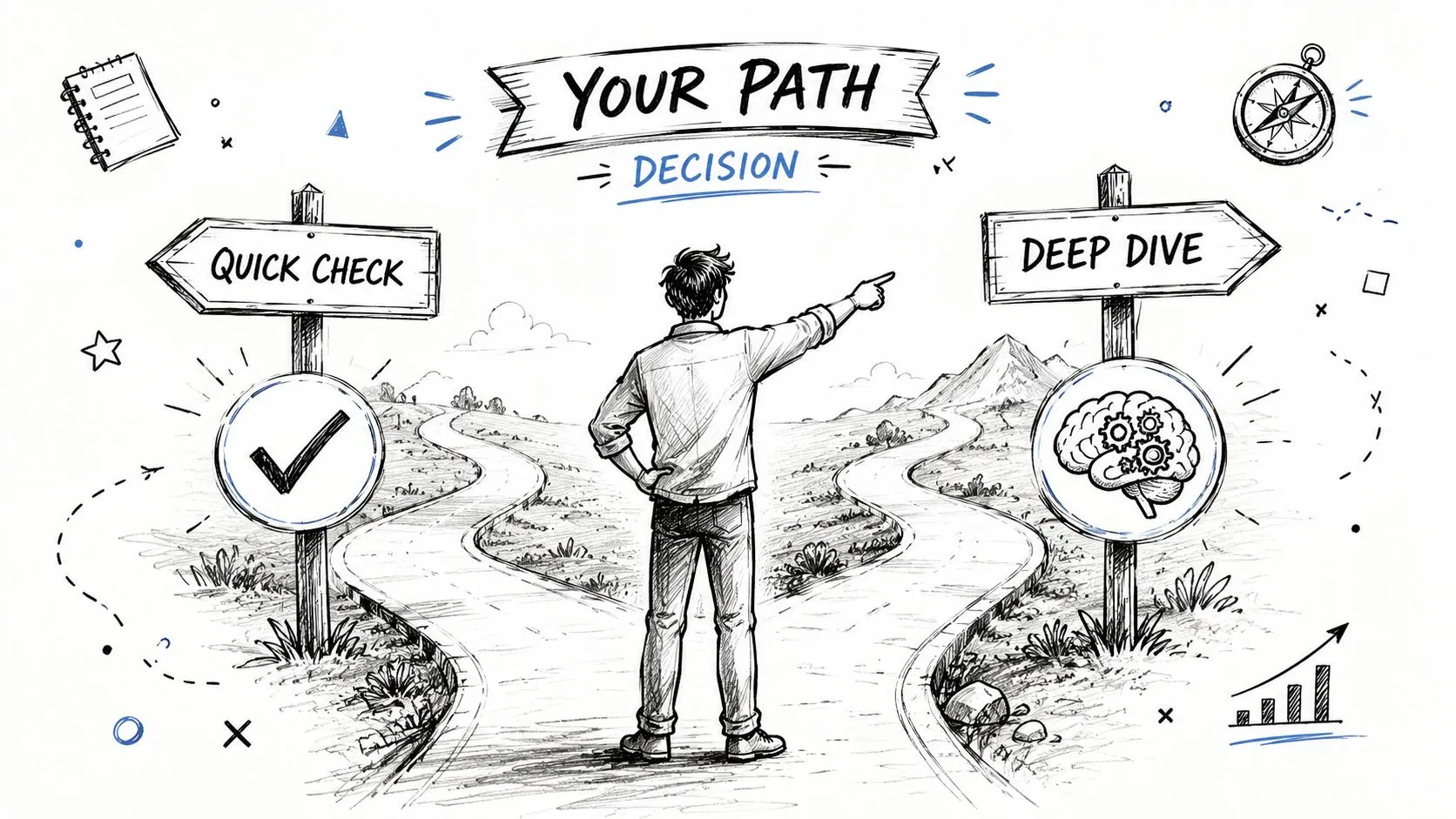
If you want a quick audit, use the grader.
If you want a better resume, expect to do deeper work.
That is the tradeoff. Speed versus extraction. Light editing versus actual interpretation. One path is cheaper in effort upfront. The other gives you a document with a point of view.
The same logic applies after the resume is done. Getting interviews often requires direct outreach, not just portal submissions. EmailScout's cold email job guide is useful for that step because it deals with contact strategy, not resume cosmetics.
My recommendation
Do not pay to be graded on vague bullets.
If your draft already tells a sharp, specific story, a scoring tool can help tighten the packaging. If it does not, start with the tool that helps you uncover what your work meant. That takes more commitment, but at least you're paying to solve the core problem.
Grade Your Past or Write Your Future
Most resume software sells relief. Paste. scan. improve. done.
The problem is that the easiest workflow often produces the weakest document. It rewards compliance. Not insight. You end up with a resume that looks clean, says the expected things, and disappears into the pile because it never gave a human reader a reason to care.
That's why I don't buy the score obsession. A computer doesn't hire you. A person does. The software can help with packaging, but packaging isn't the product. Your judgment, your trade-offs, your wins under pressure, that's the product.
If your resume only gets better when a grader approves it, you still don't control your own story.
There are useful supporting tactics around the resume too. If you're reaching out directly instead of waiting on portals, EmailScout's cold email job guide is worth a read because it deals with the next step after the document exists. Getting seen still matters.
My opinion is blunt. If you're deciding between StoryCV and Resume Worded, start by asking whether your draft is already telling the truth in a compelling way. If the answer is no, scoring is a side quest.
Build the substance first. Then polish it.
Resume Worded grades the words you already wrote. StoryCV helps you figure out if you're telling the right story in the first place.
If you're tired of editing around the underlying problem, try StoryCV. It helps you turn messy experience into a clear resume draft by guiding you through the thinking first, then shaping the writing.