You send out applications. You know you're a good fit. Then… silence. The void. You start to question your skills. But the problem isn't you. It’s your method. Your resume is getting lost in a digital traffic jam.
Your Resume Isn't Reaching a Human
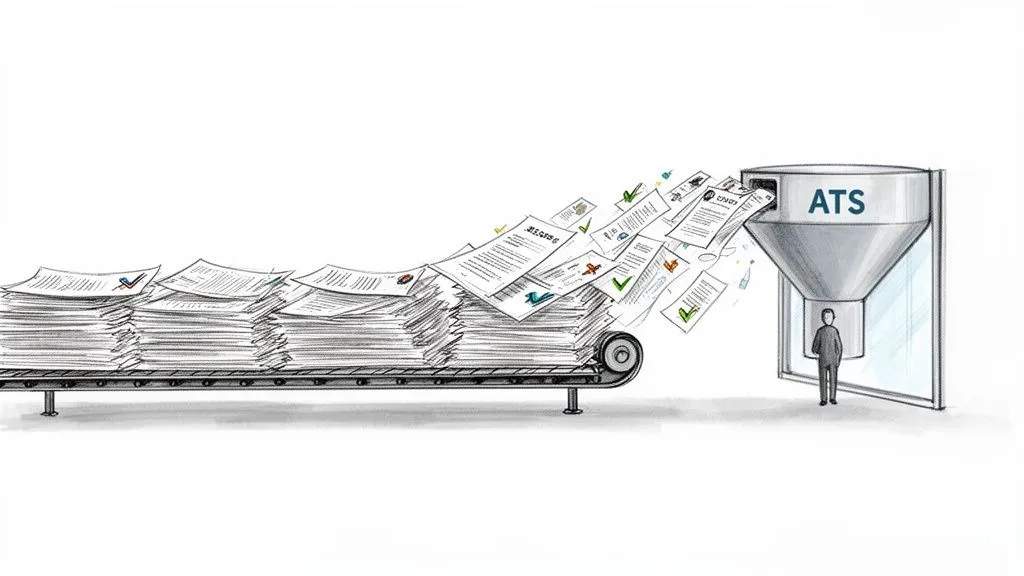
Here's the hard truth: most applications are never seen by a person. They’re automatically rejected by software called an Applicant Tracking System (ATS).
Think of the ATS as a club bouncer. It has a list. If your resume's content and format aren't on it, you're not getting in. These systems are the gatekeepers. They exist to manage the flood of resumes recruiters get every day.
The Numbers Don’t Lie
The data is brutal. The average applicant-to-interview ratio is just 3%. For every 100 people who apply, only three get a call.
Worse, 50% of all applications are never seen by a recruiter at all. They’re lost in the noise or rejected by the ATS.
The game has changed. Your first obstacle isn’t a hiring manager. It’s a machine. The ATS scans for specific keywords and needs a clean format. Fancy layouts, columns, and graphics look good to you, but they crash the system. Instant rejection.
Your first battle isn’t proving your skills to a human. It's proving your relevance to an algorithm.
Why Your Resume Gets Stuck
Why does your resume get filtered out? It's usually one of these mistakes:
- Complex Formatting: You used tables, columns, or graphics the ATS can't read.
- Keyword Mismatch: Your resume doesn't use the specific words from the job description.
- Vague Language: You describe duties ("responsible for…") instead of results.
The old strategy of one "master" resume is broken. To get interviews, your resume must be built to pass these digital filters. Check out our deep dive on how the ATS filter impacts your job search. A new approach is essential.
You Are Describing Duties, Not Showing Impact
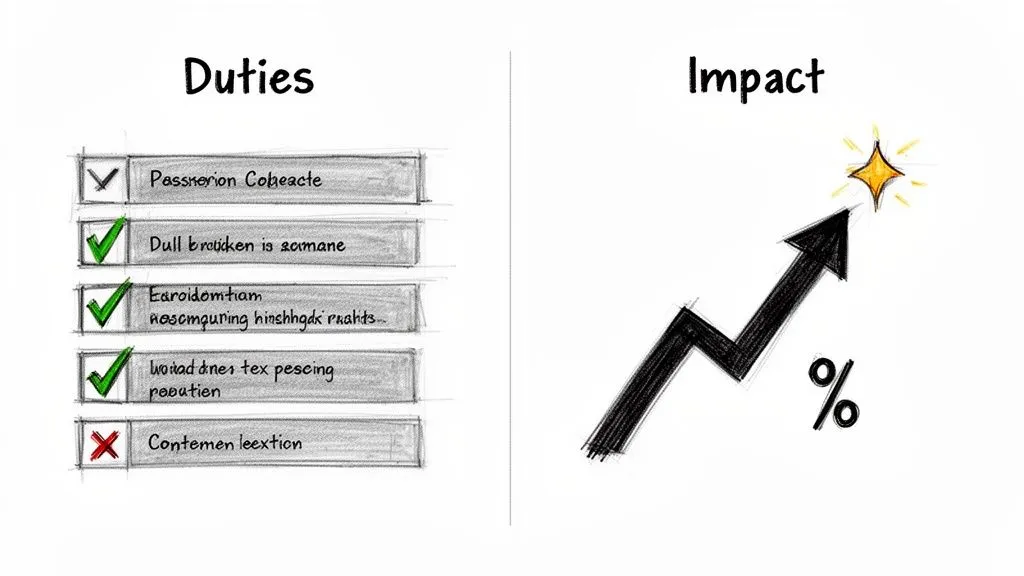
Okay, your resume made it past the bots. Now for the human test. A recruiter will give it about seven seconds.
They are not looking for your job responsibilities. They don't care what you were "responsible for."
They want to know what you achieved.
This is the most common mistake qualified people make. They turn their resume into a generic checklist. "Managed social media accounts" or "Handled client communications" says nothing about the value you delivered.
From Passive Duty To Active Impact
The fix is a simple shift. Stop talking about what you did. Start showing what happened because you did it. Every bullet point must answer, "So what?"
A duty is the job description. An impact is the story of your success. Which one does a hiring manager want to read?
Even the data agrees. A 2025 study from HiringThing found candidates are 2.6% more likely to accept offers when the interview process focuses on skills. Everyone wants to know what you can actually do.
'Responsible for team management' is a task. 'Led a team of 8 through product launch, reducing time-to-market by 30%' is a result. One gets ignored; the other gets an interview.
How To Frame Your Achievements
Turning a duty into an achievement is easy. Use a simple formula: Action + Metric + Outcome.
You did [X Action] which resulted in [Y Metric-Driven Outcome].
Don't worry if your role isn't tied to sales. You can always quantify your impact. Think in terms of time saved, processes improved, or customer satisfaction boosted.
Duty vs. Impact: Before and After
See the difference between passive tasks and active, metric-driven results.
| Passive Duty (What to Avoid) | Impact Statement (What to Do) |
|---|---|
| Responsible for managing project budgets. | Managed a $2M project budget, reallocating funds to reduce costs by 15% while meeting all key deadlines. |
| Wrote blog posts for the company website. | Authored 20+ SEO-focused articles that increased organic traffic by 40% in six months. |
| Handled customer support tickets. | Resolved 50+ customer tickets daily, improving the team’s average response time by 25% and boosting CSAT scores by 10%. |
This is the core of a resume that lands interviews. It proves you're a problem-solver, not just someone who ticks boxes.
If you're stuck, learn more about how to write achievements in your resume and make your value impossible to ignore.
Your Resume Is Not Optimized For AI Screeners
Let's be blunt. A human probably isn't the first to read your resume. An AI is. Ignoring this is a big reason you're not getting interviews.
Most companies use an Applicant Tracking System (ATS) to sort applications. This software is a gatekeeper. It scans for keywords, skills, and formatting. If the machine can't read your document, you're out. Simple as that.
Think of it this way: your resume is a message. If you write it in a code the ATS bot can't read, the message gets tossed. It doesn't matter how qualified you are.
How To Get Past The Robots
Beating the ATS isn't about keyword-stuffing. It's about structure and simplicity. The goal is to frame your impact in a way the machine can understand.
Focus on clean, logical formatting. This means ditching the things you think make a resume look "designed."
- Tables and Columns: These are resume killers. An ATS reads left to right, top to bottom. Columns scramble your information.
- Fancy Fonts and Graphics: Stick to standard fonts like Arial or Calibri. Logos, photos, and skill-rating bars are unreadable.
- Complex Headers and Footers: Information here can be ignored. Keep your contact info in the main body.
Your resume has two audiences: the machine and the human. Impress the machine first to earn a chance to impress the human. Forget fancy design; clarity is your only goal.
This doesn't mean your resume has to be boring. It means it has to be functional. A clean, single-column layout ensures your achievements are seen.
Simple Fixes For Better ATS Performance
Optimize for AI by stripping away the noise. A minimalist approach works best.
- Use Standard Section Headings: Don't get creative. Stick to "Professional Experience," "Education," and "Skills." The ATS is programmed to look for these.
- Mirror Keywords From The Job Description: Read the job post. Find the key skills. Weave those exact phrases into your impact statements. If they need "project management," make sure that term appears.
- Save as a .docx or .pdf: A .docx file is often the safest bet for ATS compatibility. Some older systems struggle with PDFs. Have both versions ready.
This clean framework gets you past the gatekeeper. Your accomplishments finally take center stage and land in the hands of a human.
You Are Applying For The Wrong Jobs
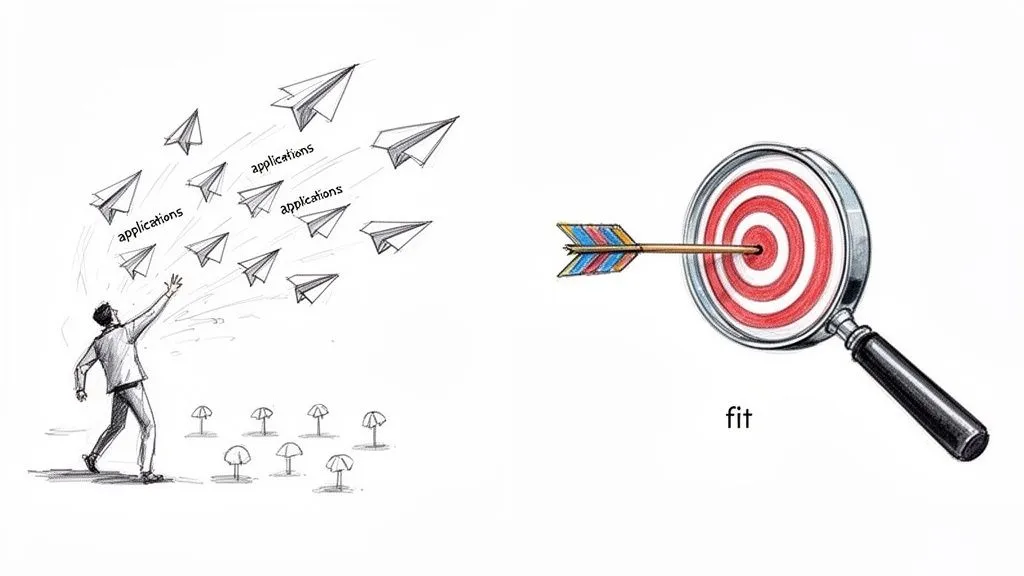
It feels productive, right? Firing off dozens of applications a day. But that "spray and pray" method is a huge reason you’re not getting interviews. It’s a fast track to burnout.
If you’re applying to everything, your application is generic. Recruiters can spot it a mile away. It says you’re not invested in their company or this role.
Most jobs attract 250 applications. Without focus, you’re just another number. Quality smashes quantity every time. Three highly targeted applications are better than 30 generic ones.
How To Read A Job Description
Stop seeing job descriptions as wish lists. They are problem statements. The company has a problem; they’re hiring someone to fix it. Your job is to prove you are the solution.
Dissect the job description to find the 3-5 core requirements. These are the non-negotiables. They’re often prefaced with "The ideal candidate will have..." or listed first under "Responsibilities."
Once you find them, your entire application must prove you meet them.
Stop applying for jobs. Start solving problems. Your application isn't your life story. It's proof you can solve their immediate pain points.
This mindset shift changes everything. You become the perfect specialist for that role.
The Litmus Test For Job Fit
Before you apply, ask yourself these questions. Be honest.
- Can I prove I meet at least 70% of the core requirements? You don’t need 100%, but you have to be close on what matters.
- Do my impact statements address their biggest problems? If they need to boost user engagement, your resume better have a metric showing you did that.
- Am I genuinely interested in what this company does? You can't fake enthusiasm. If you don't care, it shows.
This is about focusing your energy where it gets a response. Applying for the wrong jobs is a waste of time. When you target roles that are a real fit, you stop asking "why am I not getting job interviews?"
Your Online Presence Raises Red Flags
The recruiter likes your resume. What's next? They Google you.
And just like that, your application is dead. Not because of your resume, but because of what they found—or didn't find—online.
Your application doesn't stop at the PDF. An incomplete or unprofessional online presence is a massive red flag. A blurry photo or a profile that contradicts your resume screams one thing: you’re not taking this seriously.
You're failing the informal background check every recruiter runs. Your digital footprint must tell the same powerful story as your resume. It should reinforce your expertise, not create doubt.
What Recruiters See
Your professional profile is the trailer for your career. If it's a mess, no one will watch the movie. A sloppy digital brand is worse than no brand at all. It signals a lack of attention to detail.
Your online presence is not a separate thing. It's the verification of your resume. Recruiters look for consistency and proof of your claims.
This isn't about being an "influencer." It's basic professional hygiene. You have to control the narrative. You can make your online reputation more hire-worthy and present a polished, coherent image.
A No-Nonsense Digital Audit
Go through this quick checklist right now.
- Is your profile complete? An empty "About" section is a wasted opportunity. Fill out every section with the same impact-driven language from your resume.
- Does your headline sell you? Don't just say "Marketing Manager." Try "Marketing Manager Driving Growth with Data-Driven B2B Strategies."
- Do your profile and resume match? Dates, titles, and accomplishments must be identical. Any discrepancy kills trust.
- Are you sharing relevant content? Occasionally sharing an industry article shows you're engaged.
- Is your photo professional? No party pictures. No blurry selfies. A clean headshot is non-negotiable.
A strong online presence gives recruiters the confidence to call. It proves you manage your professional brand with intention.
The Fix: A Narrative-First Resume Strategy
Enough with the problems. Let's talk about the solution. Stop filling out soul-crushing templates. Start telling your story.
Every problem we've covered—getting past AI, proving impact, targeting jobs, fixing your online profile—boils down to one thing. You need a clear, powerful narrative. A resume isn't data entry. It's storytelling.
The fix is a narrative-first strategy. Don't start with a blank document. Start by answering simple questions, the kind you’d get in an interview, to uncover your real achievements.
Building Your Core Story
This approach builds a foundational narrative for your resume, professional profile, and interviews. It’s all about articulating the context of your work, the challenge you faced, the action you took, and the result you delivered.
When you focus on the story first, the keywords and formatting fall into place. You’re no longer gaming a system. You’re communicating your value with clarity.
You are not a list of duties. You are a collection of achievements. Stop documenting tasks and start narrating your impact.
A Digital Resume Writer guides you through this. It acts like a partner, asking the right questions to pull out the metrics you’ve overlooked. It helps you turn vague responsibilities into compelling proof. If you're struggling, our guide on crafting my perfect resume is a great place to start.
This concept map shows how a strong resume narrative becomes the bedrock for your entire professional brand.
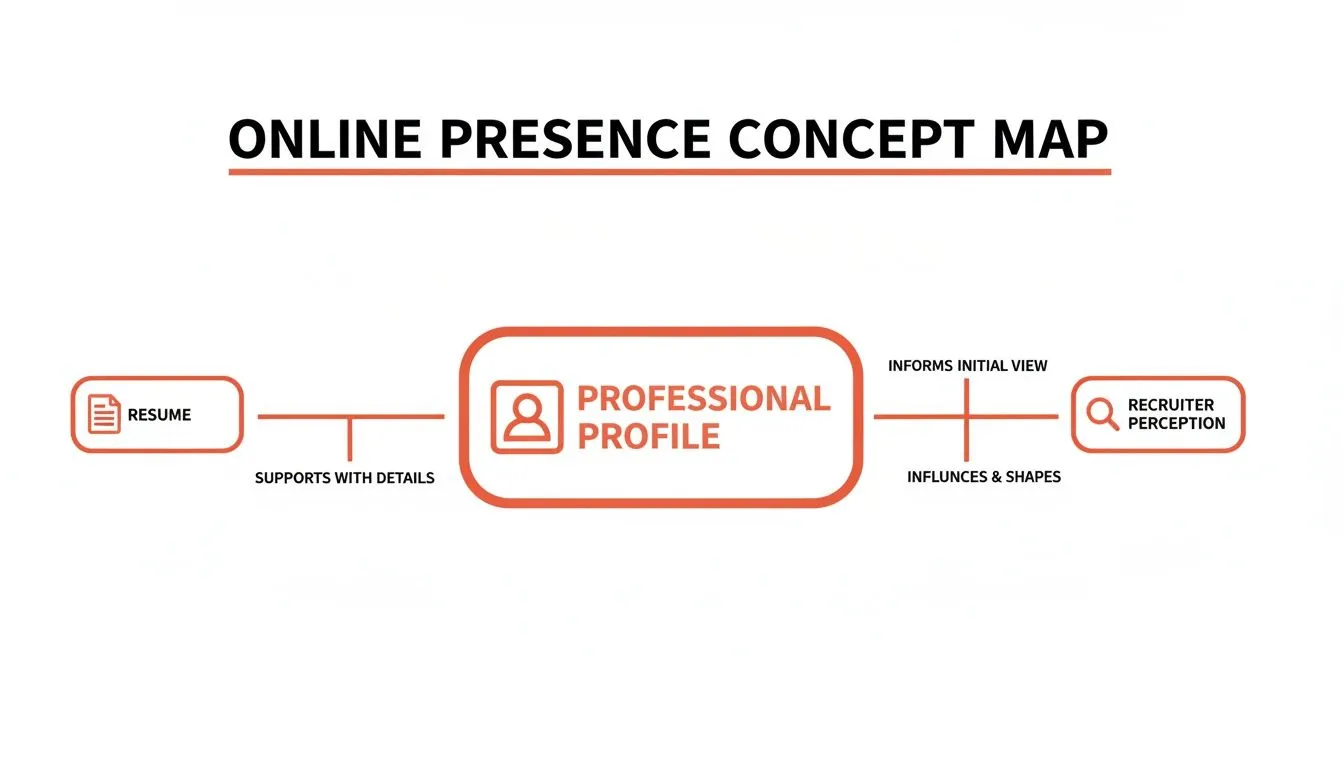
As you can see, your resume isn't an island. It's the engine that powers your professional profile, which influences a recruiter's decision to call you. A weak narrative breaks the chain.
Benefits of a Narrative-First Approach
This strategy is a fundamental shift. It inherently solves the problems that lead to silence.
- It’s AI and Human-Friendly: A clear story naturally contains keywords but is written to compel a human.
- It Forces Good Targeting: You can't build an authentic narrative for a job you don't fit. It forces you to focus on roles where your story aligns with their needs.
- It Powers Your Entire Presence: The impact statements you create are building blocks for your professional profile, interview answers, and networking conversations.
Stop asking, "why am I not getting job interviews?" and start telling a story that makes them call.
Your Toughest Job Search Questions, Answered
Let's tackle the most frustrating questions. No fluff, just direct answers.
How Many Applications Should It Take to Get an Interview?
Forget a magic number. It's about quality, not quantity. If you’ve sent 50+ truly targeted applications and hear nothing, stop. It's time to diagnose the problem.
Firing off hundreds of generic resumes gets you ignored. You're better off sending 3-5 incredible, relevant applications a week.
Could I Be Overqualified for the Jobs I’m Applying For?
Yes. It’s a classic reason for rejection. Hiring managers see an overqualified hire as a flight risk. They worry you’ll get bored, ask for too much money, or leave when a better role appears.
If you’re aiming for a role that seems like a step back, you have to explain why. Use your cover letter to state exactly why this specific role fits your career goals right now.
An overqualified candidate looks like a risk. Don't make the recruiter guess your motives—spell out your "why."
Why Am I Not Getting Interviews, Even When I'm a Perfect Match?
It’s maddening. You check every box, but your inbox is empty. Being a "perfect match" on paper isn't always enough. The silence could be due to things you can't control:
- Bad Timing: The role was filled internally or put on hold.
- Fierce Competition: Another "perfect match" applied first or had a referral.
- Hidden Biases: Unconscious bias is a real factor. Understanding what is interview bias can shine a light on subtle hurdles.
Don't let it get you down. If your strategy is solid and your narrative is compelling, keep going. Persistence is key.
Stop getting lost in the resume black hole. StoryCV is a Digital Resume Writer that interviews you to uncover your real impact. We help you build a compelling narrative that gets you noticed by recruiters and lands you the interviews you deserve. Tell your first career story for free.