Most advice on affiliations on resume gets the job wrong.
It treats affiliations like admin. Add a section. List some memberships. Move on.
Bad advice.
A weak affiliations section is dead weight. A strong one does something your skills list can't. It shows you're active in your field, visible to the right people, and trusted outside your job title.
That is the primary use. Not name-dropping. Not decoration. Signal.
Your Resume's Most Wasted Section
The affiliations section is usually a graveyard of lazy lines.
Member, XYZ Association.
Member, ABC Network.
Member since 2019.
None of that helps.
A recruiter isn't impressed because you paid dues. They care whether the affiliation changes how they see you. Does it make you more credible? More connected? More relevant? More memorable?
Most resumes fail that test.
Membership is cheap. Proof is not.
The problem isn't the section itself. The problem is how people use it.
They treat affiliations like background information. But this space can carry real weight when it shows:
- Professional credibility in your target field
- Visible participation beyond your day job
- Community leadership that signals influence
- Industry engagement that makes you easier to trust
If your resume already says what you did at work, affiliations should show what you chose to do outside the minimum.
That matters.
A hiring manager can teach a new process. It's harder to teach curiosity, professional presence, or initiative.
Most candidates list what they belonged to. Better candidates show what they built, led, or contributed to.
Why this section changes the read of your whole resume
A smart affiliation line can shift the narrative.
It can tell a recruiter you're not isolated inside one company. You're in the room. You know the language of the field. You contribute. People know your name.
That's powerful because resumes are pattern recognition devices. One strong signal changes how the rest gets interpreted.
A bland work history plus active industry involvement feels different from a bland work history alone.
So stop asking, “Should I include affiliations?”
Ask the only useful question.
What does this line prove?
Affiliations Are Proof Not a Shopping List
Here's the blunt version. An affiliation is only useful if it signals something valuable.
If it doesn't strengthen your candidacy, it doesn't belong.
That rule gets sharper when you remember how hiring operates. Between 70% and 85% of jobs are filled through personal and professional connections rather than public postings, according to this summary of hidden job market data. Affiliations matter because they can signal access to those networks. Not because they make your resume look busy.
Signal beats noise
This is the split.
Noise
- Member, Marketing Association
- Member, Local Tech Group
- Alumni Network Participant
Signal
- Led a panel for a regional marketing association on retention strategy
- Organized monthly product meetups with 150+ attendees
- Mentored early-career analysts through an alumni career network
One set says you joined. The other says you acted.
Recruiters don't care about passive belonging. They care about evidence that you're involved in your profession in a way that others can see and value.
What affiliations should communicate
A good affiliation line can do one or more of these jobs:
-
Confirm relevance
It tells the reader you operate inside the same professional ecosystem as the role. -
Show initiative
You didn't stop at your job description. -
Add social proof
You're visible to peers, organizers, or industry communities. -
Support career transitions
If your current title doesn't match your target role, affiliations can help bridge the story.
“Member of XYZ since 2018” is noise. “Active contributor, speaker, or committee member” is signal.
That's the standard.
The best affiliations are mini work samples
Treat them like proof of behavior.
If you chaired a committee, ran a meetup, mentored junior peers, reviewed portfolios, spoke on a panel, or helped plan an event, that's useful. It reveals how you show up when nobody is forcing you to.
That often says more than another generic bullet under your last job.
So don't build a shopping list of organizations. Build a case.
The 5-Second Test for Including an Affiliation
Your resume gets skimmed fast. Every line has to earn its spot.
Use this filter. If an affiliation survives it, keep it. If not, cut it.
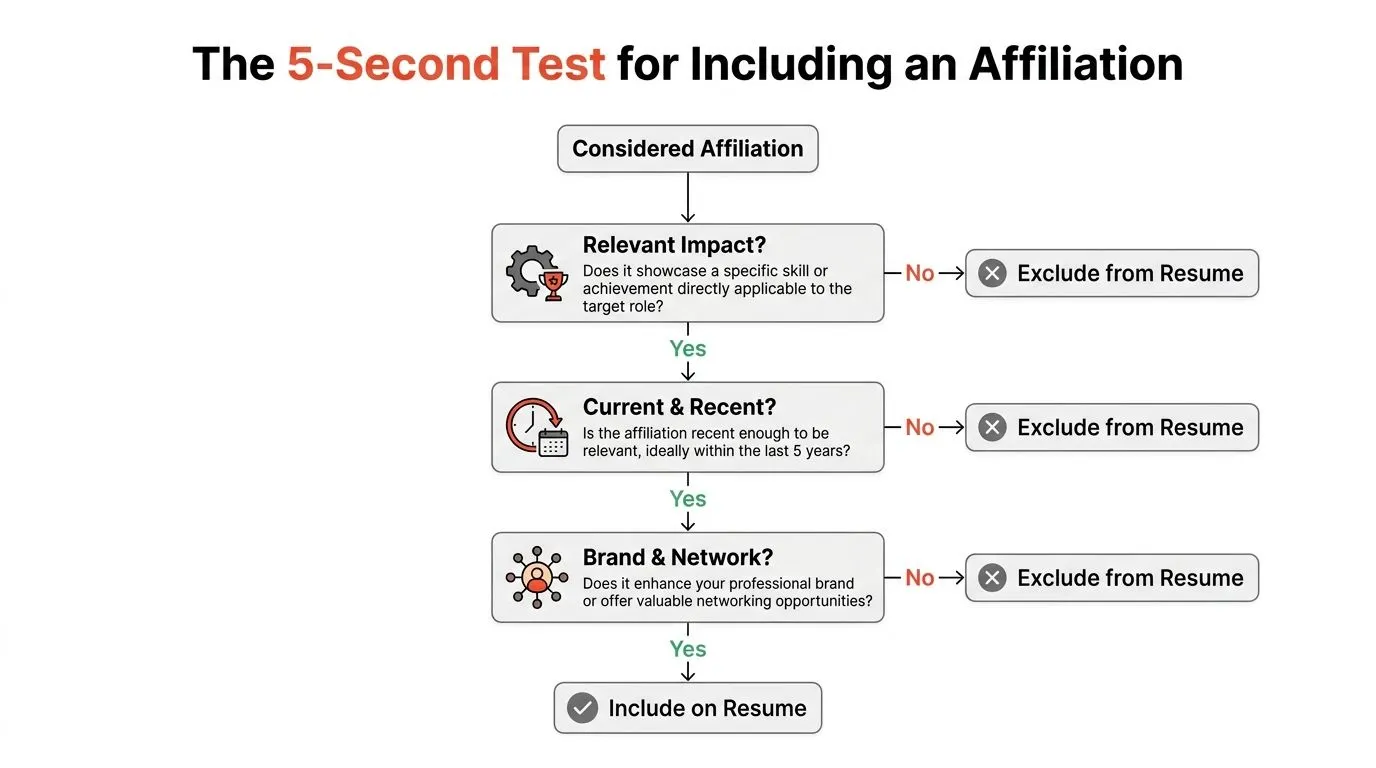
The three-question filter
-
Does it signal credibility for the job you want?
If you're applying for product roles, a product community can help. If you're applying for finance leadership, a random nonprofit club probably won't. -
Does it show activity, not just association?
Attended, joined, member. Weak verbs. Organized, mentored, spoke, led. Better. -
Would a recruiter care in five seconds?
If you need a paragraph of explanation, it probably doesn't belong.
What to cut fast
Some affiliations aren't bad. They're just irrelevant.
Cut these first:
- Old college clubs unless they're directly tied to your current target role
- Generic memberships with no visible contribution
- Personal cause groups that don't support the application
- Expired associations that create confusion instead of value
A resume isn't a biography. It's a selective argument.
What usually makes the cut
These affiliations tend to survive the filter:
| Type | Keep it when |
|---|---|
| Professional association | It reinforces domain credibility |
| Industry meetup or community | You had an active role or visible contribution |
| Alumni network | It directly supports networking or mentoring relevance |
| Board or committee role | You can describe scope and responsibility |
| Volunteer organization | It proves transferable skills tied to the target job |
A ruthless rule of thumb
If the line only says you existed near an organization, remove it.
If it shows contribution, leadership, credibility, or network relevance, keep it.
Practical rule: The best affiliation is one that would still be interesting if you removed the organization name and kept only what you did.
That forces honesty.
“Organized quarterly design critiques for senior UX peers” has value.
“Member, Design Association” mostly doesn't.
Where to Place Affiliations on Your Resume
People overcomplicate this. You have two real options.
Either give affiliations their own section, or fold them into experience. These are the only options.
Use a dedicated section when the affiliation acts like a credential
This works when the name itself carries weight.
Think:
- Project Management Institute (PMI)
- Society for Human Resource Management (SHRM)
- Institute of Electrical and Electronics Engineers (IEEE)
- American Marketing Association (AMA)
In that case, a clean section near the bottom is fine. Use a standard heading like Professional Affiliations or Memberships.
Keep it tidy. Full name first. Acronym in parentheses if useful.
Integrate it into experience when it tells a story
If the value is in what you did, don't bury it in a separate list.
Put it where recruiters already pay attention. Inside your experience bullets. Or under a short project or leadership subsection.
Example:
Weak
- Professional Affiliations: Product Collective, Member
Better
- Organized monthly product meetups featuring startup operators and cross-functional leaders
The second version reads like evidence, not paperwork.
My opinion
If the affiliation is mostly a label, list it cleanly.
If the affiliation has action, scope, and outcome, weave it into the body of the resume.
That's the rule. Story goes in experience. Credential goes in a section.
One more thing. Don't create a section just to fill space. One excellent line inside your experience is stronger than four weak memberships at the bottom.
How to Write Affiliations That Show Impact
Many resumes fall short at this stage. The writing is passive.
“Member of…”
“Affiliated with…”
“Participated in…”
Dead language. No energy. No proof.
Write affiliations the same way you write strong work experience. Use action + scope + outcome.
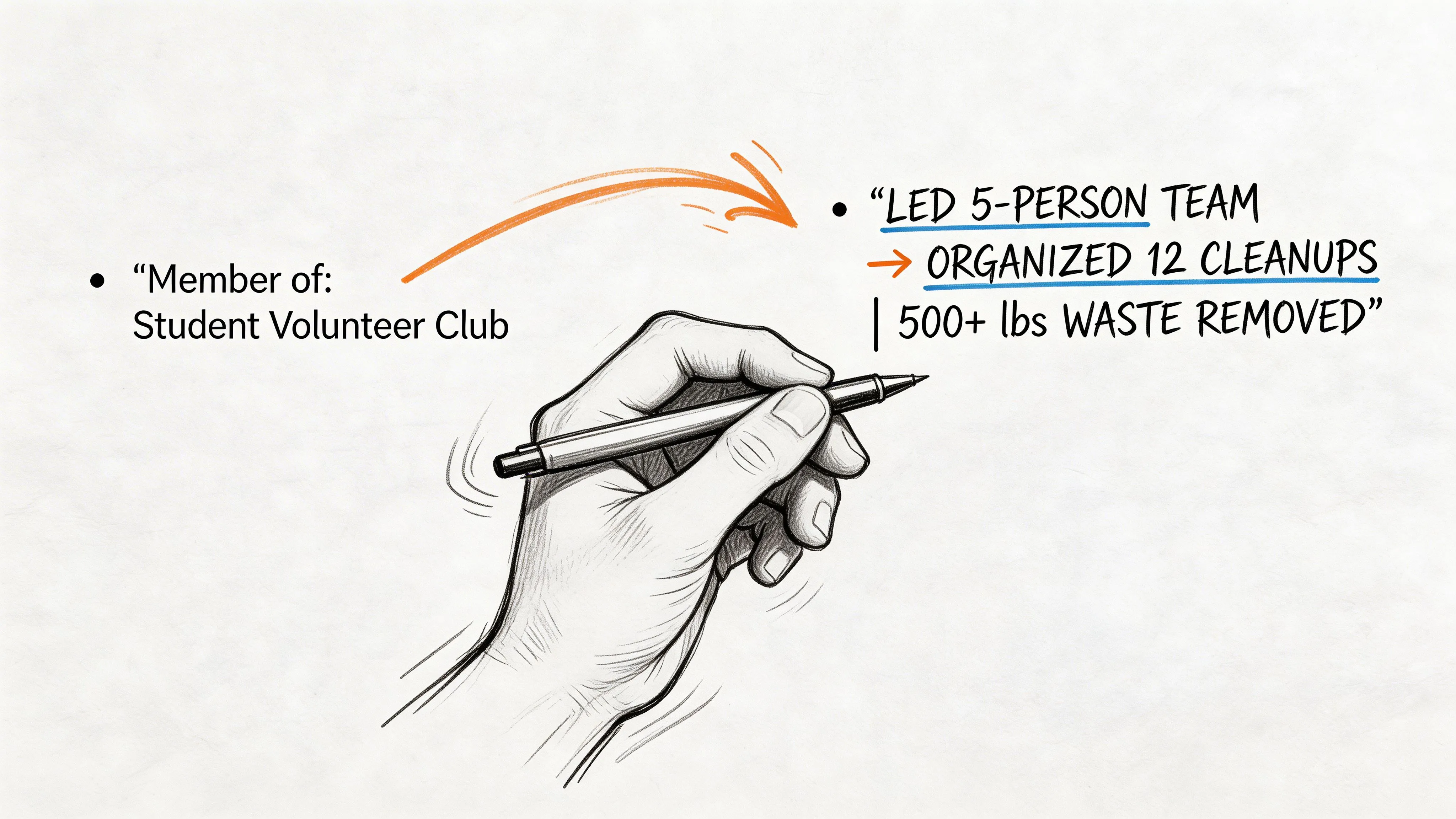
The formula
Action
What did you do?
Scope
How big was it? Team, audience, frequency, responsibility.
Outcome
What changed because of your involvement?
That structure works because it forces you out of label mode and into evidence mode.
Before and after examples
Before
- Member, Marketing Association
After
- Led a 5-member committee to organize quarterly industry events, increasing average attendance from 60 to 180+ professionals
Before
- Volunteer organizer for a regional product meetup
After
- Organized monthly product meetups with 150+ attendees, featuring speakers from top startups
Before
- Mentor, professional design network
After
- Mentored 10+ early-career designers through a professional network, helping 6 secure full-time roles within 6 months
Those lines work because they read like contribution, not affiliation.
What counts as an outcome
People get stuck here because they think outcomes must mean revenue.
Wrong.
For affiliations, useful outcomes include:
- Attendance growth
- Event reach
- Mentoring results
- Community engagement
- Program launch
- Speaker quality
- Committee output
- Member participation
If you need help getting better at evidence-based writing, StoryCV's guide on how to use metrics in your resume is worth reading.
Small role, strong line
You don't need a board seat for this to work.
Even modest involvement can become strong resume material if the writing is specific.
“Belonging” is not impressive. Participating is.
That same rule applies to adjacent sections too. If you're also deciding what recognition belongs on the page, this guide to awards to put on your resume is useful because it follows the same idea. Keep what adds proof. Cut what adds clutter.
A simple rewrite checklist
When you edit your affiliations, ask:
-
What verb opens the line?
If it's passive, rewrite it. -
Can I show scope?
Team size, audience, cadence, responsibility. -
Is there a visible result?
Even a soft outcome beats none. -
Would this still sound good without the organization name?
If not, the name is doing too much work.
The best affiliations on resume don't say, “I joined.”
They say, “I contributed.”
Real-World Examples for Every Career Stage
Theory is cheap. Good examples provide practical application.
Here are three versions of affiliations on resume that prove helpful.
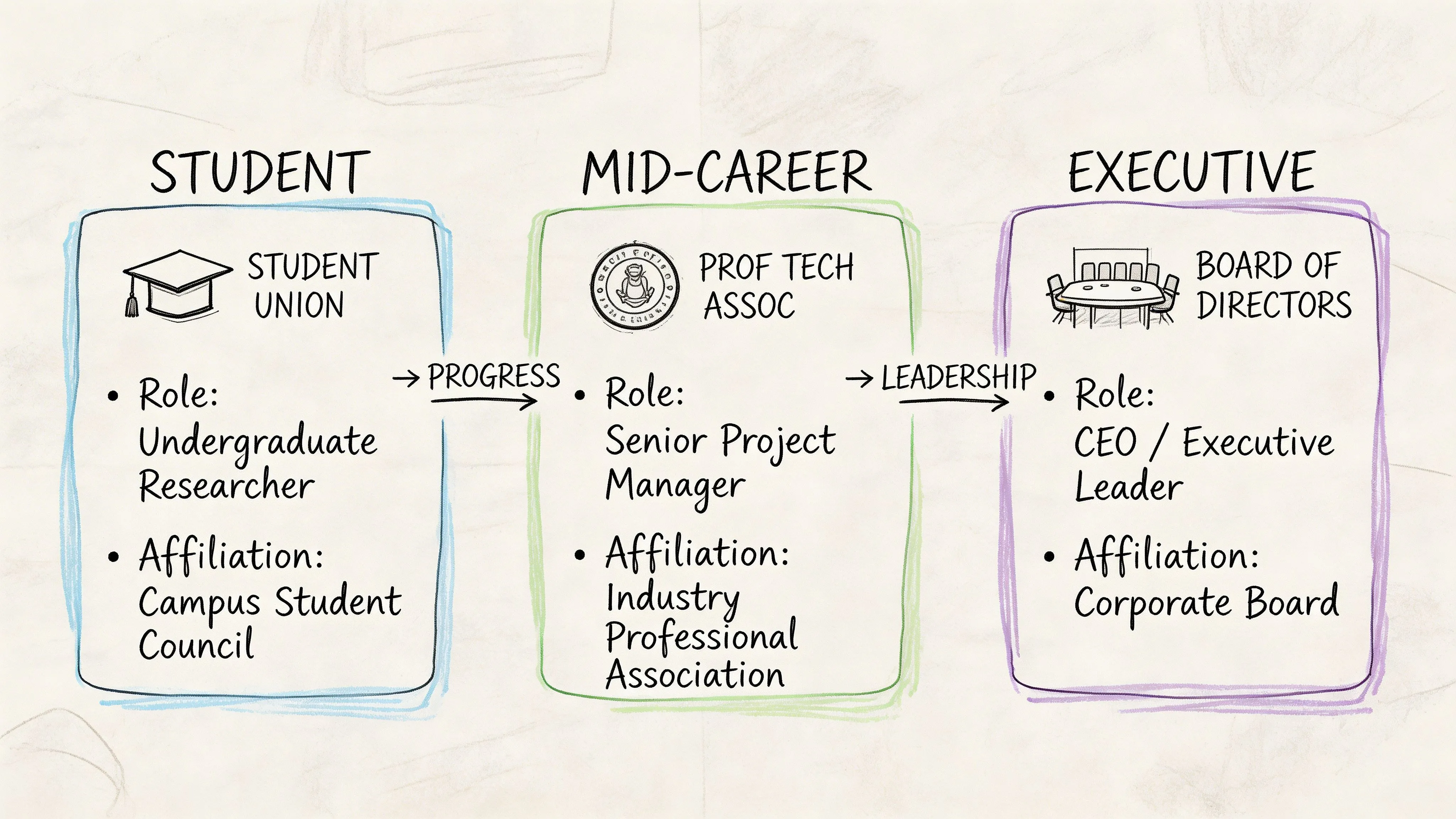
Student or early-career candidate
You probably don't have deep industry tenure yet. That's fine.
Your affiliations should prove initiative, teamwork, and real participation.
Weak
- Member, Finance Club
- Member, Women in Business
Better
- Coordinated employer-facing events for a campus finance club, helping connect students with alumni and local hiring teams
- Led outreach for a women in business event series, recruiting speakers and managing attendee communication
If you also have relevant community work, fold it into your narrative instead of hiding it. This guide on building a resume with volunteer work shows how to do that without making it feel like filler.
Mid-level professional
For mid-level professionals, affiliations can really sharpen your positioning.
You've already got work history. Now use affiliations to show you're active beyond your employer.
A product manager example:
Weak
- Volunteer organizer for a regional product meetup
Better
- Organized monthly product meetups with 150+ attendees, featuring speakers from top startups
Why it works:
- It shows leadership outside the job
- It places the candidate inside the product community
- It makes the person easier to remember
A recruiter once mentioned that exact kind of line in an interview because it made the candidate stand out. Not because the role was huge. Because it was visible and specific.
Career changer
This group needs affiliations most strategically.
If you're moving into a new field, affiliations can prove commitment before your title catches up.
Say you're moving from operations into UX.
Weak
- Member, UX community
- Volunteer, design network
Better
- Facilitated peer portfolio reviews through a UX community, giving structured feedback to career switchers and junior designers
- Coordinated virtual design discussions on accessibility and user flows, building visible involvement in the UX field
That works because it bridges the gap. You're not claiming a new identity out of thin air. You're showing active participation in the target space.
The pattern across all three
Different stage. Same rule.
| Career stage | Best affiliation angle |
|---|---|
| Student | Initiative and practical involvement |
| Mid-level | Leadership and industry visibility |
| Career changer | Commitment and narrative bridge |
Use affiliations to answer the unspoken doubt.
For students, “Have they done anything real yet?”
For professionals, “Are they visible beyond one company?”
For career changers, “Are they serious about this move?”
A strong line answers without begging.
Your Smart Strategy for Affiliations and the ATS
ATS advice is full of nonsense. Most of it confuses gaming with clarity.
You don't need tricks. You need clean structure.
In 2024, 98.4% of Fortune 500 companies use Applicant Tracking Systems, according to LockedIn AI's resume affiliations guide. So yes, your affiliations need to be readable by software. But the fix is boring and effective.
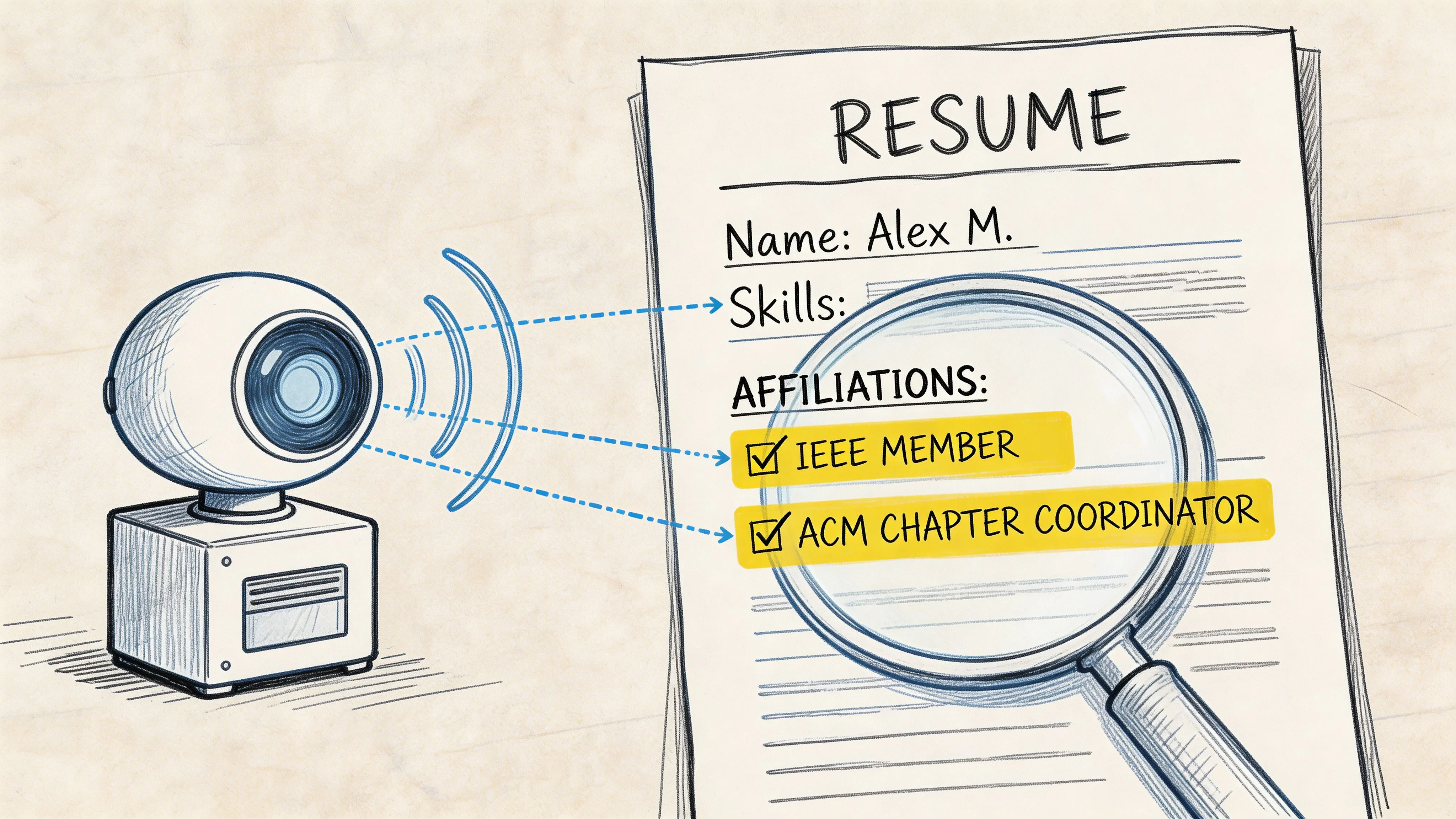
What to do
-
Use standard headings
Professional Affiliations. Memberships. Professional Development. -
Write full names first
Project Management Institute (PMI), not just PMI. -
Keep formatting plain
No logos. No text boxes. No fancy sidebars. -
Match language to the role
If the job description names an organization, certification body, or industry group you belong to, include the proper wording naturally.
If you're tailoring each application anyway, this guide on tailoring resume to job description is the right companion move.
What not to do
Don't stuff acronyms. Don't create a junk section full of barely related associations. Don't write for bots and forget humans.
ATS-friendly writing is just structured writing.
The same logic applies to the rest of your professional brand. If you want the profile version of this cleanup, this piece on how to optimize your LinkedIn profile for career growth is useful, especially if your resume and public profile are telling slightly different stories.
A clear resume parses better because it's clear. That's the whole game.
Frequently Asked Questions About Resume Affiliations
Some affiliations help. Some create risk. You need judgment.
Should you include political or religious affiliations
Usually, no.
They rarely strengthen your candidacy. More often, they distract or trigger unnecessary bias. Keep them off the resume unless they're directly relevant to the role or organization.
What about affiliations that signal race, ethnicity, or origin
Be strategic.
A meta-analysis of 123 resume studies found that ethnic minorities receive about half as many callbacks, and research summarized by King's College London notes that removing ethnic cues from resumes can double callbacks in some cases. That's why affiliations that strongly signal race or origin need careful handling, especially if they don't directly strengthen the application. See the King's College London summary of resume bias research.
That doesn't mean you should erase your identity by default. It means every line should earn its risk.
If an affiliation is relevant, frame the work, not just the label.
Safer
- Mentored early-career professionals through a leadership network
Riskier
- Member, identity-based association
The first centers contribution. The second centers a cue that may trigger bias before your value is understood.
Should you list expired memberships
Only if the work tied to them still matters.
If the membership expired and all you have is the label, cut it. If you led a committee, ran programs, or built something worth mentioning, keep the achievement and make the timeframe clear.
Do international applications change the approach
Yes.
Resume norms vary by market. In some places, affiliations help as credibility signals. In others, skills and direct experience carry more weight, and separate sections can feel less useful.
Keep the rule simple:
- Use affiliations when they clearly support the target role
- Focus on active contribution over identity signaling
- Adapt the framing to local norms instead of copying US-style resume habits blindly
For global applications, conservative framing usually wins. Clear work. Clear relevance. Low drama.
If your resume still sounds like a list of memberships instead of proof of value, StoryCV can help. It's a Digital Resume Writer that turns raw experience into sharp, credible narrative, so your resume says what matters and cuts what doesn't.