Your resume has a 'Skills' section. So does everyone else’s. It's a lazy list of keywords you hope an algorithm notices. It tells recruiters you know how to fill a box, not how to solve their problems.
You've built things, led teams, and solved complex problems. Your work is more than a jumble of jargon like 'Strategic Thinker' or 'Team Player.' The words you choose matter. A generic heading is a missed opportunity to frame your value. It’s time to kill the default 'Skills' section. Replace it with a heading that tells a story and frames your abilities with intent.
This isn't about finding a synonym. It's a strategic shift. While you're refining your resume, remember your professional presentation matters. A strong profile picture, like those from AI headshots for job seekers, can boost how recruiters perceive your credibility.
Let's look at eight powerful alternatives for "another word for skills on resume" that actually work. We’ll cover what each one says about you, who should use it, and how to implement it without the fluff.
1. Core Competencies
Tired of the generic "Skills" header? "Core Competencies" instantly shifts the perception from a simple list to a strategic showcase of your professional value. This title frames your skills as foundational, business-critical capabilities.
It suggests a deeper level of mastery. You're not just someone who has skills; you're an expert whose abilities are central to the role. This is powerful for experienced professionals who want to highlight deep knowledge over a scattered list of minor abilities.
Who Should Use It?
Mid-level to senior professionals, career changers, or anyone in fields like tech, finance, and operations where functional expertise is a primary hiring criterion.
Key Takeaway: "Core Competencies" tells a recruiter you're presenting the fundamental pillars of your professional capability.
How to Do It
Be selective. Avoid a laundry list of every tool you've ever touched.
- Focus on 5-8 key areas: Align them with the job description's requirements.
- Use industry language: Match the terminology used by employers to pass Applicant Tracking Systems (ATS).
- Order by relevance: Put the most critical competency first.
- Show proof: Ensure every competency is demonstrated with achievements in your work experience section.
For a deeper dive, our guide on what skills to put on a resume can help you identify your most valuable talents.
Examples:
-
For a Software Engineer:
- Core Competencies: System Design, Cloud Architecture (AWS, GCP), Python, Agile Methodologies, CI/CD Pipelines
-
For an Operations Manager:
- Core Competencies: Process Optimization, Supply Chain Management, Budget & P&L Oversight, Vendor Negotiation
2. Technical Skills
When your profession is defined by specific tools, platforms, or programming languages, "Technical Skills" is the most direct approach. It's a clear signpost for recruiters in tech, engineering, and data science, confirming you have the required hands-on capabilities.
"Technical Skills" is precise. It tells a hiring manager you can build, analyze, or manage their systems from day one. This section is your evidence that you speak the language of the role.
Who Should Use It?
Software developers, data scientists, engineers, IT support specialists, and cloud architects. If the job description lists specific software, languages, or certifications, this is your best choice.
Key Takeaway: "Technical Skills" signals immediate, verifiable competency in the tools required to do the job.
How to Do It
A strong "Technical Skills" section is organized and honest. It should be a quick reference, not a confusing list.
- Group skills logically: Create subheadings like "Languages," "Frameworks," "Databases," and "Tools."
- Prioritize job requirements: List technologies mentioned in the job ad first to pass ATS scans.
- Be honest: Only list technologies you are comfortable discussing in a technical interview.
- Keep it current: Regularly update your list to remove obsolete technologies and add new ones.
Distinguishing between different types of abilities is key; our guide on soft skills vs. hard skills provides helpful distinctions.
Examples:
-
For a Full-Stack Developer:
- Technical Skills: JavaScript, React, Node.js, PostgreSQL, AWS, Docker, Git
-
For a Data Scientist:
- Technical Skills: Python, R, SQL, TensorFlow, Tableau, Spark, Machine Learning
3. Professional Expertise
If you want to communicate seasoned capability, "Professional Expertise" carries serious weight. This heading presents your abilities not as standalone skills, but as specialized knowledge built through years of work. It suggests depth and a level of mastery that goes beyond simple technical execution.
This title frames your background as a collection of high-value disciplines. It tells a hiring manager you're an authoritative figure in your field. This is perfect for experienced pros, career changers, or military veterans who need to translate their background into a corporate context.
Who Should Use It?
Mid-to-senior professionals (5+ years of experience), subject matter experts, and career changers. It’s a strong choice for moving into consulting, leadership, or strategy-focused roles.
Key Takeaway: "Professional Expertise" signals you bring deep, specialized knowledge and strategic insight, not just a list of functional abilities.
How to Do It
Your goal is to connect your deep knowledge to business impact. This isn’t a list of software; it’s a summary of what you are an expert in.
- Focus on Domains: Select 4-6 areas of deep knowledge that align with the role's strategic needs.
- Combine Strategic & Operational: Mix high-level capabilities (e.g., Go-to-Market Strategy) with operational skills that support them (e.g., Marketing Operations).
- Tailor for Transition: If you're a career changer, translate your past domains into the new industry's language. "Resource Optimization" is more powerful than "Logistics Coordination."
- Show Impact: Ensure your work experience section has metrics that prove your expertise in each area.
Examples:
-
For a Career Changer to Management Consulting:
- Professional Expertise: Strategy Development, Organizational Change Management, Stakeholder Leadership, Performance Analytics
-
For a Military Veteran Transitioning to Business:
- Professional Expertise: Team Leadership, Crisis Management, Resource Optimization, Cross-functional Coordination
-
For a Senior Marketing Director:
- Professional Expertise: Go-to-Market Strategy, Brand Development, Marketing Operations, Budget Management
4. Capabilities & Achievements
This heading takes a bold step beyond just listing what you can do. "Capabilities & Achievements" merges your abilities directly with proof of your impact. It shows recruiters not just what you can do, but what you’ve done with those skills.
This hybrid approach tells a mini-story. It immediately demonstrates that your capabilities are backed by measurable, real-world results. It's a powerful way to add substance and turn a static list into a dynamic showcase of your value.
Who Should Use It?
Results-driven professionals, career changers, or anyone in a role where quantifiable outcomes are king (e.g., sales, marketing, project management). It helps you stand out by providing immediate proof.
Key Takeaway: "Capabilities & Achievements" connects your skills to tangible outcomes, proving your value before the recruiter even reads your experience section.
How to Do It
Pair each capability with a concise, high-impact achievement.
- Use a "Capability - Result" format: Start with the skill, then follow with the achievement.
- Quantify everything: Use numbers, percentages, and dollar amounts to make your impact concrete.
- Use strong action verbs: Begin each achievement with a verb like "Generated," "Reduced," or "Scaled."
- Be selective: Choose 4-6 of your most impressive pairs that align with the target job's needs.
Examples:
-
For a Sales Director:
- Capabilities & Achievements: Sales Strategy & Account Management - Grew enterprise client portfolio from 3 to 25 accounts, generating $2.3M in annual revenue.
-
For a Data Analyst:
- Capabilities & Achievements: Data Analysis & Visualization - Led dashboard redesign that cut reporting time by 40% and improved stakeholder decision-making speed.
-
For a Project Manager:
- Capabilities & Achievements: Project Management & Team Leadership - Directed cross-functional team of 8 through a system migration, delivering 2 weeks ahead of schedule.
5. Key Strengths
If you're looking for another word for skills on a resume that feels more personal, "Key Strengths" is an excellent choice. It frames your skills as distinct advantages that set you apart. It's more accessible than corporate jargon, suggesting both capability and character.
Using this header allows you to present a balanced view of your abilities. It tells a recruiter not just what you can do, but what makes you uniquely effective. This is perfect for highlighting a mix of hard and powerful soft skills.
Who Should Use It?
Ideal for roles where personality and approach are as important as technical skills, such as startups, creative fields, and leadership positions. It strikes a balance between confidence and authenticity.
Key Takeaway: "Key Strengths" presents your skills as your unique professional superpowers, blending what you can do with who you are.
How to Do It
Think about what past colleagues would say about you. What do people consistently rely on you for?
- Choose 5-7 distinct strengths: Focus on abilities that differentiate you and align with the job description.
- Use natural language: Write in a voice that feels authentic to you.
- Mix hard and soft skills: Combine technical abilities with interpersonal strengths. Our look at the top 10 strengths to put on a resume can offer inspiration.
- Provide evidence: Your work experience must back up every strength with a concrete example.
Examples:
-
For a UX Designer:
- Key Strengths: User Empathy, Design Thinking, Stakeholder Communication, Translating Research into Design Decisions
-
For an Operations Manager:
- Key Strengths: Process Improvement, Problem-Solving Under Pressure, Cross-Functional Collaboration, Data-Driven Decision Making
6. Areas of Expertise
"Areas of Expertise" frames your abilities as specialized domains of knowledge, not just isolated tasks. This title suggests depth and strategic understanding, ideal for consultants, strategists, and senior professionals who manage complex functions.
It implies you are an authority. Instead of listing "negotiation," you present "Vendor Negotiation & Contract Management," showing a broader, more impactful capability. This shift tells hiring managers you think in terms of strategic business areas.
Who Should Use It?
Senior-level professionals, consultants, and subject matter experts. It works well in fields like management consulting, healthcare operations, and business strategy where a deep knowledge base is essential.
Key Takeaway: "Areas of Expertise" communicates that you possess deep, specialized knowledge across multiple strategic domains, positioning you as an authority.
How to Do It
This section should present a high-level view of your specialized knowledge.
- Group skills into themes: Combine related skills into 5-8 distinct, high-level areas.
- Use strategic language: Frame each area in terms of business impact or function.
- Show interconnectedness: Arrange the areas to show how your expertise forms a complete package.
- Back it up: Ensure your work experience section provides concrete proof for each area listed.
Examples:
-
For a Management Consultant:
- Areas of Expertise: Digital Transformation, Organizational Restructuring, Operational Efficiency, Change Management
-
For a Healthcare Operations Specialist:
- Areas of Expertise: Clinical Workflow Optimization, Regulatory Compliance (HIPAA), Care Delivery Innovation, Healthcare Technology Implementation
7. Specialized Skills
When your abilities require specific training or rare expertise, "Specialized Skills" is the perfect title. It signals to employers that your capabilities are not common, have been formally developed, and command a premium value.
It immediately communicates that you possess credentials or knowledge that sets you apart. For roles in technical fields or regulated industries like medicine or law, this heading is incredibly direct. It frames your skill set as a portfolio of valuable, hard-to-find qualifications.
Who Should Use It?
Engineers, healthcare professionals, financial analysts, and IT experts whose value is tied to distinct, demonstrable expertise.
Key Takeaway: "Specialized Skills" tells a recruiter your abilities are niche, certified, and directly applicable to complex challenges, making you a high-value candidate.
How to Do It
Highlight the depth and exclusivity of your knowledge. Don't just list skills; provide context.
- Include credentials: List any relevant certifications or licenses alongside the skill (e.g., "Regulatory Compliance (FINRA Series 7/63)").
- Specify tools: Name the exact software to show deep familiarity (e.g., "CAD Design (AutoCAD, SolidWorks)").
- Balance with other skills: Ensure you also show transferable skills elsewhere so you don't appear overly niche.
- Show the impact: Your work experience section should contain achievements that resulted from these skills.
Reviewing some examples of technical skills for a resume can help you articulate your own unique expertise.
Examples:
-
For a Financial Analyst:
- Specialized Skills: Financial Modeling (DCF, LBO), Derivatives Pricing, Regulatory Compliance (FINRA Series 7/63), Risk Management
-
For a Healthcare Administrator:
- Specialized Skills: EMR Systems (Epic, Cerner), Clinical Assessment Protocols, Telehealth Platform Administration, HIPAA Compliance
8. Relevant Experience & Proficiencies
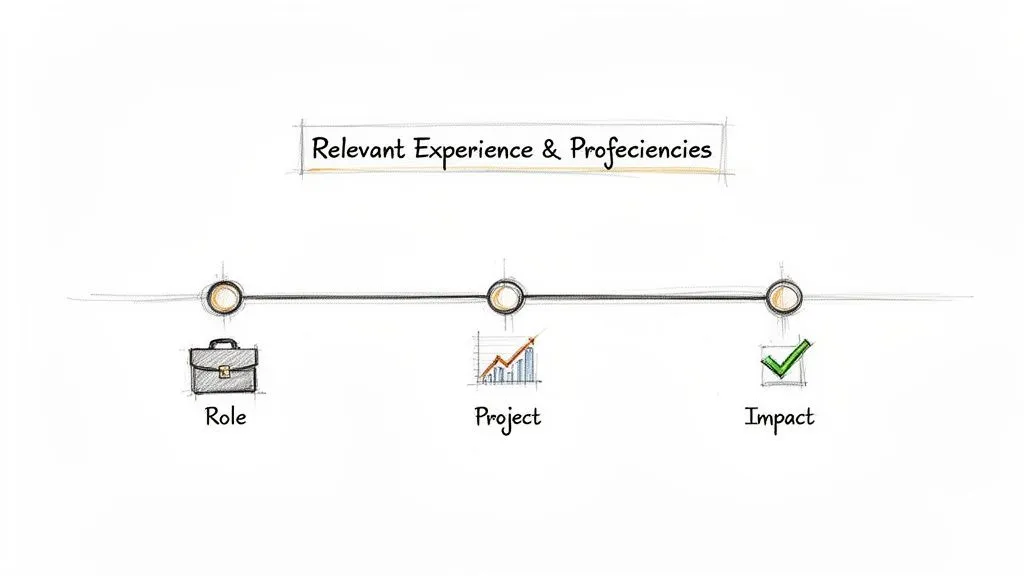
This heading frames your skills as outcomes of your work history, not just theoretical knowledge. "Relevant Experience & Proficiencies" shows your capabilities are job-tested and proven. It's a direct way to connect what you can do with what you have done.
This title acknowledges that your skills are the direct result of your roles. It suggests a high degree of practical application, which is a major selling point for roles where hands-on experience is the most critical differentiator.
Who Should Use It?
Professionals with a substantial work history who want to emphasize the connection between their skills and their career journey. Highly effective in operations, sales, and management.
Key Takeaway: "Relevant Experience & Proficiencies" proves your skills are not just learned but have been successfully applied in real professional settings.
How to Do It
Create a powerful summary that anchors your proficiencies in your experience.
- Lead with experience: Start the section by stating your total years of relevant experience.
- Order by application: List your proficiencies based on how frequently you used them in key roles.
- Connect to your roles: Ensure the proficiencies you list are clearly backed up by achievements in your work experience.
- Balance your capabilities: Include a mix of technical, functional, and leadership abilities.
Examples:
-
For a B2B Sales Director:
- Relevant Experience & Proficiencies: 10+ years in B2B SaaS sales with proficiencies in Enterprise Account Management, Consultative Selling, Pipeline Development, and Sales Forecasting.
-
For an Operations Lead:
- Relevant Experience & Proficiencies: 12 years in operations with proficiencies in Process Optimization, Team Management, Supply Chain Coordination, Vendor Relations, and ERP Systems.
8 Alternatives to Skills on a Resume
| Title | Ideal Use Cases | Key Advantages |
|---|---|---|
| Core Competencies | Mid‑level to senior professionals targeting specific roles | Conveys authority and specialization; ATS‑friendly |
| Technical Skills | Developers, engineers, data and IT roles | Highly specific and recruiter/ATS‑friendly |
| Professional Expertise | Career changers, senior/executive hires | Commands respect; emphasizes strategic value |
| Capabilities & Achievements | Candidates who want results‑focused evidence on resume | Differentiates via proof; more engaging than lists |
| Key Strengths | Broad industries, early to mid‑career or personal brands | Feels authentic; highlights soft skills and uniqueness |
| Areas of Expertise | Consultants, strategists, senior specialists | Conveys advisory capability and holistic knowledge |
| Specialized Skills | Regulated professions, niche technical roles | Highlights rarity and competitive advantage |
| Relevant Experience & Proficiencies | Mid‑career professionals with substantial work history | Links skills to real experience; highly credible |
Stop Listing. Start Framing.
You’ve seen the options. Each alternative to the tired ‘Skills’ heading does more than fill space. Choosing another word for skills on your resume is a deliberate act of professional positioning. It’s the difference between a passive list and an active statement of value.
The goal isn't just to find a synonym. The goal is to select a frame. The right heading primes the hiring manager and sets expectations. It shifts their perception from "What can this person do?" to "How does this person's expertise solve my problem?"
The Key Takeaway
Stop thinking about your skills section as a keyword dump for an Applicant Tracking System. The ATS is a gateway, not the final audience. A human makes the hiring decision, and humans respond to clarity. Your choice of heading is the title of a very short, very important story about your capabilities.
Here’s your action plan:
- Review the List: Which of the eight alternatives best fits your industry and seniority?
- Test Two Versions: Create two versions of your resume with different headings. Does
Technical Proficienciesfeel more accurate than a genericSkills? DoesCapabilities & Achievementsbetter capture your impact? - Read It Aloud: Which version sounds more confident? The right one will feel authentic and align with the jobs you’re targeting.
Ultimately, this is about articulating your value with precision. Default options are for people who haven't thought about their story. You have. Don't let a generic heading dilute your message. Frame your expertise, own your narrative, and show them exactly the professional you are.
Tired of fighting with templates? StoryCV is a Digital Resume Writer. We help you frame your experience through an AI-guided interview. We focus on the narrative, not just the keywords, turning your accomplishments into a resume a human will actually want to read. Start telling your story today.