Most manager application letters fail for a simple reason, they read like a resume wearing a tie. That's not what gets read. A hiring manager wants proof, fast, and if your letter doesn't show scope, numbers, and fit in the first pass, it goes straight into the pile with the polite noise.
If you're looking for an application letter for manager position sample, skip the soft talk. The letter's job is to make one thing obvious, you've already done manager-level work and you can do it again here. Guidance for manager letters keeps landing on the same shape, one page, three to four paragraphs, and concrete proof of leadership, not vague claims about being a “team player” or “strong leader” (MyPerfectResume, MIT CAPD).
Why Most Manager Application Letters Get Binned
The fastest way to get your letter tossed is simple. It reads like a resume copied into paragraph form, then padded with polite language. Hiring managers see that immediately. They are looking for a reason to keep reading, and if your first pass does not answer why this role, why this company, and why you, it goes straight into the no pile.
The screeners are looking for proof, not polish
A manager letter has one job, compress leadership into a fast read. The structure that keeps showing up in strong guidance starts with the exact role, moves into accomplishments, and ends with a direct request for an interview (MIT CAPD). It works because it respects how recruiters read, quickly and with little patience.
What gets a letter binned?
- Vague leadership claims. “I'm a strong leader” means nothing without proof.
- No numbers. If you managed people, say how many. If you improved something, name the result.
- Wrong opening. If the first line buries the job title, attention drops fast.
- Thank-you filler. Gratitude belongs at the end. It does not replace evidence.
- Resume repetition. The letter should not reprint your CV in sentence form. MIT CAPD says to keep it focused on the employer's needs, not your full work history.
- No screening awareness. A lot of letters fail before a person reads them closely, because they ignore how AI resume screening and human scanning both punish vague phrasing and weak structure.
Practical rule: If your letter would not help a hiring manager explain your candidacy to someone else in 20 seconds, it is too vague.
The stronger samples use specific, measurable outcomes because that is what a manager-grade reader respects. They read like short business cases, with impact up front and soft claims pushed out of the way. That shift, from generic business correspondence to evidence-based persuasion, is exactly why the cleaner examples work better (MyPerfectResume, LetterSoo).
A manager application letter is a filter test. It proves fit fast, or it disappears.
The One-Page Format That Survives a Six-Second Scan
A manager letter should be short because hiring managers scan first and read later. Header, date, greeting, three or four tight paragraphs, sign-off. That is the whole job. If the page runs long, it usually means the writer could not decide what mattered, and that is a bad sign on a management application.
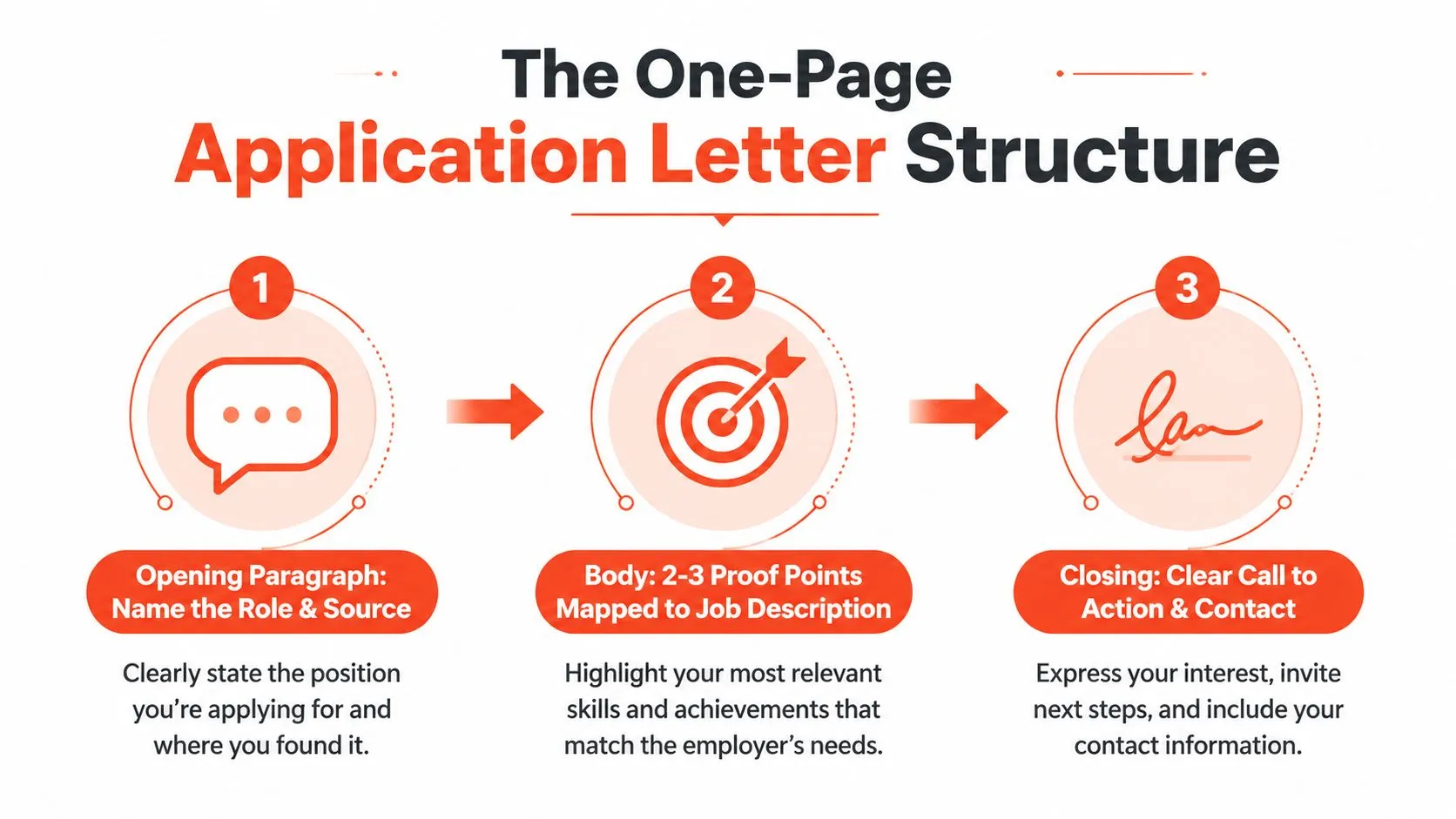
The page should do three jobs
The first paragraph names the role and source. That is not filler, it tells the reader this letter is for one opening, not a mass send. The next two paragraphs should map your strongest evidence to the job description, and the closing should ask for the interview without turning into a thank-you note.
A clean one-page manager letter usually looks like this:
- Header and contact details. Put your name, title, contact info, the date, and the recipient's details at the top, in standard business-letter form (Indeed).
- Opening paragraph. State the exact job title and where you found it.
- Body paragraph one. Match one or two core requirements from the posting.
- Body paragraph two. Add proof of leadership, using facts that make the scope clear.
- Closing paragraph. State interest, ask for a conversation, and keep the tone controlled.
Keep the letter to a single page. That format forces discipline, and it keeps the reader on the page long enough to see the evidence.
The body is where weak letters start wandering. Cut that off fast. Use the body to show fit, not chronology. If the posting wants team leadership, process control, or cross-functional coordination, give those signals directly and leave the rest out. Three paragraphs are enough when each one has a job.
A good manager letter reads like a tight business case. The opener names the role immediately and the middle moves straight to proof. The weak version hides the point behind enthusiasm, history, and polite padding before it says what it is for.
Annotated Application Letter for Manager Position Sample
Here's the kind of manager letter that gets read, because every line earns its place. I'm using an operations manager example, since that's where the proof usually gets fuzzy if you're not careful.
Sample letter with notes
[Your Name]
[Your Address]
[Your Phone Number]
[Your Email Address]
[Date]
[Hiring Manager's Name]
[Company Name]
[Company Address]
Dear [Hiring Manager's Name],
I'm writing to apply for the Operations Manager position listed on your careers page. [This opening does one job, it names the role and source immediately, so the reader knows this isn't a generic blast.]
In my current role, I lead a team of 14 across scheduling, process control, and day-to-day issue resolution. [This line proves scope with a concrete team size, which makes leadership real instead of decorative.] I've also improved handoffs between departments, which made daily work more predictable and reduced the number of last-minute escalations. [This stays qualitative because it avoids inventing a number, but it still points to operational impact.]
At my last employer, I oversaw a busy site with multiple moving parts and was responsible for tightening workflow, coaching team leads, and keeping service standards consistent. [This sentence shows size and responsibility without overclaiming.] I'm used to being the person who spots the bottleneck early, gets the right people involved, and keeps the work moving. [This sounds managerial because it focuses on decision-making, not self-congratulation.]
What matters most is that I don't just manage activity, I manage outcomes. [This is the kind of line that tells a screener you understand the job.] I'd welcome the chance to bring that approach to [Company Name] and discuss how my background fits the role's priorities. [This closing asks for the meeting directly and stays confident.]
Thank you for your time and consideration.
Sincerely,
[Your Name]
The best part of this format is what it leaves out. No life story. No “I've always wanted to work for your company” filler. No desperate gratitude. If you want another useful reference for layout and tone, the structure in this sample cover letter guide shows the same principle, keep the message tight and role-specific.
A real manager letter should sound like a competent person applying for a real job, not a candidate auditioning for approval. That's the bar.
Two Variants for Real Situations
Most sample letters are written for a neat, fictional middle. Real applicants are messier. You're either stepping up into your first manager seat, or you're crossing industries and need to translate a different title into managerial credibility.
Framing shifts for two common manager-applicant situations
| Situation | Lead proof point | Risk to avoid |
|---|---|---|
| First-time manager | Projects led, people mentored, decisions owned | Acting like direct reports are the only proof of leadership |
| Career transition into management | Scope of work, transferable judgment, cross-functional coordination | Describing your old title without connecting it to management |
For a first-time sales manager letter, don't pretend you've already held the title. Say you've led campaigns, coached peers, or owned key accounts, then connect that to sales leadership. The point is credibility through adjacent leadership, not fake seniority.
Example opening:
“I'm applying for the Sales Manager role at [Company Name]. In my current senior sales role, I've led peer onboarding, handled high-value accounts, and helped shape the team's approach to pipeline follow-up.”
That works because it shows leadership without lying about the title.
For a career-transition candidate, the move is different. You need to translate the old lane into managerial value. If you've worked in operations, finance, or client services, talk about judgment, coordination, and process ownership. Don't overexplain the old title. Explain the management muscle hidden inside it.
Example opening:
“I'm applying for the Operations Manager position at [Company Name]. My background in process-heavy roles has given me strong judgment around workflow, stakeholder coordination, and keeping teams aligned under pressure.”
The cleanest translation is usually this, past scope plus future fit. If you can't connect those two in one paragraph, the letter isn't ready.
The sample has to match the situation
A first-time manager letter should lean on mentoring and project leadership. A transition letter should lean on transferable scope and business judgment. Both need numbers if you have them, but the framing changes. That's the part most generic advice misses, and it's why template letters feel flat.
A manager letter should meet the reader where they are, not where your resume wishes they were.
Numbers, Tone, and ATS Mechanics That Matter
Manager letters do not live or die on keyword stuffing. They live or die on clarity. If the document parses cleanly, uses normal structure, and says something specific about leadership, it has a chance. If it looks like a design project, or reads like a thesaurus attack, it gets harder to trust.
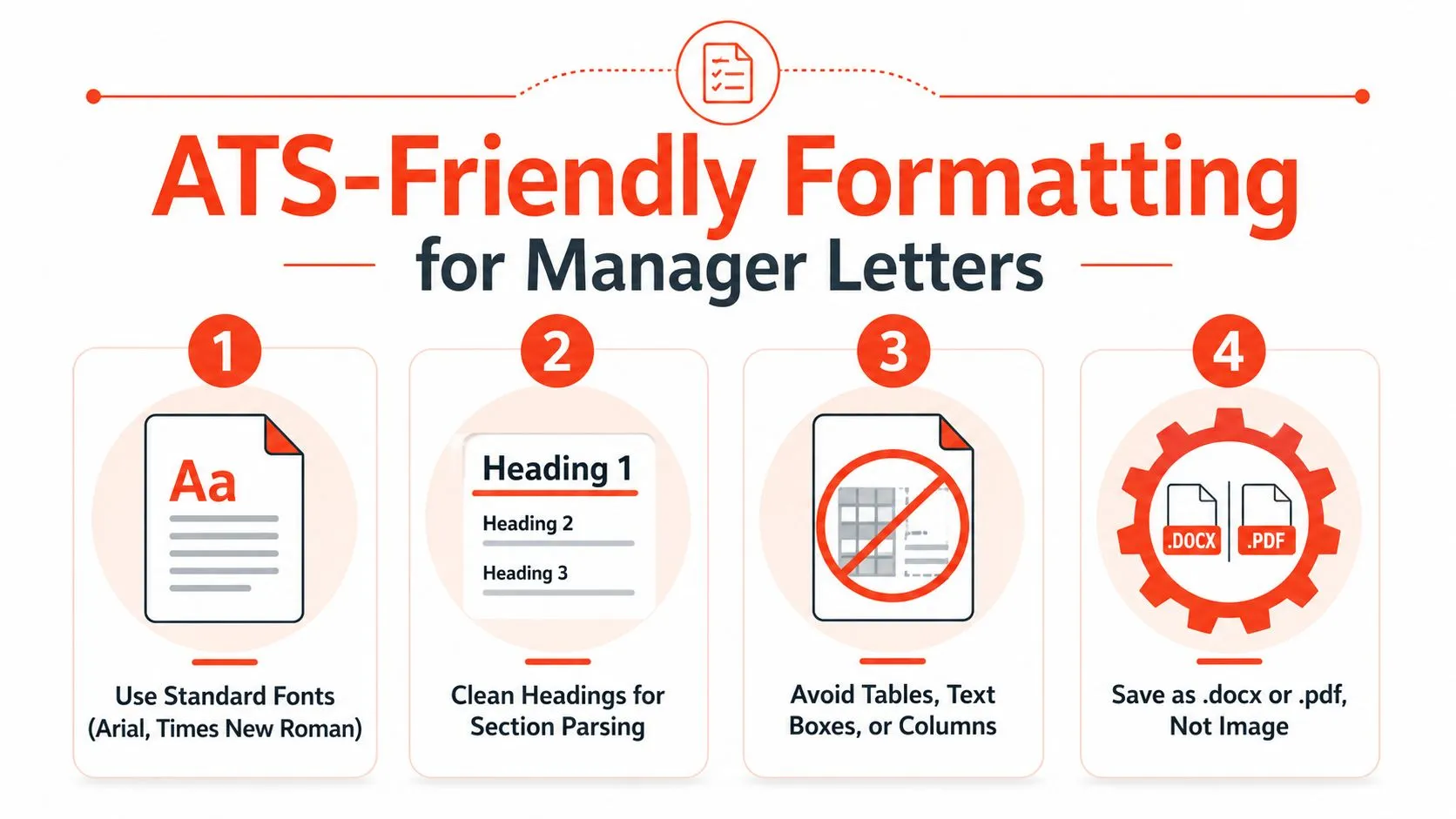
Format for parsing, not decoration
Use standard fonts, clean headings, and left alignment. Avoid tables, text boxes, and columns inside the letter body, because they can make parsing messy. Save it as .docx or .pdf, not an image, and keep the layout boring in the best possible way.
The language matters just as much. Strong manager samples use metrics like team size, efficiency lift, cost reduction, revenue growth, and retention. The point is simple, show scope and outcome in the same line. Vague praise does nothing for a hiring manager. Measurable impact does.
Now compare tone.
- Weak: I'm a strong leader with excellent communication skills.
- Strong: I led 14 people across scheduling and issue resolution, and I improved day-to-day handoffs between teams.
The second line wins because it gives a reader something real to hold. It does not brag. It demonstrates.
If you want a sharper handle on turning vague impact into readable proof, how to write persuasive copy is useful because the same logic applies here, specific claim, credible evidence, clear outcome. That is the whole game.
One more trap, overlong sign-offs. A manager letter should stay lean. If you add extra paragraphs just to sound serious, you make it easier to skip. Keep the closing direct, thank them, restate interest, ask for the conversation, and stop there.
I also would not ignore the value of quantifiable language in the application letter itself. A strong quantifiable achievements guide makes your case feel managerial instead of promotional, and it keeps the focus on outcomes, not personality.
Pre-Send Checklist and Final Edits
Before you send it, run the letter through a fast sanity check. If it fails any of these, fix it.
- Role and source named up top. The opening should state the exact job title and where you found it.
- Proof points counted. You need two or three strong evidence lines, not a biography.
- Numbers present where they matter. Team size, scope, or other measurable leadership proof should appear if you have it.
- Paragraph count tight. Three to four paragraphs is the right range for manager letters.
- Length stays on one page. If it spills, cut the padding.
- Tone sounds like a manager. Read it out loud. If it sounds needy, vague, or inflated, rewrite it.
- Formatting stays clean. Standard font, normal spacing, no decorative junk.
- Closing asks for action. Don't just thank them. Ask for the interview.
The easiest mistakes to catch are the ones hiring managers see first. People repeat the resume, open with “I am writing to apply,” and close with a generic line that says nothing about fit. That gets binned fast. Use the letter to sharpen the story, then carry the same proof points into the resume and LinkedIn so the whole profile hangs together.
StoryCV helps you turn real leadership into clear, manager-ready writing without template sludge. If you want a stronger application letter for manager position sample, and you want the resume and profile to match it, start with StoryCV and build the story once, then use it everywhere you apply.