
“Follow your passion” sounds nice, but it collapses the second you try to update your resume, explain a career pivot, or answer “Why this role?” in a way that doesn't sound rehearsed. Mid-career professionals usually don't have a passion problem. They have a translation problem.
You've done useful work. You've solved hard problems. But when it's time to explain what you want next, your language gets foggy. You say things like “I want to make an impact” or “I'm looking for growth.” Hiring managers hear static.
That's the issue. Aspirations feel abstract, while job searches demand specifics.
The fix isn't more journaling fluff. It's learning how to turn a broad life direction into a career narrative that another person can understand in under a minute. If your aspirations in life can't survive contact with a resume, they're still too vague.
Forget Your Passion Find Your Purpose
Passion is overrated.
It's unstable, moody, and wildly unhelpful when you're trying to make an actual career decision. Some days you feel energized. Some days you're tired, annoyed, or burned out. If your career depends on always feeling inspired, your plan is weak.
Purpose is better because it's more durable. It answers a harder question. Not “What excites me right now?” but “What kind of contribution, environment, and identity fit me?”
Passion is a feeling. Purpose is a filter
“Follow your passion” pushes people into vague self-expression. That's why so much career advice turns into personality theater. Long lists of values. Vision boards. Zero clarity.
Purpose is more useful because it filters choices.
Ask yourself:
-
What kind of problems do I want to be known for solving?
-
What kind of people do I want to help?
-
What kind of work leaves me with energy instead of regret?
That gets you closer to something real.
You do not need one perfect calling. You need a direction strong enough to rule things out.
Why vague aspiration talk wastes your time
A lot of “aspirations in life” content treats aspiration like a mood board. That's why people end up with goals that sound admirable but don't help with real decisions.
You don't need a prettier dream. You need language.
If you say, “I aspire to lead,” that means nothing on its own. Lead what? Through what kind of work? In what setting? Toward what outcome?
A useful aspiration has consequences. It should change what jobs you apply for, what achievements you highlight, and what story your resume tells.
That's the standard. If it doesn't affect your decisions, it's decoration.
What Are Aspirations Anyway
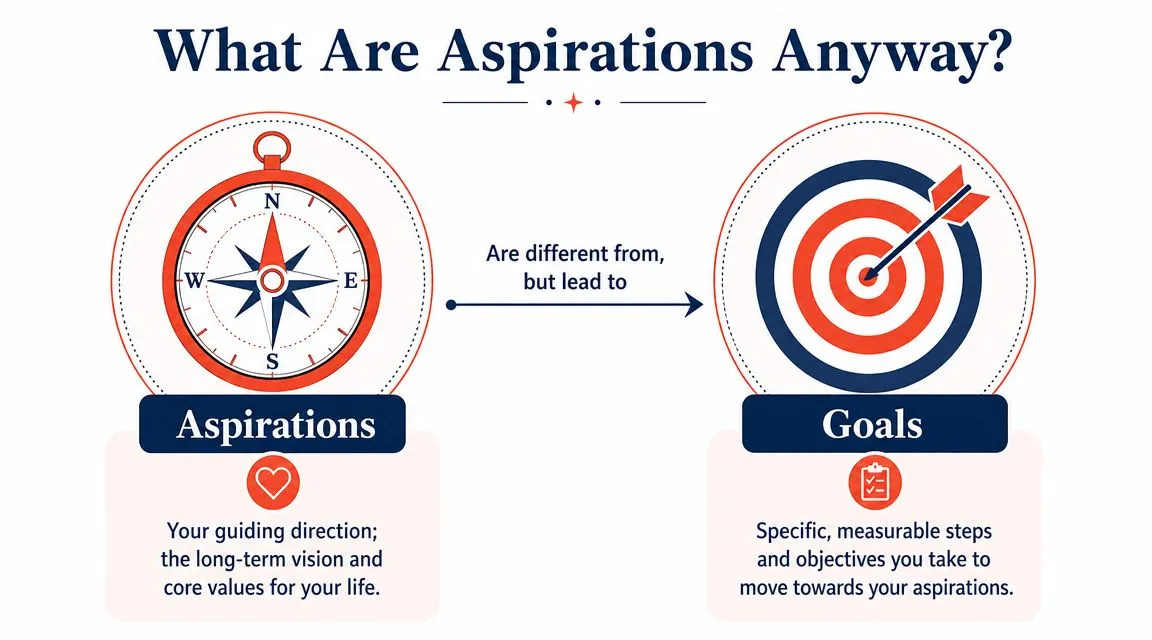
Aspirations are your direction. Goals are your moves.
That's the cleanest way to think about it. Your aspiration is the compass. Your goals are the map points. One tells you where north is. The other tells you what to do next Tuesday.
The difference that actually matters
An aspiration sounds like this:
-
Build teams that work calmly under pressure
-
Create systems that reduce waste
-
Do work that improves people's daily lives
A goal sounds like this:
-
Get promoted to senior operations manager
-
Lead a cross-functional process redesign
-
Move into healthcare technology within a year
One is identity-level. The other is execution-level.
That distinction matters because recent guidance argues that aspirations are a long-term identity or purpose while goals are short-term milestones, which is exactly what most professionals need when they're trying to turn broad intent into a believable career story in interviews and resumes, as discussed in this guidance on aspirations versus goals.
Not all aspirations are equally useful
Many falter by treating all aspirations as noble by default. They aren't.
The Self-Determination Theory Aspirations Index organizes aspirations into 7 categories with five specific items within each category, giving researchers a structured way to compare what people value across contexts, as described by the Aspirations Index framework.
That research also makes a tougher point. In self-determination theory, intrinsic aims such as personal growth, close relationships, community involvement, and physical health are linked to better psychological health, while extrinsic aims such as money, fame, and image are unrelated or slightly negative for well-being, according to the self-determination theory research summary.
A practical way to sort your own thinking
Use this quick table.
| Type | Sounds like | Usually leads to |
|---|---|---|
| Intrinsic aspiration | “I want to build useful things and grow through hard work.” | More stable motivation |
| Extrinsic aspiration | “I want the title people respect.” | Fragile motivation |
| Goal | “I want a director role in operations.” | A concrete target |
Practical rule: If your aspiration only makes sense when other people are watching, it's probably too external to guide a satisfying career.
Why Your Aspirations in Life Matter
A clear aspiration isn't a luxury. It's a stabilizer.
Careers go sideways. Teams change. Industries stall. A role that looked smart last year can feel dead by spring. If all your motivation comes from external validation, you'll wobble every time the market does.

Persistence helps. Fantasy hurts
There's solid longitudinal evidence here. An 18-year study reported by the APA found that people who became more persistent in pursuing life goals had greater reductions in depression, anxiety, and panic disorders over time. The same report noted that a more positive outlook mattered too, while perceived control did not predict those mental-health changes, according to the APA summary of goal perseverance research.
That's useful because it strips away a common myth. You do not need total certainty. You need a reason to keep going that survives setbacks.
The ugly part nobody mentions
Unexamined aspirations can also mess you up.
Research on unrealized occupational goals shows that when people use those goals as self-standards and then don't reach them, well-being can drop along with satisfaction and sense of purpose, as explained in this research on unrealized occupational goals and well-being.
That's why “dream bigger” is lazy advice. Some aspirations need revision, not worship.
-
Keep the meaning. If the original title or path is gone, keep the underlying motive.
-
Drop the vanity wrapper. Prestige goals often hide a deeper need for competence, contribution, or security.
-
Update the story. A changed path isn't failure if the core aspiration still has a home.
If this process stirs up more than career confusion, it can help to understand your Vernon counselling options and work through the emotional weight with someone trained to help.
Some aspirations anchor you. Others quietly judge you. Know the difference.
How to Identify Your Real Aspirations
You do not need a retreat in the woods. You need better questions and a notebook.
Aspirations in life usually hide under the language you already use. The problem is that people often answer career questions too quickly. They jump to job titles before they've identified the pattern underneath them.
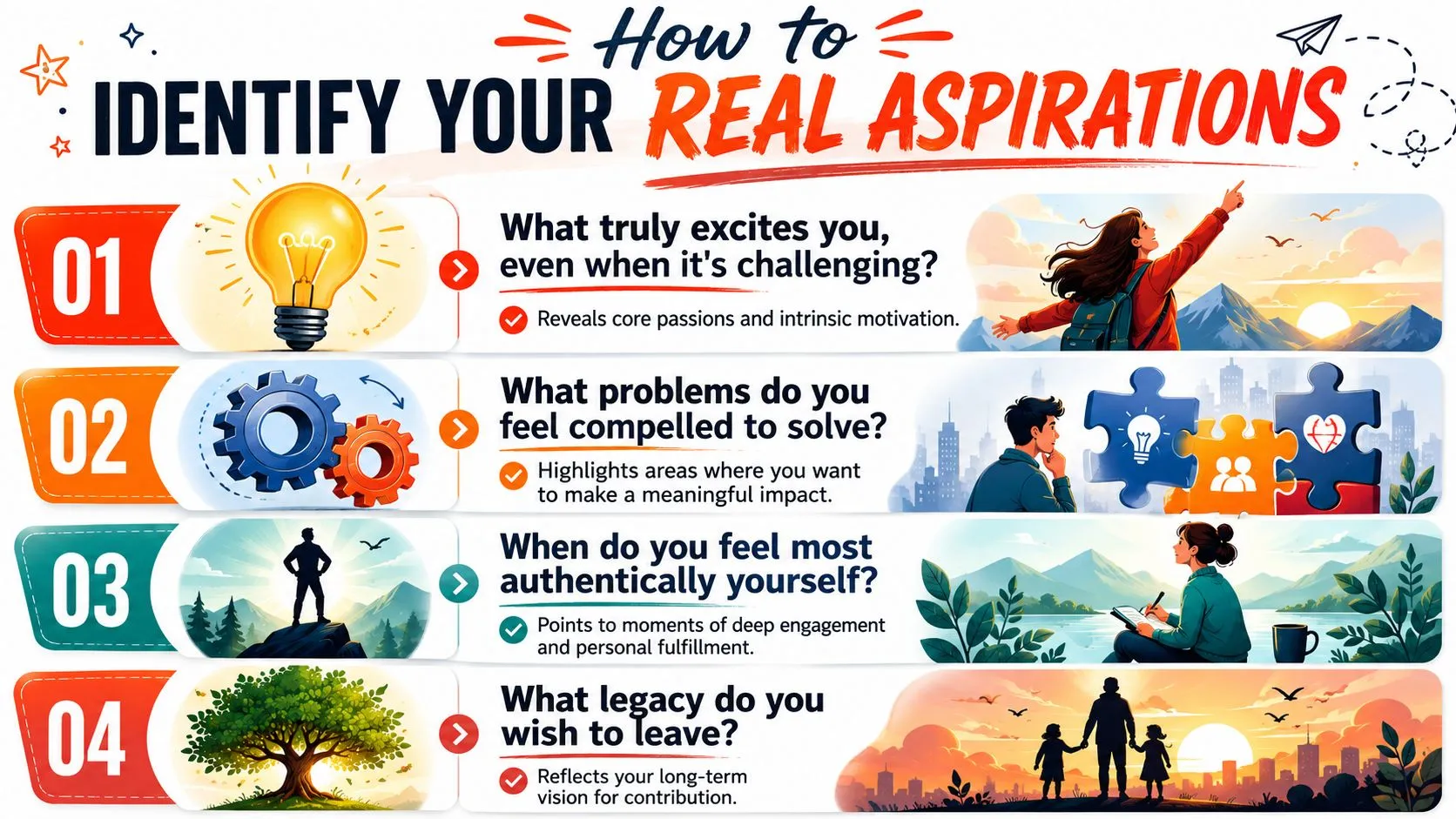
Four questions worth answering honestly
Write your answers. Don't keep them in your head. In a well-known goal-setting study, people who wrote down their goals were 20% more successful than those who did not, and people who also shared progress with a supportive friend and took specific action steps were 40% more likely to succeed, according to this summary of goal-setting research.
Use these prompts:
-
What problems do you enjoy solving even when nobody claps?
This exposes intrinsic motivation fast. Look for work you return to without needing praise. -
When have you felt proud of your work for the right reason?
Not because it looked impressive. Because it felt useful, sharp, or honest. -
What kind of dysfunction irritates you enough to fix it?
Chaos, waste, bad communication, weak product decisions, confused customers. Your irritation is often a clue. -
If you removed status from the equation, what work would still matter to you?
This helps separate aspiration from image.
For a deeper prompt set before you rewrite anything, read this guide on career reflection before your resume.
Turn answers into short aspiration statements
Bad version: “I want to do meaningful work.”
Better versions:
-
I want to make complex work simpler for teams.
-
I want to build reliable systems people trust.
-
I want to help customers make better decisions with less friction.
These are usable because they point toward specific roles, projects, and examples.
A quick video can help if you think better by listening than writing.
A simple test
Run each statement through this filter.
| Question | Keep it if the answer is yes |
|---|---|
| Can this guide job choices? | Yes |
| Can I prove it with past work? | Yes |
| Would this still matter without applause? | Yes |
If not, rewrite it until it can.
Translate Aspirations Into Your Resume
Many individuals often falter at this point.
They do the inner work, get clear on what they care about, then write a resume that says none of it. They fall back to bland bullets, generic summaries, and corporate oatmeal.
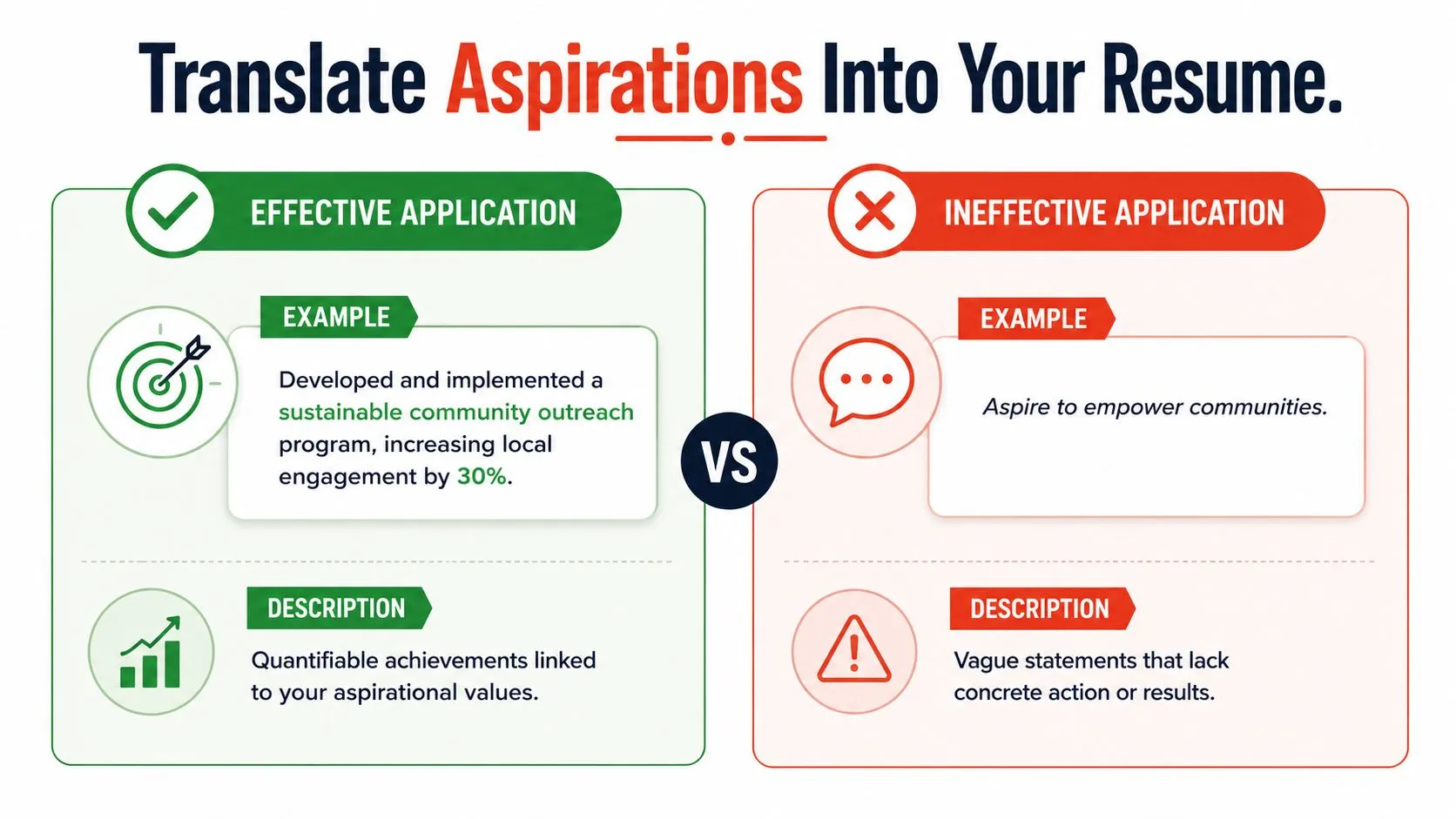
Your aspiration should not appear on the page as a slogan. It should appear as a pattern of evidence.
Don't write your aspiration. Translate it
If your aspiration is “I want to help teams work more efficiently,” do not write:
-
“Aspire to improve efficiency”
-
“Passionate about operational excellence”
-
“Driven professional with strong interest in process improvement”
That language says nothing. It's self-description without proof.
Write what you changed.
| Aspiration | Weak resume line | Stronger resume line |
|---|---|---|
| Build calmer, clearer team operations | “Improved team processes” | “Redesigned weekly project intake and handoff workflows for cross-functional teams, reducing confusion, clarifying ownership, and speeding up execution.” |
| Make complexity easier for customers | “Supported customer experience initiatives” | “Rewrote onboarding content and support flows to help customers complete key setup tasks with less back-and-forth.” |
| Create systems that scale | “Managed operations” | “Built repeatable operating procedures for hiring, onboarding, and reporting across a growing team.” |
Use this conversion formula
Take each aspiration and force it through this sequence:
-
Aspiration
“I want to build things that last.” -
Work theme
Reliable systems, durable processes, quality standards, long-term maintainability. -
Relevant evidence
Documentation, workflow design, governance, enablement, risk reduction. -
Resume language
Bullets that show what you improved, organized, clarified, or strengthened.
If your resume only shows tasks, your aspiration is invisible.
A good bullet usually has three parts:
-
What you changed
-
Where it mattered
-
What kind of impact it had
Not every bullet needs a metric. But every bullet needs consequence.
Before and after examples
Before
“Worked with stakeholders across departments.”
After
“Aligned product, operations, and support teams around a shared rollout process to reduce confusion during launch periods.”
Before
“Responsible for process improvements.”
After
“Identified recurring workflow bottlenecks, standardized handoffs, and introduced clearer documentation for recurring operational tasks.”
If you need help sharpening that style, this guide on how to write impact statements is worth using as a checklist.
For people who want structured help turning messy experience into clear narrative, StoryCV works as a digital resume writer. It uses a guided interview to pull out context, achievements, and stronger phrasing, which is a different job from filling out a builder.
Stop Dreaming Start Articulating
Your aspirations in life are not the final product. They're raw material.
The point isn't to sound deep. The point is to get clear enough that your next move makes sense, your resume sounds like a real person wrote it, and your interviews stop drifting into vague motivational sludge.
Clarity beats intensity
You do not need bigger dreams. You need sharper language.
Aspirations matter because they help you choose. Which roles fit. Which achievements belong on the page. Which version of your experience is authentic. If you can't articulate the through-line in your work, you'll keep applying with a resume that looks competent but forgettable.
If you struggle to keep momentum while doing this work, it may help to work with an accountability coach who can push you to define the next step and follow through.
For the next draft of your career story, stop obsessing over keyword stuffing and start learning how to talk about your work like someone who understands why it mattered.
The hiring manager doesn't need your dream. They need a coherent reason to believe you fit the job.
If you want help turning fuzzy experience into a sharp resume narrative, StoryCV is built for that. It acts like a digital resume writer, using a guided interview to pull out your real contributions and shape them into clear, credible language a hiring manager can understand.