Most asst HR manager resume advice is backward. It tells you to cram in keywords first, then hope a recruiter notices you. That's lazy. A hiring manager wants a decision document, not a keyword compost pile.
The resume has one job, get someone to believe you can handle people, process, and pressure without babysitting. That means your bullets need scope, scale, and outcome. If they don't, they read like admin notes, not proof.
Why Most Asst HR Manager Resumes Get Skipped
Recruiters and HR leaders skim for evidence, not effort. A line like “responsible for recruiting” tells them almost nothing. It hides team size, workload, and whether you improved anything worth tracking.
The strongest asst HR manager resume is built on measurable people impact, not duty lists. HR resume guidance consistently favors metrics like turnover reduction, time-to-fill, engagement scores, cost-per-hire, and retention improvements, and it recommends putting the strongest people metrics in the summary and the first bullet of each role careerbldr HR resume guidance. That is not decoration. That is the difference between “I helped” and “I changed the result.”
Practical rule: If a bullet could describe five other candidates, it is too soft.
Context matters just as much. An assistant HR manager supporting 300 employees across 4 locations is doing a very different job from someone supporting one office and a single HR generalist. HR guidance also recommends adding headcount supported, years of experience, industry, and region because those scale markers help employers judge whether the outcome matters AIHR HR manager resume guidance.
A resume also has to read like proof. A recent look at why resumes stall before the interview stage shows how quickly weak wording gets ignored once a hiring manager starts scanning for real evidence. The old habit of listing responsibilities first does not help you. Start with what changed because you were there, then make the manager do the easy math.
The Section-by-Section Structure That Works
A good asst HR manager resume does not need clever formatting. It needs a structure a hiring manager can scan fast and an ATS can read without confusion. The safest default is reverse chronological, single-column, and ATS-friendly, with the resume kept to 1 to 2 pages depending on experience AIHR resume format guidance.
Start with contact information at the top. Use your name, phone number, email, and location if relevant. Then add a professional summary that states your years of experience, industry context, focus areas, and one or two measurable wins. HR University's format guidance is blunt about the mechanics here, include the job title, full name, phone number, email, educational institute names, degree names, graduation years, relevant skills, tools, and certifications HR University HR assistant resume guide.
Recommended Asst HR Manager Resume Structure
| Section | Purpose | Approximate Length |
|---|---|---|
| Contact Information | Makes you reachable and identifiable fast | 2 to 4 lines |
| Summary | Frames your scope, focus, and best proof | 3 to 4 lines |
| Work Experience | Shows impact in reverse order | 4 to 6 bullets per role |
| Skills | Signals HR functions and tools clearly | 8 to 15 items |
| Education | Confirms training and credentials | 2 to 4 lines |
| Certifications | Adds authority and specialization | 1 to 3 lines |
Work experience comes next, newest job first. That part is fixed. HR resume guidance favors reverse chronology because it makes recent scope obvious, and it helps the reader see whether your last role matches the job you want now. A compact skills block, education, and certifications follow. That is the minimum defensible content set for this role, and it matches what you see in the Mint Resume sample.
Keep the summary tight. Keep the bullets measurable. Keep the page count honest.
For bullets that prove value, use the advice in how to write achievements in a resume and strip out vague duty language. A hiring manager does not need a recycled task list. They need proof that you handled scope, improved a process, or supported people outcomes that mattered to the business.
One more thing. Read your resume like an evaluator, not like the person who wrote it. The Talantrix resume reading tips mindset helps here, because it forces you to ask what decision each line supports. If a section does not help the reader place you, trust you, or compare you against the next candidate, it is taking up space you could use for better evidence.
If you have plenty of experience, skip the bloated objective. Use the room to show scope, judgment, and the kind of people operations support a real business can rely on.
Writing Bullets That Prove People Impact
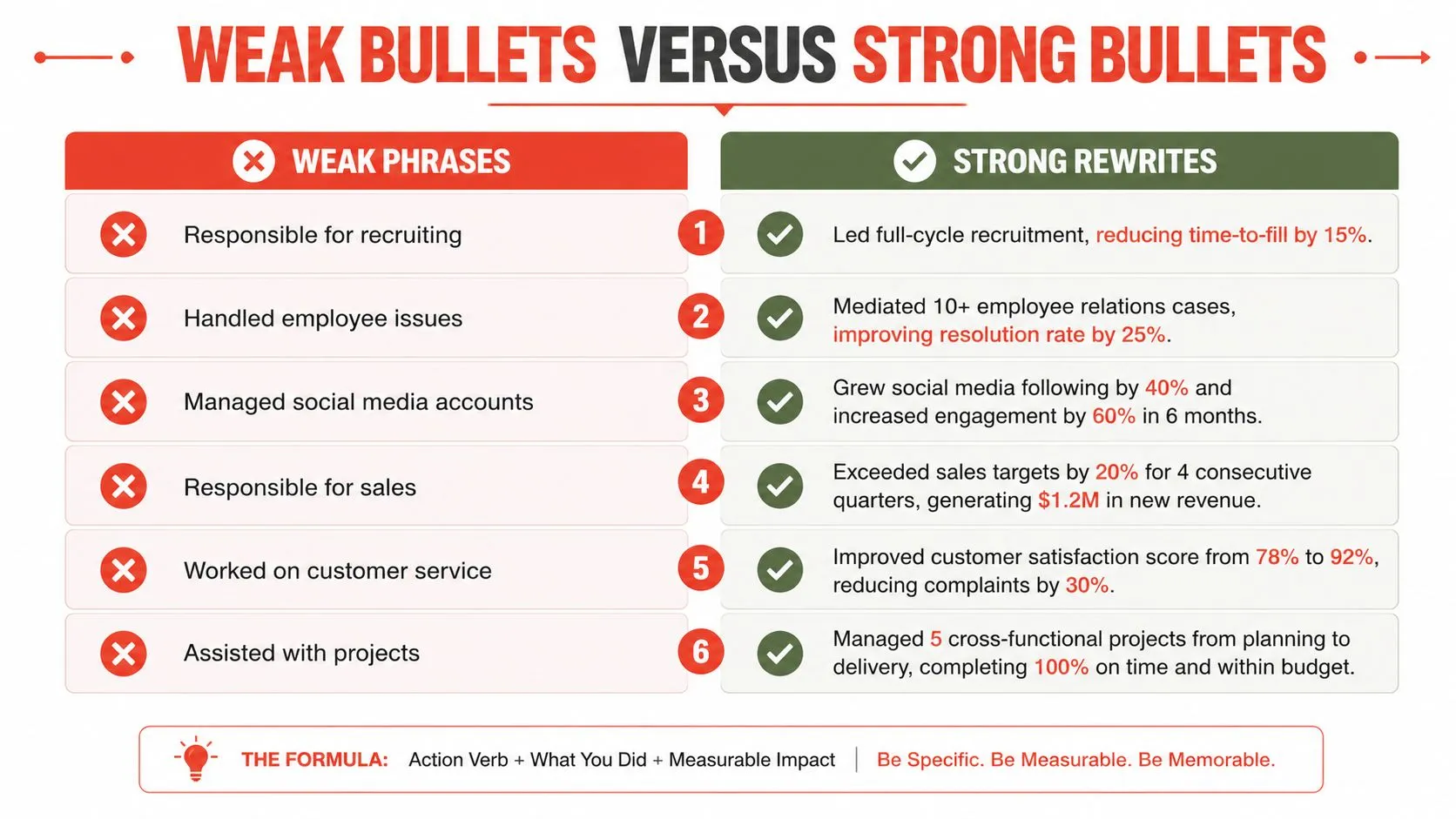
Write bullets that prove outcomes, not chores. Action Verb + What You Did + Measurable Result is the cleanest formula because it forces you to stop hiding behind duty language. HR resume guidance keeps coming back to people metrics like time-to-fill, turnover, headcount, cost savings, and engagement because those are the numbers hiring managers can use to judge your impact WriteCV human resources resume guide.
Turn HR tasks into outcomes
Weak: “Assisted with hiring and onboarding.”
Strong: Led full-cycle recruitment support, cut time-to-fill from 65 to 35 days, and helped new hires get through onboarding faster careerbldr HR resume guidance.
Weak: “Handled employee surveys.”
Strong: Collected and analyzed engagement survey results, then supported actions that raised engagement scores by 22 points careerbldr HR resume guidance.
Weak: “Managed onboarding paperwork.”
Strong: Managed onboarding administration, reducing turnover from 28% to 14% for the intake group you supported careerbldr HR resume guidance.
That structure works because it ties process to business meaning. If you say you screened candidates, I learn almost nothing. If you say you supported recruitment across 50 new hires, or helped onboard 300 employees across 4 locations, the reader can judge the scale AIHR HR manager resume guidance. That is the point.
A good bullet also answers a simple question, what changed because you did the work? Use the achievement bullet writing guide to strip out vague duty language and keep only lines that show scope, judgment, or people impact. A hiring manager should not have to translate your sentence into meaning. The result should be obvious on the first read.
Read your resume the way an evaluator reads it, line by line, with no patience for fluff. The Talantrix resume reading tips mindset helps here because it forces you to ask what decision each bullet supports. If a line does not help the reader place you, trust you, or compare you with the next candidate, cut it and use the space for evidence that matters.
If you have solid experience, skip the bloated objective. Use that space to show scope, judgment, and the kind of people operations support a real business can rely on.
HR Keywords That Help Without Sounding Stuffed
Keywords matter, but stuffing them is a rookie mistake. A strong asst HR manager resume reads like a person wrote it, not a search engine. The trick is to group terms by function, then use only the ones that match your actual experience.
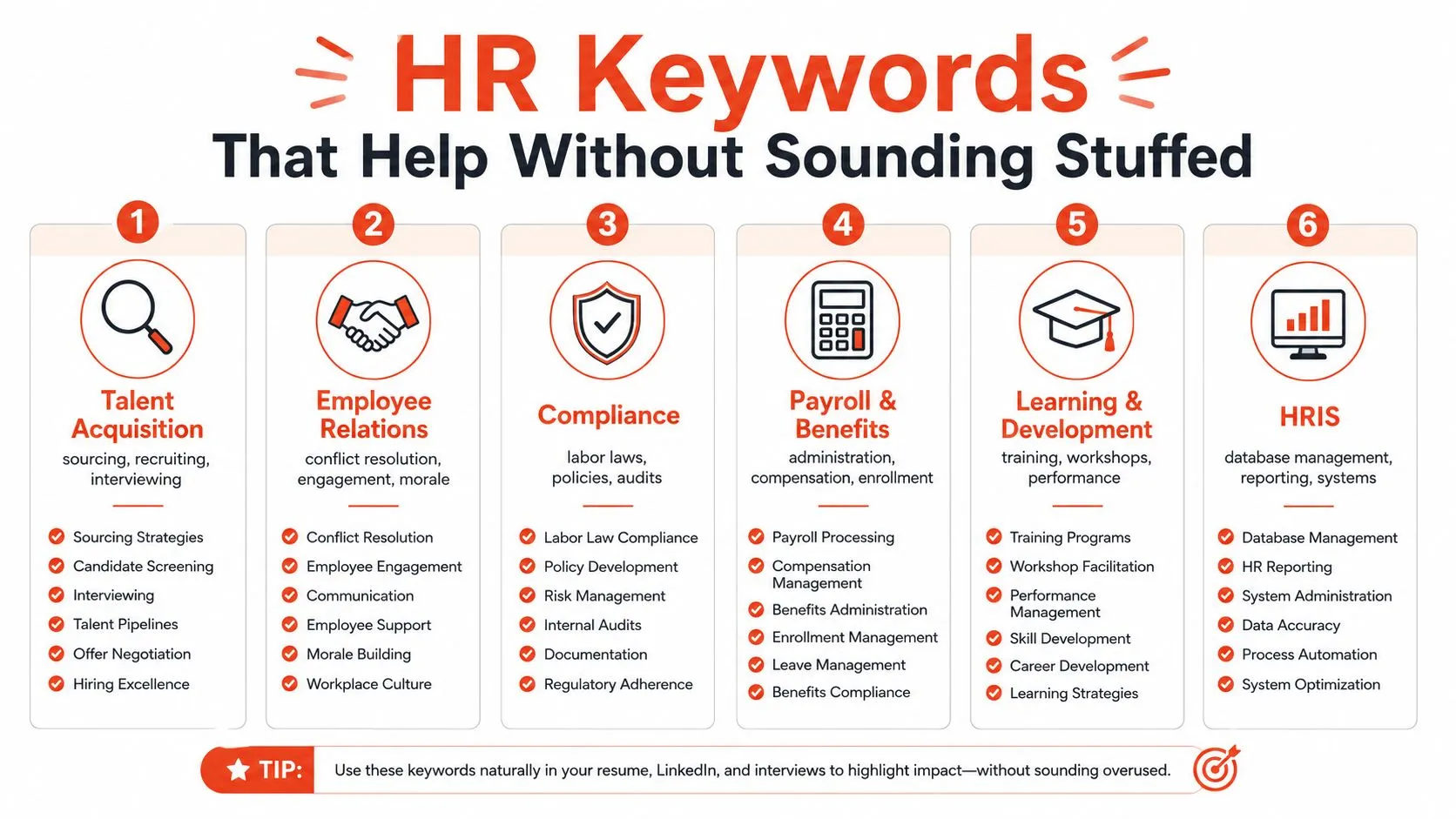
Use keyword families, not random nouns
- Talent Acquisition: sourcing, recruiting, interviewing, candidate coordination, job postings.
- Employee Relations: conflict resolution, engagement, morale, employee support, grievance handling.
- Compliance: labor laws, policies, audits, I-9 verification, confidentiality.
- Payroll and Benefits: payroll support, compensation, enrollment, open enrollment, deductions.
- Learning and Development: training, workshops, onboarding, performance support.
- HRIS: Workday, BambooHR, ADP, data entry, reporting, employee records.
That list is useful only if it matches what you've done. Don't paste every term into your summary and call it strategy. Use a few high-value keywords in the summary, then spread the rest naturally through bullet points and the skills section. That keeps the language readable while still helping ATS systems recognize fit.
A decent test is this, if a phrase sounds like it was copied from the job description, make sure it's attached to a real result. “Managed employee records” is flat. “Maintained employee records with reporting support for HR leadership” is better. Add a number only if you can defend it. If you can't, keep it qualitative and specific.
Avoid the trap of writing a keyword graveyard. The goal is relevance, not saturation. If you need a deeper filter on what not to do, use how to avoid keyword stuffing as your guardrail.
Weak Bullets Versus Strong Bullets
Weak bullets fail for one reason. They describe activity, not impact. “Responsible for” sounds dead on arrival because it signals motion, not value.
Here's the difference that matters.
| Weak Phrases | Strong Rewrites |
|---|---|
| Responsible for recruiting | Led recruiting support for multiple openings, reducing time-to-fill from 65 to 35 days careerbldr HR resume guidance |
| Handled employee issues | Resolved employee relations cases and supported actions that improved engagement scores by 22 points careerbldr HR resume guidance |
| Did onboarding paperwork | Improved onboarding administration for 50 new hires and made intake more consistent AIHR HR manager resume guidance |
| Helped with payroll | Supported payroll and benefits administration for a defined employee population AIHR HR manager resume guidance |
| Kept records updated | Maintained HR records and reporting for employee files across multiple locations AIHR HR manager resume guidance |
| Supported HR team | Coordinated daily HR operations across hiring, onboarding, and compliance tasks AIHR HR manager resume guidance |
If you don't have a hard number, use honest scale. Say how many employees, locations, teams, or hires you supported.
That last point matters. A good resume does not fake precision. It uses real context. If you supported a department, name the department. If you covered several locations, name the number of locations. If you owned recurring work, say what the cycle was and what changed because you were in it.
Do not overstate tools. Knowing an HRIS is fine. Proving you used it to maintain clean records, speed reporting, or support onboarding is stronger. HR leaders care less about the software name and more about whether you used it to make operations smoother. If you want a simple test for whether your bullets read like real proof, boost retention and save time by cutting vague verbs first and rewriting from the result backward.
Scale Markers and Non-Obvious Signals That Set You Apart
Mid-level HR resumes blur together fast. Same duties. Same software. Same soft summary language. The cleanest way to separate yourself is with scale markers. Put years of experience, headcount supported, locations covered, industry, and business units in the summary so the hiring manager has context immediately. That is the kind of detail that helps a reader judge whether your experience matches the role.
That context does real work. It tells the hiring manager whether your results happened in a small office or across a distributed workforce. It also shows whether you handled onboarding for one team or multiple departments, which is a very different level of operating pressure.
Surface the signals that hiring managers do not want to hunt for. Credentials, affiliations, board appointments, leadership posts, presentations, media features, quotes, and publications all help show that your experience reaches beyond day-to-day admin SHRM HR resume guidance. That is a stronger read than a resume that only lists job titles and task names.
Use those signals to show both execution and authority. A certification says you invested in the profession. A membership says you stay connected to it. A presentation or publication says you can explain HR work clearly, which matters when a hiring manager is trying to decide whether you can represent the function well.
If your background feels thin on paper, do not pad it. Pull forward the proof that you are serious about the role. One relevant credential or affiliation can change how the whole resume reads. If you want a cleaner drafting process, a guided writer like StoryCV can help you turn raw experience into resume-ready language, and that can help you boost retention and save time when you are revising quickly.
A Fifteen-Minute Edit Checklist Before You Send
Run this pass before you hit submit.
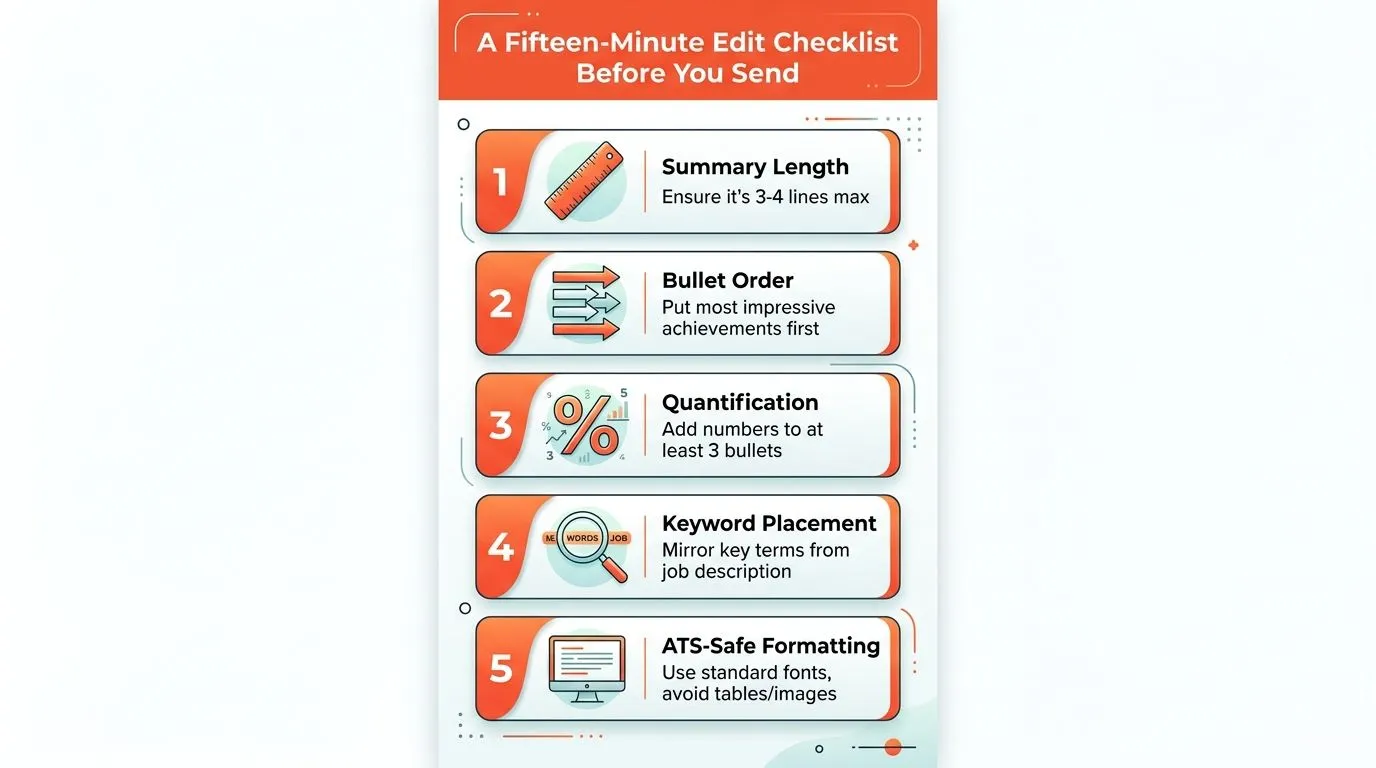
- Summary length: Keep it to 3 to 4 lines. If it runs longer, it stops being a summary and starts looking padded.
- Bullet order: Put the strongest result first in each role. Hiring managers scan top to bottom, and they should hit your best proof fast.
- Quantification: Add numbers to at least three bullets. Use real counts, real scale, and real outcomes, not vague claims.
- Keyword placement: Mirror the job description where it fits naturally, especially for HRIS, onboarding, payroll support, and compliance.
- ATS-safe formatting: Use a reverse-chronological, single-column layout with standard fonts and no decorative clutter AIHR resume format guidance.
- Redundancy pass: Cut repeated duties, duplicate verbs, and filler phrases like “responsible for” and “assisted with.”
Then read it like a hiring manager, not like the owner. If a bullet does not say what changed, cut it or rewrite it. If a section feels padded, trim it. The point is not a longer resume. It is a sharper one.
If you want this done faster, build one role at a time and rewrite the bullets before you touch the rest. That keeps the document honest and makes the strongest content obvious.