Putting "bartender on a resume" often feels like admitting you were just paying the bills. That’s a mistake. Your experience behind the bar is a goldmine of skills any industry—from tech to finance—is desperate to find: sales, high-pressure operations, and customer retention.
The problem isn't your experience. It's how you’re selling it.
Your Bartending Experience Is More Than a Job

Stop thinking of your bartending gig as just a side hustle. It was a high-stakes role that built a skill set most office jobs can't touch. You didn't just pour drinks. You ran a business.
A barman cv that just lists tasks undersells what you actually did.
From Pouring Drinks to Driving Business
Every shift was a masterclass in:
- Operations: You ran real-time inventory, optimized workflow for speed, and kept a complex space running under extreme pressure. That’s operational excellence.
- Sales: You upsold premium spirits, made recommendations that boosted check sizes, and built the rapport that turns a one-time visitor into a regular. That’s consultative sales.
- Customer Success: You de-escalated conflict, turned unhappy customers into fans, and were the face of the entire brand.
Your resume needs to stop saying "I mixed drinks" and start proving "I managed a fast-paced retail environment, drove revenue through direct customer interaction, and maintained operational efficiency during peak hours."
This shift in mindset is everything. Recruiters aren't hiring a "bartender" for their marketing team. They're hiring someone who can handle chaos, communicate with precision, and add to the bottom line. Your mixologist resume isn't a liability; it's your secret weapon. You just need to frame it right.
Translate Your Skills from the Bar to the Boardroom
Let's get specific. You have to learn to translate bar slang into business-speak. A hiring manager doesn't care about your killer margarita recipe. They care about the skills that went into it.
The good news? Your bartending experience is packed with valuable, transferable skills. You just need a new vocabulary to describe what you've already mastered.
From Inventory to Operations Management
Stop saying you "managed stock." You ran the hub of a complex, real-time supply chain.
You executed inventory control for a high-volume service. You forecasted demand to ensure you never ran out of gin on a Saturday night, all while minimizing waste. That directly impacts the bottom line—a core operational function in any business.
From Small Talk to Client Relationship Management
"Remembering regulars' orders" isn't trivial. It's the foundation of customer retention.
Reframe this as cultivating client relationships to drive repeat business. You weren’t just being friendly; you were strategically building a loyal customer base. That’s pure gold in sales, account management, and customer success. This blend of precision and hospitality, also crucial for roles like Becoming a barista, is highly sought after.
From a Busy Night to High-Pressure Performance
That chaotic Saturday night wasn't just "busy." It was a real-world stress test.
This is crisis resolution and high-pressure performance management. You juggled priorities, de-escalated tense situations, and maintained quality control when everything was on fire. That’s an education most office jobs can't replicate. We have more tips on framing these competencies in our guide on listing strengths on a resume.
Your bartender resume isn’t just a list of past jobs; it's a portfolio of business skills. Whether you write a
mixologist resumeor abarman cv, the language must show commercial acumen.
This translation is crucial. It’s no surprise that 45% of U.S. bartenders hold college degrees, blending education with real-world hustle. Your time behind the bar taught you how to run a small business, one customer at a time. Now, it's time your resume reflected that.
Crafting Resume Bullet Points That Show Real Impact
"Served drinks," "handled cash," "managed stock"—these are duties, not achievements. They tell recruiters what a bartender does, not what you did. They get ignored.
Your bullet points need to prove your value. Each one should be a tiny story: you saw a problem (context), you did something about it (action), and you got a result (impact). This simple shift turns a boring duty into a compelling win.
This isn't fluff. It's translating your skills into tangible business assets.
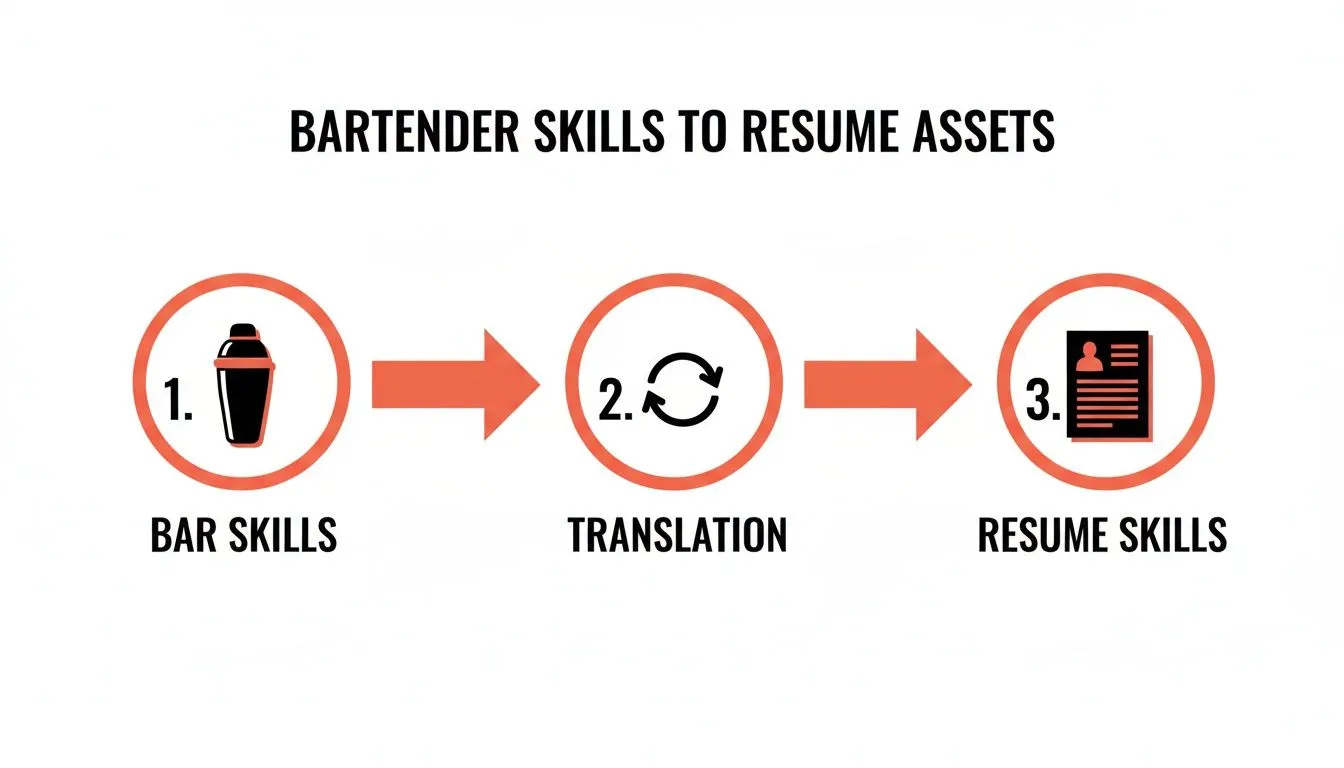
You’re moving from just describing your job to highlighting your business value.
From Weak Bullets to Strong Achievements
Let's get practical. You need numbers, percentages, and results.
Weak Bullet (The Task):
* Mixed drinks and served customers at the bar.
Strong Bullet (The Impact):
* Increased nightly bar revenue by 20% through strategic upselling and menu recommendations, contributing to a $3,000 weekly sales uplift.
Weak Bullet (The Task):
* Managed bar inventory.
Strong Bullet (The Impact):
* Implemented a new digital inventory system that reduced product waste by 30% and cut monthly supply costs by $1,500.
The weak bullets state a task. The strong ones prove a business outcome—more revenue, less waste. That's the language managers understand. Don't undersell yourself. Frame your experience to highlight your true contribution.
Don’t just state what you did. Quantify the result. Metrics are the language of business. They make your contributions undeniable.
Showcasing People Skills with Data
Even "soft skills" can be backed by hard data. You weren't just "handling difficult customers." You were protecting the brand and retaining business.
Think about a time you turned a bad situation around. Instead of a generic bullet point, you get this:
- Resolved 95% of customer escalations directly at the bar, preventing negative online reviews and retaining repeat business through active listening and immediate problem-solving.
This shows you can handle pressure, manage client relationships, and mitigate risk—critical skills that transfer far beyond hospitality. A barman cv filled with points like these proves you can contribute to a business. For a deeper dive on framing your wins, check out our guide on how to write achievements in a resume.
Choosing the Right Bartender Resume Format
Think of your resume format like setting up your bar. If a recruiter can’t find what they need in six seconds, they're moving on.
Stop using flashy, multi-column templates. They break in resume scanners (ATS) and annoy humans. A clean, single-column bartender resume format is your safest and strongest bet. It ensures the machine can read it and the human can scan it.
Getting this right is critical. Bartending is a serious profession, with U.S. employment at 756,700 and projected to grow 6% by 2034. More competition means you must be smarter about your presentation. You can dig into the numbers yourself with the official BLS occupational outlook.
The Chronological Format
This is the industry standard for a reason. It lists jobs from most recent to oldest.
- Who it’s for: The career bartender or anyone building a career in hospitality. It shows a clear history of growth.
- Why it works: It’s what recruiters expect. A clear timeline from "Bartender" to "Head Bartender" tells a powerful story of progression.
The Combination (or Hybrid) Format
This format opens with a powerful summary of your skills before your work history. It grabs attention immediately.
- Who it’s for: The career changer. Pivoting from the bar to corporate sales, client relations, or operations? This is your play.
- Why it works: It translates your skills for a new audience. Lead with "Client Relationship Management," not "Bartender."
Forget the functional resume. Recruiters see it as a red flag. Stick with chronological for a clear path or combination for a strategic pivot. There are no other good options.
Your resume’s format is the foundation of your career story. Choose the one that tells your story most effectively.
Putting It All Together with a Real Resume Example
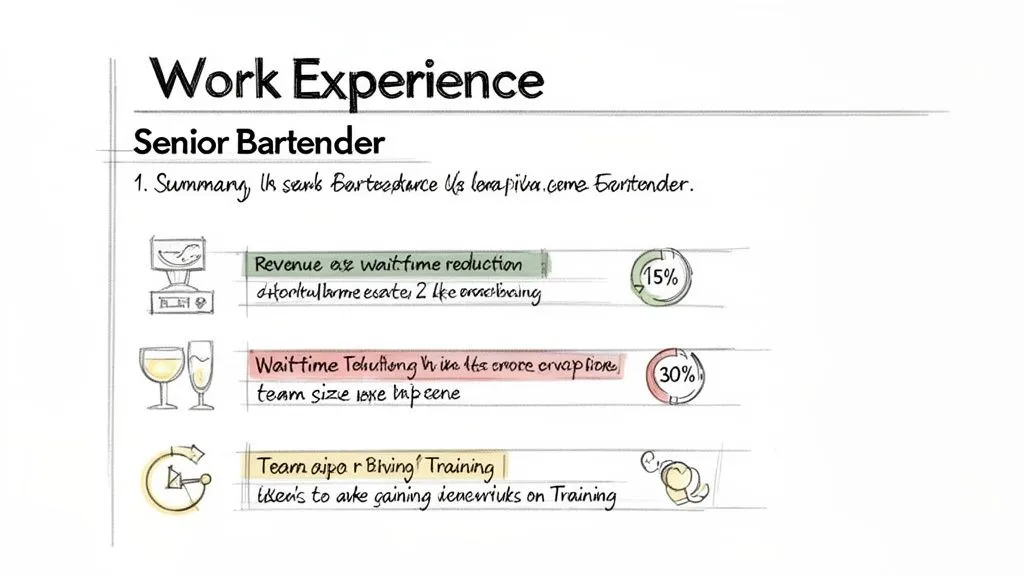
Alright, strategy is done. Let's see what this looks like in the wild. This isn't a fill-in-the-blanks template. It’s an example showing how to frame your impact.
We’ll build out an entry for a senior bartender. Notice how it kicks off with a one-sentence summary, then follows with bullet points that tell a story of achievement. This is how you make your bartender on a resume entry impossible to ignore.
Senior Bartender Example
Senior Bartender | The Alchemist Lounge, New York, NY | 2021 – Present
Managed nightly service for a 150-seat upscale cocktail bar, leading a team of 4 bartenders to deliver an exceptional guest experience and drive revenue growth in a high-volume setting.
- Spearheaded a menu refresh and upsell strategy that increased the average check size by 18%, resulting in an additional $4,000 in weekly sales.
- Reduced average ticket times by 30% during peak hours by redesigning the bar station layout and standardizing our ordering process, improving service for 300+ patrons nightly.
- Trained and mentored 5 junior bartenders on mixology techniques and customer engagement, leading to a 40% reduction in staff turnover and a 25% improvement in positive online mentions.
- Cut monthly supply costs by $1,500 through a new inventory tracking system that minimized waste and optimized purchasing based on sales data.
Breaking Down Why It Works
Each bullet point uses the Context-Action-Impact model. They don’t list a duty; they prove a result.
- The Upsell Bullet: It doesn’t just say "upsold drinks." It shows leadership ("spearheaded") and a clear financial outcome ($4,000/week).
- The Efficiency Bullet: This is more than "made drinks faster." It highlights problem-solving ("redesigning the layout") and a direct business benefit ("reduced ticket times by 30%").
- The Training Bullet: Instead of "trained staff," it demonstrates mentorship and connects it to critical metrics like retention and brand reputation.
- The Cost-Cutting Bullet: This moves beyond a
barman cvthat says "managed stock." It proves you used data to make smart decisions that saved thousands.
Your resume isn’t a logbook of your shifts. It's a highlight reel of your biggest wins. Each bullet point should answer: "How did you make this place better?"
This level of detail is non-negotiable. You need to prove you can do more than just mix drinks. You have to show you can generate revenue and manage chaos.
Use this as your guide. Swap in your own achievements. And if you need more ideas for turning duties into achievements, check out our collection of sample resume bullet points. Stop underselling yourself.
Common Questions, Answered
Let's tackle a few common questions. How you frame your bartending experience is everything.
Should My Bartending Job Be on My Resume for a Tech Role?
Absolutely. But you have to translate it. Stop talking about mixing drinks. Start talking about solving problems.
Your time behind the bar was a crash course in operations, sales, and customer relations.
- Did you master a POS system? That’s proficiency with payment and service software.
- Did you manage inventory with an app? You were handling operational logistics.
- Did you ever calm down an angry customer? That’s high-stakes client management.
Focus on the data, the process, and the people. A bullet point like, "Managed service across a 200-seat bar, using a digital POS to process 500+ transactions nightly with 99.8% accuracy," shows a recruiter you understand tech, process, and precision.
How Far Back Is Too Far for Bartending Experience?
The 10-15 year rule is a guideline, not a law. Relevance matters more than chronology.
If a bartending job from eight years ago was your first management role and you're applying for a team lead position, it’s incredibly relevant. But if it was a short-term gig from a decade ago and you’ve built a corporate career since, it might only need one line or can be dropped.
Your resume is a sales pitch, not a historical archive. If an old role supports your current goal, keep it.
This is especially true for career changers. That older bartending experience might be the only place to show the customer-facing skills your recent desk job doesn't highlight.
Is It Better to Use 'Mixologist' or 'Bartender'?
This depends on who you want to impress. "Mixologist" signals deep knowledge of craft and high-end beverage programs.
Go with a mixologist resume title if you're targeting a role as a Beverage Director, Brand Ambassador, or a Bar Manager at a craft-cocktail bar. For almost every other job—and especially if you're changing careers—"Bartender" is better. It's universally understood and grounds your experience in service, operations, and sales.
When in doubt, mirror the language in the job description. It’s the safest bet.
Tired of guessing how to frame your experience? StoryCV is a Digital Resume Writer that interviews you to uncover the real impact of your work. We turn your bartending experience into a powerful career story that opens doors, no templates or fluff required. Get started for free at https://story.cv.