The most popular advice about a brand management resume is backwards. Fonts and templates matter only after the reader understands what you owned, what changed, and why the business cared.
A launch isn't “managed campaigns.” A share gain isn't “drove brand growth.” Those phrases describe motion, not value. Your resume needs to turn brand work into compact business stories, then make those stories easy for both a recruiter and an applicant tracking system to find.
Why Most Brand Management Resumes Fail
Brand managers rarely lose interviews because they chose the wrong font. They lose because strong work gets flattened into activity lists.
“Managed social campaigns.”
“Partnered with agencies.”
“Supported product launches.”
“Developed brand strategy.”
Every one of those bullets could belong to a coordinator, a generalist, or a director. None tells the reader what you decided, what was at stake, or what improved.
The task-log problem
A brand management resume should prove ownership, scale, and measurable impact. That expectation matches the commercial weight of the function. The U.S. Bureau of Labor Statistics classifies brand management most closely under marketing managers, an occupation with a $161,030 median annual wage in May 2024, a $111,210 25th percentile, and a $211,080 75th percentile, according to this brand manager compensation reference. That spread matters. Stronger resumes need evidence that helps employers place you at the right level.
A task log hides that evidence. It makes a substantial relaunch sound like calendar management. It makes cross-functional leadership sound like meeting attendance. It also weakens ATS relevance because the resume may omit the precise language that describes your actual scope, such as P&L management, market share, trade marketing, brand positioning, consumer insights, or go-to-market strategy.
Recruiters see the same problem from the other side. They're scanning quickly for proof that you can make commercial decisions, not just coordinate deliverables.
Practical rule: Every major bullet should answer four questions: What situation needed attention? What action did you take? What metric changed? What did that change mean for the brand?
The order of operations is simple:
- Structure the story. Make scope and progression visible.
- Write evidence-led bullets. Replace duties with decisions and outcomes.
- Match the role. Use the employer's language where it accurately describes your experience.
- Optimize the mechanics. Make the document easy for ATS software to parse.
Content comes before optimization. A perfectly formatted resume still fails if it says nothing commercially useful.
The Right Structure for a Brand Management Resume
Build the document from the top down. The first third should tell a hiring manager what kind of brand leader you are before they reach the detailed chronology.
Start with a clear commercial identity
Your header needs your name, location, email, phone number, and a direct professional headline. Use a headline such as CPG Brand Manager, P&L and Go-to-Market Strategy or B2B SaaS Brand Leader, Positioning and Demand Generation. Avoid “Marketing Professional” because it gives the reader no lane.
Follow it with a short summary. State your level, category or market, core brand capabilities, and strongest proof point. A useful structure looks like this:
P&L-owning CPG brand manager with experience across consumer insights, integrated campaigns, trade marketing, and cross-functional go-to-market execution. Led brand positioning and launch programs that connected customer research to commercial outcomes.
That summary frames your scope. It doesn't need a career philosophy or an objective statement.
Give keywords a useful home
Place a focused skills section beneath the summary. Group terms by meaning rather than dumping them into a long cloud.
- Brand strategy: Brand positioning, brand architecture, brand equity, consumer insights
- Commercial ownership: P&L management, budget management, trade marketing, promotional planning
- Execution: Go-to-market strategy, agency management, integrated marketing communications
- Analytics and tools: Nielsen, Kantar, Qualtrics, Google Analytics, Tableau
Use only skills you can defend in an interview. Generic soft skills such as “hardworking,” “creative,” and “excellent communicator” take space without adding evidence. Show cross-functional leadership inside the experience bullets instead.
Let experience carry the argument
Use reverse chronology and give each role enough room to show progression. Put brand size, portfolio scope, market context, budget ownership, or category responsibility near the role title or opening line. Then lead with the most consequential result, not the easiest task to remember.
Mid-career professionals should usually keep a resume to 1–2 pages, while entry-level candidates are commonly advised to stay at 1 page. ATS systems generally parse the whole document and don't penalize page count by themselves, as explained in this resume length guidance for ATS.
For a mid-career brand management resume, cut the objective statement, repeated early-career duties, and irrelevant coursework. Keep the market context that helps a reader calibrate your work, such as category, geography, portfolio size, customer type, channel mix, or P&L scope.
Writing Accomplishment Bullets That Prove Impact
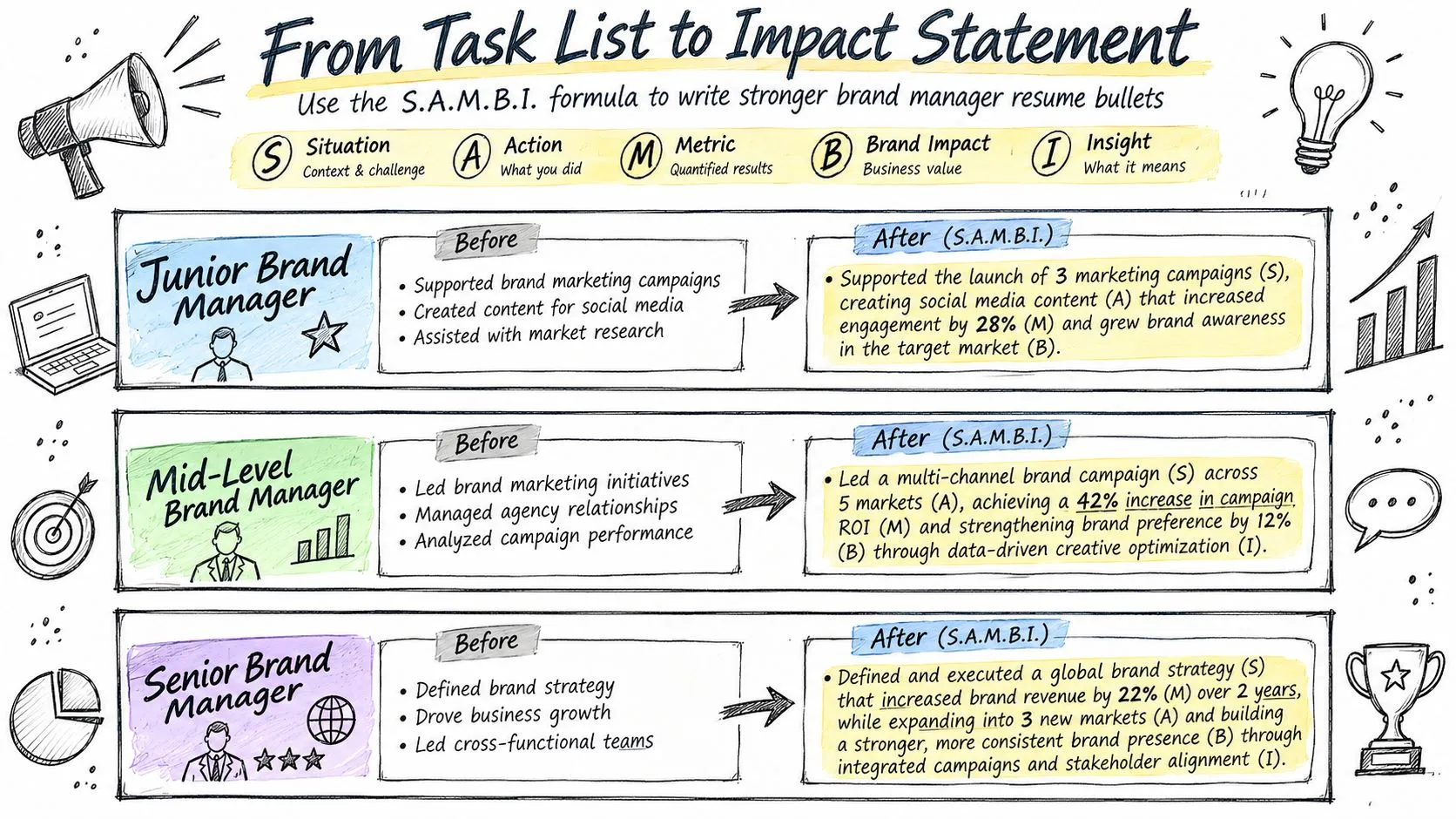
A strong bullet is a mini case study, not a compressed job description. Use Situation, Action, Metric, Brand Impact, or SAMBI, as your drafting filter.
Apply SAMBI at your level
The situation supplies context. The action shows ownership. The metric proves movement. The brand impact explains why the result mattered.
Junior or assistant level
Weak: “Assisted with brand campaigns and social media.”
Stronger: “Supported a seasonal campaign across paid social and retail content, improving campaign conversion rate and giving the brand team a clearer read on which audience messages moved shoppers.”
If you have the number, use it. If you don't, don't invent one. Pull the evidence from campaign reports, performance dashboards, quarterly reviews, launch decks, and budget summaries.
Mid-level brand manager
Weak: “Managed a new product launch with multiple teams.”
Stronger: “Owned go-to-market planning for a new product launch, aligning product, sales, creative, and agency partners around a single positioning platform and tracking launch performance through conversion, retail acceptance, and early revenue.”
The bullet shows the decision system, not just participation.
Senior brand manager or director
Weak: “Led portfolio strategy and worked with senior stakeholders.”
Stronger: “Directed portfolio positioning across priority categories, aligning finance, sales, product, and creative leaders around investment choices that supported portfolio growth, brand equity, and commercial contribution.”
At senior level, your bullets should sound broader. Show trade-offs, resource allocation, portfolio architecture, P&L contribution, and team leadership where those facts are true.
A practical standard is to give every role at least one hard business result, one brand-equity signal, and one market-context detail. That combination keeps the resume commercially grounded without reducing brand work to revenue alone.
For more help turning duties into evidence, use this guide to write achievements in a resume.
Reconstruct the numbers you forgot
Don't rely on memory alone. Open old performance reviews and campaign reports. Search presentation decks for “results,” “lift,” “share,” “budget,” “launch,” “revenue,” and “ROI.” Ask former teammates which metric the leadership team used to judge the work.
Then separate direct ownership from contribution. “Led” means you drove the decision or workstream. “Contributed to” is better when the result belonged to a larger team. Accuracy builds credibility.
Customization also matters. A 2026 dataset reported a 4.23% interview rate for customized applications versus 2.07% for uncustomized applications, roughly a 2x lift, in this resume tailoring benchmark. Your best bullet still needs the right audience.
Lead into the video only after you've drafted at least one evidence-led bullet:
Keywords and ATS Without Losing Your Voice
ATS software isn't the enemy. Treating it like the hiring manager is.
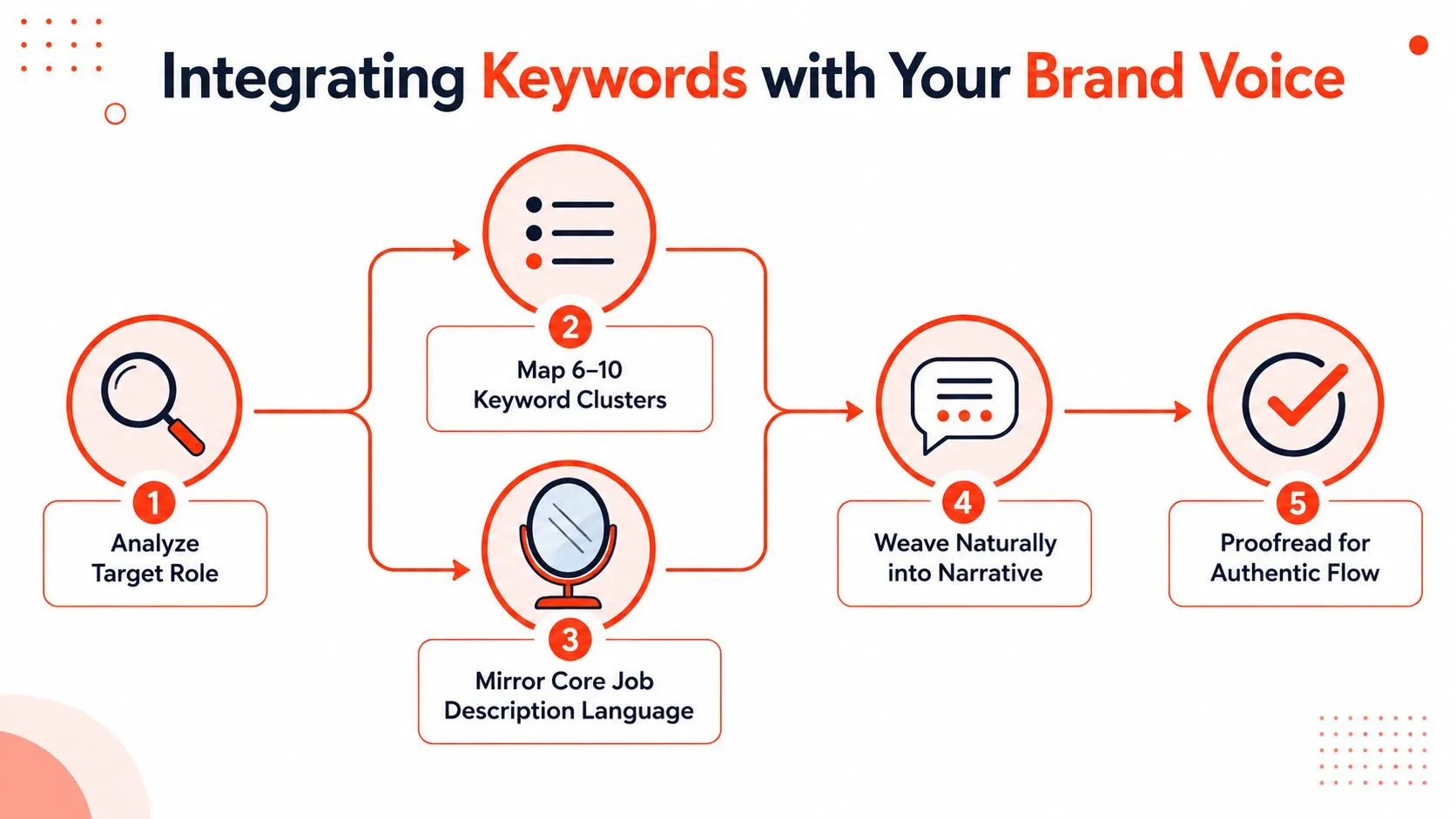
Your job is to make your experience recognizable, not to stuff every phrase from the posting into a skills block. Start by mapping the target role into 6–10 keyword clusters. For a CPG role, clusters might include P&L management, trade marketing, consumer insights, promotional planning, agency management, and market share. For a tech role, they might include brand positioning, go-to-market strategy, product-led growth, demand generation, analytics, and brand guidelines.
Put priority terms where they earn attention
Mirror the job description's core competency language when it accurately matches your work. If the posting says “go-to-market strategy,” don't hide behind “launch support.” If it says “consumer insights,” name the research approach or platform you used.
Place the highest-value terms in three locations:
- Headline: State the target lane and seniority.
- Summary: Include the most important capabilities in natural sentences.
- Top third: Use the strongest matching skills and the opening bullets of your current role.
Then distribute supporting terms through experience bullets. “Used analytics” is weak. “Used Google Analytics and Tableau to evaluate campaign performance and inform channel investment” is clearer, assuming it reflects your actual work.
Aim for a passable document, not a robotic one
One 2026 benchmark recorded an average ATS score of 59.8/100 across 109,672 resumes, with only 40% meeting a 70/100 ATS-ready threshold, according to this ATS resume benchmark. Treat 70+ as a practical target, not a promise of interviews.
Keep contact details in the main document body. Roughly 25% of ATS systems may fail to parse contact information in headers or footers, so a visually clever header can create a very basic problem. Use standard headings such as Summary, Experience, Skills, Education, and Certifications.
Don't use keyword stuffing. Recruiters recognize a resume that reads like a search query. Before submitting, read every keyword-heavy sentence aloud. If it sounds unlike you, rewrite it around a real decision or outcome.
For a focused explanation of keeping keywords natural, see how to avoid keyword stuffing. Get past the automated pass quickly, then spend your time on the content software can't judge.
Tailoring Your Resume for Different Brand Roles
The same experience can signal different value depending on the lane. Tailoring isn't swapping a few keywords. It's choosing which proof points lead.
A consumer packaged goods employer wants evidence of portfolio economics, retail execution, consumer research, and launches. A technology company may care more about positioning, audience expansion, go-to-market, and adoption. An agency looks for client outcomes and campaign performance. A director-level employer wants portfolio strategy, P&L responsibility, and leadership scale.
What to lead with by brand role lane
| Role Lane | Lead With | Signal Metrics |
|---|---|---|
| CPG brand management | P&L ownership, consumer insights, trade marketing, launch execution | Revenue contribution, market share, promotional performance, launch results |
| Tech product branding | Brand positioning, go-to-market strategy, audience expansion, growth programs | Conversion, adoption, retention, NPS, branded demand |
| Agency brand leadership | Client strategy, integrated campaigns, account growth, agency leadership | Campaign ROI, client retention, revenue contribution, delivery scope |
| Senior or director brand leadership | Portfolio strategy, brand architecture, investment choices, team leadership | Portfolio growth, P&L contribution, market context, organizational scale |
Salary data from 2026 shows why this distinction matters. Indeed reported an average U.S. brand manager salary of $91,521, while PayScale reported $53,569 for entry-level compensation and $80,414 for early-career pay, as summarized in this 2026 brand manager resume and salary guide. Quantified ownership helps employers understand the level you're ready to hold.
Rewrite the same experience for the target lane
One experience, framed for CPG:
“Led a cross-functional launch, coordinating consumer insights, trade marketing, sales, and creative teams to support retail execution and commercial performance.”
Framed for tech:
“Owned go-to-market positioning for a new product, aligning product, sales, content, and creative teams around audience messaging and conversion goals.”
Framed for agency:
“Directed client launch strategy across creative, media, and account teams, translating audience insight into an integrated campaign and performance reporting.”
The work may overlap. The lead proof changes.
If your experience spans digital and brand work, this digital marketer resume example can help you decide which evidence belongs in the foreground. For people using AI during that process, this guide to practical AI for better resumes is useful when the goal is editing and comparison, not fabricating achievements.
Common Mistakes and How to Fix Them Fast
Most resume problems are easy to diagnose once you stop treating the document as a design object. Read each bullet as a hiring manager would and ask whether it proves a decision, a result, or useful scale.
Fix the visible failures first
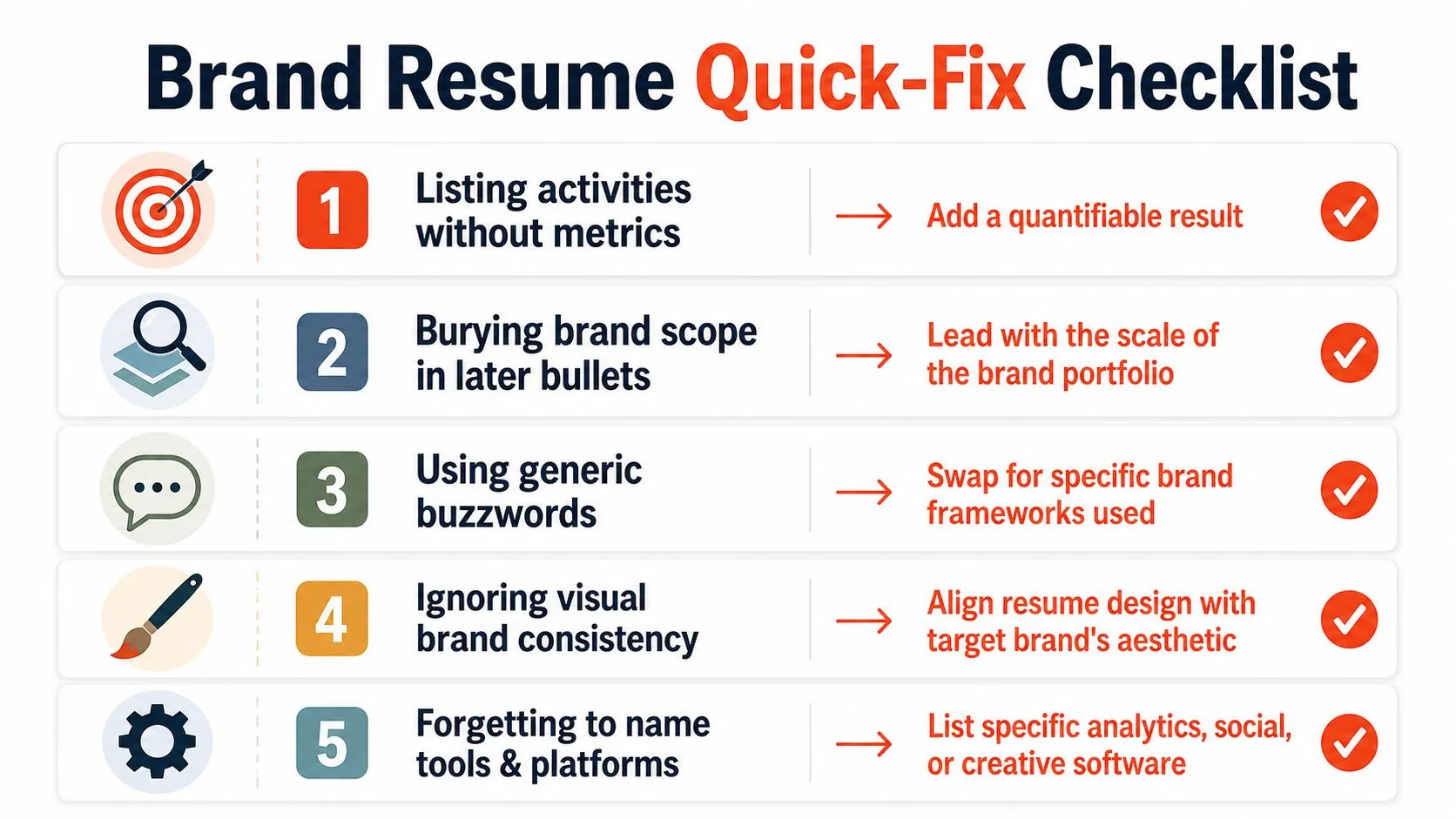
- Activities without metrics: Replace “managed campaigns” with the business result, brand-health change, or operational outcome you can verify.
- Brand scope buried in later bullets: Put portfolio size, category, market, budget, or P&L context in the opening line of the role.
- Contact information in a header: Move it into the document body so parsers can read it reliably.
- One resume for every posting: Create a target version for CPG, tech, agency, or senior leadership roles, then lead with the proof that matches.
- Campaign names without context: Explain the audience, business problem, channel role, and outcome. An internal campaign name means nothing outside your company.
Generic buzzwords create the same issue in a quieter way. “Strategic,” “innovative,” and “results-driven” aren't evidence. Replace them with the frameworks, tools, decisions, and outcomes you can discuss in an interview.
Visual consistency still matters, but keep it subordinate to readability. A clean single-column layout with standard headings is safer than decorative columns, text boxes, or graphics that interrupt parsing. Your personal brand should come through in the writing, not in a complicated layout.
For another perspective on issues that can concern hiring teams, review these resume red flags for tech recruiters. The principle travels across industries: ambiguity makes the reader work too hard.
Use questions instead of guesswork
The fastest way to improve a weak bullet is often to ask better questions:
- What business problem existed before the work?
- What decision did you personally make?
- Which teams, markets, products, or agencies were involved?
- What metric did leadership track?
- What changed for the brand afterward?
Research on structured interviewing supports this workflow. Collecting the same job-relevant information from each candidate improves consistency and predictive value compared with unstructured conversations, which makes guided achievement extraction more reliable than trying to remember everything in one sitting.
Your work was real. The job is making it legible.
StoryCV is an online resume writer, not a template library. It uses a guided interview to uncover the decisions, constraints, achievements, and outcomes behind your brand work, then turns them into clear, ATS-compatible bullets and summaries. Start with one fully written role for free by visiting StoryCV, and make the evidence in your brand management resume impossible to miss.