
Most advice about a business operations resume is wrong. It tells you to list responsibilities, add keywords, and hope the reader connects the dots. They won't.
An operations resume isn't a career history. It's a decision log. The reader wants proof that you handled real process complexity, used real systems, and changed something that mattered.
That matters because hiring is a volume game now. Online job openings get over 250 resumes each, IT roles average around 386 applications, and only about 2% of submitted resumes lead to an interview according to ResumeFast's 2026 resume statistics summary. Your resume doesn't get read like a memoir. It gets skimmed like an incident report.
Why Most Business Operations Resumes Fail to Prove Impact
Business operations resumes fail for a simple reason. They describe activity without proving scope, systems, or decisions.
Ops hiring managers are not looking for generic leadership language. They want evidence that you handled a real operating environment, owned a defined process, made judgment calls under pressure, and produced a result people could see. Resume benchmarks also show a clear gap between resumes that are customized to the role and resumes without tailoring, as noted earlier.

A duty list does not prove anything
“Managed operations” is filler.
It hides the only parts that matter. Did you own order flow for one business unit or redesign workflow across finance, sales ops, and customer support? Did you work inside Excel and Slack, or inside NetSuite, SAP, Salesforce, Jira, and a reporting layer other teams depended on? Did you improve SLA performance and cut exceptions, or did you keep an inherited process running?
That is why so many business operations resumes sound interchangeable. The bullets may be accurate. They still read weak because they leave out operating context.
Here is the difference:
- Weak: Managed vendor relationships and internal processes.
- Stronger: Owned vendor intake and purchase approval workflow across finance, procurement, and department leads; rebuilt routing in the ERP and reduced approval delays by fixing incomplete submissions and handoff bottlenecks.
The stronger version works because it gives the reader enough to judge the work.
The three filters every ops bullet should pass
-
Scope
Show the size of the work. Volume, regions, functions, backlog, cycle time pressure, or number of stakeholders. -
System
Name the workflow or tool. ERP approval chain, CRM hygiene process, KPI dashboard, ticket triage queue, contract routing, inventory reconciliation. -
Decision
Show where your judgment mattered. You changed routing logic, set escalation rules, prioritized exceptions, tightened controls, or standardized inputs.
A strong operations bullet reads like a short case. It gives context, shows what you owned, and makes your decision visible.
Templates are not the problem
Formatting rarely kills an ops resume. Thin recall does.
Candidates remember job titles and broad responsibilities. They forget the details that prove seniority. Monthly transaction volume. Exception rates. A broken handoff between teams. A report leadership actually used. A migration that stopped slipping because someone finally imposed a process.
That is also why generic advice misses the mark for operations people. The resume has to show how you think, not just what sat in your job description.
If a bullet does not answer “what changed, in what system, at what scale, because you were there,” it is still a draft.
Turn Responsibilities Into Evidence With Context and Metrics
Hiring managers do not give ops resumes much credit for task lists. They want proof that you handled scale, worked inside real systems, and made decisions that changed the outcome.
Use a simple bullet structure: context, system, action, outcome.
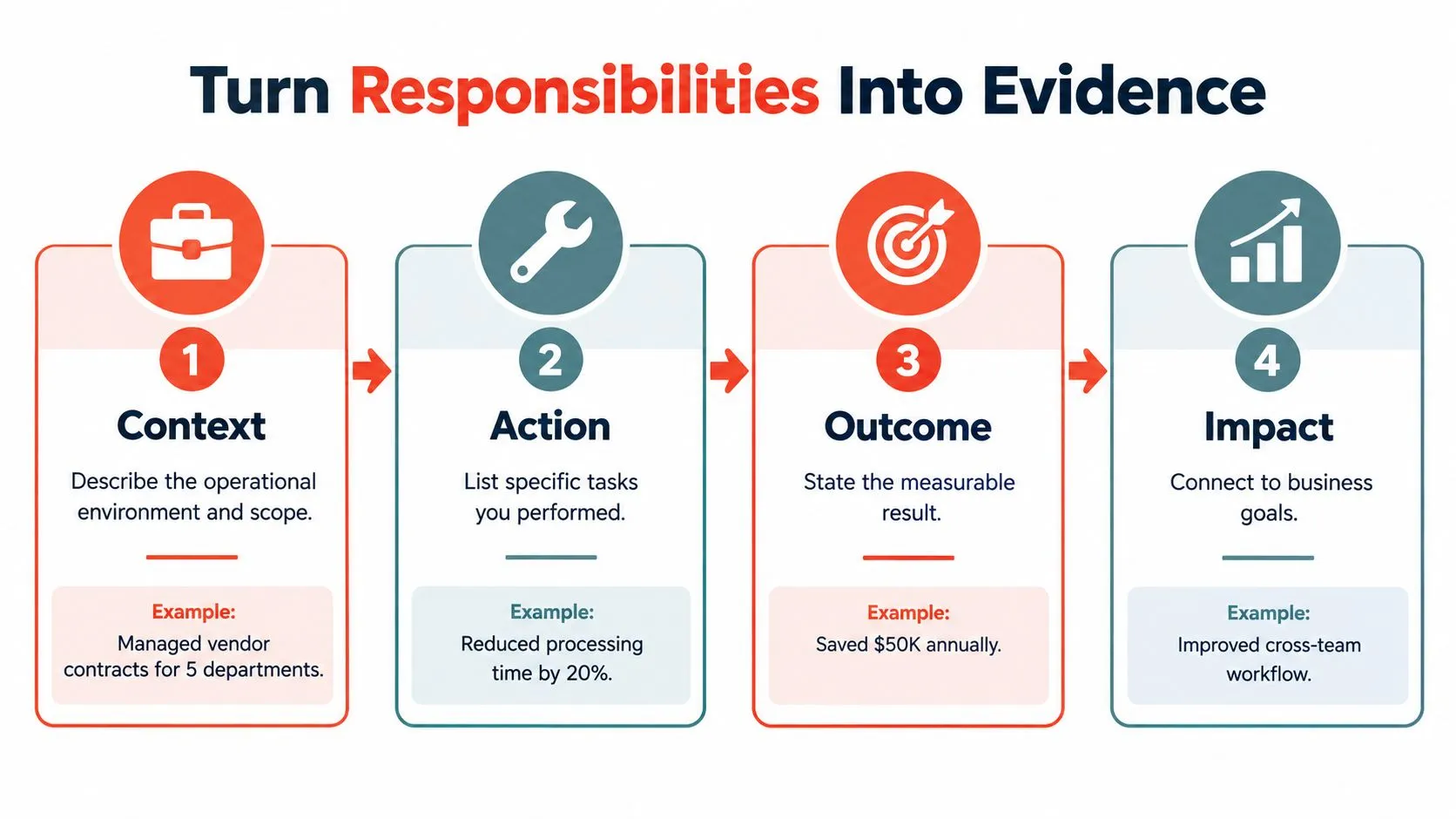
Use this writing pattern
Write each bullet in this order:
-
Context
Show the operating conditions. Volume, backlog, turnaround pressure, number of teams involved, regional coverage, or the recurring failure point. -
System
Name the workflow, tool, or process you owned. ERP approvals, vendor onboarding, CRM hygiene, service queue triage, monthly KPI reporting, contract routing, inventory reconciliation. -
Action
State the call you made. Changed routing logic, tightened inputs, set escalation rules, rebuilt a report, rewrote SOPs, cleaned master data, or standardized handoffs. -
Outcome
Show what changed. Lower error rate, faster cycle time, fewer manual touches, better SLA performance, smaller backlog, cleaner reporting.
That structure forces specificity. It also makes weak bullets obvious. If you want a good benchmark for what measurable resume evidence looks like, review StoryCV's guide to resume metrics that strengthen bullets.
Before and after examples
Process ownership
- Before: Managed order operations for internal teams.
- After: Owned the order exception workflow across sales, finance, and fulfillment; standardized intake rules and escalation paths, which reduced rework and clarified handoffs.
Vendor coordination
- Before: Worked with vendors to solve issues.
- After: Coordinated vendor issue resolution across procurement, finance, and department leads; tracked open dependencies, enforced response cadence, and shortened resolution time by assigning clear ownership.
Reporting
- Before: Created weekly reports for leadership.
- After: Built weekly operations dashboards in Excel and Power BI that combined backlog, SLA, and defect trends into one reporting view leadership used to prioritize issues.
Workflow improvement
- Before: Improved internal processes.
- After: Mapped the intake-to-approval workflow, found repeat failure points in submissions and routing, and redesigned the process to cut manual correction work.
What makes a bullet believable
Generic bullets fail because they hide the hard part. Operations work always has constraints. Bad inputs, broken handoffs, exception queues, conflicting stakeholders, missing ownership, or deadlines that force tradeoffs.
Put that friction on the page.
A good ops bullet reads like a short case file. The reader should see the condition you inherited, the system you touched, the judgment you applied, and the change that followed. That is what signals seniority.
Candidates usually get stuck on recall, not writing. They remember the title and the broad responsibility. They forget the monthly volume, the approval bottleneck, the exception rate, or the report that leadership actually used. StoryCV helps by prompting for those details and turning them into draft bullets. That is useful because the real work is remembering the evidence.
Metrics worth using in operations roles
Every bullet does not need a number. Many should.
Use metrics like:
- Speed: cycle time, turnaround time, queue aging, time to resolution
- Quality: error rate, defect rate, first-pass accuracy, audit exceptions
- Service: SLA adherence, response time, completion rate
- Volume: cases processed, orders handled, vendors supported, sites covered
- Efficiency: cost per transaction, manual touches removed, throughput
If you do not have exact numbers, use defensible scope markers. Name the teams, process, frequency, reporting cadence, or business unit. A precise qualitative bullet beats a fake metric every time.
Make Your Resume Readable for ATS and Humans
ATS panic has broken a lot of resumes.
People stuff in nouns, add awkward skill dumps, and over-format the page until neither a recruiter nor a parser can read it cleanly. That's backward. You need a document that parses well and skims fast.
ATS matters because it's now standard in large employers. A 2025 to 2026 benchmark reports 97.8% of Fortune 500 companies use applicant tracking systems, with Workday used by 39% and SuccessFactors by 13.2% of those companies. Separate 2026 reporting says 75% of resumes never reach a human recruiter because they are filtered out by ATS software first, according to ScoutApply's ATS resume statistics.
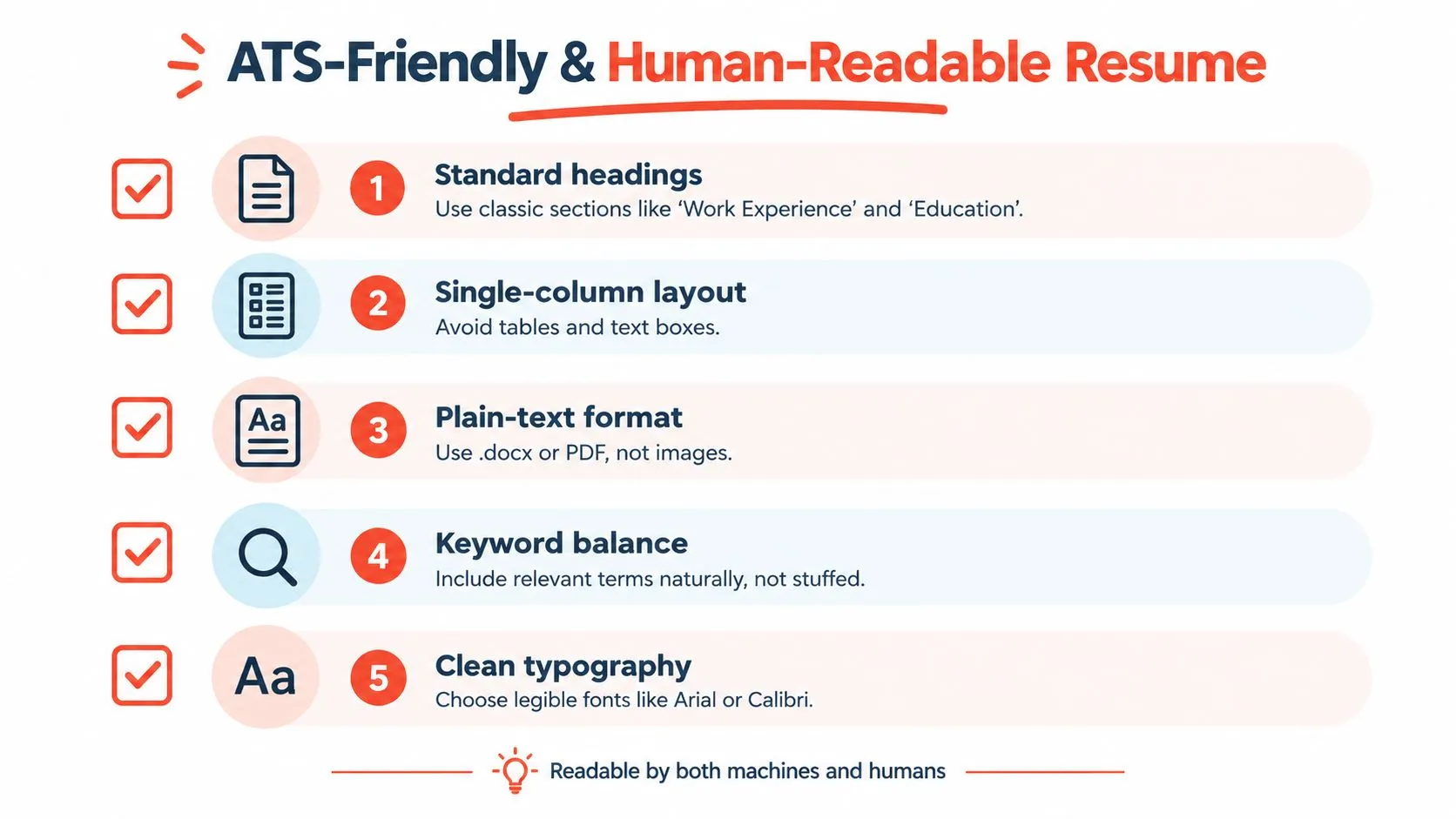
Clean structure wins
ATS-friendly guidance is boring for a reason. It works.
Use:
- Standard headings: Work Experience, Skills, Education
- Single-column layout: No sidebars, tables, or floating text boxes
- Text-based files: Plain .docx or a clean PDF
- Simple typography: Arial, Calibri, Helvetica, Georgia. Nothing decorative.
That lines up with Forbes Advisor's summary of ATS-friendly resume formatting basics.
Don't optimize for a fake robot score
A lot of ATS advice treats screening like a universal pass-fail number. It isn't that simple.
One benchmark found a median ATS compatibility score of 52/100 on first submission, with 44% of resumes below 50 and 28% below 40. A separate scan analysis reported a 71.4% rejection rate and a median resume score of 62/100. At the same time, recruiter surveys cited in 2026 found 92% said their systems do not auto-reject resumes, according to ResumeAdapter's ATS statistics roundup.
The lesson is simple. Don't chase a mythical score. Make the resume easy to parse, then easy to skim.
A quick self-check before you submit
Use this checklist:
- Mirror role nouns: If the posting says vendor management, SLA reporting, ERP, procurement, or process improvement, use those exact terms where they're true.
- Tie keywords to proof: “Power BI” in a skills list is fine. “Built Power BI dashboards used in weekly operations reviews” is better.
- Prioritize ops KPIs: Lead with cycle time, backlog reduction, defect rate, SLA adherence, or cost per transaction where relevant.
- Cut formatting tricks: Icons, columns, graphics, and text boxes make parsing worse.
- Read the top half only: If the first half-page doesn't explain your scope and value, the rest won't save it.
For a deeper pass on structure and keyword matching, StoryCV's article on how to optimize a resume for ATS is a solid companion to this one.
Tailor Your Summary Skills and Bullets to the Posting
Over-tailoring the wrong parts and under-tailoring the right ones is a common mistake.
You do not need to rewrite the whole resume for every application. You do need to tune the summary, core skills, and top two or three bullets so the document matches the role in front of you. That's where the reader decides whether you belong in the pile.
Start with the nouns and verbs that matter
Pull the posting apart fast.
Look for:
- Operating nouns: ERP, procurement, vendor management, supply chain, business process, compliance, reporting, forecasting
- Decision verbs: optimize, streamline, lead, implement, analyze, standardize, monitor
- Proof signals: KPI tracking, SLA management, backlog reduction, cross-functional coordination, dashboard reporting
Then map those to your real work. Not your aspirations. Not the buzzwords you think look senior. Your actual work.
If the role asks for “cross-functional process improvement” and your resume says “supported multiple teams,” rewrite it. The second phrase is passive and forgettable. The first tells the reader what kind of operations work you did.
Tailor the top, not every line
The fastest way to tailor a business operations resume is this:
- Rewrite the summary to match the target role's operating environment
- Reorder the skills so the most relevant systems and workflows appear first
- Rewrite two or three bullets under your most relevant role to mirror the posting's language with proof
That's enough to change the read.
“Tailoring” doesn't mean adding more words. It means making the right evidence easier to find.
Tailoring Decision Matrix for Operations Bullets
| Bullet Type | Keep If | Rewrite Prompt | Example Signal |
|---|---|---|---|
| Direct match | It already names the same workflow or system as the posting | Can I tighten wording to mirror the role's terminology? | ERP workflow, vendor management, SLA reporting |
| Partial match | The work is relevant but too generic | What process did I actually own, and what changed? | Cross-functional coordination with outcome |
| Good result, wrong framing | It has impact but buries the operational context | What was the baseline process, tool, or constraint? | Backlog reduction tied to intake redesign |
| Skills-only bullet | It lists tools or duties without a business result | Where did I use this tool, and for what decision? | Power BI dashboard used for weekly reviews |
| Off-target bullet | It's solid work but unrelated to the posting | Cut it or replace it with a closer example | Leave out unrelated admin filler |
A 30-minute tailoring loop
Read the posting once for meaning, once for language.
Then do this:
-
Circle repeated terms
If “process improvement” appears three times, that's not decoration. It matters. -
Match each term to a real example
If you can't match it, don't fake it. -
Rewrite for specificity
Replace broad phrasing with named systems, process scope, and outcomes. -
Trim anything that steals attention
Old bullets that don't support the target role should shrink or disappear.
Generic keyword stuffing doesn't help. Ops hiring managers can tell when someone pasted in vocabulary without operational context. The right move is tighter evidence, not louder wording.
Example Bullets and Mini Resumes by Seniority and Career Change
The easiest way to improve your business operations resume is to look at what stronger ops writing sounds like.
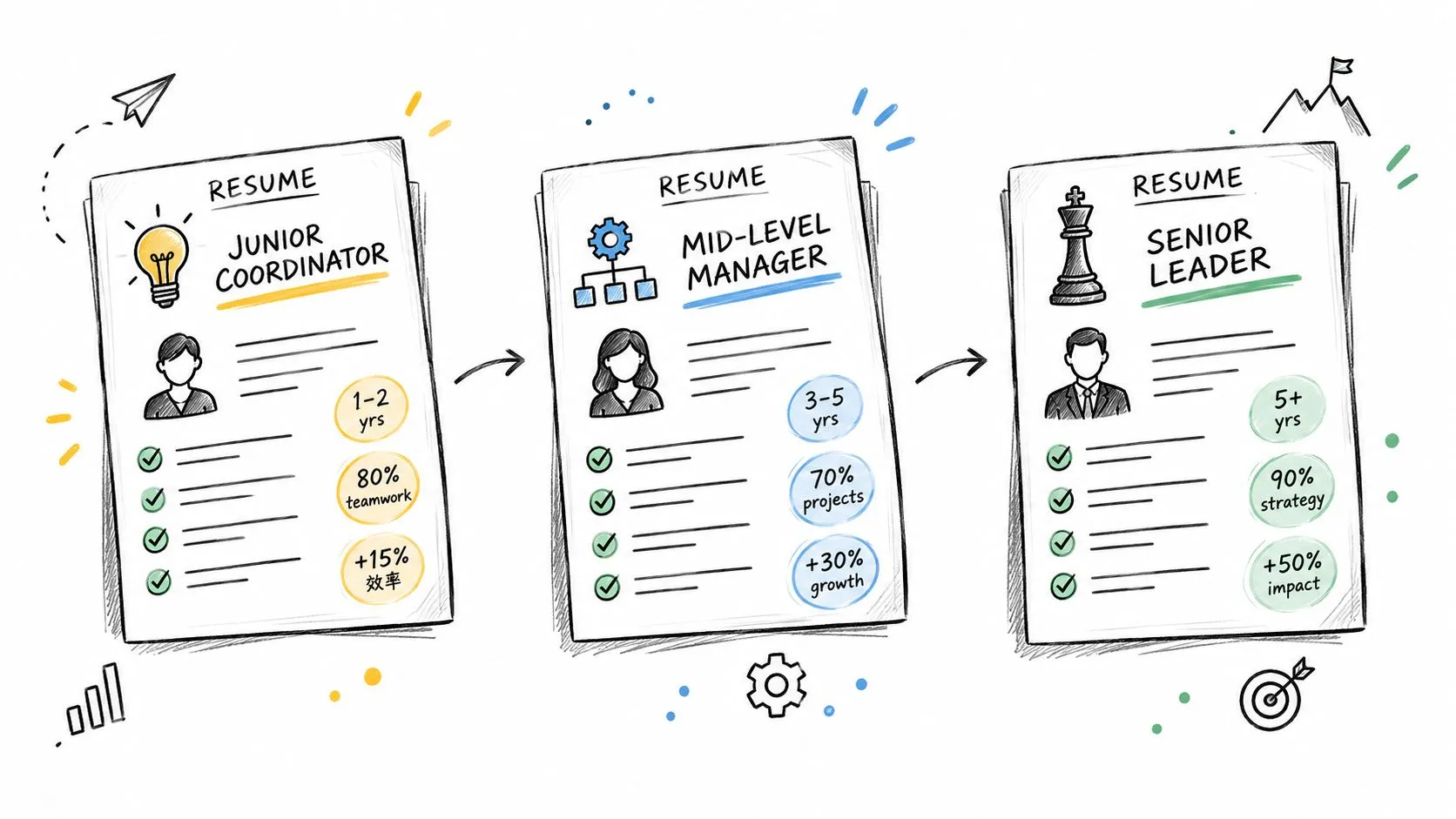
Early-career operations coordinator
This level is about reliability, process ownership, and clean execution. Don't pretend to be strategic if you were mainly running the machine. Show that you understood the machine.
Summary
Business operations coordinator with experience supporting cross-functional workflows, recurring reporting, and process execution across internal stakeholders. Strong in documentation, issue tracking, dashboard upkeep, and follow-through.
Sample bullets
- Coordinated intake and status tracking for internal service requests, keeping stakeholders updated and reducing confusion around ownership and next steps.
- Maintained weekly KPI reporting in Excel, consolidating updates from multiple teams into a consistent operating view for managers.
- Supported vendor onboarding and documentation checks, flagging missing information early to prevent downstream approval delays.
- Updated SOPs and training notes after workflow changes so new steps were documented and easier to follow.
Mid-level operations manager
The resume needs more than execution. It needs judgment.
Summary
Operations manager with experience leading cross-functional process improvement, KPI reporting, vendor coordination, and workflow design across business teams. Known for tightening handoffs, clarifying ownership, and turning messy operational processes into repeatable systems.
Sample bullets
- Owned business process reviews across finance, procurement, and operations teams; mapped recurring failure points and redesigned handoffs to improve turnaround consistency.
- Built reporting rhythms for backlog, SLA, and exception tracking, giving managers a clearer operating view and faster escalation path.
- Led vendor issue resolution across internal stakeholders, using a structured follow-up process to improve accountability and close open items faster.
- Introduced workflow automation where appropriate and documented the surrounding process so the automation stuck.
If you want more operations-specific phrasing, these operations manager resume bullet examples are useful because they stay close to business outcomes instead of empty verbs.
Senior operations lead or head of operations
Senior resumes fail when they become abstract. “Drove strategic initiatives” is dead language.
Summary
Senior operations leader with experience shaping operating cadence, cross-functional execution, systems adoption, and performance reporting. Strong in turning fragmented workflows into accountable operating models.
Sample bullets
- Led cross-functional operating reviews spanning service delivery, finance, and business operations, aligning teams around shared metrics, open risks, and execution priorities.
- Standardized performance reporting across multiple workflows, giving leadership a cleaner view of bottlenecks, backlog pressure, and process health.
- Partnered with functional leads on workflow redesign and systems adoption, balancing process discipline with practical rollout constraints.
- Included AI workflow automation experience where it was true and relevant, especially when the work involved automating repetitive routing, reporting, or triage tasks.
Recent operations resume guidance keeps pushing the same idea: named processes, tools, team scope, and measurable deltas matter. It also notes that candidates should include AI workflow automation experience when true, which is covered in PassTheScan's operations resume guide.
Here's a useful outside reference if you want to compare approaches with a more traditional AI resume builder. Just don't let any builder flatten your work into generic claims.
A quick explainer helps if you want to hear a resume reviewer walk through bullet quality in real time.
Career change examples that still read like operations
Career changers usually have the raw material already. They just label it badly.
Retail to operations
- Ran store-level inventory, scheduling, and issue resolution across daily operations, using recurring reports and exception tracking to keep service levels stable.
- Coordinated vendor deliveries and internal follow-up on stock issues, improving visibility into delays and missing items.
Administrative to operations
- Managed multi-step approval workflows, calendar dependencies, and internal documentation across department stakeholders, improving process consistency and reducing follow-up confusion.
- Built and maintained recurring tracking sheets for requests, status changes, and unresolved items, giving managers a clearer operating picture.
Military to operations
- Coordinated time-sensitive logistics, documentation, and team execution in structured operating environments with clear accountability and process discipline.
- Maintained readiness and reporting standards by enforcing checklists, escalation paths, and procedural compliance across moving parts.
The best resume bullets don't make your work sound bigger. They make it easier to understand.
Final Polish Length Gaps and Your Next Draft
A solid business operations resume is usually shorter than people think and more selective than they're comfortable with.
For most professionals, resume length is typically one to two pages. One page is favored for entry-level and less-experienced candidates, while two pages is accepted for mid-level or senior candidates with substantial relevant experience, according to Resumly's guide to resume length. Other resume advice also says longer resumes are acceptable only when the content stays relevant and targeted, not padded with filler, as noted by Monster's resume length guidance.
Length rules that actually help
Use one page if you're early-career or your relevant experience is still compact.
Use two pages if you've built up useful complexity. Multiple roles, systems ownership, leadership scope, and meaningful process work can justify the space. But every extra line needs a job.
Cut these first:
- Old filler bullets: especially duty-only lines from earlier roles
- Redundant skills: repeated software and vague strengths
- Soft language: “helped with,” “responsible for,” “assisted in”
- Weak summaries: generic profile paragraphs with no operating context
Handle gaps without performing anxiety
Explaining employment gaps too much is a common mistake.
Current 2026 resume advice says short gaps often do not need explanation, gaps of 6 to 12 months may need only a one-line factual entry, and gaps over a year benefit from a resume entry showing productive activity such as freelancing, volunteering, coursework, or certifications, according to Resume Optimizer Pro's guidance on employment gaps.
That's the right approach. Keep dates accurate. Stay factual. Shift attention to current relevance.
Examples:
- Short gap: no special explanation on the resume
- Medium gap: Career Break, relocation and job search
- Longer gap: Independent operations support, volunteer coordination, coursework, certification study
Don't write a defense brief. Write a clear record.
The final pre-send check
Before you submit, ask:
- Is the top third sharp? Title, summary, and first bullets should explain your scope fast.
- Are the systems named? ERP, CRM, Power BI, Excel, procurement workflow, vendor intake, reporting cadence.
- Do the bullets show decisions? Not just duties.
- Did you cut filler? If a line doesn't prove relevance, remove it.
- Is the resume easy to scan? Clean headings, clean sections, no visual gimmicks.
That's enough. Most resumes don't fail because they were missing one more adjective. They fail because they never proved operational value in the first place.
If your work is real but hard to phrase, StoryCV helps you talk through what you owned, changed, and improved, then turns that into resume-ready writing. It's built for exactly this problem: taking messy operational experience and shaping it into clear bullets that prove scope, systems, and decisions.