Most advice on a career transition resume summary is wrong. It tells you to explain yourself.
Bad move. Your summary is not a tiny memoir. It's a fast relevance test.
If you're changing fields, the reader isn't asking whether your journey makes emotional sense. They're asking whether you can solve their problem without a long ramp-up. That's the whole game.
A good career transition resume summary does one job. It turns “unusual background” into “useful candidate.”
Your Summary Fails for One Reason
Most career-change summaries fail because they sound apologetic.
They explain the pivot. They defend the background. They narrate the realization. None of that helps. Indeed notes that 68% of hiring managers spend less than 7 seconds on a resume, and summaries with concrete metrics receive 3x more engagement than summaries built only on soft-skill descriptions. If you spend those seconds on justification, you're done.
Stop telling your story
The popular advice says “tell your story.” That's fine for an interview. It's weak on a resume.
A hiring manager doesn't need your pivot explained in emotional detail. They need a clear answer to three questions:
- What role do you want
- What from your background transfers
- What proof says you can do the job
If your summary opens with “After discovering a passion for…” you've already wasted space.
Practical rule: Replace “why I'm changing careers” with “why I'm a fit for this role.”
Sell the future, not the past
Your old industry isn't the problem. Your framing is.
A weak summary treats the career change like a liability to manage. A strong one treats it like a strategic angle. Teacher becomes facilitator. Retail manager becomes high-volume operations lead. Account executive becomes stakeholder-heavy problem solver.
Here's the difference:
| Weak summary | Strong summary |
|---|---|
| Focuses on motivation | Focuses on contribution |
| Uses soft phrases like “eager to learn” | Uses direct language about skills and outcomes |
| Explains the switch | Connects past work to target-role needs |
| Sounds cautious | Sounds hireable |
The right question to ask
Stop asking, “How do I explain this shift?”
Ask, “What can I help them do on day one?”
That question forces better writing. It cuts out autobiography. It also keeps your tone clean. No hedging. No “although.” No “despite lacking direct experience.” Never volunteer your weakness in the first lines of the resume.
Your summary is a pitch. Tight. specific. A little sharp. That's good.
Uncover Your Hidden Achievements First
You don't have a writing problem. You have a memory problem.
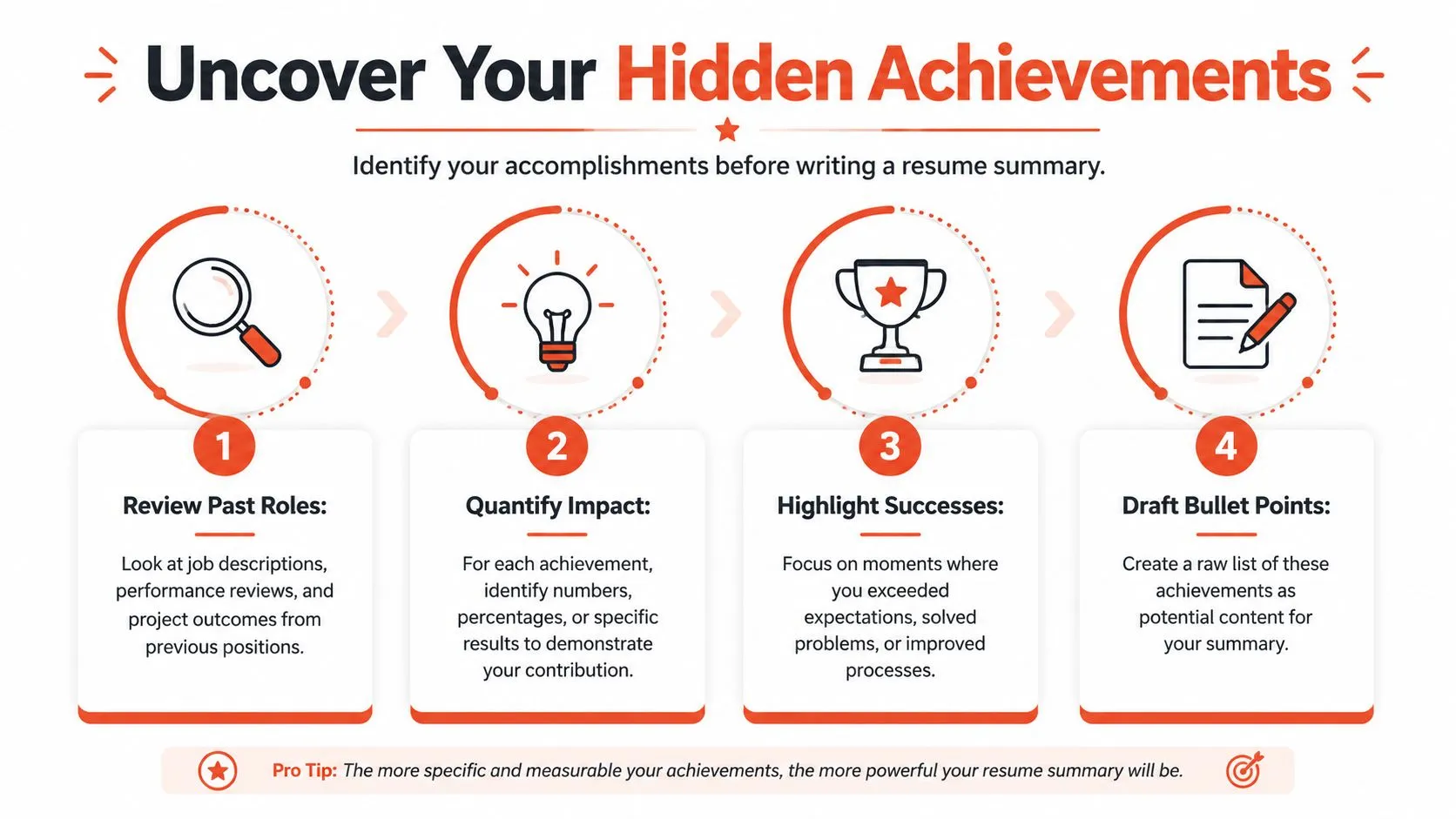
Most mid-career professionals have enough material for a strong career transition resume summary. They just keep reaching for job duties instead of achievements. Duties are dead weight. Achievements create movement.
Run a self-interview, not a writing session
Don't start by drafting sentences. Start by interrogating your work history.
Use prompts that force specificity:
- What did you fix because the old way was clumsy?
- Where did people rely on you when something was slipping?
- What did you build, streamline, teach, or rescue?
- When did you learn a new tool or process fast because the job demanded it?
- Which projects made other people's work easier?
- What result kept repeating because of your work?
These questions surface transferable value. That's what you need.
If you need help turning fuzzy memories into usable bullets, StoryCV's own guide on writing achievements on a resume is useful because it forces you to describe what changed, not just what you were responsible for.
Look for proof, not praise
You don't need grand awards. You need evidence.
Good raw material includes:
- Process improvements: simplified handoffs, reduced confusion, cleaned up workflows
- Cross-functional work: coordinated teams, managed stakeholders, translated between groups
- Training and enablement: onboarded people, documented systems, taught new procedures
- Crisis handling: recovered a late project, calmed a client issue, stepped into a gap
- Ownership: ran operations without hand-holding, managed schedules, kept delivery moving
“I handled communication” is weak. “Coordinated updates across sales, operations, and clients during a messy rollout” is usable.
Build an achievement bank
Make a rough list before you write the summary itself. No polishing yet. Just gather material.
Try this format:
- Situation: what was messy, broken, delayed, unclear, or high-stakes
- Action: what you changed, built, led, taught, or solved
- Outcome: what improved, sped up, stabilized, or got delivered
If you have hard numbers from your own work, use them. If you don't, stay concrete without faking precision. “Reduced back-and-forth across teams” is still stronger than “excellent communicator.”
That's the hidden advantage in a career pivot. You often have more proof than people with the “correct” title. You just haven't translated it yet.
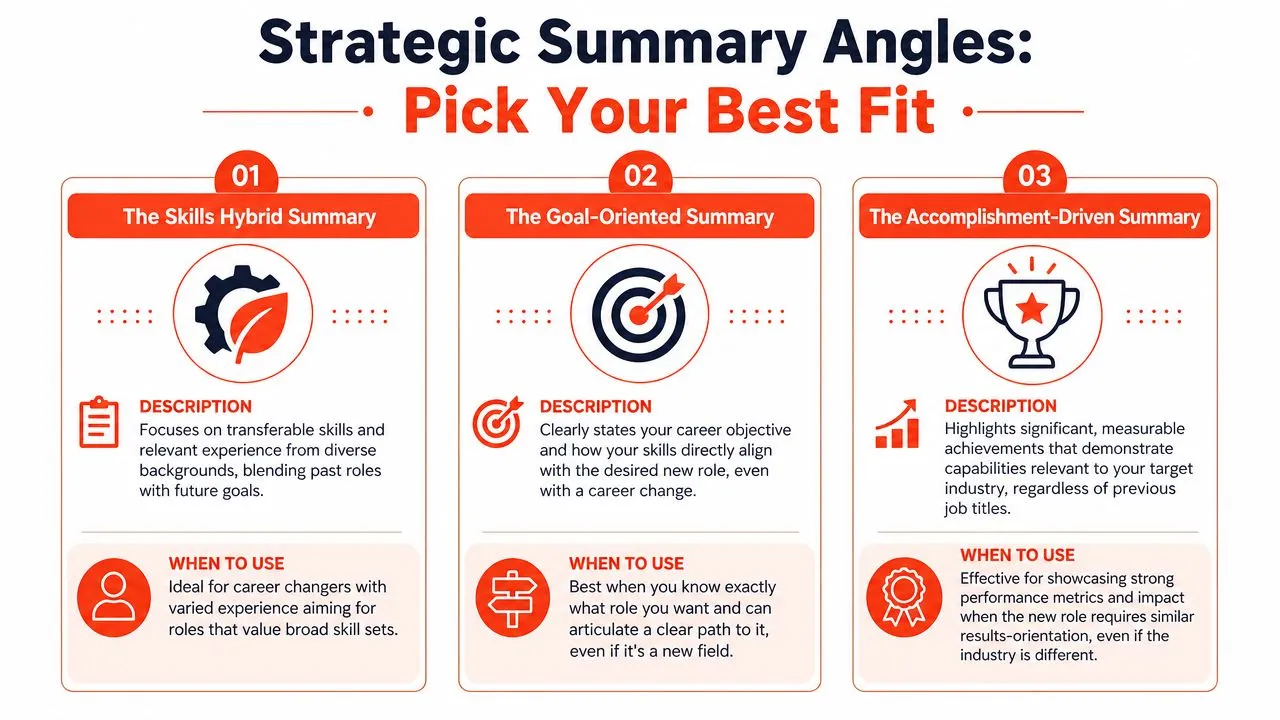
Pick Your Angle The Skills Hybrid or Goal Summary
There isn't one right format for a career transition resume summary. There are better and worse choices based on your pivot.
The mistake is grabbing a template and hoping it fits. Pick the angle that makes your background easiest to understand.
A solid summary also needs structure. ProRes says a high-impact career transition resume summary should name the target role, summarize relevant background, include 2 to 4 industry-matched skills pulled from job postings, and add at least one quantified outcome. That's the baseline.
The skills hybrid summary
This is the most useful option for many individuals.
It works when your old role and target role aren't identical, but the underlying work overlaps. Think operations to project management. Teaching to enablement. Customer support to customer success.
It blends three things:
- your target role
- your strongest transferable skills
- a proof point
Example structure:
Project Coordinator with experience in stakeholder communication, scheduling, and process follow-through across fast-moving service environments. Background in retail operations and team support, with a record of training staff and keeping daily workflows on track. Skilled in cross-functional coordination, documentation, and issue resolution.
Use this when your story needs translation, not reinvention.
A lot of creators use short identity statements to do the same thing across platforms. This piece on understanding statements for creators is useful because it shows how to compress identity and value into a few lines without sounding inflated.
The goal-oriented summary
Use this only when your target is narrow and explicit.
This version is cleaner when you know exactly what role you're pursuing and can name a direct bridge. It can work for someone moving from financial operations into data analysis, or from executive support into project coordination.
It should sound intentional, not hopeful.
| Use it when | Avoid it when |
|---|---|
| You have a single target role | You're applying across several role types |
| You can match your background to the job clearly | Your pivot is still broad or exploratory |
| You want to foreground direction | You need to foreground proof first |
The accomplishment-driven summary
This is the strongest choice if your results are obvious and portable.
If you've led teams, improved workflows, retained clients, trained people, or delivered measurable outcomes, lead with that. The title mismatch matters less when the performance signal is strong.
Example:
Customer-facing operations professional targeting Customer Success roles. Built trust in high-volume service environments, resolved complex issues, and supported retention through clear communication and follow-through. Recognized for improving team consistency and mentoring new staff.
For many career changers, significant work happens in the translation layer. That's why a good list of transferable skills for career changers matters. It helps you rename old work in language the new field recognizes.
Career Transition Resume Summary Examples That Work
Theory is nice. Examples are better.
A career transition resume summary should be short enough to scan and dense enough to matter. A YouTube guide on career change resumes recommends a 2 to 4 sentence paragraph that mentions years of experience, skills, data-backed accomplishments, and relevant certifications, while dropping jargon from the old field in this career-change summary guidance.
Teacher to corporate trainer
Before
Elementary school teacher looking to transition into corporate training. Passionate about helping others learn and grow. Strong communication skills and a desire to bring classroom experience into the business world.
After
Corporate Trainer with 6 years of experience designing lessons, facilitating group learning, and tracking performance outcomes in fast-paced environments. Background in building structured learning plans, presenting to diverse audiences, and adapting materials to different needs. Skilled in facilitation, curriculum design, and stakeholder communication.
Why the second one works:
- Names the target role immediately
- Translates teaching into business language
- Drops vague passion language
- Shows capability without apologizing
Marketing to product management
Before
Marketing professional seeking to pivot into product management after working closely with teams on campaigns and launches. Brings creativity, collaboration, and a strong interest in product.
After
Product Manager candidate with 5 years of experience working across campaigns, launches, and customer messaging in cross-functional environments. Background includes synthesizing customer feedback, aligning teams around go-to-market priorities, and supporting execution across multiple stakeholders. Skilled in market research, roadmap communication, and cross-functional collaboration.
This works because it pulls the right overlap into view. Product hiring teams care about prioritization, communication, user insight, and cross-functional work. That's what the summary foregrounds.
A quick gut check helps here. If the summary sounds polished but strangely flat, review advice on making AI writing undetectable and strip out generic phrasing. The goal isn't to fool anyone. It's to make the writing sound like a competent human who has done the work.
Here's a short walkthrough if you want another perspective on summary wording:
Retail to customer success
Before
Retail professional looking to move into customer success. Great with people, problem-solving, and working in busy environments. Excited to apply customer service skills in tech.
After
Customer Success candidate with 4 years of experience handling high-volume customer interactions, resolving issues, and building loyalty in service-driven environments. Trusted to train new staff, de-escalate problems, and maintain consistent customer experiences under pressure. Skilled in client communication, issue resolution, and relationship management.
Strong summaries don't hide the old job. They reinterpret it.
That's the shift. You aren't erasing your background. You're translating it into the buyer's language.
Write for the ATS Without Sounding Like a Robot
The ATS isn't smart. It's a filter.
And yes, you need to account for it. A 2025 SHRM analysis cited by The Interview Guys says 75% of resumes are filtered by ATS before a human sees them. If you're changing careers, sloppy keyword alignment makes the job harder than it already is.
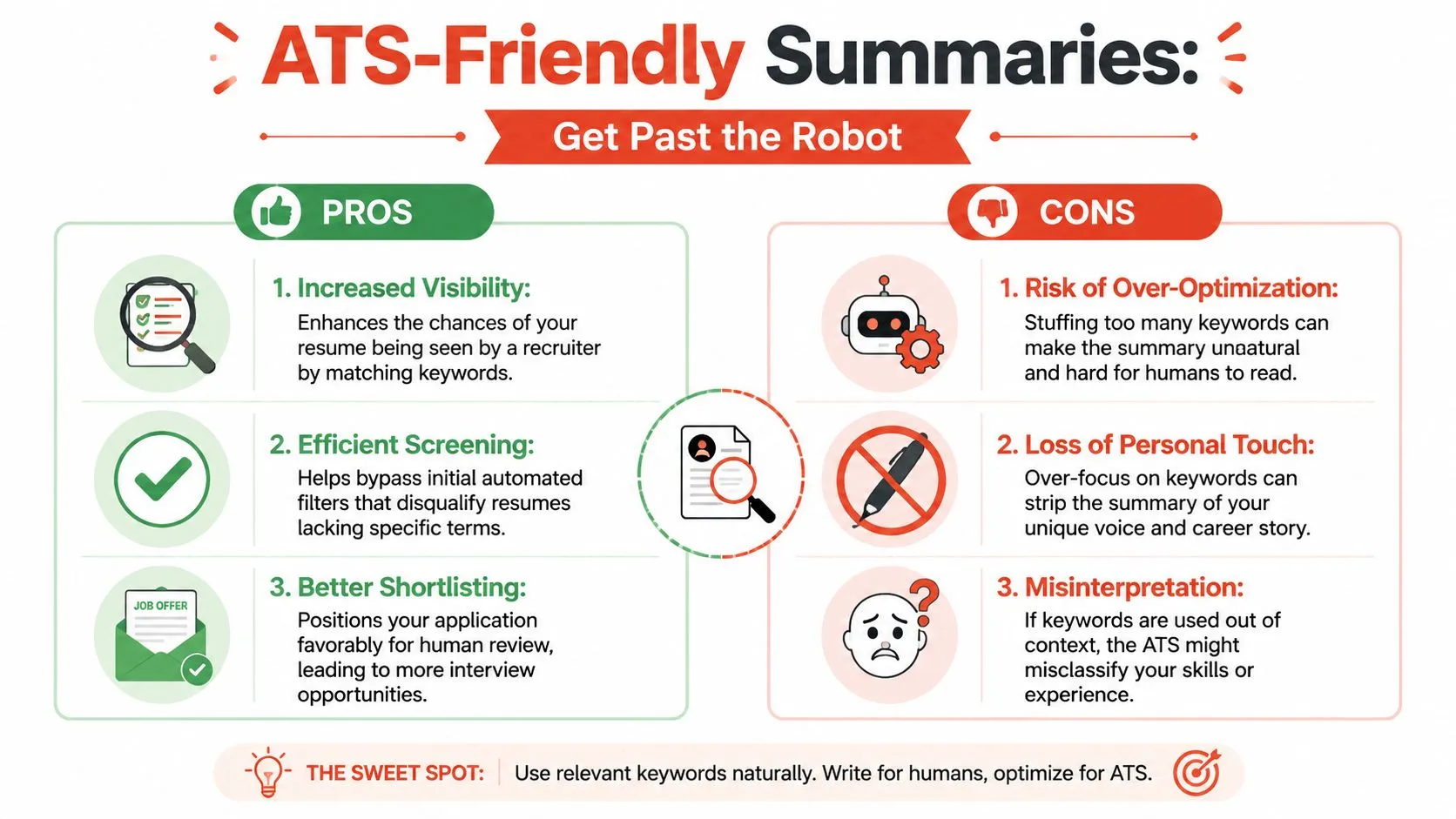
Borrow language. Don't stuff it.
Read several job descriptions for the same role. Pull repeated terms that hold true for you.
Look for phrases like:
- Stakeholder management
- Cross-functional collaboration
- Process improvement
- Client onboarding
- Data analysis
- Documentation
- Training and enablement
Then use those words inside real claims, not as a dead list.
Bad:
“Stakeholder management, communication, leadership, problem solving, teamwork.”
Better:
“Background in stakeholder management, cross-functional coordination, and documentation across service and operations roles.”
Match the role, keep your voice
You want alignment, not mimicry. If the posting says “client retention” and your old field called it “repeat business,” use the term the new field uses. That's not gaming the system. That's translation.
If you're using AI to draft or revise, read the summary out loud. If it sounds synthetic, flatten the inflated wording. StoryCV's explainer on AI resume screening is worth a read because it helps you write for filters without destroying readability.
Don't write for software alone. The software passes you through. A person still decides.
The Final Polish A Sanity Check
Now cut it harder.
Read the summary once as if you're the hiring manager. Then read it again as if you're the recruiter who doesn't know your industry. If either person has to pause and decode it, rewrite it.
Use the ten-second check
Ask these questions:
- Is the target role visible in the first line?
- Can someone spot the transferable skills fast?
- Is there proof, not just personality words?
- Did you remove filler like “results-driven” or “passionate team player”?
- Does it sound confident when read aloud?
Wharton Online recommends putting a skills summary right below the main summary and keeping work experience focused on the most recent two or three jobs, while dropping older irrelevant roles in this career-change resume guidance from Wharton Online. That's smart. It keeps the rest of the resume aligned with the story your summary starts.
One last practical detail. Before sending the file, check the document metadata. This guide on protecting PDF privacy is useful if you want to remove hidden author or file details from the PDF version of your resume.
Your summary doesn't need more personality. It needs more signal.
StoryCV is an Online Resume Writer built for people who've done strong work but need help articulating it clearly. Instead of making you fill boxes, it uses guided prompts to surface real achievements, translate them for the role you want, and turn them into clean, credible resume language fast.