Most computer science student resume advice is bad because it starts with formatting trivia and ends with a keyword checklist.
That misses the underlying problem.
Your resume isn’t weak because you chose the wrong template. It’s weak because it reads like a record of what you studied instead of proof of what you built. Recruiters don’t care that you took Operating Systems, Databases, and Machine Learning. They care whether you used that knowledge to solve something concrete.
A strong computer science student resume does one job. It makes a smart stranger believe you can contribute fast.
Your CS Resume Is Not a Transcript
If your resume is mostly coursework, skill lists, and club names, you’re handing people an academic summary and hoping they imagine the value themselves.
They won’t.
Recent CS grads are already dealing with a rough start. Unemployment for recent computer science graduates is 6.1% as of 2025, and entry-level tech roles have declined significantly, which makes specialized skills and quantifiable achievements much more important on a resume, according to Cengage’s analysis of the computer science graduate job market.
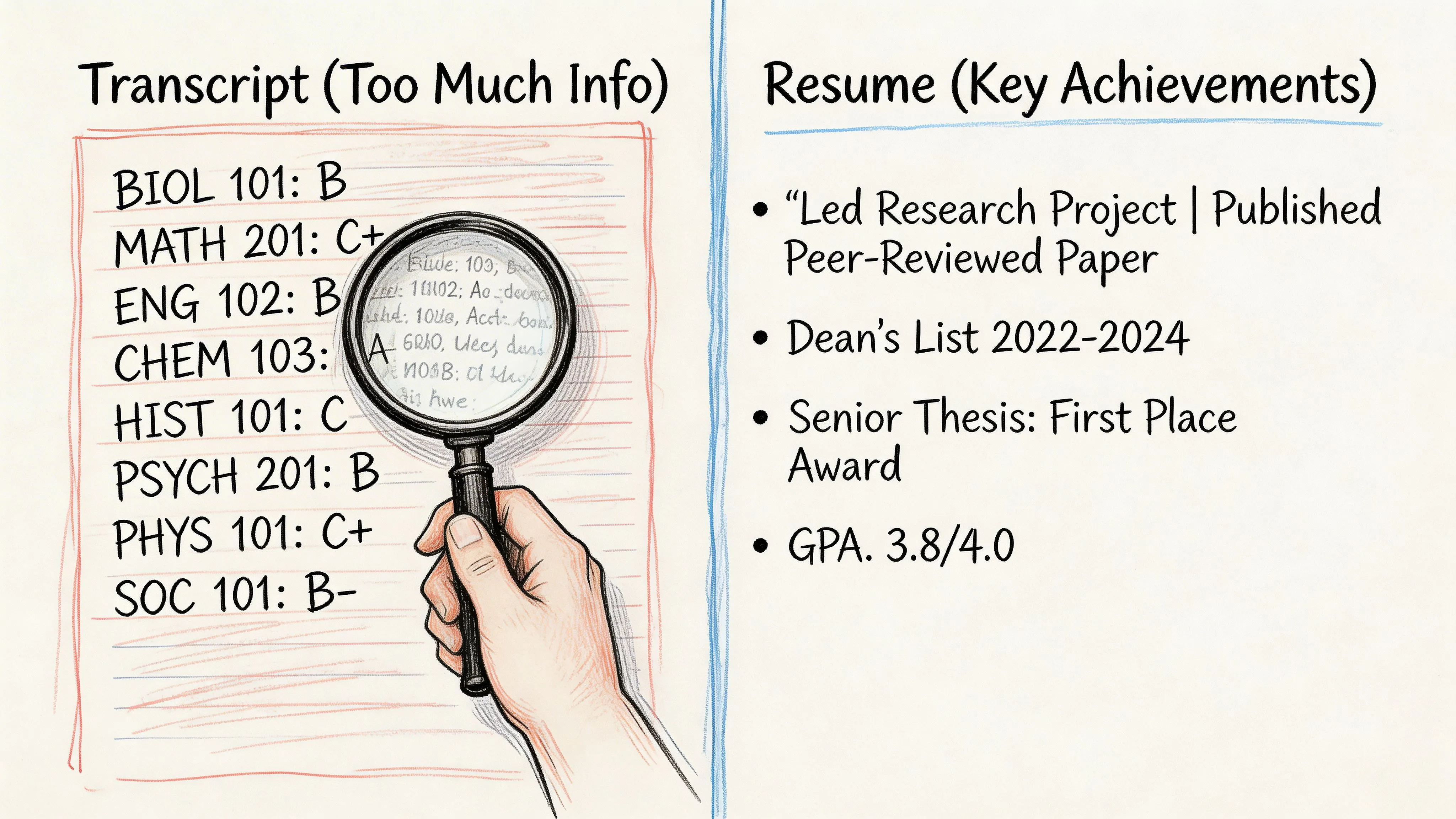
What recruiters actually want
They want evidence that you can do useful work.
That means your computer science student resume should emphasize:
- Projects with outcomes that show what problem you solved
- Internship bullets with context so your work sounds tied to a real team goal
- A focused skills section with tools you can discuss in an interview
- A GitHub profile that backs up your claims
Coursework belongs on the page only if it supports the role. If you’re applying for machine learning work, relevant ML or data courses can help. If you’re applying for backend roles, listing Intro to Programming and Discrete Math adds nothing.
Stop trying to fill space
Students make the same mistake over and over. They think an empty line is dangerous, so they pad the page with every language they’ve touched and every class they’ve passed.
That’s backwards.
Three strong projects beat fifteen vague skills. One internship bullet with business context beats a block of generic responsibilities. A resume should feel selective. Selective reads as confident.
Your resume is not a memory dump. It’s an argument.
Here’s the simple test. If a bullet could apply to half your graduating class, delete it.
Bad:
- Took courses in algorithms, databases, and software engineering
- Familiar with Python, Java, C, C++, JavaScript, React, Node.js, Docker, Kubernetes, AWS
- Built several academic projects
Better:
- Built a campus scheduling tool that automated timetable conflict checks for student users
- Implemented API endpoints and authentication for a team project used by a student organization
- Optimized database queries in a class system project and documented the tradeoffs
The first version tells me you attended school. The second tells me you can build.
The One-Page One-Column Mandate
Use one page. Use one column. Skip the clever layout.
That’s not old-fashioned advice. It’s practical.
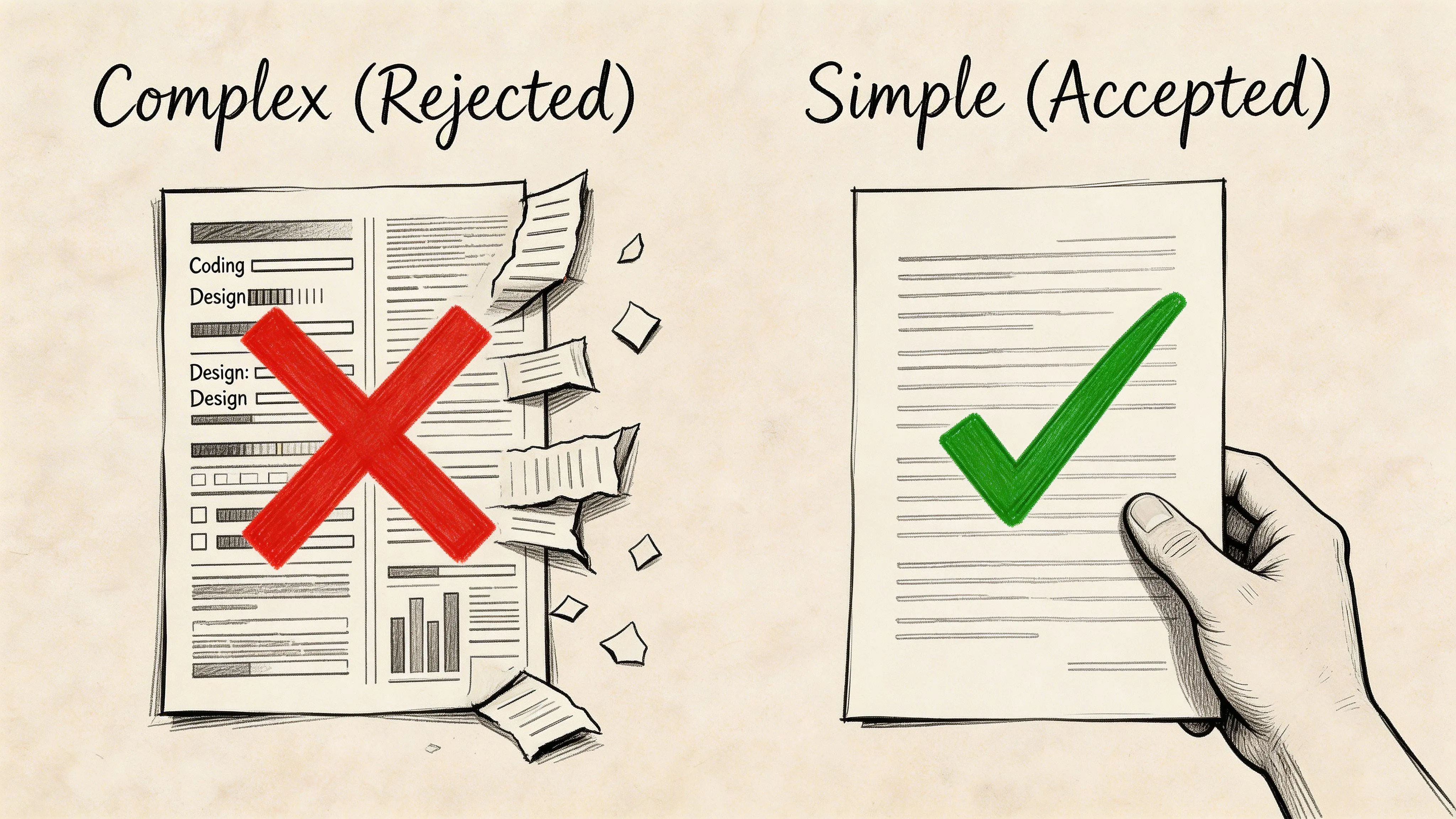
A student resume has one job during the first scan. It needs to be read fast by software and by a human. Fancy sidebars, icon grids, progress bars, photos, and multi-column templates make both harder.
If you’re still wondering whether length is negotiable, this breakdown on can a resume be 2 pages gives the broader rule. For students, the answer is almost always no.
The format that works
Use this order:
- Name and contact
- Education
- Skills
- Projects
- Experience
- Optional extras, only if they matter
That order is not sacred for every person, but it’s the right default for most students. Education belongs high because you’re still in school or recently graduated. Projects belong above weak experience because they usually provide better proof of skill.
A clean layout also forces discipline. That’s good. If something doesn’t make the cut, it probably wasn’t helping.
What to remove immediately
Cut these first:
- Skill bars because “Python 80%” is nonsense
- Two-column templates because they break reading flow
- Objective statements because most say nothing
- Dense coursework lists unless they directly support the target role
- High school details unless you’re very early and they’re unusually relevant
A resume should be plain enough that nobody notices the design.
Practical rule: If the template is doing the work, the content probably isn’t.
You can also keep the mechanics simple. Clean fonts like Arial or Calibri are fine. Bold headings are fine. PDF export is fine. No tables. No graphics pretending to be data.
This quick video explains the same idea in a more visual way:
The best computer science student resume rarely looks impressive at first glance. It reads clearly. That matters more.
Projects Are Your Real Work Experience
Most students sabotage their best material.
They know projects matter, so they include them. Then they describe them like this:
- Built a to-do app using React and Firebase
- Created a chatbot in Python
- Made a web scraper with BeautifulSoup
- Worked on a hackathon team project
That tells me almost nothing.
Career advice often says to include projects, but it usually stops there. It doesn’t explain how to frame them as evidence of capability. As BeamJobs notes in its computer science resume examples, recruiters care less about titles and more about what you can build. The problem is that most students never translate projects into useful narrative.
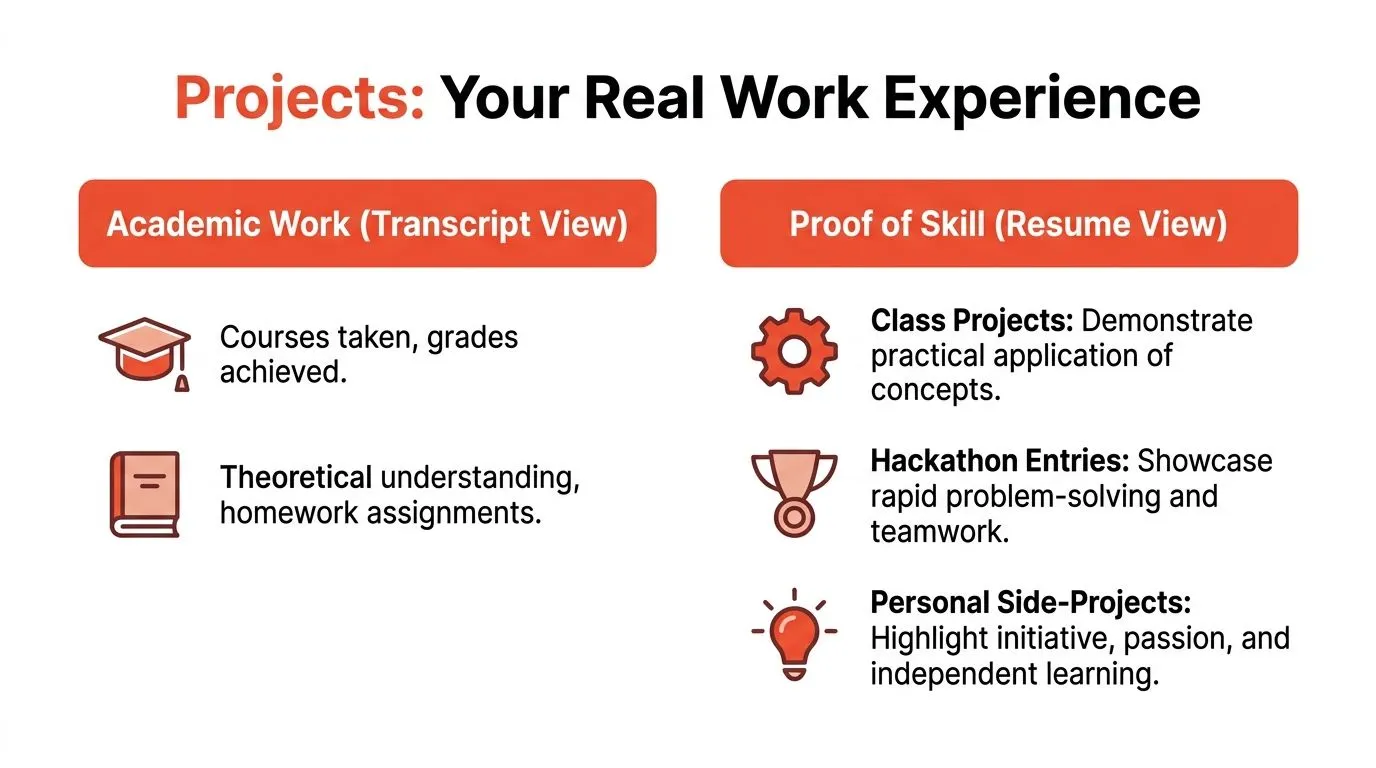
The only project formula you need
Every bullet should answer three things:
| Question | What to write |
|---|---|
| What problem existed | The user pain, workflow issue, technical bottleneck, or goal |
| What you did | The tools, architecture, implementation, or decisions |
| What changed | The result, performance gain, time saved, reliability improvement, or adoption outcome |
If you can’t answer all three, the bullet is incomplete.
Before and after examples
Here’s how students usually write project bullets, followed by how they should write them.
Weak
- Used React and Firebase to build a to-do app
Better
- Built a task management web app in React with Firebase authentication and real-time sync, simplifying task updates across devices for student users
Weak
- Created a Python scraper for collecting data
Better
- Developed a Python scraper that automated repetitive data collection, replacing manual copy-paste work and producing a reusable dataset for analysis
Weak
- Made a chatbot using NLP
Better
- Implemented a chatbot prototype with NLP techniques to answer common support questions, reducing the need for manual responses during testing
Weak
- Participated in a hackathon and built an app with friends
Better
- Collaborated in a hackathon team to ship a working prototype under deadline, handling backend API integration and debugging deployment issues before final demo
The second versions work because they describe usefulness, not just technology.
Treat class assignments like product work
A class project can absolutely count. But don’t present it like homework.
Bad:
- Database Management System project for course requirement
Better:
- Designed and implemented a relational database system for a campus use case, modeling entities, writing SQL queries, and improving data retrieval for common user actions
Bad:
- Machine learning final project
Better:
- Built an ML classification project from data cleaning through evaluation, comparing model performance and documenting tradeoffs in feature selection
You’re not lying by framing academic work this way. You’re clarifying why it mattered and what you did.
Pick fewer projects and go deeper
Most students should feature three to five strong projects. Not eight. Not twelve.
Choose projects that prove one of these:
- Technical depth with real engineering decisions
- Initiative because you built it outside class
- Collaboration because you worked with a team
- Relevance to the role you want
Then rewrite every bullet using the impact-first approach. If you need help thinking in outcomes, this guide on resume metrics is useful because it pushes you past vague verbs.
Don’t list technologies like badges. Use them to explain how you solved a problem.
The best project section on a computer science student resume makes the reader think, “This person already works like an engineer.”
Translate Your Internship into Business Impact
Students undersell internships because they describe tasks instead of outcomes.
“Fixed bugs.”
“Wrote tests.”
“Worked on frontend features.”
“Helped the team with deployment.”
That’s not useless, but it’s weak. It reads like you were nearby while work happened.
Recruiters move fast. They spend about 6 to 7 seconds on the initial resume scan, and resumes that quantify achievements can secure 2.3 times more interviews, according to the CareerVillage summary citing LinkedIn data.
The rewrite that changes everything
For each internship bullet, ask:
- What system, feature, or workflow did this affect?
- Who used it?
- What improved because I touched it?
- What did my manager care about?
- Was this about speed, quality, reliability, maintainability, or support load?
Now rewrite.
Instead of:
- Fixed bugs in internal dashboard
Write:
- Resolved high-priority issues in an internal dashboard used by operations staff, improving reliability for day-to-day reporting workflows
Instead of:
- Wrote unit tests for authentication module
Write:
- Added unit tests for the authentication module, reducing regression risk in a critical user flow and making releases safer for the team
Instead of:
- Worked on API development
Write:
- Implemented and documented API endpoints for internal services, helping the team ship integrations with clearer contracts and fewer handoff issues
How to find metrics when nobody gave you metrics
You may not have exact numbers. That’s fine. Don’t invent them.
Use qualitative impact if that’s all you have:
- cut manual work
- improved reliability
- reduced debugging time
- simplified deployment
- supported faster testing
- made onboarding easier for teammates
If you do have real numbers from your internship notes, tickets, dashboards, or pull requests, use them. If you don’t, describe the operational effect.
A junior internship bullet can still be strong if it shows context.
A manager reads for leverage
Managers don’t hire interns and new grads because they expect mastery. They hire for usefulness.
That means your bullet points should show impact. Did your work save somebody time? Reduce risk? Make a system easier to maintain? Support customers better? Help the team ship?
A good internship bullet connects your code to a team outcome.
That framing matters more than trying to sound senior. Nobody expects you to have led an org-wide migration. They do expect you to understand why your work mattered.
Your GitHub Is Your Real Resume
A GitHub link on a computer science student resume is not optional. But a bad GitHub can hurt you.
If your profile is a junk drawer full of half-finished repos, broken README files, tutorial clones, and mystery commit histories, don’t expect it to help.
With hiring leaning toward specialists in areas like AI, cloud, and cybersecurity, a curated portfolio matters. The U.S. Bureau of Labor Statistics projects 36% growth for data scientists and 17% growth for software developers through 2033, and a strong GitHub profile is one of the clearest ways to show hands-on ability in those areas, as summarized in this 2025 CS job market write-up.
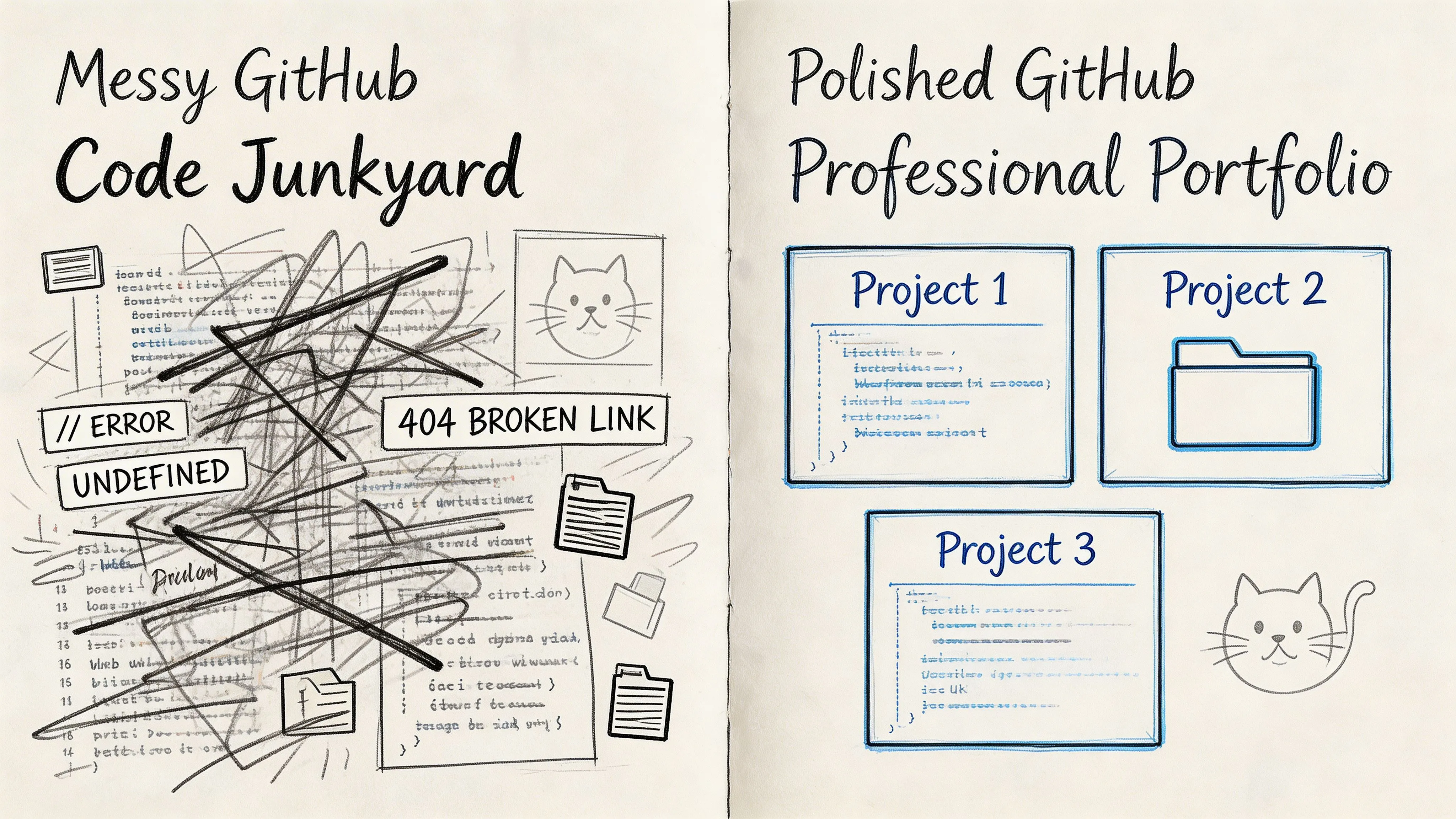
What a recruiter should see in thirty seconds
Pin your best three or four projects. Make them relevant to the kind of role you want.
If you want backend roles, pin backend work. If you want data roles, pin data or ML projects. If you want security work, show security-oriented projects or tooling.
Then fix the basics.
- Write a real README with what the project does, why it exists, how to run it, and what stack it uses
- Clean the repo by removing abandoned branches, secrets, junk files, and empty placeholders
- Use meaningful names for repos, folders, and files
- Show active thinking through clear commit messages and issue notes where appropriate
Treat each repo like a product page
A strong README should answer this fast:
| Item | What to include |
|---|---|
| Problem | What the project solves |
| Stack | Python, React, Docker, PostgreSQL, TensorFlow, whatever you actually used |
| Setup | Simple run instructions |
| Features | What it can do |
| Notes | Tradeoffs, limitations, or future improvements |
That alone puts you ahead of a lot of students.
Also, don’t pin throwaway tutorial projects unless you seriously extended them. Recruiters can spot clones. They want to see judgment, not copy-paste stamina.
Your GitHub should confirm your resume, not contradict it.
If your resume says you built APIs, your GitHub should show API work. If your resume says you care about ML, there should be evidence beyond one imported notebook.
Tailoring and the Truth About ATS
Students obsess over ATS and miss the obvious fix. Write a resume that is relevant, specific, and easy to parse.
That’s it.
You do not need keyword soup. You do need alignment.
According to Indeed’s computer science resume guidance, customized resumes with clear metrics pass ATS scans in 89% of cases, compared with 45% for generic ones, and that approach can drive a 40% higher interview rate for entry-level software roles. Their advice also points to a practical targeting method: reverse-engineer the job description for 10 to 15 key phrases and skills.
How to tailor without rewriting from scratch
Read the job description once for substance, then once for language.
Pull out:
- core tools
- core domain terms
- required workflows
- expected outcomes
Then adjust your resume in small, honest ways:
- Reorder bullets so the most relevant projects appear first
- Mirror language from the posting if it matches your real experience
- Trim unrelated material that distracts from fit
- Move matching skills upward in the skills section
If the role says APIs, say APIs, not “service communication layer.” If it says data visualization in Tableau and you’ve done that work, use that exact phrasing.
ATS is not the enemy
The machine is looking for signals. The human is looking for judgment.
A stuffed resume fails both.
Broader CV guidance can still help, especially if you’re applying across academic, research, and industry contexts. The Women in STEM Network has a useful primer on how to write a CV that helps clarify when a longer academic document makes sense and when a concise resume is the better move.
For industry roles, stick to the one-page resume and tailor it cleanly. This walkthrough on tailoring your resume to a job description is the right habit to build because it focuses on matching real evidence to the role, not gaming software.
The best way to pass ATS is to describe work you actually did in language the employer actually uses.
That’s the whole game.
If you’ve done solid work but can’t turn it into sharp, credible resume language, StoryCV helps you write it like an actual professional. It’s a Digital Resume Writer, not a template toy. You answer smart prompts, it pulls out the context and impact, and you get a resume draft that sounds like you on your best day.