The most repeated advice about a nursing student resume is also the least helpful: “quantify your achievements.”
Nice idea. Useless if your experience was mostly supervised clinicals, simulation labs, short rotations, and part-time jobs that had nothing to do with a hospital.
You still need a strong resume. You just need to stop pretending your first resume should read like an experienced RN's. A good nursing student resume doesn't fake senior-level impact. It proves you're safe, trainable, observant, organized, and ready to work under supervision without creating problems for the team.
That's the standard. Not “passionate.” Not “hardworking.” Not “I love helping people.”
Your Resume Is an Argument Not a Transcript
Hiring managers do not care that you completed Nursing 201, passed Pharmacology, and joined the student nurses association.
They care whether your resume gives them a clear reason to trust you with real patients, real protocols, and a team that does not have time to babysit a new hire.
That is the standard. Your resume needs to argue that you are safe, coachable, observant, and useful under supervision. If it reads like a school record, it fails.
Stop treating education like proof
Your degree belongs on the page. A list of classes usually does not.
Students keep stuffing resumes with coursework because they think a thin resume has to be padded. Wrong move. If you do not have paid nursing experience yet, your job is to translate what you did in clinicals, labs, simulations, campus roles, and regular jobs into evidence of competence.
Good evidence includes:
-
Clinical context: rotation sites, units, patient populations, and supervising organization
-
Readiness markers: BLS, CNA status, CPR, EHR exposure, documentation practice
-
Observed and practiced work: patient communication, vital signs, infection control, mobility support, reporting changes, handoff participation
-
Reliable work habits: punctuality, documentation accuracy, follow-through, calm behavior under pressure
That is what gives a hiring manager something to work with.
Use the top of the page to make your case
An objective statement wastes space because it talks about what you want. Your summary needs to explain why you are worth interviewing.
Keep it short. Make it specific. Name your training, your strongest clinical exposure, and the kind of contribution you can make on day one under supervision.
Bad:
Nursing student seeking a role where I can utilize my skills and grow professionally.
Better:
BSN student with supervised clinical experience in med-surg and community health, BLS certified, trained in vital signs, patient communication, documentation, and basic care support. Recognized for accurate follow-through, calm communication, and clear reporting to instructors and staff nurses.
That works because it proves judgment. It does not pretend you already function like an experienced RN.
If you want a broader look at the role of a resume in job applications, read that before you start polishing empty buzzwords. A resume decides whether your application gets a serious look.
A strong student resume does not fake experience. It turns supervised work, observation, simulation, and unrelated jobs into credible proof that you can be trusted in a clinical setting.
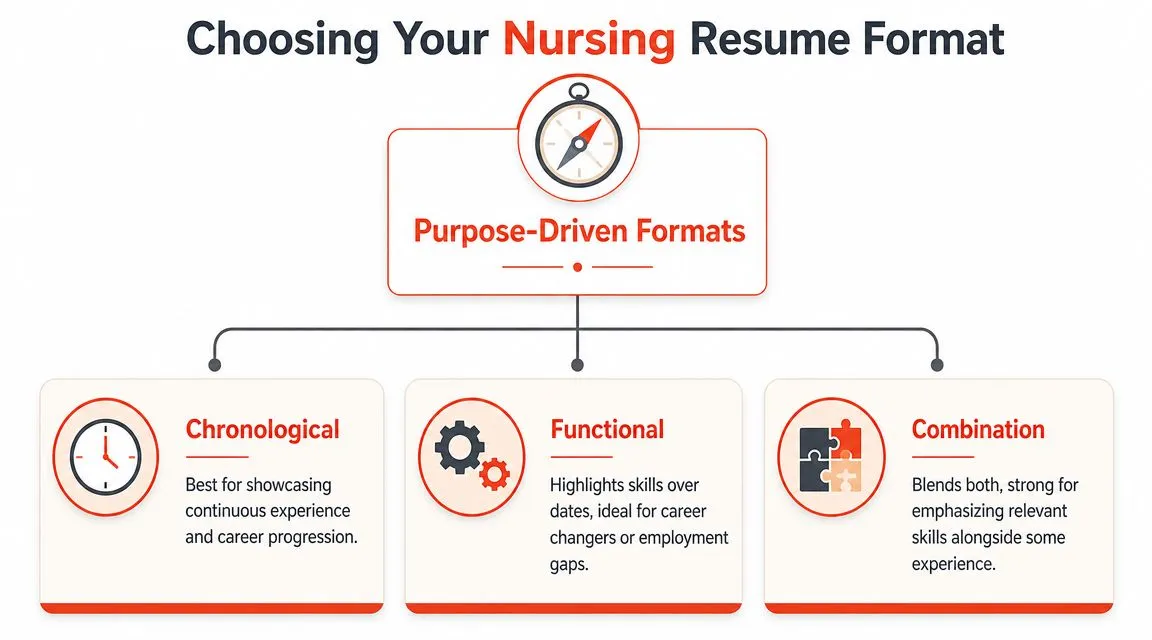
Choose a Resume Format That Proves Your Point
Stop hunting for the “perfect” template. Templates make students fill boxes. Good resumes make choices.
Your job is simple. Put the strongest evidence near the top and remove everything that dilutes it.
The one-page rule is good for you
Nursing programs commonly advise recent graduates to keep resumes to one page, use a plain font, consistent style, and single spacing, and place education, licensure or certifications, and the most relevant clinical experience near the top. Common mistakes include first-person writing, cluttered formatting, missing license details or expiration dates, and leaving out clinical context such as unit names, rotations, or supervising organizations (AllHeart's nursing student resume guidance).
That's not restrictive. That's helpful.
One page forces honesty. If something isn't earning space, cut it.
Pick the section order based on evidence
Here's the structure I'd use for most students:
| Resume section | Put it high when | Put it lower when |
|---|---|---|
| Summary | You can clearly state relevant clinical exposure or strengths | You have nothing specific to say |
| Licensure and certifications | You hold BLS, CNA, or active student-related credentials | You have no certifications yet |
| Clinical experience | Your rotations are your strongest proof | They were minimal and highly observational |
| Education | You're still in school and the program name matters | Your clinicals and healthcare work are stronger |
| Skills | You can support them elsewhere on the page | They're just generic keywords |
| Other experience | It shows reliability, communication, or service under pressure | It's old, irrelevant, or weakly described |
Don't get cute with formatting
Use a normal font. Use standard section labels. Don't add color blocks, icons, photos, text boxes, or fake design flourishes that make scanning harder.
Three direct rules:
-
Lead with relevance: if your rotations are better evidence than your cashier job, put them first.
-
Label clearly: “Clinical Experience” beats “Professional Journey.”
-
Include credential details: if a certification expires, list that.
Practical rule: If a section doesn't help someone trust you with patients, it probably doesn't belong.
Describe Clinical Rotations with Authority
Weak resumes often meet their demise.
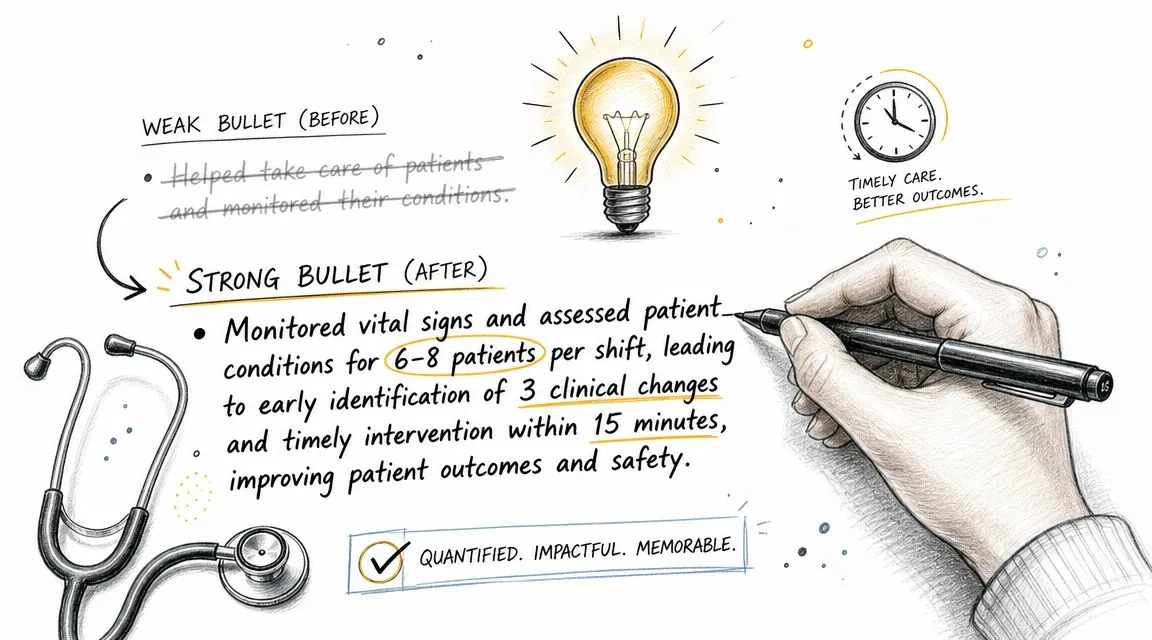
“Assisted nurses with patient care” tells me almost nothing. It could mean you observed. It could mean you stocked supplies. It could mean you performed basic care under supervision. I shouldn't have to guess.
Yale School of Nursing advises using statistics, percentages, or numbers wherever possible in bullet points and placing clinical experience before generic work history when it's the more relevant evidence of readiness. The point isn't decoration. It's scope (Yale School of Nursing resume guide).
Add the context first
Every clinical rotation entry should answer basic questions:
-
Where were you? Med-Surg, pediatrics, long-term care, community health, labor and delivery
-
Under whose supervision? faculty, preceptor, supervising RN, hospital unit team
-
What kind of patients or tasks? vitals, hygiene support, charting exposure, discharge education, specimen handling, infection control, observation of procedures
-
How often or how much? if you know the hours, patient interactions, assigned tasks, or repeated responsibilities, include them
If you need help naming the right competencies, this guide to nursing student skills for a resume is useful because it maps school-based experience to language employers recognize.
Before and after examples
Here's how to fix weak bullets.
Weak
-
Assisted nurses with patient care
-
Observed procedures and learned hospital workflow
-
Helped with documentation
Better
-
Supported supervised patient care on a medical-surgical unit by assisting with vital signs, hygiene, mobility, and room readiness during assigned shifts
-
Observed preceptor-led assessments and medication workflows, then reinforced learning through post-shift documentation review and instructor feedback
-
Recorded patient information in assigned clinical documentation exercises while following unit protocol and privacy standards
Notice what changed. The better version doesn't fake heroics. It adds setting, supervision, task type, and clinical seriousness.
What to do when the rotation was mostly observational
A lot of students get stuck here. They think observation “doesn't count.” Wrong. Observation counts if you write it like training, not like dead space.
Use verbs that show disciplined participation:
-
Observed
-
Documented
-
Prepared
-
Reinforced
-
Practiced
-
Escalated
-
Supported
-
Communicated
Try lines like these:
-
Observation-based: Observed RN-led patient assessments and shift handoff practices in a telemetry setting, then completed instructor-reviewed reflections on prioritization and safety checks.
-
Simulation-based: Practiced sterile technique, patient communication, and scenario-based decision making in simulation labs designed around acute care workflows.
-
Indirect contribution: Prepared patient rooms, restocked supplies, and supported flow during supervised clinical placement while maintaining infection-control standards.
If you didn't independently own the result, don't write as if you did. Write the truth with better detail.
That's how authority works on a student resume. Clear language. No inflation.
Write Skill Bullets That Actually Prove Something
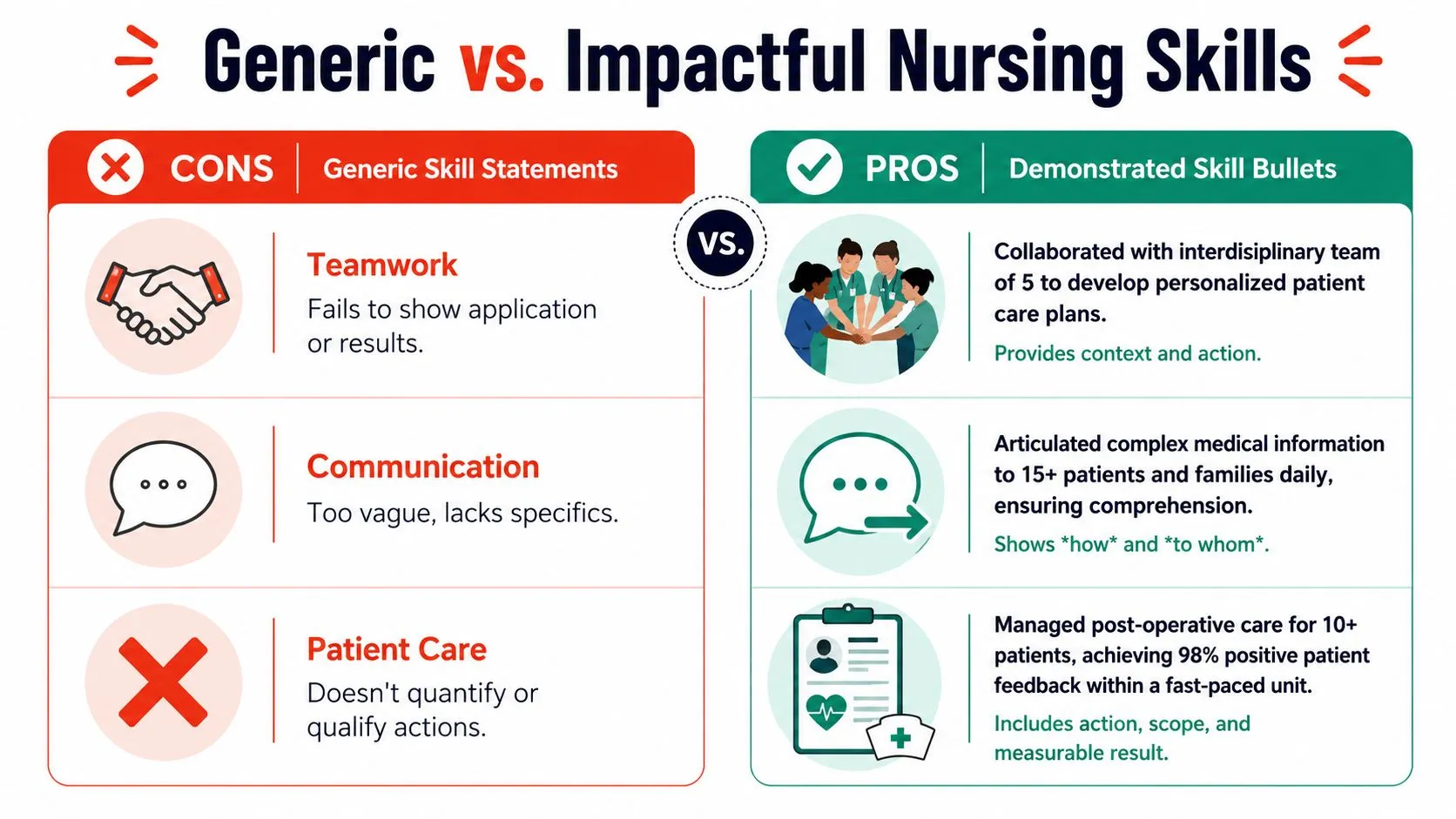
Hiring managers do not care that you listed “communication,” “teamwork,” and “patient care.” Every nursing student lists those. If your bullets do not show where those skills showed up, under what supervision, and in what kind of setting, the skills section reads like filler.
Your job here is simple. Turn vague traits into evidence. That matters even more for students, because you often do not have big numbers, independent caseloads, or headline-worthy outcomes. You still have proof. It just lives in observation, simulation, lab practice, class projects, and non-clinical work. Write those experiences like training evidence, not like diary entries.
A good bullet answers four questions fast: what did you do, why were you doing it, how did you do it, and what was the scope or setting? A university nursing resume guide makes the same point. Specific details such as tools, unit type, or context make your experience easier to judge (University of Northwestern nursing resume writing guide).
Use the four-part bullet test
Use this formula:
Action + purpose + method + setting, frequency, or scope
That structure forces you to prove the claim instead of naming it.
Examples:
-
Documentation: Practiced charting in Epic during supervised coursework to build accurate documentation habits aligned with inpatient workflow.
-
Patient communication: Explained basic care steps and comfort measures during supervised placements using calm, clear language and instructor guidance.
-
Team-based care: Worked with assigned classmates and supervising staff during simulation scenarios to complete handoffs, role delegation, and status updates.
-
Safety practices: Followed isolation, hand hygiene, and room-entry procedures during clinical days to support safe care routines and proper protocol use.
These bullets work because they stay honest and still sound competent. That is the standard.
Hard skills and soft skills both need proof
Keep the skills section short. Then back up those claims in your experience bullets.
Good skills section:
-
Clinical documentation
-
Vital signs
-
Infection control
-
Patient communication
-
Basic wound care exposure
-
Epic or Cerner exposure
-
BLS
-
Team-based care
Weak skills section:
-
Hard worker
-
Friendly
-
People person
-
Works well under pressure
-
Leadership
Traits are cheap. Behaviors carry weight. If you need help tightening your wording, this guide on how to write resume bullet points gives a clear framework you can apply line by line.
Strong bullets also come from stronger coursework habits. Students who build better notes, cleaner recall systems, and sharper clinical writeups usually describe their experience more clearly on the page too. If your schoolwork feels scattered, fix that first with smarter study systems and AI tools.
This short video is worth watching before you edit your bullets:
Example skill bullets you can adapt
Use examples like these as models, then swap in your actual setting, supervision level, and task:
-
Simulation lab: Completed instructor-led simulation exercises focused on patient assessment, prioritization, and escalation in changing-condition scenarios.
-
Family communication: Supported patient and family interactions during supervised clinical days by answering basic questions within scope and directing concerns to licensed staff.
-
Organization: Prepared supplies, reviewed assignment instructions, and kept structured notes during rotations to improve handoff readiness and reduce missed steps.
-
Service recovery: Responded calmly to frustrated customers in non-clinical roles, using active listening and de-escalation that transfers well to patient-facing care.
One more rule. Stop chasing “impressive” wording. Chase credible wording. On a student resume, credibility wins.
Leverage Experience Beyond the Bedside
A lot of nursing students dismiss their non-clinical background too early. That's a mistake.
Most resume guides keep repeating the same basic advice about rotations, coursework, and certifications. The harder issue is how to write a convincing nursing student resume when you have little direct patient-care experience to quantify. That gap is real, and it leaves students sounding generic if they don't know how to translate adjacent experience (Huntr's nursing student resume examples discussion).
Translate the job, don't hide it
Your retail, food service, childcare, front-desk, or volunteer experience can support a nursing application if you rewrite it in the language of healthcare.
Look at the difference.
| Old framing | Better nursing-relevant framing |
|---|---|
| Cashier | High-volume customer communication, accuracy, and issue resolution |
| Barista | Multitasking, prioritization, sanitation, and calm service under pressure |
| Camp counselor | Safety monitoring, behavior management, and family communication |
| Receptionist | Scheduling, documentation, confidentiality, and front-line communication |
| Food bank volunteer | Service to vulnerable populations, teamwork, and organized distribution |
Examples that work
Instead of:
-
Worked at coffee shop
-
Helped customers
-
Volunteered locally
Write:
-
Managed high-volume customer interactions in a fast-paced service setting while maintaining accuracy, professionalism, and clean work areas
-
Resolved complaints and answered questions using calm communication, active listening, and quick judgment
-
Supported community-facing volunteer work serving individuals and families with varied needs, building empathy and respectful communication
That's not spin. That's translation.
You can also strengthen thin experience with certifications, coursework, academic projects, and structured study habits. If you're still building your academic profile, these smarter study systems and AI tools can help you produce stronger coursework, steadier performance, and better examples to talk about on the page.
Your old job doesn't need to look clinical. It needs to look relevant.
The Final Sanity Check Before You Apply
Your resume gets judged in seconds. Nobody is reading it like a professor grading effort. They are scanning for proof that you can step into a unit, follow directions, communicate clearly, and not create extra work.
That means your last review should focus on credibility. Not style. Not filler. Credibility.
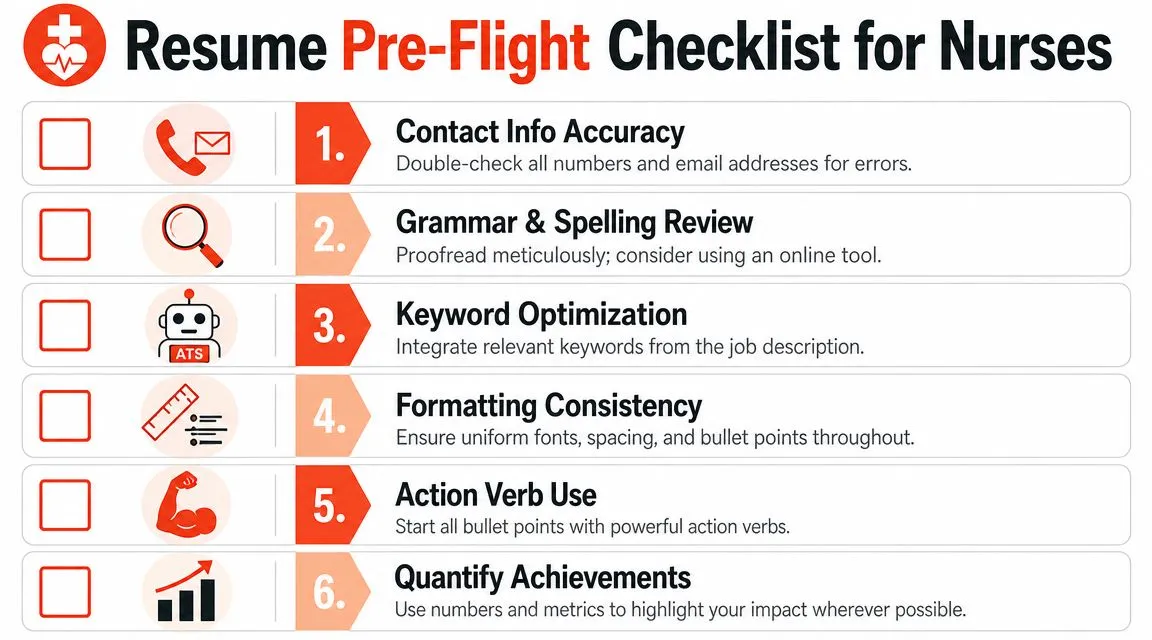
Use this checklist before you send anything
-
Check contact details: one typo in your email or phone number kills the application.
-
Match the posting: mirror the employer's wording for units, certifications, and responsibilities. If your resume keeps sounding generic, this guide on tailoring your resume to a job description will fix that.
-
Keep formatting plain: save as PDF unless the application says otherwise. Use standard headings, clean spacing, and one bullet style.
-
Cut empty adjectives: delete “hardworking,” “passionate,” and “fast learner” unless a bullet underneath proves it.
-
List credentials clearly: include BLS, CPR, CNA, or other certifications with issuer and date when relevant.
-
Check your evidence: every major claim should tie back to something real, clinical observation, simulation performance, school projects, customer-facing work, or volunteer responsibilities.
-
Proofread like a nurse: details matter. Sloppy punctuation and inconsistent tense make you look careless.
The fastest ways to get rejected
I see the same mistakes over and over:
-
A summary full of traits but no evidence
-
Clinical rotations with no unit, patient population, or responsibilities
-
Skills listed with zero context
-
Observation and simulation experience written like it does not count
-
Old jobs described vaguely instead of translated into relevant strengths
-
Messy formatting, inconsistent punctuation, and obvious copy-paste tailoring
-
The same resume sent to every employer
Student resumes are often thin. Fine. Thin is not the problem. Vague is. You may not have paid RN experience yet, but you do have enough material to show judgment, accuracy, communication, and professionalism if you write it properly.
If your resume gets the interview, prepare for that with HypeScribe's comprehensive interview guide. It is a practical next step after your application is ready.
Your nursing student resume does not need to sound impressive. It needs to read like a safe hire.
StoryCV helps with that without forcing your experience into generic template language. It works like a digital resume writer, helping you turn classwork, clinicals, and non-clinical experience into a draft that sounds specific, clear, and credible.