Most receptionist cover letters are dead on arrival. They read like a watered-down resume with extra adjectives. “Friendly.” “Organized.” “Team player.” None of that helps a hiring manager picture you running a front desk when phones are ringing, visitors are waiting, and someone needs an answer now.
A cover letter for a receptionist should do one job well. It should make you sound like the calm, capable person they want greeting clients, handling interruptions, and keeping the day from sliding off the rails. Not a template. A person.
Your Cover Letter Isn't a Resume Summary
If your letter just repeats your resume, cut it.
The resume already lists jobs, software, and dates. The cover letter has a different purpose. It gives the employer a feel for how you think, how you communicate, and whether you understand the role beyond the job title.
For receptionist roles, that matters more than people admit. You are often the first human contact with the business. Your writing is part of the audition. If your letter is bloated, generic, or stiff, that sends a message.
A receptionist cover letter isn't there to prove you know how to apply. It's there to prove you know how to communicate.
The usual advice gets this wrong. It pushes you toward stuffing in every duty you've ever done. Answered phones. Scheduled meetings. Managed emails. Filed documents. Great. So did half the applicant pool.
What works is sharper. Pick a few details that show judgment, professionalism, and reliability under pressure. Show the employer how you operate.
Here's the test:
-
Bad approach: “I have experience answering calls, greeting guests, and performing administrative duties.”
-
Better approach: “In my last front-desk role, I handled walk-ins, incoming calls, and scheduling without letting the reception area feel chaotic or ignored.”
The second one says something. It shows your standard.
A good letter also respects the reader's time. Receptionist-specific guidance recommends keeping it to one page and using three or four paragraphs so hiring managers can scan it quickly and see your fit fast.
Short is not lazy. Short is controlled.
The Unskippable Three-Part Letter Structure
You don't need a “creative” format. You need one that works.
A technically strong receptionist cover letter follows a tight one-page, 3 to 4 paragraph structure with a professional header, readable formatting, and a clear close asking for an interview, as described in My Perfect Resume's receptionist cover letter format guide.
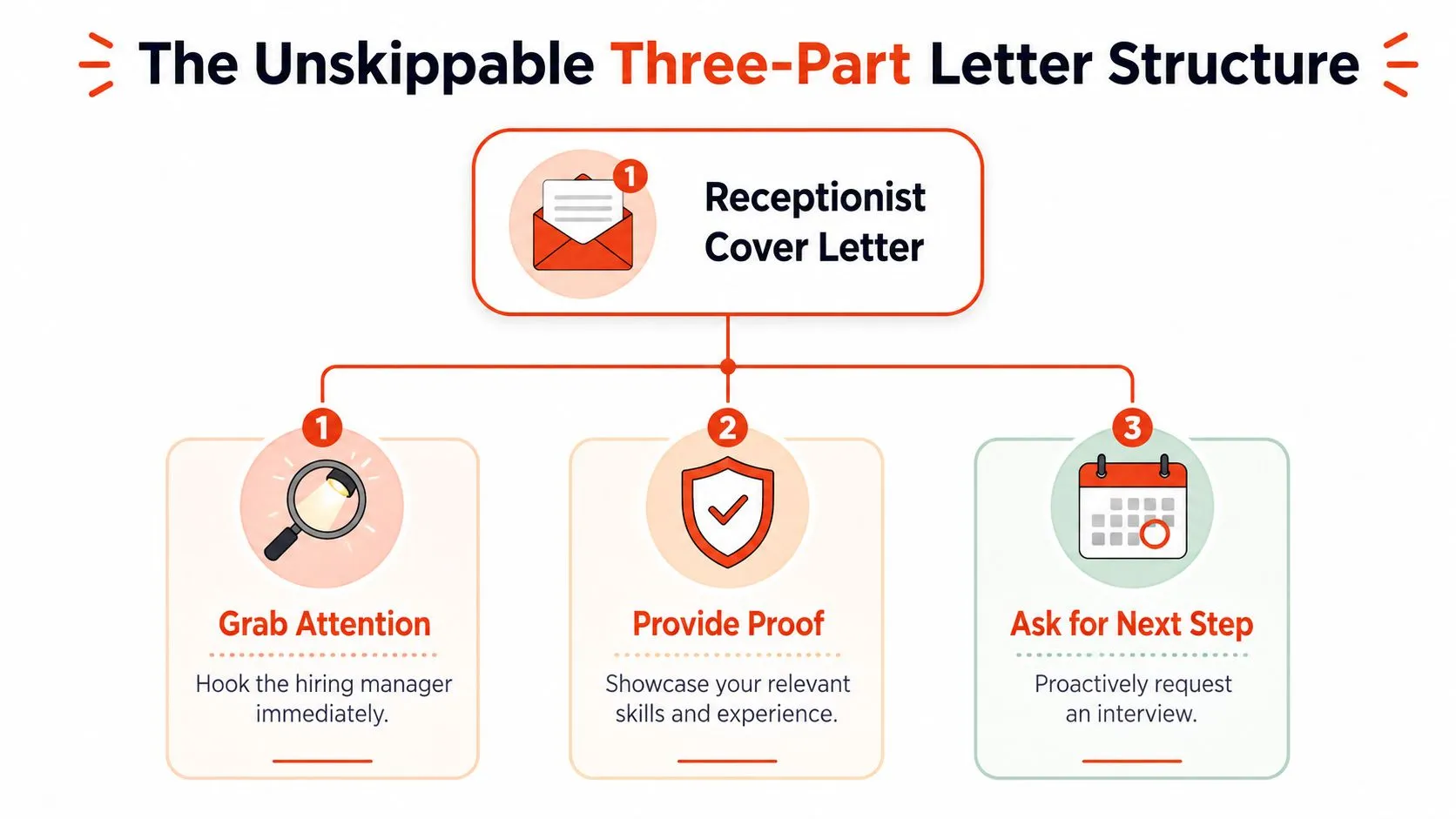
Part one grabs attention
Your opening paragraph has one job. Make it obvious why you're relevant to this role.
Name the role. Mention the setting if it matters. Then give a focused reason they should keep reading. Not your life story. Not a grand statement about passion.
Use this formula:
-
Target the role: “I'm applying for the Receptionist position at Westbrook Dental.”
-
Add immediate fit: “My background in front-desk coordination and client-facing administration fits the mix of scheduling, communication, and day-to-day organization this role requires.”
-
Signal value: “I'm strongest in fast-moving offices where people need clear answers quickly.”
That's enough. Clean. Direct. Professional.
Part two provides proof
This is the core of the letter.
Do not dump duties. Pick 2 to 3 qualifications and tie them to what the employer needs. That's the sweet spot for a receptionist letter because space is limited and focus beats volume.
A hiring manager won't be impressed that you “used Outlook and Microsoft Office.” They'll care more about how you used them. Did you keep scheduling accurate? Did you prevent missed messages? Did you handle constant interruptions without losing track?
Try this kind of language:
-
Instead of duties: “Responsible for greeting clients and answering phones.”
-
Use proof: “I managed front-desk traffic, incoming calls, and calendar coordination in a way that kept visitors informed and internal staff on schedule.”
Practical rule: If a sentence could appear in any receptionist cover letter, delete it.
Good proof also sounds specific without trying too hard. Mention tools only when they support the story. Outlook, Excel, Calendly, Teams, Avaya, Cisco. Fine. But they are props, not the plot.
Part three asks for the next step
Too many closings fade out. Don't end with “Thank you for your time and consideration” and nothing else.
Close like someone who knows how business communication works. Reaffirm fit. Show interest. Ask for the interview.
A strong closing sounds like this:
I'd welcome the chance to discuss how my front-desk experience, client communication skills, and administrative judgment could support your team.
That's confident without being pushy.
The formatting rules aren't optional
Receptionists get judged on presentation. Your letter should reflect that.
Use a clean header. Keep margins at 1 inch. Use a readable 10 to 12 pt font. Stick to standard choices like Arial or Calibri. Save as PDF unless the employer asks for something else.
Here's the quick checklist:
| Element | What to do |
|---|---|
| Length | Keep it to one page |
| Paragraphs | Use 3 to 4 short paragraphs |
| Greeting | Personalize it if you have a name |
| Font | Use a clean 10 to 12 pt font |
| Spacing | Leave enough white space to scan easily |
| File type | Send a PDF unless instructed otherwise |
A messy letter for a receptionist job is a contradiction. It tells them you want a front-desk role, then shows them poor front-desk judgment.
Beyond 'Friendly' Skills That Signal Competence
“Friendly” is baseline. It doesn't get you hired.
Receptionists need soft skills, yes. But vague soft skills are useless unless you translate them into workplace behavior. That matters because 88% of managers say a receptionist's soft skills, including communication, professionalism, and diplomacy, are as important or more important than technical ability, according to Robert Half's summary of OfficeTeam survey findings.
So stop writing like this:
-
Weak: “I am friendly and organized.”
-
Better: “I stay composed when multiple priorities hit at once and make sure visitors, callers, and internal staff all get clear responses.”
Use stronger words for the real job
Reception work is operational. It's not decorative.
Better language includes:
-
Poise under pressure when calls, guests, and schedule changes collide
-
Professional discretion when you handle confidential or sensitive information
-
Information management when messages, documents, and appointments need to stay accurate
-
Diplomacy when someone is frustrated and still needs help
-
Administrative judgment when you decide what needs immediate action and what can wait
If you want a useful breakdown of how employers weigh capability, read our piece on soft skills vs hard skills. The useful move is not choosing one over the other. It's showing how your soft skills make your hard skills matter.
Show the skill through a scene
Don't claim composure. Write a line that demonstrates it.
For example:
-
Generic: “I have excellent communication skills.”
-
Stronger: “I'm used to being the first point of contact for visitors and callers, which means listening carefully, speaking clearly, and keeping interactions professional even when the office is busy.”
-
Generic: “I'm detail-oriented.”
-
Stronger: “I pay close attention to scheduling, message-taking, and follow-up so details don't get lost between the front desk and the wider team.”
The best receptionist letters make employers feel relief. “Good, this person can handle the front desk.”
That's the target feeling. Not admiration. Relief.
Three Receptionist Cover Letter Samples That Get Interviews
Examples beat theory. Every time.
These aren't copy-paste templates. They're working models. Read them for structure, tone, and what each one chooses to emphasize. If you want more general reference points after this, StoryCV also has a broader guide to a sample cover letter for job application.
Sample one for entry-level receptionist roles
This version works because it doesn't pretend to have years of front-desk experience. It builds credibility from customer-facing work, reliability, and professional instincts.
Dear Hiring Manager,
I'm applying for the Receptionist position at Hartwell Office Suites. My background in customer service and administrative support has taught me how to stay composed, communicate clearly, and keep people informed, which is exactly what a front desk needs.
In my previous role, I handled customer questions, scheduled appointments, and managed day-to-day requests in a busy environment where people expected quick, accurate help. That experience taught me how to listen carefully, keep details organized, and stay professional even when priorities changed without warning. I'm also comfortable using Outlook, Microsoft Office, and shared calendars to keep communication clear and tasks moving.
What draws me to this role is the chance to be the person who sets the tone for the office. I'd bring a calm approach, strong follow-through, and the kind of professionalism that makes visitors and colleagues feel looked after from the start. I'd welcome the opportunity to discuss my application further.
Sincerely,
[Your Name]
Sample two for experienced receptionist candidates
This one is sharper. It assumes you already know the job and focuses on the way you operate.
Dear Ms. Patel,
I'm writing to apply for the Receptionist role at Greenline Legal Services. I've spent the last several years in front-desk and administrative positions where accuracy, discretion, and calm communication were essential, and that background fits the standard your office is looking for.
In my current role, I manage a high-volume front desk, coordinate appointment schedules, route incoming calls, and handle visitor interactions without letting service slip when the office gets busy. I'm trusted to keep communication professional, protect sensitive information, and make sure messages and scheduling details reach the right people quickly. Colleagues rely on me because I don't just react. I keep the front office steady.
I'm interested in Greenline because the role calls for someone who can combine client service with strong administrative judgment. That's the part of receptionist work I take most seriously. I'd welcome the opportunity to discuss how my experience could support your team.
Kind regards,
[Your Name]
If you want a quick walkthrough on tightening your draft, this video is worth a look.
Sample three for career changers
Career changers usually make one mistake. They apologize for changing direction. Don't.
Build the bridge instead.
Dear Hiring Manager,
I'm applying for the Receptionist position at Northfield Wellness. Although my background is in hospitality, the core of my work has always been the same: helping people, managing requests, staying organized, and keeping service professional in fast-moving environments. That's why this role makes sense for me.
In my previous position, I was responsible for greeting customers, handling bookings, answering questions, resolving day-to-day issues, and coordinating with team members to keep operations running smoothly. That work strengthened the exact skills a receptionist needs, especially poise under pressure, attention to detail, and clear communication with people who need help right away. I'm comfortable learning new systems quickly and applying strong service standards in structured office settings.
I'm making this move intentionally. I want a role where professionalism, consistency, and client experience matter every day. I'd value the opportunity to bring my customer-facing experience into a front-desk position and discuss how I could contribute to your team.
Sincerely,
[Your Name]
Why these samples work
They all do a few things right:
-
They stay short. No wasted backstory.
-
They pick a lane. Entry-level, experienced, or career-change.
-
They show behavior. Not just trait words.
-
They sound human. Not like a template stitched together from search results.
The best sample for you is the one that sounds closest to how you already work.
Stop Templating How to Tailor Your Letter in Minutes
Tailoring doesn't mean rewriting from scratch. It means paying attention.
Generic letters fail because they ignore context. A receptionist at a design studio, a law firm, and a medical office may share core duties, but the tone and pressure are different. In healthcare especially, a generic office script falls flat. Industry-specific guidance for medical receptionist roles points out that employers need candidates to address practical demands like patient scheduling, HIPAA, and administrative accuracy under tight constraints, not just general office friendliness.
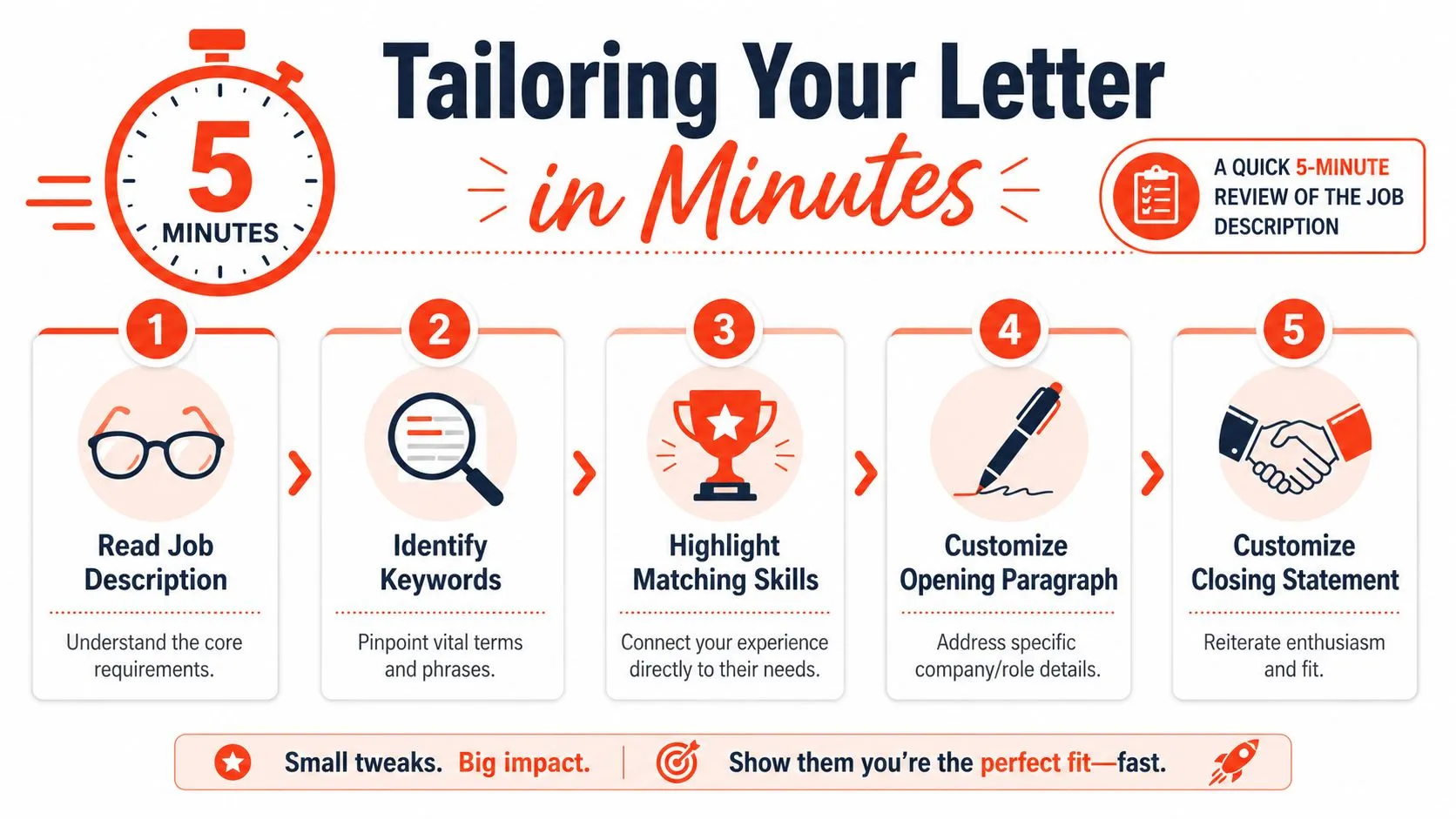
Use this fast tailoring method
-
Read for pressure points
Ignore the whole posting at first. Scan for what will make the job hard. High call volume? Confidential information? Constant scheduling changes? -
Pull out the repeat language
If they repeat words like professional, discreet, fast-paced, patient-focused, or detail-oriented, those are your targets. -
Match each one to a real moment
Ask yourself, “When have I shown this?” Then write the answer in one or two lines. -
Adjust your tone
A law office usually calls for a more formal tone. A startup may want polished but warmer language. -
Change the opening and closing
That's where tailoring shows fastest. Mention the company, the setting, and the kind of support they need.
Quick filter: If your letter could be sent to five different employers unchanged, it isn't tailored.
If you want help extracting the right keywords and turning them into stronger application language, StoryCV's article on tailoring a resume to the job description is useful for the same reason it works for cover letters. It forces relevance.
A strong cover letter for a receptionist sounds like a person you'd trust at the front desk. Clear. Calm. Specific. If you want help turning your experience into that kind of narrative, StoryCV helps write application materials through a guided interview process instead of pushing you into generic templates.