Contract work isn't the problem. Hiding it is. A recruiter who sees three short stints with no contract label doesn't think, “highly adaptable.” They think, “messy timeline.”
That's the mistake to stop making. Contract work on resume should read like deliberate specialization, not a damage control exercise.
Contract Work Is Not a Resume Problem
The biggest lie people tell themselves is that contract work makes them look unstable. It doesn't. The Bureau of Labor Statistics counted 8.2 million contingent workers in 2017, or 5.6% of employed people, including 2.6 million agency temporary help workers, 1.4 million on-call workers, 1.0 million independent contractors, 3.2 million self-employed workers, and 2.2 million standard-issue workers with alternative arrangements, which means nontraditional work has been measurable for years, not some weird exception (BLS data referenced in resume guidance).
What recruiters actually judge
They're not punishing the contract itself. They're reacting to confusion. If your resume buries the arrangement, the dates, or the client context, you've made them work too hard. That's when they start filling gaps with their own bad assumptions.
Practical rule: if the work was real, paid, and relevant, it belongs on the page. The job is to explain it cleanly, not apologize for it.
That matters even more for people searching after a break or after a move between markets. If you're also trying to figure out how to find remote work, contract experience can be a strength, because it already shows you can step in, ramp up, and deliver without hand-holding.
The story isn't “I kept bouncing.” It's “I kept getting hired to solve specific problems.” Write it that way.
Choosing the Right Title and Employer Format
Start with the label. Don't get cute. Use the actual role title plus Contractor or Consultant when that's accurate, then name the employer in a way a recruiter can verify. Neutral resume guidance recommends a clear, chronological experience entry with explicit contract labeling, month-and-year dates, and 3 to 6 accomplishment bullets per role (resume writing guidance).
Pick the employer that paid you
If a staffing agency paid you, list the agency as the employer and make the client visible too. That's the cleanest path for ATS and for human readers. When a contract is through an agency, one strong format is “Software Engineer, Google (via Robert Half)”, which gives the resume two employer keyword matches and tells hiring managers where the work happened (agency/client format guidance).
If you worked directly with the client, list the client. If you operated as an independent consultant, use Consultant or Independent Contractor and keep the language honest. Don't make the reader decode your setup.
Use month and year, always
Month-and-year dates matter because contracts often sit close together. A vague year-only range smears the timeline and can hide good work behind ambiguity. That's especially bad when you've done back-to-back placements or you've had an overlapping mix of direct and agency roles.
Use the title line to remove doubt. Use the bullets to prove the work was worth hiring you for.
For a contract-heavy resume, that combination does more than look tidy. It makes your history readable by both people and software, which is the whole game.
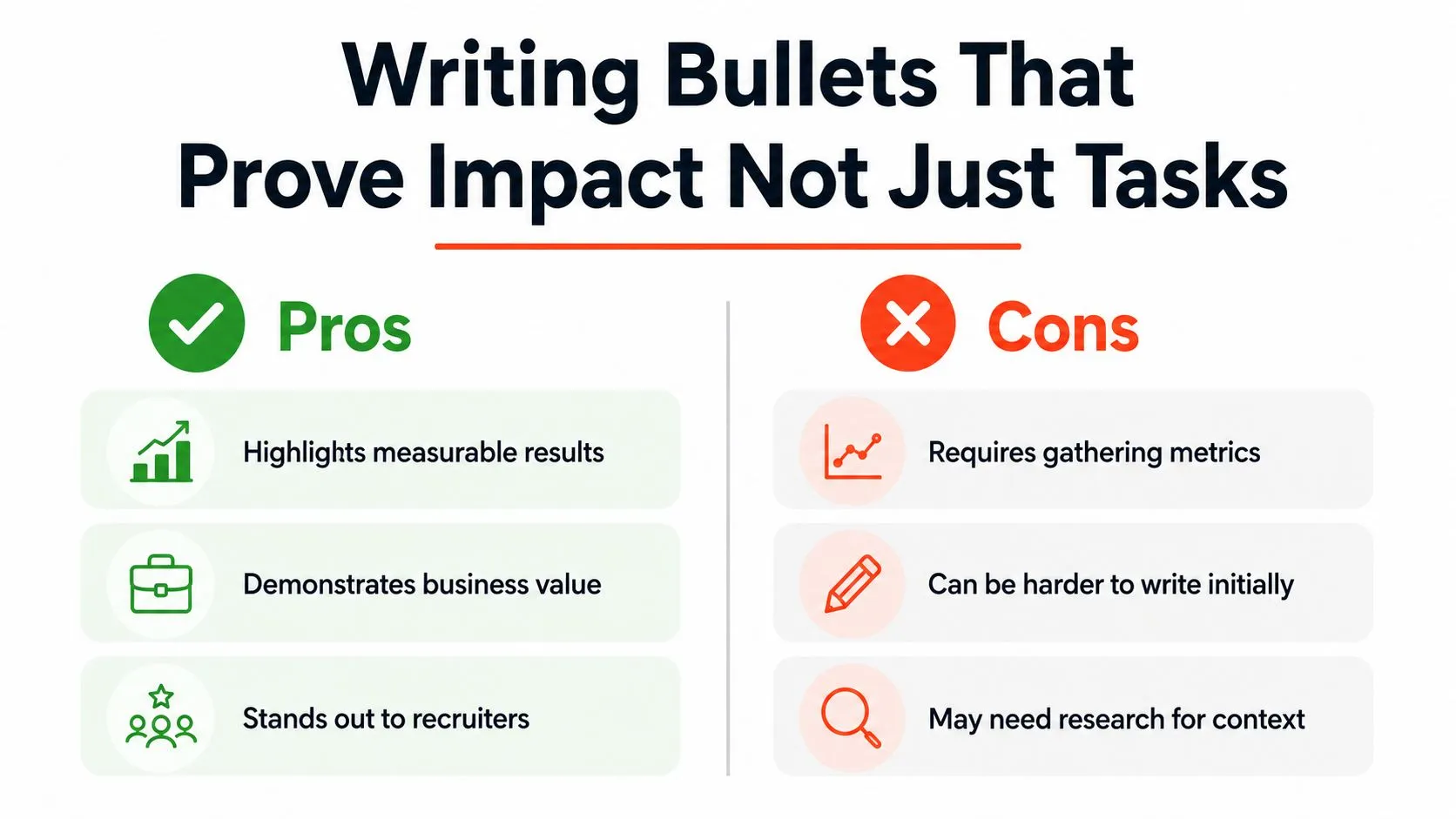
Writing Bullets That Prove Impact Not Just Tasks
Most contract resumes fail in the bullets. People list duties, not outcomes. That's lazy, and it's the fastest way to make six months of real work look disposable. A better pattern is simple, action verb + deliverable + scope + result.
Turn chores into evidence
Weak bullet, “Managed social media accounts.” Nobody learns anything from that. Better, “Launched LinkedIn campaign content calendar for a B2B audience, coordinated weekly publishing, and built reporting that clarified which posts drove qualified leads.” That version has a deliverable, a platform, and a business outcome.
The same logic works in tech and operations. “Built Power BI revenue dashboard for 8 stakeholders, reducing weekly reporting time from 4 hours to 45 minutes” is strong because it names the tool, the audience, and the result. That's the bar.
Write bullets like someone who expects scrutiny. If a bullet can't survive a follow-up question in an interview, it's not finished.
Use short contracts to your advantage
Short engagements need sharper bullets, not more bullets. If the role lasted a few months, focus on the one or two things that mattered. A contract isn't a place to document every errand you ran. It's a place to show scope and speed.
Here's the discipline I want to see:
- Lead with outcomes. Don't bury the result at the end.
- Name the system, platform, or team. Specificity makes the work feel real.
- Show scale. Stakeholders, clients, dashboards, launches, or deliverables all count when they're concrete.
- Keep the bullets tight. If a point rambles, you're probably hiding the value.
For a deeper framework on phrasing these statements, use StoryCV's impact statement guide as a model for turning raw work into credible accomplishments. You don't need more adjectives. You need better proof.
Grouping Short Contracts Without Looking Like a Job Hopper
Most advice falls apart here. One or two contracts are easy. Four or five short stints start to look chaotic unless you shape the narrative. You're not choosing between “honest” and “dishonest.” You're choosing between scattered and strategic.
Use the structure that matches the pattern
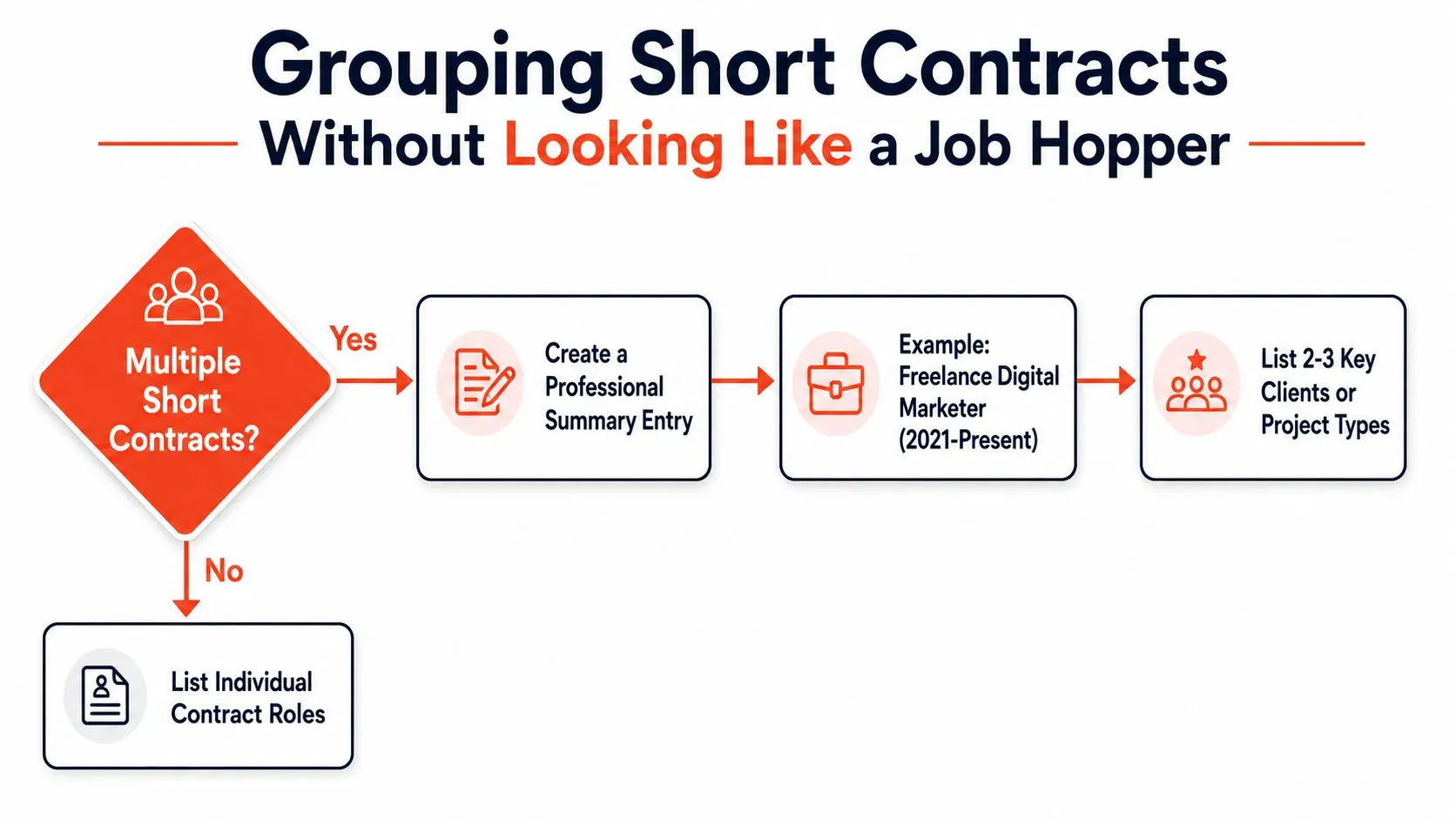
If you've had only a few notable contracts, list each one separately in reverse chronological order. That's clean and recruiter-friendly. If you've had several short engagements, group them under an umbrella heading like Consulting or Contract Work and use sub-entries for the client names or project types.
A single block works especially well when the work tells one broader story, like a specialist who keeps getting hired for similar problems. That's not job hopping. That's demand.
For readers dealing with this exact edge case, this guide on multiple short stints is worth pairing with the structure you choose here.
When grouping helps and when it hurts
Grouping helps when the alternative is a wall of tiny entries. It hurts when the contracts are distinct, recognizable, and substantial enough to stand alone. Don't hide strong client names behind an umbrella just because you're nervous about the timeline.
A good rule:
- List separately when each role is substantial and easy to explain.
- Group together when the contracts are short, repetitive, or too numerous.
- Use sub-entries when you want the cleanest balance of readability and detail.
If you had overlapping work, say so by implication through dates and structure, not by overexplaining. If you moved from contract work into full-time employment, treat that as one story with a logical progression, not two disconnected jobs.
The point is simple. Your resume should read like specialization, not scattershot movement.
Making Contract Work ATS-Friendly and LinkedIn-Ready
ATS systems don't reward creativity. They reward standard structure. Keep the section label normal, keep the dates in a plain format, and put the contract label where a parser expects it. No fancy glyphs, no decorative layouts, no games.
Keep the machine and the human on the same page
Use straightforward titles like Marketing Manager (Contract) or Senior Analyst, Contract. Both are readable. Both are honest. What matters is consistency across the document, because recruiters do cross-check resumes against profiles.
If you want a clean, practical review of profile structure, a LinkedIn profile optimization guide can help you align names, titles, and dates so the same story shows up everywhere. The goal isn't polish for its own sake. It's consistency.
For AI screening specifically, the important thing is not to create a resume that looks clever but parses badly. StoryCV's AI screening guidance is relevant here because contract entries need to stay legible to software as well as to people.
Don't let LinkedIn tell a different story
LinkedIn often pushes people toward a vague Self-Employed block. That's a trap for contract workers. It hides client context and weakens search visibility. Better to list the actual client or employer of record in the experience section and make the contract nature clear in the title or description.
If the role converted from contract to full-time, keep it in one continuous entry and note the conversion in plain language. Don't split the same role into two entries just to make the timeline look neat. That usually makes it look more confusing, not less.
Contract work only looks unstable when the resume and profile fight each other. Make them match.
Your Contract Resume Decision Checklist
If your contract history is short and clean, list each role separately. If it's dense, group it. If the agency paid you, name the agency and the client. If the client paid you directly, name the client. If the role converted to full-time, keep it as one continuous entry with the conversion noted in the title or dates.
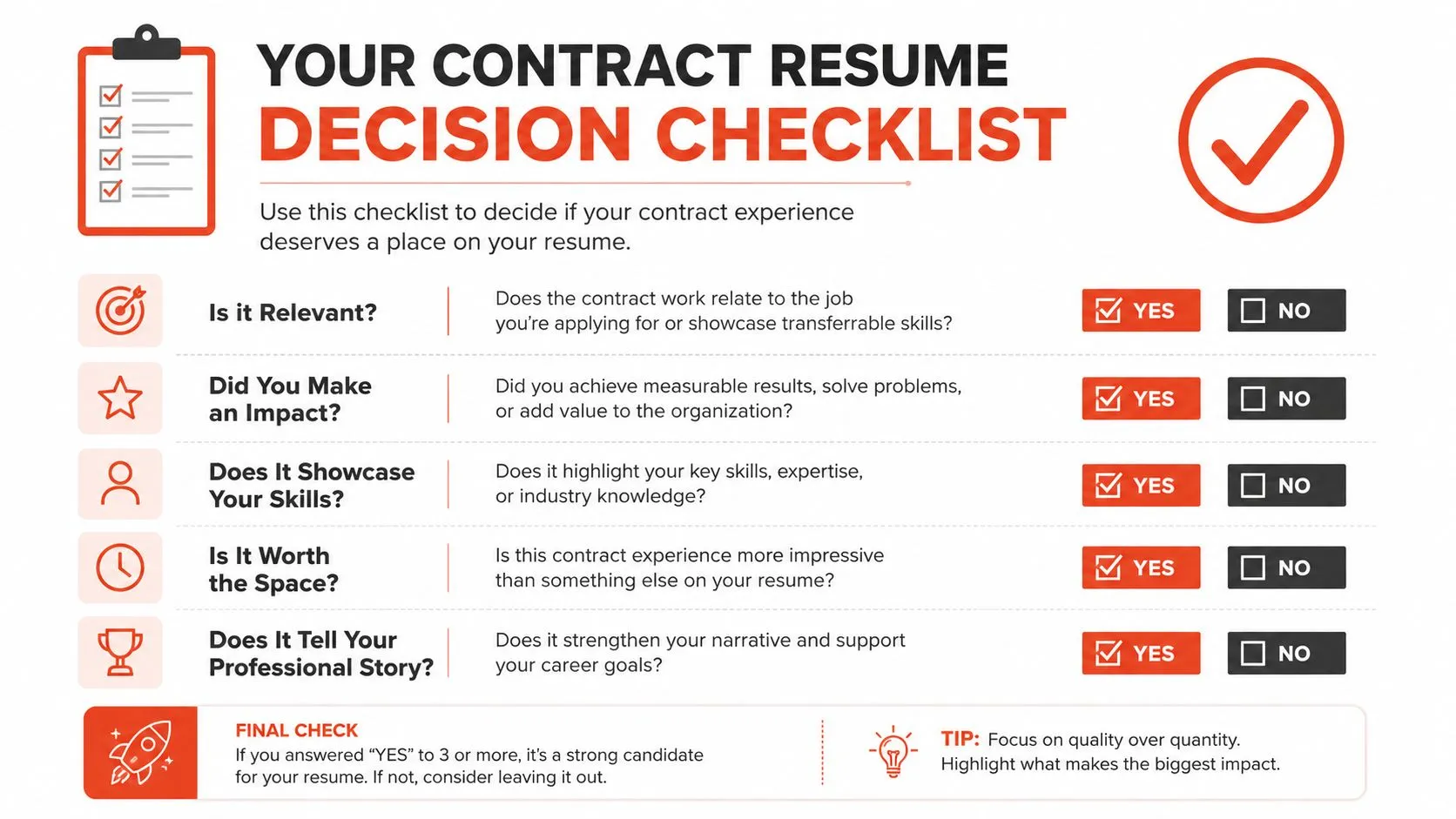
Use this quick filter before you send the resume
- Is the contract clearly labeled? If not, fix the title.
- Can a recruiter see who the employer was? If not, add the agency or client.
- Do the bullets show outcomes, not chores? If not, rewrite them.
- Does the timeline look intentional? If not, group or re-sequence the entries.
- Would LinkedIn tell the same story? If not, align it before you apply.
A clean contract entry might read like this, Project Manager (Contract), Acme Health (via Robert Half), January 2024 to June 2024, followed by bullets that show deliverables, scope, and measurable outcomes. That format is boring in the best possible way. It leaves nothing for the recruiter to guess.
StoryCV turns fragmented contract history into a resume that reads like a career, not a pile of gigs. If you want a sharper way to frame short stints, client work, and contract-to-hire roles, visit StoryCV and start shaping the version of your experience that gets interviews.