
A cover letter for an interior design role shouldn't summarize your career. It should tell the reviewer which portfolio pages to open first, and why those pages belong in this studio's world.
That's the unpopular part. Your resume already carries the chronology. Your portfolio carries the visual proof. The letter has one high-value job left: connect the two before the reviewer moves on.
Stop Writing About Yourself
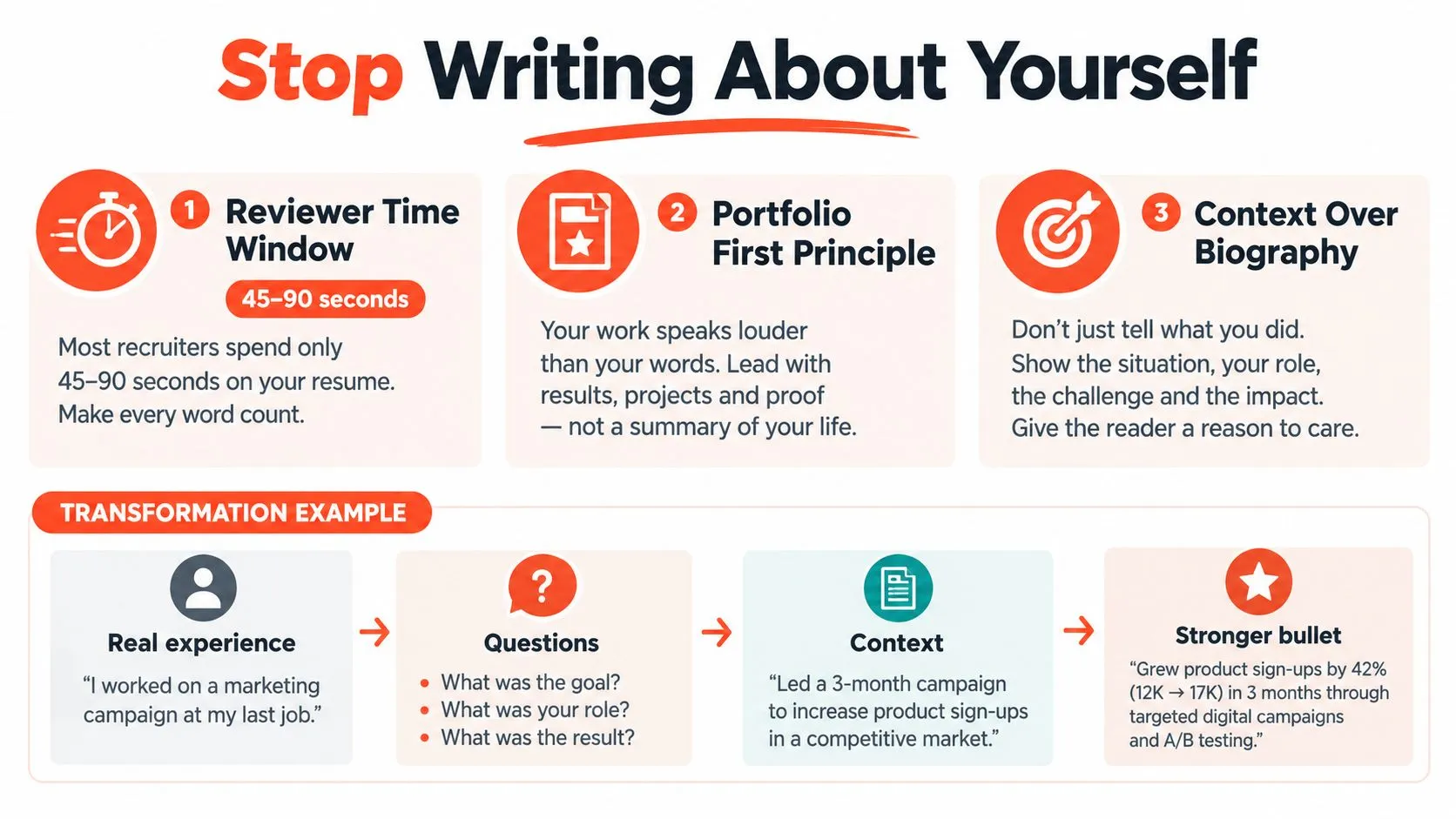
The popular advice is wrong in one important way. A cover letter isn't your biography with better adjectives. It's a viewing guide for your portfolio.
Interior design hiring is portfolio-first. The reviewer wants to know what you designed, what constraints you handled, and whether your process fits the firm's work. A paragraph about being passionate, creative, and detail-oriented burns attention without directing anyone to a project. A software list does the same thing unless it explains where that software supported delivery.
The letter doesn't win the interview by itself. It decides which three portfolio pages get looked at first.
The U.S. Bureau of Labor Statistics projected 3% employment growth for interior designers from 2025 to 2035, with about 7,700 openings per year on average and approximately 97,100 jobs in 2025. That kind of market gives studios plenty of reasons to filter quickly, so a generic letter won't rescue an undifferentiated portfolio. BLS employment projections for interior designers show why the document needs to communicate fit fast.
Use the reviewer's filter
Delete any sentence that only tells the reader who you are. Keep sentences that do one of three jobs:
- Direct attention: Name a project and the portfolio page or spread worth opening.
- Explain fit: Connect that project to the firm's sector, clients, or current work.
- Signal workflow: Mention the tools, documentation, coordination, or handoff process the studio can verify.
“Interior designer with extensive experience in residential and commercial projects” is a label. “Open the loft renovation spread for the custom joinery details, then the hospitality project for finish coordination” is useful.
If describing your work is difficult, the problem may not be your writing. You may be missing the details that make the work memorable. This distinction is also central to describing yourself in a resume, where responsibility must give way to context, action, and outcome.
The Structure That Earns the Portfolio Review
A strong interior design cover letter is short because the portfolio is doing the heavy lifting. Guidance from Indeed on ideal cover letter length supports keeping the document to half a page or one full page, commonly around 250 to 400 words.
Use four compact blocks.
| Block | Words | Must Accomplish |
|---|---|---|
| Hook | About 40 | Name the role, the firm's sector, and the reason your work belongs there. |
| Project pairing | About 90 | Direct the reviewer to three portfolio projects and explain the relevance of each. |
| Proof | About 100 | Show software depth, documentation experience, coordination, and project outcomes. |
| Close | About 50 | State your availability and ask for a portfolio review or conversation. |
The hook earns the next paragraph. Don't open with “I am writing to apply.” Open with the firm's actual work and your relevant evidence.
The project paragraph controls the reviewer's eye. Name projects in the order you want them viewed. If the studio works in workplace interiors, don't lead with your most photogenic bedroom unless it demonstrates a skill the studio needs.
The proof block answers the question behind most first reads: Can this person move a design from concept to delivery? Mention Revit, AutoCAD, FF&E schedules, code research, vendor coordination, construction administration, or client presentations only when you've used them.
The close removes friction. Say what you'd like to discuss and point back to the portfolio. Don't end with a vague statement about hoping to hear from the firm.
The software signal matters. Revit and AutoCAD fluency can indicate readiness for larger commercial workflows, while SketchUp and hand-rendering often point toward boutique, residential, or smaller-scale work. Neither is automatically better. The mismatch is the problem.
Pairing the Letter With Your Three Best Projects
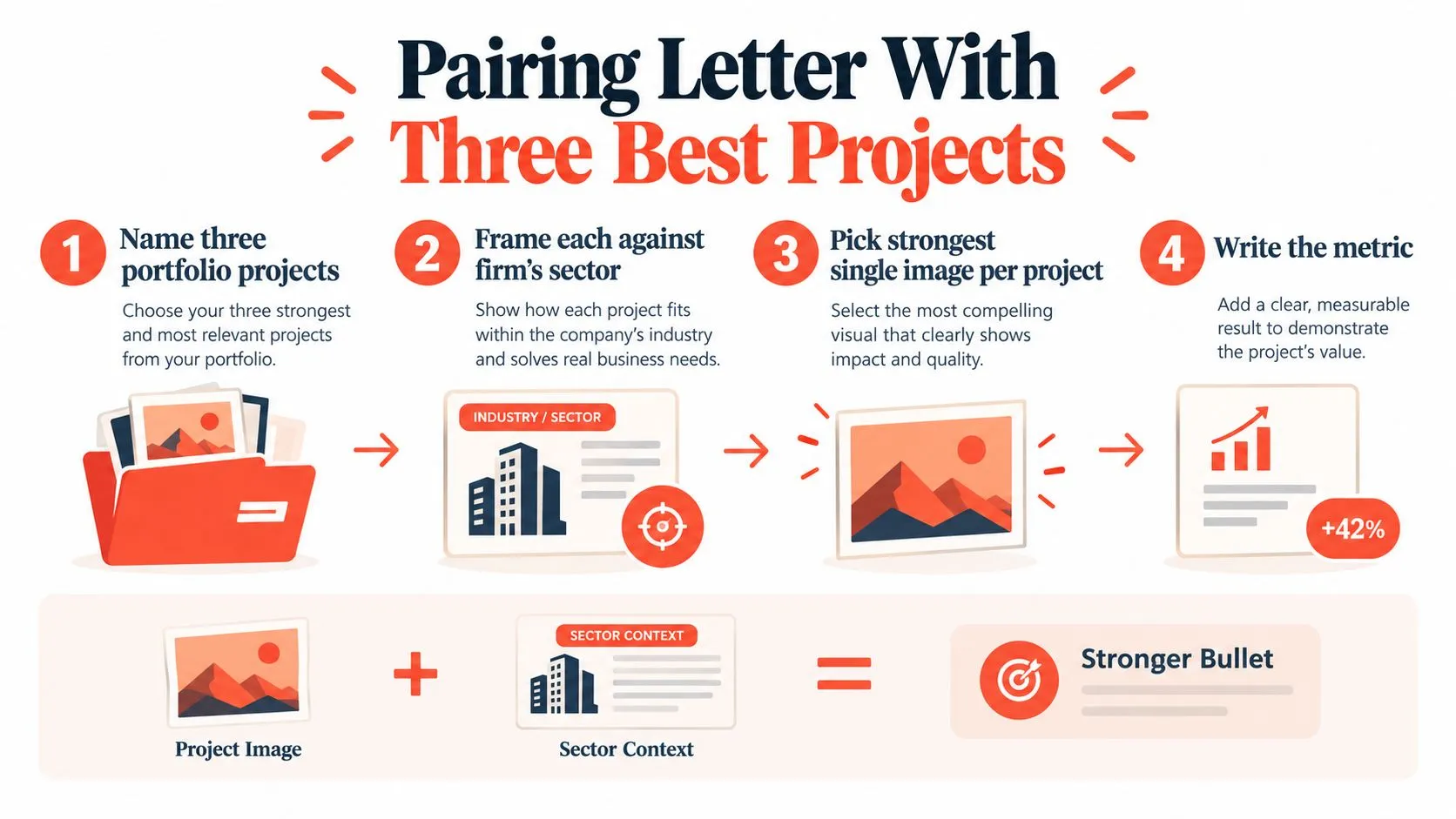
Your three projects shouldn't just be your favorites. They should form an argument about fit.
Start by naming each project. Then connect it to the firm's sector. Finally, add one real measure of scope or impact, such as square footage, budget tier, lead time, a certification result, an occupancy change, or a before-and-after outcome. Use only details you can defend in an interview.
A useful sentence pattern looks like this:
“The office repositioning project shows how I handle space planning and stakeholder coordination, while the residential loft demonstrates custom joinery and material specification. The boutique hospitality project is the closest match to your current work because it combines guest circulation, finish schedules, and vendor coordination.”
That paragraph does more than announce three images. It tells the reviewer what to inspect.
Choose evidence that matches the sector
A hospitality firm may care about FF&E schedules, finish specifications, guest circulation, and installation coordination. A corporate interiors practice may look for code compliance, Revit families, consultant coordination, and MEP integration. A residential studio may care more about custom detailing, sourcing judgment, client communication, and the relationship between concept and lived experience.
Use one strong image per project in your thinking. The letter doesn't need to describe every angle. It needs to create a reason to click into the spread.
Don't write:
“I worked on several successful projects and developed strong design skills.”
Write:
“Open the kitchen remodel spread for the material transition details, then the workplace project for the Revit documentation and consultant coordination.”
The same principle applies to resume bullets. Projects for resumes should show what changed, not merely list what you were responsible for.
A project belongs in the letter only if it changes the reviewer's next click. If it doesn't, leave it out.
Studio Versus Corporate Tone
A boutique studio and a large commercial practice may both advertise for an interior designer, but they're listening for different evidence.
| Signal | Boutique Studio | Corporate or Commercial Firm |
|---|---|---|
| Tone | Conversational, personal, point-of-view driven | Formal, precise, scope-oriented |
| Software | SketchUp, Enscape, Adobe tools, hand sketches | Revit, AutoCAD, Navisworks, BIM 360 |
| Process language | Materials, sourcing, mood, client relationships | BIM coordination, code compliance, FF&E, handoff |
| Proof | Taste, resourcefulness, presentation, detailing | Documentation, coordination, delivery, stakeholder control |
The software line affects fit. A resume that mentions SketchUp but says nothing about Revit may suggest residential, hospitality, or small-scale experience. Revit paired with Navisworks or BIM 360 suggests familiarity with larger coordinated workflows. That signal isn't a verdict, but it shapes the lead designer's first assumption.
Match the letter to the firm's deliverables page, not your favorite moodboard. If the studio publishes warm residential interiors, describe your material decisions, sourcing process, and client presentations. If it delivers healthcare or workplace projects, foreground documentation, standards, coordination, and construction administration.
Name a recent project from the firm when you can do so naturally. Then explain the connection without flattering the studio with empty praise.
Practical rule: Borrow the firm's vocabulary only when it describes work you've actually done.
Don't call yourself “highly creative” for a corporate practice that needs a reliable project partner. Don't write like a compliance manual to a small studio that hires for taste and personal judgment. Your tone should make the reviewer feel that your working habits already belong in the room.
ATS, File Names, and Submission Habits
A beautiful cover letter can still fail if the application is difficult to parse. Keep the letter visually quiet and let the portfolio carry the design expression.
Use plain text, a standard font, simple section headers, and a single-column layout. Avoid tables, text boxes, header images, decorative icons, and specialty fonts. Applicant tracking systems can strip formatting, so the information architecture needs to survive without visual styling.
Use a clear file name such as Firstname_Lastname_Interior_Design_Cover_Letter.pdf. Give the portfolio a matching name with a different descriptive suffix. The reviewer should understand both files without opening them.
Keep the submission literal
Repeat the exact job title and any reference number in the email subject and body. Use the language from the listing when it accurately describes your experience. If the role asks for Revit, FF&E coordination, or construction administration, those terms should appear in the letter when they're true.
Submit the cover letter and portfolio as separate PDFs. Don't embed them inside a Word document or bury the letter in an email attachment with an unclear name.
Keep the letter concise enough that the parsed text remains intact. The same resume file-naming guidance applies here: predictable names reduce friction for both people and systems.
Three Annotated Sample Letters
These samples use the same principle at different career stages. The wording is brief because each letter points toward a portfolio, not away from it.
Junior residential designer
Dear Hiring Manager,
Your residential work treats storage and circulation as part of the architecture, which is why I'm applying for the Junior Interior Designer role. During my internship, I supported a kitchen remodel from concept development through client presentations and used SketchUp to test layout and material options.
I'd suggest opening the kitchen remodel spread first for the custom storage details, then the material study for my sourcing process, and finally the small-space project for the circulation decisions. My experience with SketchUp, hand sketches, finish research, and presentation boards would let me contribute to your residential workflow while continuing to develop my technical documentation skills.
I'd welcome the opportunity to walk you through the portfolio and discuss how I could support your team.
Sincerely,
[Name]
Why it works: The opener names the firm's point of view instead of making a claim about talent. The project is specific and credible for a junior candidate. SketchUp appears because it supports the project story, not because the writer copied a software list. “Support” is the right verb. It shows contribution without overstating ownership.
Mid-level hospitality designer
Dear Hiring Manager,
The completed hotel lobby project on your website reflects the kind of guest-focused work I've delivered from concept through installation. In my portfolio, open the lobby project first for the circulation strategy, the finish package second for FF&E coordination, and the guestroom project third for material consistency across a larger program.
I work in Revit and coordinate FF&E information across designers, vendors, and project stakeholders. My experience includes client presentations, finish specifications, documentation reviews, and resolving design decisions during delivery. I'm interested in your practice because the work connects visual identity with operational requirements.
I'd be glad to discuss the projects in more detail and share how I approach hospitality interiors from first concept through handoff.
Best,
[Name]
Why it works: The first sentence establishes sector fit. The second paragraph directs the viewing order and uses hospitality language the reviewer can verify. “Coordinate” and “resolve” are stronger than “helped with” because they describe action. The close asks for a conversation tied to the portfolio.
Architect moving into interiors
Dear Hiring Manager,
I'm applying for the Interior Designer role because my architectural experience has centered on how people move through, use, and understand space. My portfolio opens with a workplace planning project, followed by a retail environment and a residential material study. Together, they show space planning, client communication, and material specification across different user needs.
I bring experience translating requirements into layouts, coordinating technical information, and presenting decisions to clients and consultants. I'm comfortable working with AutoCAD and Revit, and I'm moving into interiors because I want to focus more directly on material experience, furnishings, and the detail of the finished environment.
I'd welcome a portfolio review to discuss how that background could support your current projects.
Sincerely,
[Name]
Why it works: The career change is framed as a direction, not an apology. The selected projects prove transferable skills. The software supports the target firm's workflow, while the final sentence explains the motivation in practical terms.
The One Thing Every Letter Must Do
Every strong interior design cover letter must direct attention to three projects, connect each project to the firm's sector, and signal software fluency that matches the role's pipeline.
Skip the first requirement and the letter stays vague. The reviewer may understand that you have experience, but not where to look for proof. Skip the second and the projects become disconnected images rather than evidence of fit. Skip the third and the lead designer may assume your workflow belongs somewhere else.
The second paragraph should survive a fast skim. A recruiter should know:
- Which three projects to open first.
- Why each project matches the firm's work.
- Which tools and delivery processes you can bring to the role.
- What changed because of your work.
The junior sample uses a kitchen remodel, a residential sector connection, and SketchUp. The mid-level sample uses a hotel lobby, hospitality vocabulary, and Revit with FF&E coordination. The career-change sample uses workplace, retail, and residential projects to prove space planning, communication, and material judgment.
Run one final test. Read only the second paragraph. Would a recruiter know which projects to open and why you fit this studio?
If not, cut the biography and rewrite the paragraph as directions. The cover letter's job ends when the portfolio is opened, not when the applicant has been fully described.
StoryCV helps you turn real work into clear, resume-ready writing by asking about the context, actions, and outcomes behind each project. Try StoryCV to find the words for your experience, then use that evidence to build a cover letter that sends the reviewer to the right portfolio pages.