
The most popular advice about a double major on a resume is incomplete: listing both majors isn't automatically a win. A second field earns space only when it helps a hiring manager understand your fit for this specific role. Otherwise, it's academic clutter competing with the experience, projects, and results that move your application forward.
When a Double Major Actually Matters on Your Resume
A double major matters when the two fields create a clear professional story. Computer Science and Economics can support a product, analytics, or technology strategy narrative. Marketing and Psychology can reinforce a brand or consumer-insights position. The combination works because the majors point toward connected work.
Two unrelated majors can still be valuable, but you have to earn their space. If one major matches the job and the other doesn't, lead with the relevant field and let your experience carry the argument. A hiring manager for a software role doesn't need equal emphasis on an unrelated humanities major unless your work shows why that perspective matters.
Double majors are no longer an unusual credential. About 12% of 2023–2024 graduates earned a double major, up from 6% roughly a decade earlier, a 100% increase over that period, according to Investopedia's cited analysis of double majors. That makes the credential recognizable, but recognition isn't differentiation.
Practical rule: A double major should answer “Why this candidate for this role?” If it only answers “What else did this person study?”, keep it quiet.
Use this decision test:
- Feature both prominently when the job needs both kinds of thinking and your projects or work prove you've used them together.
- List both, but prioritize one when one major maps directly to the role and the other adds useful context.
- De-emphasize one field when it doesn't support the target position and takes attention away from stronger evidence.
- Drop one entirely when your education section is competing with substantial professional experience and the second major has no relevance.
The credential has value, but relevance beats prestige. A focused resume with one clearly connected major and strong accomplishments is better than a crowded resume that asks the reader to connect unrelated dots.
How to Format a Double Major in Your Education Section
A double major is one degree entry with two majors, not two separate degrees. Put both fields under the same institution and graduation date. Creating two education blocks can imply that you earned two degrees, which is inaccurate and unnecessary.
Use this order:
- Degree type
- Institution
- Graduation date
- Both majors on one line
The cleanest format is:
Bachelor of Science in Computer Science and Economics
University Name, Graduation Year
If you need a more compact version, write the degree, institution, date, and majors in one line. Use “and” or a slash as the separator, while keeping the wording easy to scan. Indeed's guidance on writing a double major on a resume supports this sequence, with education near the top for recent graduates and below work history for experienced professionals.
For a recent graduate, the education block may look like this:
EDUCATION
Bachelor of Arts in Political Science and Economics
University Name, Graduation Year
For a mid-career professional, place the same block beneath your experience:
EDUCATION
Bachelor of Science in Computer Science and Economics
University Name, Graduation Year
The most relevant major should come first when space is limited. Resume education section guidance from StoryCV can help you decide what else belongs in the block, such as relevant coursework, honors, a thesis, or a capstone. Don't add those details by default. Include them only when they strengthen your case for the job.
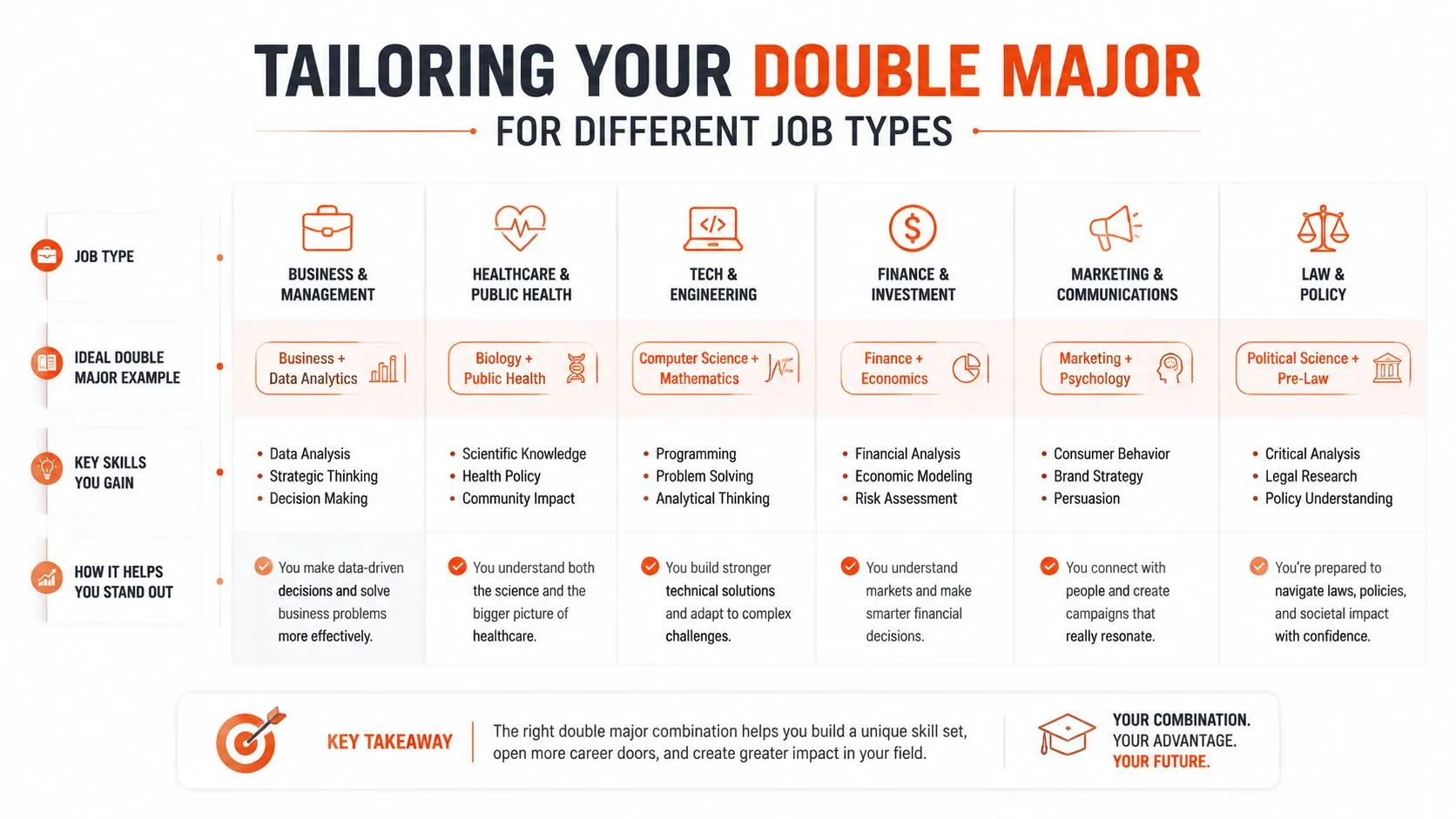
Tailoring Your Double Major for Different Job Types
Your majors don't change between applications. Their positioning should.
For a technical role, lead with the technical major. A candidate targeting software engineering might write Computer Science and Economics, then emphasize programming projects, systems work, or analytics experience elsewhere. Economics remains useful if the company values product judgment, financial modeling, or data interpretation, but it shouldn't compete with the core technical signal.
For a business role, reverse the order when the business field is more relevant:
Bachelor of Arts in Economics and Computer Science
That line makes Economics the first scan while preserving the technical qualification. For consulting, finance, operations, or commercial strategy, your bullets should then prove analysis, decision-making, and business impact.
Creative and communications roles require a sharper choice. Journalism and Political Science can fit policy reporting, public affairs, or editorial work. Psychology and Marketing can support brand strategy. But the majors alone aren't enough. Published work, campaigns, audience research, presentations, and portfolio evidence should do most of the persuasion.
For cross-functional roles, present both fields with equal weight. Product management, business analytics, technical program management, and policy research often benefit from a combination such as Computer Science and Economics. The resume should show the connection through projects and outcomes, not by repeating the degree in the summary, skills section, and education section.
A useful application habit is to mirror the job description's priorities without copying its language mechanically. StoryCV's guide to tailoring a resume to a job description is useful for deciding which major, project, and accomplishment should lead.
The degree is fixed. The emphasis is not.
Making Your Double Major ATS-Friendly
Applicant tracking systems need plain structure. Fancy layouts, decorative separators, and ambiguous abbreviations create avoidable parsing problems. Write both major names in full and keep them together in a conventional Education entry.
Use:
Bachelor of Science in Computer Science and Economics
University Name, Graduation Year
Or:
Bachelor of Science, University Name, Graduation Year
Majors: Computer Science and Economics
The first format is usually the strongest because it puts the degree and both searchable fields in one readable line. The second works when the degree line would become difficult to scan.
Follow these rules:
- Spell out both majors: Use “Computer Science,” not only “CS.”
- Use a clear connector: “And” is easier to understand than an inventive symbol.
- Keep one degree entry: Don't create separate blocks for fields earned under one degree.
- Match official wording: Use the formal name shown by your university.
- Place the relevant major first: This helps the human reader identify your fit quickly.
- Separate a minor clearly: A minor isn't a second major and shouldn't be joined with “and.”
Avoid putting education in a sidebar or using a two-column design if parsing accuracy matters. A clean, single-column resume gives software and people fewer opportunities to misread the entry.
For more context on how automated systems evaluate resume content, see StoryCV's overview of AI resume screening. The broader principle is simple: optimize for accurate extraction first, visual personality second.
Real Resume Line Examples for Every Scenario
Use the version that matches your career stage and target role. Keep the education block compact, then use the rest of the resume to prove what the degree enabled.

Recent graduate, technical target
EDUCATION
Bachelor of Science in Computer Science and Economics
State University, Graduation Year
Put this near the top. Follow it with technical projects, internships, or coursework that demonstrates how you used both fields.
Mid-career professional, business target
EDUCATION
Bachelor of Arts in Economics and Political Science
Regional University, Graduation Year
Place this below experience. Your work history should lead, while the education entry confirms your foundation.
Technical and business combination
Bachelor of Science in Computer Science and Business Administration
University Name, Graduation Year
Lead with Computer Science for engineering, analytics, or technical product roles. Put Business Administration first for operations, commercial strategy, or business analysis applications.
Two humanities fields
Bachelor of Arts in English and History
University Name, Graduation Year
This can work for communications, editorial, research, education, or public-sector roles. Your writing samples, research output, and stakeholder work matter more than the academic pairing itself.
Recognized institution
Bachelor of Arts in Economics and Political Science
University Name, Graduation Year
Don't spend extra resume space explaining a familiar institution. Use the room for relevant achievements.
Less familiar institution
Bachelor of Arts in Economics and Political Science
Regional University, Graduation Year
Relevant coursework: Public Policy, Econometrics, Research Methods
Add context only when it strengthens relevance. The school's name matters less than the evidence beneath it.
Your Double Major Resume Checklist
Before sending your resume, make six decisions.
- Check relevance: Does each major support the role, directly or through a clear combination?
- Choose the order: Put the field that best matches the job first.
- Use one degree entry: One double major should look like one degree with two fields.
- Protect parsing: Spell out both majors and use a clear connector.
- Place education correctly: Recent graduates can move it near the top. Experienced professionals should usually put work history first.
- Add proof: Use projects, coursework, certifications, or accomplishments to show how the two fields connect.
Then run the subtraction test. Remove the second major temporarily and read the resume as a hiring manager. If the application becomes clearer without it, the credential is probably taking up space rather than creating value.
The academic signal can still matter. Research on early-career graduates found that double majors generally outperformed single majors for good-job placement, with some combinations showing about 1.2x to 2.0x higher odds than a single humanities major, while double majors were about 3.2% higher earners on average than single-major peers, as reported in the cited study on double majors and labor-market outcomes. Those findings don't make every double major equally useful. They reinforce the practical point: the combination works best when it matches the work you want to do.
If your experience is substantial, let experience win. List both majors accurately when they add context, but don't let an old credential crowd out recent results.
StoryCV helps you turn raw experience into clear resume language, while keeping education details such as a double major structured and readable. Start with StoryCV to draft one role for free, then use the resulting narrative to make your education support the story instead of carrying it.