
“Put education at the bottom if you've got experience.” That's the advice most resume guides repeat, and it's incomplete. Your education resume section belongs wherever it makes the strongest case for the job, whether it's proving capability, closing a credential gap, or supporting a career pivot.
The section appears on 76% of 2.1 million resumes analyzed by Zety, and on 97.25% of 133,000 resumes in another analysis, according to Zety's resume statistics. It's common enough that including a degree won't distinguish you. Clear structure and strategic placement will.
Why Most Education Resume Sections Are Wasted Space
Most education sections are technically correct and strategically empty. They list a school, a degree, and a year, then stop. Recruiters can parse the entry, but they still can't tell whether the credential matters to the role.
That's the problem with treating education as a form field. A resume isn't a transcript. It's a short argument about why you should move forward.
Education can do several jobs:
- Prove capability: A relevant degree or program can support skills your work history only implies.
- Fill a credential gap: A required degree, license, or certification can remove an objection before it appears.
- Support a pivot: New study can make a career change credible when previous job titles point elsewhere.
- Reinforce seniority: Advanced education can add context to specialized leadership, technical work, or regulated practice.
The amount of space you give the section should follow that job. A mid-career professional with a directly relevant master's degree may need one strong entry near the top. Someone with an unrelated undergraduate degree may need only the degree, institution, and year near the bottom.
Practical rule: Don't ask whether education belongs on your resume. Ask what it needs to prove for this specific role.
Education remains a standard resume component alongside experience and skills, but its strategic value changes by candidate. One large analysis found that bachelor's degrees appeared on 42.49% of resumes, master's degrees on 15.77%, associate degrees or professional diplomas on 7.58%, and PhDs on 1.25%, as summarized by Rezi's education-section guidance. The section is familiar. Your job is to make its relevance obvious.
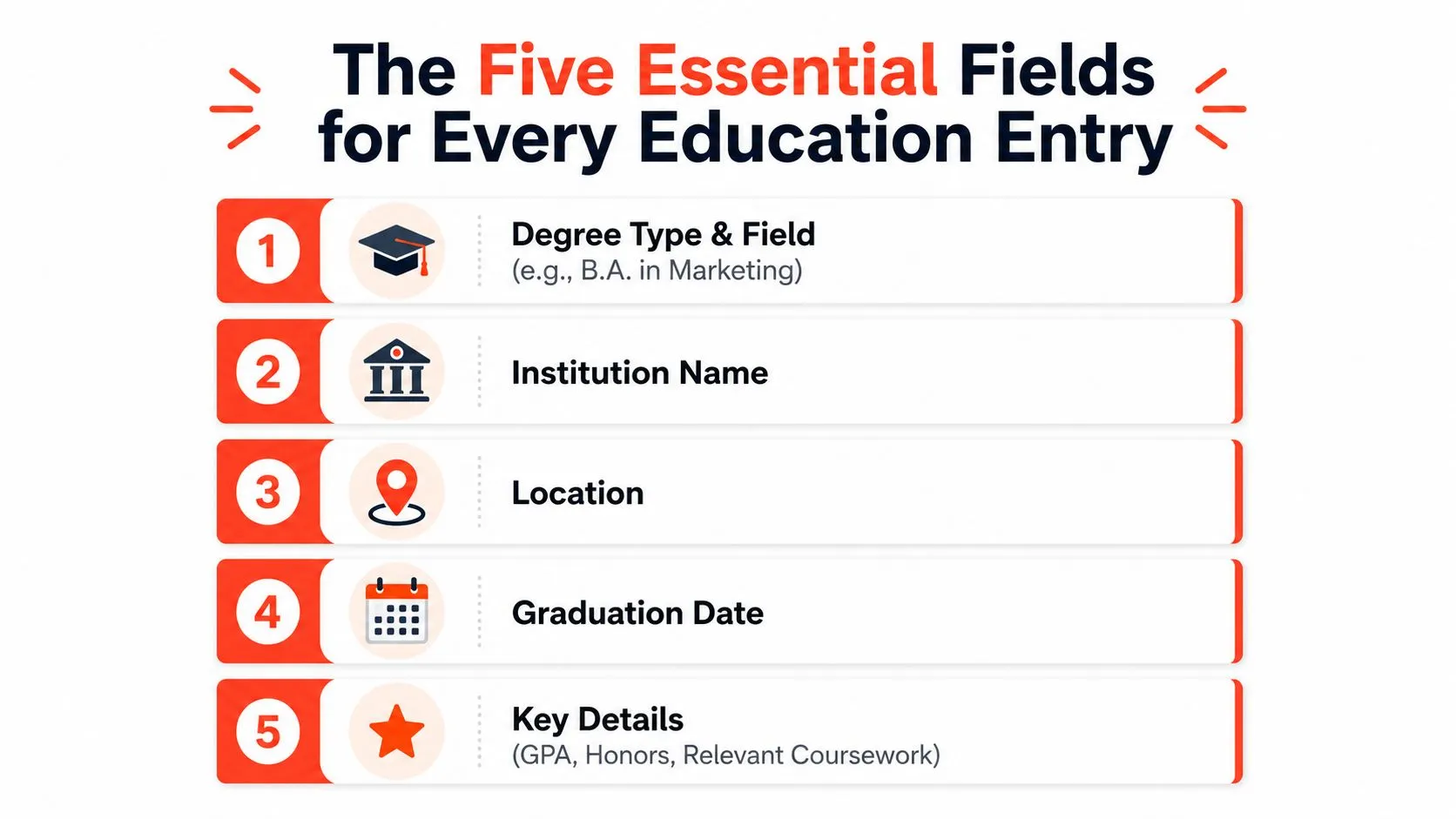
The Five Fields That Should Appear in Every Entry
Before you decide where the section belongs, make each entry easy to read. The reliable structure is linear:
- Degree type and field of study: Write the full credential and major first.
- Institution name: Use the school's official name.
- Location: Add city and state, country, or “Remote” when appropriate.
- Graduation date: Use a standard month-year or year-only format.
- Key details: Add honors, GPA, relevant coursework, or projects only when they strengthen your fit.
The degree comes first because it tells the reader what the entry is doing. The institution verifies where you earned it. Location and date provide context. The final field is optional, and it should earn its space.
Compare these entries:
Weak
B.A., State University, 2019
Clear
B.A. in Marketing
State University, Austin, TX
2019
Honors: Dean's List
The second version gives both software and human readers distinct fields. It also avoids forcing the recruiter to guess whether “B.A.” means marketing, communications, or something else.
For a current degree, replace the completion date with an honest status:
B.S. in Data Analytics
University of Texas, Austin, TX
Expected May 2027
Don't project a GPA or imply completion before it happens. If you're building a specialized academic document, such as building a standout medical CV, education may need more supporting detail than it would on a standard professional resume. Certifications deserve the same care, but they may belong in a separate section. See how to put certifications on a resume when a credential matters more than the degree itself.
Where the Education Resume Section Actually Belongs
Placement should follow signal strength, not a simplistic experience rule.
Put education near the top when it explains why you're qualified for the target role better than your recent job titles do. Put it below experience when your professional record already carries the argument. For most mid-to-senior professionals, work history leads. That's a default, not a law.
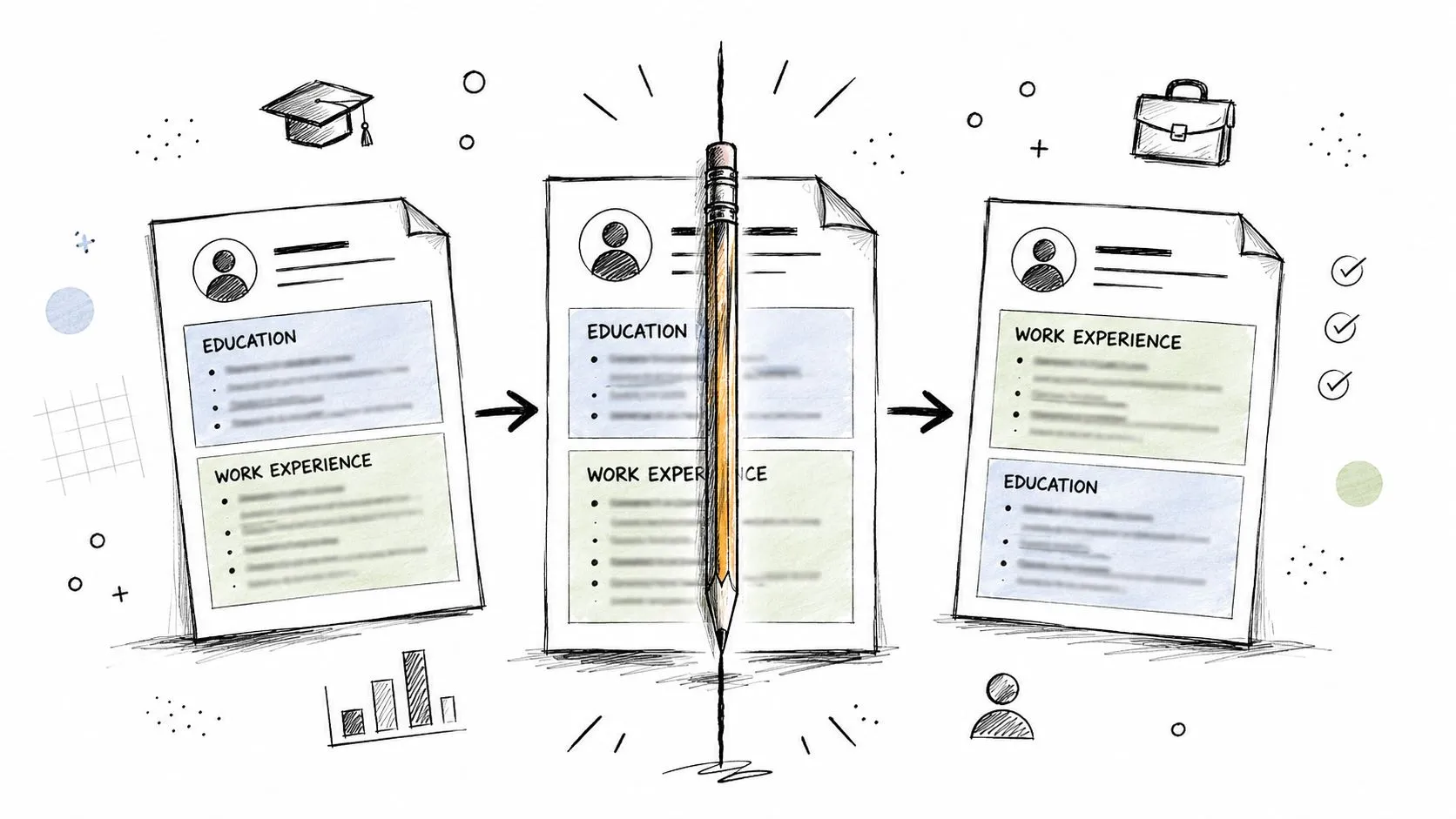
Use this quick test:
If a recruiter sees only your summary and the first education entry, will they understand your fit more clearly than if they see your recent experience first?
If yes, move education up. If no, keep it below experience and let the entry stay compact.
Three common decisions
A marketing coordinator moving into data work has a new analytics certificate and perhaps relevant coursework or projects. If the certificate supplies the clearest evidence of the new direction, place it near the top, often under a focused summary. The previous marketing experience still matters, but it shouldn't bury the credential that makes the pivot legible.
A senior engineer applying for a role that directly matches a master's specialization can promote that degree. The candidate has experience, but the advanced education may provide the exact technical signal the job requires. Keep the entry concise, then use experience to demonstrate application.
A career changer with an unrelated bachelor's degree shouldn't pretend the old degree is central. Put it below the experience or project work that supports the new field. If the degree adds no relevant proof, compress it to one line.
Education guidance has long favored reverse chronological order, with the newest qualification first. It also generally places education near the top for recent graduates and below experience for established professionals, as outlined in Indeed's resume education guidance. The sharper rule is this: lead with the evidence that best answers the employer's first question.
For broader section-order decisions, use resume categories that support your story.
A visual example can help when the decision feels abstract:
Tailoring the Section to Your Career Stage
The right education section changes as your evidence changes. Students need academic proof because their work history is still developing. Mid-career professionals need restraint because experience has already done more of the persuading.
| Career stage | Include | Drop |
|---|---|---|
| Student or recent graduate | Degree, institution, expected date, relevant coursework, honors, GPA when useful, academic projects | Unrelated coursework and decorative detail |
| Mid-career professional | Highest relevant degree, school, graduation year | Old coursework, routine academic activities, weak honors |
| Career changer | Education that supports the new direction, relevant projects, targeted training | Unrelated detail that reinforces the old career |
| International candidate | Official institution name, credential, field, location, clear local context when useful | Confusing translations or unexplained equivalencies |
Students and recent graduates
A student applying for an internship might write:
B.S. in Computer Science
University of Michigan, Ann Arbor, MI
Expected May 2027
Relevant coursework: Database Systems, Machine Learning, Statistical Computing
Project: Built a data visualization dashboard using Python and SQL
That level of detail makes sense because academic work is carrying more of the proof. Guidance for writing a resume for an internship can help connect those projects to the rest of the document.
Mid-career professionals
A professional with several years of relevant experience should usually write:
M.S. in Information Systems
Northeastern University, Boston, MA
2018
That's enough unless the degree directly answers a requirement or supports a specialized claim. Your recent work should show what you did with the education.
Career changers
A career changer should be selective, not apologetic. If a new program supports the target role, bring it forward and add one or two relevant projects. If the original degree is unrelated, keep it accurate and brief while giving more space to transferable achievements, training, and evidence of current capability.
International candidates
List the official institution and credential clearly. Add a concise local equivalent only when it improves understanding, and don't replace the original name with a loose translation that could create doubt. The reader should understand what you studied, where you studied it, and how it relates to the role without needing to decode the entry.
ATS Formatting Rules That Actually Matter
ATS advice often turns ordinary formatting preferences into mythology. The useful rules are simpler: give the system recognizable fields in a predictable order.
Use a standard Education heading. Put each entry on its own line. Lead with the degree type and field, follow with the institution, then location and date. A clean structure helps parsers identify the same fields recruiters expect to find, as explained in ATS-friendly education formatting guidance.
Keep the block boring
Avoid tables, columns, icons, text boxes, and decorative layouts inside the education section. A visually clever block may look polished in a PDF while extracting badly in an applicant tracking system.
Use dates such as:
- Completed: 2024
- Completed: May 2024
- In progress: Expected May 2027
Avoid “Spring 2026” and “Class of 2026.” ATS-focused guidance identifies those nonstandard labels as parsing risks, not merely style issues, in resume education ATS guidance. For current study, label the expected date clearly rather than making the recruiter infer whether the program is complete.
Some choices aren't problems. Bold institution names are fine. Standard punctuation is fine. A two-line entry is fine. The danger isn't formatting that looks plain. The danger is formatting that hides the fields software needs to extract.
Run a simple final check:
- Header: Does the section say “Education”?
- Order: Does the degree appear before the institution?
- Dates: Are dates consistent and recognizable?
- Structure: Is every entry linear and readable without visual design elements?
- Relevance: Does every extra detail support the target role?
What to Remember Next Time You Update Your Resume
The education resume section is common, almost universal in practice. Its value doesn't come from existing. It comes from making the right credential easy to verify and easy to connect to the job.
Placement is a signal-strength decision. Recent graduates usually lead with education because academic credentials carry more weight. Experienced professionals usually lead with work, unless a degree, certification, or current program explains the target role better.
Depth should shrink as relevant experience grows. Students can use coursework, honors, GPA, and projects to fill an evidence gap. Mid-career professionals should usually keep the section to the highest useful credential, school, and date.
Tailoring beats decoration. A plain entry that names the right degree and field will outperform a designed block that makes recruiters hunt for meaning. ATS compatibility matters, but clarity for a person comes first.
Incomplete education needs judgment, not concealment. Include unfinished study when it proves capability or supports the target role, label current study accurately, and leave out fragments that add noise. Don't overexplain a complicated academic history inside the resume.
Your next update should take about 30 seconds to diagnose: identify what education is proving, decide whether it belongs above or below experience, then remove every detail that doesn't help that proof.
StoryCV is an online resume writer that uses a guided interview to turn your real experience, achievements, and context into clear resume language, including a focused education section. Visit StoryCV to start with one fully written role for free and build a resume that sounds like your work, not a template.