
Most advice about resume bullets is backwards. It tells you to write better when your real problem is that you remember your work in fragments.
That's why smart people end up with bullets like “Led cross-functional initiatives” and “Managed stakeholder communication.” Those lines aren't false. They're just empty. They describe activity, not proof.
If you want to explain your work in bullet points, stop trying to sound polished first. Start by recovering the missing details. What was broken. What you touched. What changed. That's the difference between a resume that sounds employed and one that sounds useful.
Why Your Work Sounds Vague on Paper
A bullet is a decision, not a description.
You're deciding what part of your work deserves proof. Most mid-to-senior professionals skip that step. They grab the official version of the job and write down responsibilities. That's how ten years of real work gets flattened into “oversaw operations” and “supported leadership.”
You don't have a writing problem
You have a remembering problem and a filtering problem.
You remember the job as a blur. Meetings. requests. launches. escalations. fixes. Then you filter badly. You choose what was assigned to you instead of what changed because of you.
That's why the same person can talk intelligently in an interview, then write lifeless bullets on paper. Talking surfaces detail. Boxes kill it.
“It looks fine. I just can't tell what you did.”
That's the hiring manager's problem with vague bullets. They aren't grading your effort. They're scanning for evidence. Fast.
A widely cited resume analysis found that 36% of 125,484 resumes contained no measurable metric anywhere, while only 26% contained five or more measurable metrics according to this resume bullet point analysis. The takeaway is simple. Many still write vague bullets. Many still make the recruiter do the work.
Responsibility is not impact
“Managed vendor relationships” is a responsibility.
“Renegotiated vendor workflow with procurement and finance, cutting approval delays and reducing back-and-forth for urgent purchases” is closer to impact.
The first tells me your area. The second tells me what you changed.
Use this mental ladder:
-
Responsibility
What were you there to handle? -
Context
What environment, scale, pressure, or constraint shaped the work? -
Action
What did you personally do? -
Outcome
What improved, moved, shipped, stabilized, or got solved?
When people say they can't convert my work to bullet points, they usually haven't climbed that ladder. They stop at line one.
What this fixes
If you get this right, your resume stops sounding like a job description. It starts sounding like a record of decisions, execution, and results.
By the end, you should be able to talk about my work in bullets without defaulting to filler. More important, you'll know how to pull proof out of roles where the numbers aren't obvious.
The Anatomy of a Bullet That Proves Impact
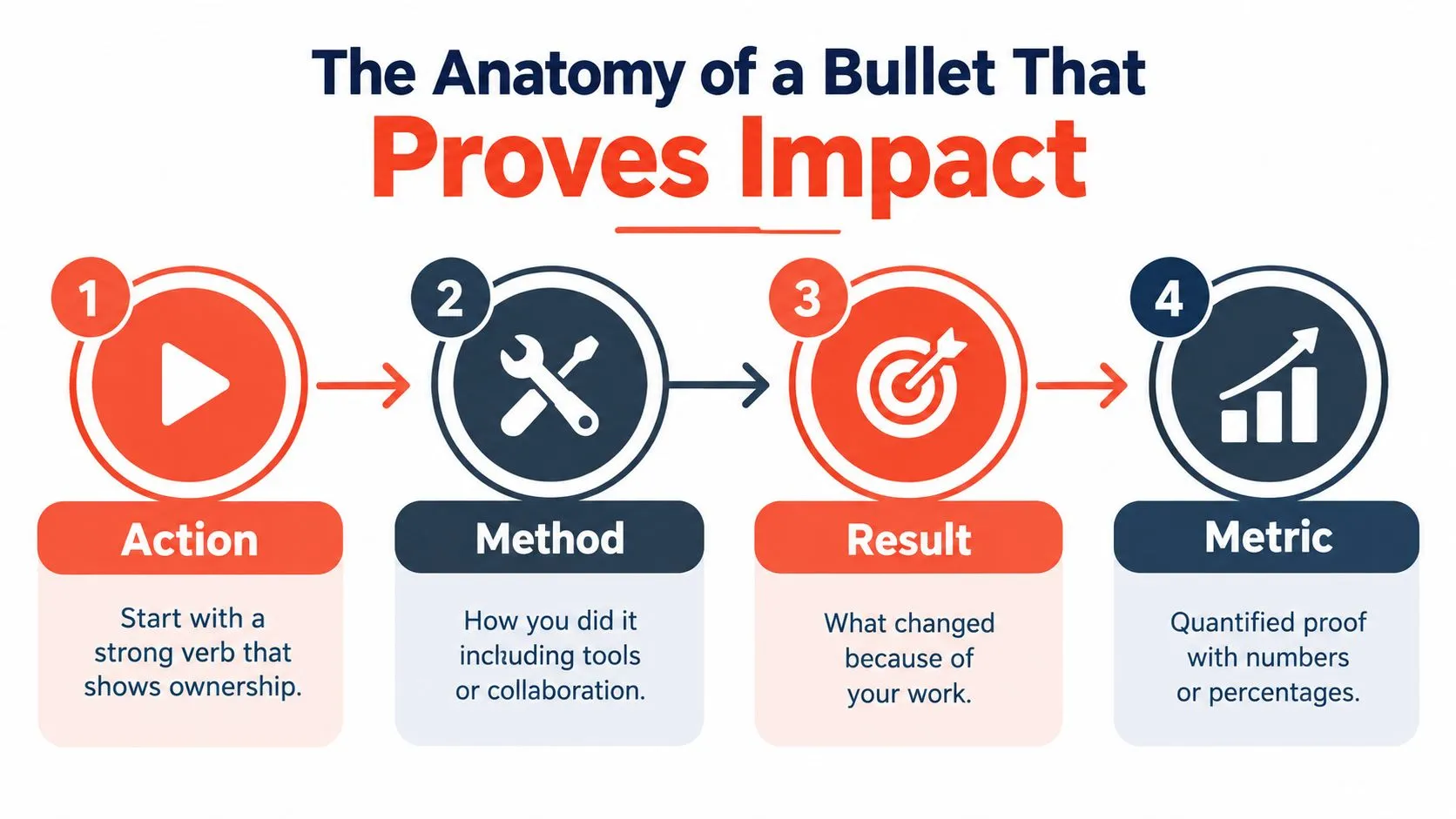
A strong bullet has four parts. Not because formulas are magic. Because evidence needs structure.
Expert guidance on resume bullets recommends a 4-part sequence: action, method, result, and metric, with the top three bullets in each role carrying at least one metric where possible, as explained in this guide to action verbs and ATS-friendly impact statements.
The four parts
Action is ownership.
Start with a verb that shows what you drove, built, fixed, launched, redesigned, negotiated, or analyzed.
Method is credibility.
Name the tool, process, collaboration, or approach. SQL. Salesforce. Jira. Quarterly planning. Cross-functional workshops. Root-cause analysis.
Result is the point.
What changed because you did the work? Faster handoff. Better data quality. Cleaner reporting. Fewer escalations. Stronger adoption.
Metric is proof.
Attach a number when you can. Percentages, time saved, volume handled, team size, cycle time, sites supported, ticket load, and ranges all count.
Weak bullets fail for predictable reasons
Industry guidance warns against openers like “responsible for” or “helped with” because they hide ownership and make bullets harder to scan, as outlined in this resume action verb guide. I agree.
“Responsible for monthly reporting” tells me nothing useful.
“Built monthly reporting pack in Excel and Power BI for sales and finance leaders, reducing manual consolidation and improving forecast visibility” is better because it gives me action, method, and result. If you can add a metric, even better.
Practical rule: If a bullet could describe half the department, it's too vague.
Before and after
Weak
- Responsible for customer onboarding
- Helped with quarterly planning
- Managed support tickets
Stronger
- Built onboarding checklist and email sequence for new B2B clients, reducing handoff confusion between sales and implementation
- Coordinated quarterly planning across product, sales, and operations using Asana and shared scorecards to align launch priorities
- Resolved high-volume support queue issues in Zendesk, triaging urgent cases and surfacing repeat defects to engineering
None of those are literary. Good. Resume bullets are not for showing style. They're for proving judgment.
Choosing the Right Proof for Your Bullet
| Work Type | Best Proxy Metric | Example Phrase |
|---|---|---|
| Operations | Cycle time or volume | “processed high-volume requests across regional teams” |
| Support | Ticket load or resolution speed | “handled escalations across enterprise accounts” |
| Project work | Timeline or stakeholder scope | “coordinated launch across sales, product, and legal” |
| People leadership | Team size or function span | “led onboarding for a distributed support team” |
| Student or early career work | Frequency, ownership, or deliverables | “prepared weekly briefs for faculty and student leadership” |
| Technical roles | System scope, incidents, or environments | “supported multi-site Cisco network infrastructure” |
If you want more help on turning broad responsibilities into stronger evidence, this breakdown of how to write impact statements is worth reading. The same principle also shows up in other executive writing contexts. Good summaries work because they cut to consequence, which is why executive impact through clear summaries matters beyond resumes too.
How to Turn What You Did Into What You Changed
You won't write your best bullets by staring at old bullets.
Say the job out loud first. Then extract the useful parts.
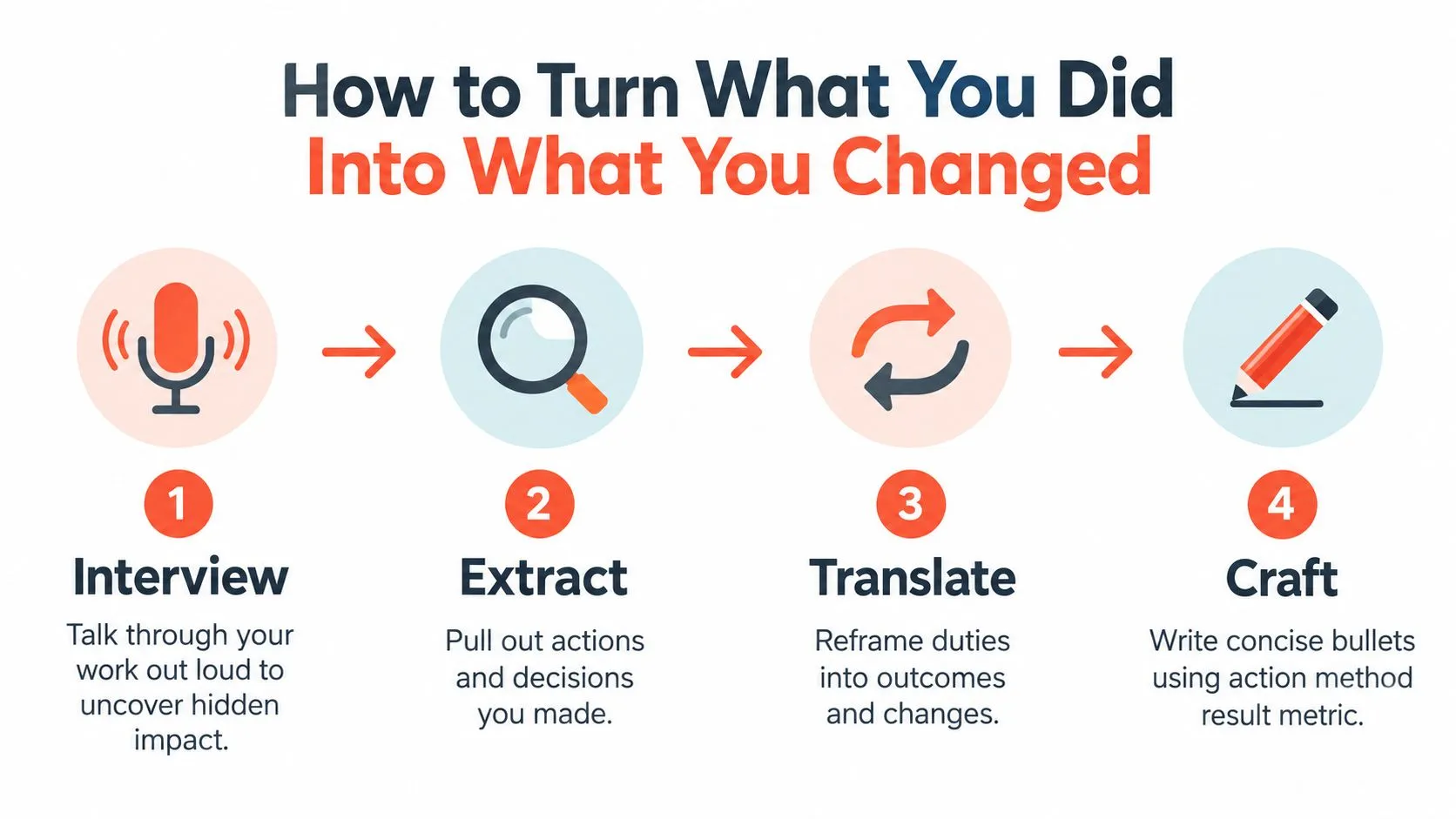
Use interview prompts, not templates
Prompts need to sound like a decent interviewer, not a spreadsheet.
Ask yourself:
- What was messy when you took over? Process gaps, missed deadlines, bad data, confused customers, slow handoffs.
- What did you do? Built, cleaned, negotiated, documented, escalated, automated, coached, analyzed.
- What tools or systems were involved? Salesforce, NetSuite, SQL, Workday, Jira, Excel, Cisco, Zendesk.
- Who depended on your work? Sales, finance, executives, customers, field teams, engineers.
- What changed at the end? Faster approvals, fewer errors, smoother launches, cleaner reporting, fewer complaints.
- What can you measure? Team size, regions covered, requests per week, meeting cadence, system size, turnaround time, project count.
That's the whole game. Details first. Wording second.
A guided interview is why some people move faster with an online resume writer than with a template. StoryCV, for example, asks about the role, your actions, context, and results, then turns those answers into resume-ready bullets. That's useful if your real block is remembering and translating, not formatting. If that sounds like your problem, try StoryCV.
Map answers into one bullet
Here's a worked example from a mid-level operations role.
What the person says out loud
“I handled onboarding for new vendor partners. The process was messy. Legal, procurement, and operations all needed different information, and things kept getting stuck. I built a shared checklist, cleaned up the handoff steps, and started tracking blockers in Airtable. After that, fewer requests bounced around and people got through the process faster.”
What matters inside that answer
- Responsibility: vendor onboarding
- Context: cross-functional delays across legal, procurement, and operations
- Action: built checklist, cleaned handoffs, tracked blockers
- Outcome: fewer delays, smoother process
- Metric proxy: process speed or volume, if known
Bullet
- Vendor onboarding by building a shared checklist and Airtable blocker tracker across legal, procurement, and operations, reducing handoff delays and clarifying ownership
That bullet works even without a hard number because it has shape. It proves the person improved a process.
Here's a quick explainer if you want to hear this thinking in a different format:
Pick the top three bullets first
Don't write eight average bullets and hope three rise to the top.
Write the top three for each role first. Those are the ones most likely to be read. Guidance on impact statements recommends making sure those top bullets carry clear evidence and metrics where possible. I'd add one more rule. Make each top bullet prove a different kind of value.
Try this mix:
-
One scale bullet
Scope, volume, team, region, systems, or complexity. -
One improvement bullet
Speed, quality, cost, accuracy, reliability, adoption. -
One judgment bullet
Leadership, prioritization, cross-functional coordination, problem solving under pressure.
Don't repeat the same metric in three different bullets. If one bullet shows volume, let another show speed or quality. Variety reads as real.
Real Examples That Convert Duties to Achievements
Examples matter because most advice dies at the formula. The gap is always the same. People understand action plus result. They still can't see how to explain my work in bullet points when the work feels messy or unquantified.
Student or recent graduate with thin experience
Weak
- Helped with event planning for campus organizations
Prompts that reveal detail
What kind of events?
Who attended?
What did you own?
What did you make easier or better?
Stronger
- Coordinated logistics and communications for campus events, managing schedules, speaker materials, and volunteer handoffs to keep events running smoothly
No hard numbers. Still credible. The bullet shows ownership, moving parts, and outcome.
Mid-level professional with real scale
Weak
- Managed reporting for leadership
Prompts that reveal detail
Which leaders?
What systems did you use?
Was the data messy before?
What changed after your process improved?
Stronger
- Built leadership reporting in Excel and Power BI by consolidating inputs from sales and finance, improving consistency in weekly performance reviews
This works because it names the method and the practical outcome. “Managed reporting” says task. “Built leadership reporting” says ownership.
The strongest bullets usually come from the sentence you say after “the tricky part was…”
Career changer translating transferable work
A career changer often has proof. It's just trapped in the wrong language.
Say someone is moving from teaching into project coordination.
Weak
- Taught classes and supported students
That undersells the transferable work.
Prompts that reveal detail
What did you plan repeatedly?
What did you track?
Who did you coordinate with?
How did you handle competing priorities?
Stronger
- Coordinated lesson delivery, progress tracking, and parent communication across multiple priorities, maintaining clear documentation and adapting plans based on student needs
That bullet translates classroom work into planning, communication, documentation, and adaptation. Those are real professional skills. They just needed business framing.
Tech role with infrastructure context
Weak
- Managed network infrastructure
Prompts that reveal detail
What environment?
How many sites or devices?
What platforms?
What were you protecting against or maintaining?
Stronger
- Supported Cisco network infrastructure across multiple sites, troubleshooting outages, coordinating upgrades, and maintaining stable connectivity for distributed teams
If you have exact scale, use it. If you don't, “multiple sites” and “distributed teams” are honest scope markers.
Business role with stakeholder complexity
Weak
- Worked with cross-functional teams on launches
This sounds busy, not valuable.
Prompts that reveal detail
Which teams?
What were you responsible for?
Did you create a process?
What friction did you remove?
Stronger
- Coordinated product launch workflows across marketing, sales, and operations, aligning timelines, resolving handoff gaps, and keeping launch materials on track
This bullet works because it names the friction. Handoff gaps are real. Resolving them is impact.
Operations role where metrics are missing
Generic advice usually fails. Not every good role comes with dashboards.
Use credible proof that doesn't pretend precision:
- Scope words like regional, multi-site, cross-functional, recurring, enterprise, or distributed
- Volume cues like high-volume, weekly, monthly, daily, frontline
- Complexity markers like escalations, compliance, handoffs, scheduling, audit prep
- Tool evidence like Salesforce, Workday, Jira, Zendesk, Excel, NetSuite
Weak
- Responsible for scheduling and team support
Stronger
- Managed scheduling, coverage changes, and frontline coordination for a distributed team, keeping shift handoffs organized during frequent last-minute updates
No fake metric. No fluff. Just believable proof.
Tailor Trim and Pass the Human Scan
A good bullet can still fail if it's bloated, generic, or aimed at the wrong job.
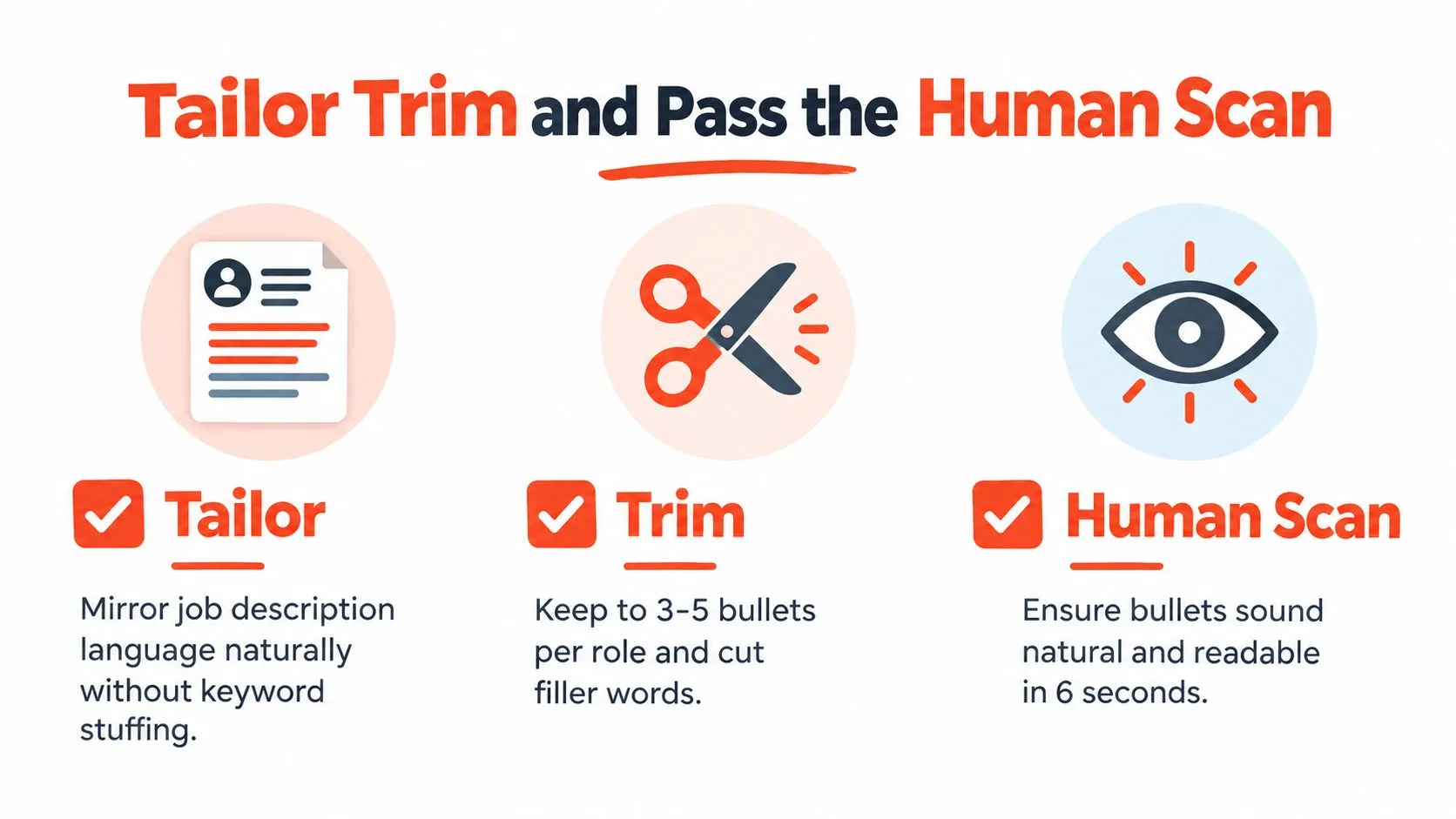
Tailoring matters. But ATS advice gets distorted into keyword stuffing, which is lazy writing with a technical excuse. A better keyword strategy is to use relevant language from the job description and your industry while avoiding clichés and empty superlatives, as explained in this guide to resume keywords for ATS.
The editing checklist that actually matters
- Match the language: If the job says stakeholder management, operations reporting, or incident response, use those terms where they fit.
- Cut filler verbs: Remove “responsible for,” “helped with,” and “worked on.”
- Keep verb variety: Don't start five bullets with managed.
- Trim obvious words: “Successfully,” “various,” and “duties included” rarely help.
- Check metric honesty: Use ranges, time, scope, or volume if exact counts aren't available.
- Read for human scan: If the point isn't clear on a fast read, rewrite it.
Your resume does not need more keywords than the job description. It needs better evidence attached to the right keywords.
Keep the document to a sane length
Most resumes should be one to two pages, with one page ideal for students, new graduates, and professionals with one to 10 years of experience, while three pages are usually appropriate for people with over 25 years of continuous related experience or fields such as academia or medicine, according to Indeed's resume length guide. A recruiter-focused guide says the same thing in practical terms. One page for limited experience, two pages for mid-career candidates, and three pages for senior or highly technical roles, as noted in this resume length breakdown.
Length should scale with complexity. Not insecurity.
Tailor after the bullets are strong
Don't tailor weak bullets. Fix them first. Then swap language to fit the target role.
If you need a sharper process for that edit, this guide on tailoring your resume to the job description is useful. It's easier to adjust wording once the core bullet already proves something.
Your Work Already Has the Proof
Your job isn't to make your experience sound impressive. Your job is to recover what happened and state it clearly.
That means two shifts. First, move from responsibility to outcome. Second, move from vague claims to evidence. Not fake precision. Real proof. Scope, tools, constraints, decisions, and changes.
The same thinking shows up outside resumes. Good analysts don't just collect comments. They look for patterns, context, and signal, which is why this guide to analyzing customer feedback is a useful parallel. Your work history needs the same treatment. Raw memory isn't the final draft.
If you're stuck on quantifying impact, read this guide on how to use metrics in a resume. Then go back to one real role and talk it through out loud. That's usually where the missing detail shows up.
Templates won't remember your job for you. They won't decide what mattered either.
If your real problem is turning messy experience into clear bullets, StoryCV is built for that. It asks about the work you did, helps surface the context and outcomes, and turns those answers into resume-ready bullet points. Start with one role and find the words you'd probably never write from scratch.